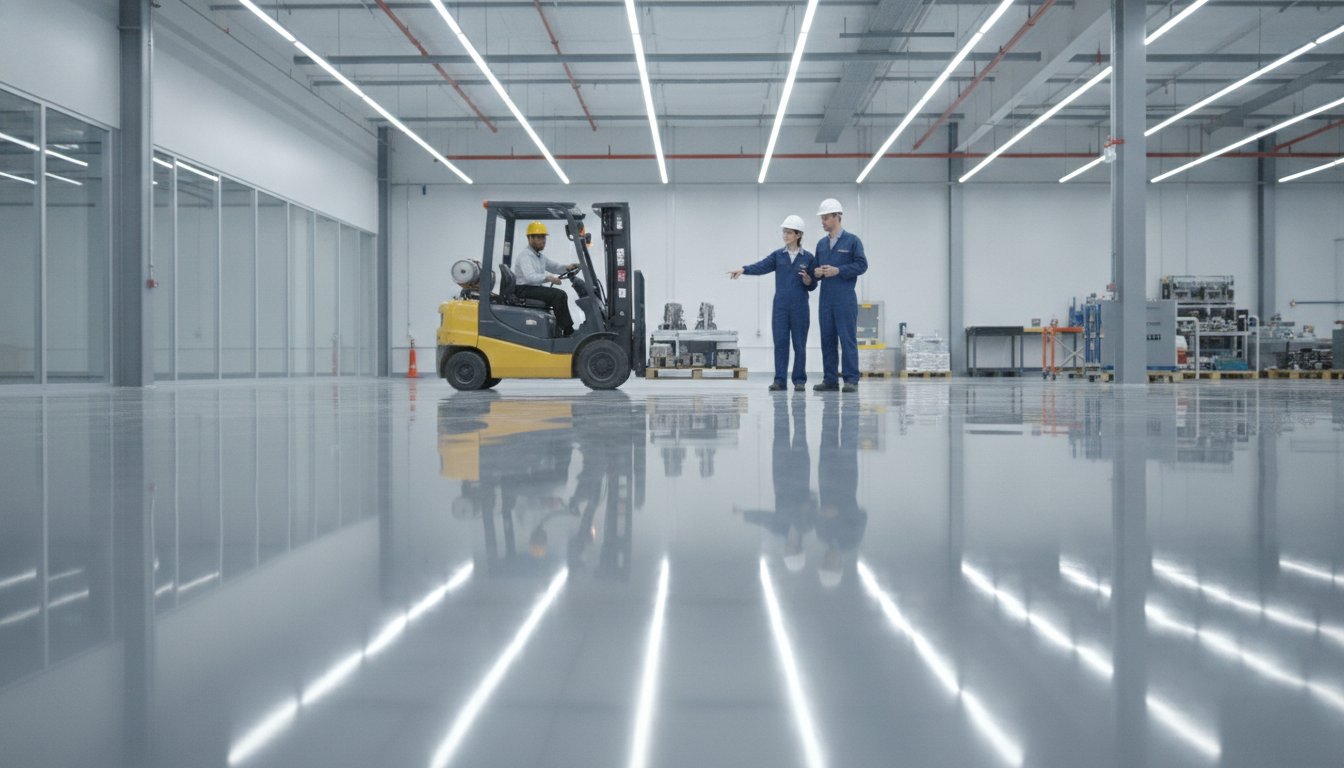
Cheap floor paint is a temporary mask, not a structural solution. If your facility relies on heavy machinery, a thin coating will fail within months; it’s a technical certainty. You’ve likely seen the results: frequent peeling, concrete dusting, and the high maintenance costs that follow a “budget” installation. You need a surface engineered for industrial abuse. Specifying high build epoxy systems provides the necessary mil thickness to absorb impact and support heavy loads without delaminating.
We understand that a floor is a foundation for your operations, not just a colour choice. This article details the technical specifications and performance advantages of high build epoxy systems to ensure your industrial floor survives the most demanding conditions. You’ll learn how 100% solids chemistry and professional mechanical profiling create a permanent bond. We’ll preview the essential standards for chemical resistance and safety that turn a vulnerable slab into a high-performance asset.
Key Takeaways
- Understand why high build epoxy systems must exceed 10 mils in dry film thickness to be classified as a structural flooring solution rather than a simple aesthetic coating.
- Learn how the chemistry of 100% solids resinous flooring effectively distributes heavy point loads to protect the underlying concrete slab from catastrophic failure.
- Identify the specific operational criteria that necessitate a high build specification over standard thin-film alternatives to prevent premature peeling and dusting.
- Recognize the non-negotiable role of mechanical surface profiling and environmental control in achieving a permanent bond that survives industrial traffic.
- Realize the long-term ROI of a system engineered to meet rigorous Canadian industrial standards for durability, safety, and chemical resistance.
Defining High Build Epoxy Systems: More Than Just Thick Floor Paint
Appearance is secondary in an industrial environment. While many facilities choose flooring based on colour, true performance is measured in microns and mil thickness. High build epoxy systems are engineered to function as structural reinforcements rather than mere decorative layers. By definition, these systems typically exceed 10 mils in dry film thickness, creating a dense, resilient barrier that standard floor paints cannot replicate. We view these installations as comprehensive systems designed to integrate with the concrete substrate, protecting it from the relentless mechanical and chemical stresses of a working plant.
The distinction between a “coating” and a “system” is critical for long-term durability. A simple coating might improve aesthetics for a few months, but it lacks the body to survive heavy point loads or consistent machinery traffic. In contrast, high build epoxy systems utilize 100% solids chemistry to build a physical structure over the slab. This ensures the floor remains intact under pressure, preventing the concrete underneath from fracturing or dusting under the weight of forklifts and industrial equipment.
The Mil Thickness Standard
Thickness determines longevity. In the flooring industry, we measure this in “mils,” where one mil represents 1/1000th of an inch. To put this in perspective, a standard residential floor paint or a thin-film solvent coating might only provide 1 to 3 mils of protection. This is barely thicker than a sheet of paper. High build epoxy systems are specified at ranges between 10 and 30+ mils depending on the intended use. This increased volume isn’t just for show; thickness directly correlates to the system’s ability to absorb energy and resist impact damage from dropped tools or heavy pallets. Without this depth, the coating is easily punctured, leading to delamination and the high maintenance costs associated with floor failure.
100% Solids vs. Solvent-Based Chemistries
Chemistry dictates the final result. Many off-the-shelf products are solvent-based or water-borne, meaning they contain carriers that evaporate as the floor dries. When these liquids vanish, the coating shrinks, often losing up to 50% of its original wet thickness. High build epoxy systems rely on 100% solids epoxy resins that contain no volatile carriers. What we apply to the floor stays on the floor. Because there’s no evaporation, the wet-to-dry thickness remains exactly the same, ensuring the specified protection is actually delivered. For Canadian facilities, this chemistry offers a significant secondary benefit: zero-VOC (volatile organic compound) profiles. This allows for installation in occupied buildings without the risk of toxic fumes or lingering chemical odours, ensuring your facility remains compliant with modern safety and environmental standards.
The Engineering Behind 100% Solids: Why Thickness Equals Performance
Thickness is the foundation of structural integrity. In an industrial setting, your floor is a mechanical component, not a finishing touch. High build epoxy systems function by distributing heavy point loads across the concrete surface, effectively spreading the weight of heavy machinery to prevent localized slab failure. Without this engineering, the underlying concrete often succumbs to compressive stress, leading to hairline cracks that eventually compromise the entire facility. We’ve seen countless floors fail because the installer treated the epoxy as a paint rather than a structural layer.
High build layers also act as a permanent cure for concrete “dusting,” a common failure where the top layer of concrete breaks down into a fine powder. By penetrating and sealing the pores with a high-performance resin, these systems create a monolithic surface that is impossible to dust. This is why we reference the Unified Facilities Criteria (UFC) 3-190-06 when designing these environments; the engineering requirements for protective coatings are precise and leave no room for error. A floor that cannot handle the weight of your operations is a liability you can’t afford.
Impact and Abrasion Resistance
Industrial floors face constant bombardment. Whether it’s a dropped heavy tool or the grinding friction of forklift tires, a thin coating will shatter because it lacks the mass to absorb shock. High build epoxy systems are often reinforced with aggregates like quartz or silica sand to increase their density and wear-resistance. This added mass allows the floor to serve as a shock absorber, protecting the concrete-epoxy bond from shearing forces. For a deeper dive into these technical requirements, our Industrial Epoxy Flooring guide provides a detailed breakdown of how different aggregate loadings affect performance in high-traffic zones.
Chemical and Moisture Barrier Properties
Thickness is your primary defence against permeation. In food processing or chemical manufacturing, aggressive liquids can eat through a thin film in days, reaching the concrete and causing irreversible damage. A high build system creates a dense barrier that slows chemical migration, giving your maintenance team time to respond to spills before they compromise the slab. These 100% solids systems are non-porous, meaning they prevent moisture from reaching the bond line where it could cause hydrostatic pressure failures. If you’re managing a facility where chemical spills are a daily reality, choosing the right Chemical Resistance Flooring is a non-negotiable step for long-term safety and compliance.
High Build vs. Thin-Film Coatings: Selecting the Right Specification
Misapplying a coating is a costly oversight. In industrial environments, selecting the wrong specification leads to operational downtime and wasted capital. Thin-film coatings and high build epoxy systems serve entirely different purposes; confusing the two is a recipe for catastrophic delamination. While a thin-film product might look acceptable on day one, it lacks the structural body required to survive the thermal shock and mechanical stress common in Canadian manufacturing facilities.
Longevity is the primary differentiator. A professionally installed high build system typically provides a service life exceeding 10 years even under heavy use. Conversely, thin-film coatings often begin to show significant wear or failure within 1 to 3 years. For facility managers, our Commercial Epoxy Flooring Canada guide offers a detailed framework for matching specifications to specific operational demands. Choosing the right system ensures you aren’t paying for a floor twice.
Application Use-Cases
Thin-film coatings are strictly for light-duty environments. These include storage closets, mechanical rooms with minimal foot traffic, or small commercial spaces where aesthetics matter more than impact resistance. High build epoxy systems are the standard for warehouses, aircraft hangars, manufacturing floors, and loading docks. These are zones where heavy point loads and chemical exposure are non-negotiable realities.
The most common objection we encounter is the initial price point. However, savvy operators realize that the total cost of ownership (TCO) for a high build system is significantly lower over a ten-year period. Replacing a failed thin-film coating three times in a decade, including the cost of surface re-preparation and business interruption, far exceeds the one-time investment in a high-performance system. We organize our installations to maximize this long-term value, ensuring the specification matches the abuse the floor will actually take.
The “Peel” Factor: Why Cheap Coatings Fail
Thin coatings fail because they cannot bridge the gap between aesthetics and engineering. When a heavy forklift moves across a thin-film floor, the point load “pinches” the coating against the concrete. Because the film is only a few mils thick, it lacks the tensile strength to resist this force and eventually snaps or shears away from the substrate. This is the primary cause of the unsightly peeling found in budget-conscious facilities across the GTA.
Inadequate thickness also magnifies the impact of poor surface preparation. A thin layer has less surface area for a mechanical bond, making it susceptible to delamination from even minor moisture vapour or temperature fluctuations. At Epoxy Solutions™, we specialize in rescuing these failed installations. We strip away the remnants of “cheap” coatings and replace them with high build epoxy systems designed to survive the harshest industrial conditions. We don’t just apply paint; we install a permanent solution.

Installation Realities in the GTA: Surface Preparation and Environmental Control
Success is decided before the first gallon of resin is opened. In the Greater Toronto Area, industrial facilities face unique challenges that demand a meticulous approach to installation. We don’t just show up and pour; we organize the labour and centre the heavy equipment required to transform a raw slab into a high-performance surface. High build epoxy systems require a specific set of environmental and mechanical conditions to achieve their engineered potential. If these installation realities are ignored, the system will fail regardless of the material quality.
In Toronto, Mississauga, and Brampton, we see many floors that have failed because the installer cut corners on preparation. A high-performance floor is a multi-step process that requires professional-grade machinery and a deep understanding of concrete science. We treat every job site as a unique engineering challenge, ensuring that the local climate and specific facility conditions are accounted for before the application begins.
Mechanical Profiling: CSP Levels 1-3
Adhesion is a mechanical process, not a chemical one. To ensure high build epoxy systems bond permanently, the concrete must be profiled using diamond grinding or shot blasting. We use the Concrete Surface Profile (CSP) scale to measure this texture. While thin coatings might survive on a CSP 1, high build systems require a CSP 2 or 3. This level of profiling opens the concrete’s capillary pores, allowing the epoxy to “root” deeply into the substrate. Without mechanical prep, even the best epoxy is just expensive paint. This anchor profile is what prevents delamination when heavy forklifts apply shearing forces to the floor.
Environmental Controls and Curing
Ontario’s climate is notoriously volatile. In facilities across the GTA, seasonal humidity can fluctuate wildly, creating a thin layer of moisture on the concrete that is invisible to the naked eye. We calculate the “dew point” before every application to ensure the slab temperature is at least three degrees Celsius above the point where condensation occurs. If moisture is trapped under the resin, it will cause osmotic blistering and eventual bond failure.
Professional climate control is non-negotiable during the 12 to 48 hour cure cycle. Rapid temperature drops can stall the chemical reaction, while high humidity can cause “amine blush,” a greasy film that ruins the finish. Our teams monitor these variables in real-time to guarantee the system reaches its full compressive strength and chemical resistance. For a floor that stands up to the most extreme conditions, you need a partner who understands the science of the slab. Contact our local experts to discuss your facility’s specific environmental requirements and ensure a standard-setting installation.
Ensuring Long-Term Integrity: The Epoxy Solutions™ Professional Standard
Experience cannot be manufactured. While retail kits promise ease of use, high build epoxy systems require a level of technical precision that only comes from decades on the job site. Since 1981, Epoxy Solutions™ has set the standard for high-performance resinous flooring across North America. We’ve seen every failure imaginable, from delaminating thin-films to improperly cured slabs; we possess the specialized expertise to resolve them permanently. A professional installation is not just a service. It’s a guarantee that your facility will remain operational under the most extreme industrial conditions.
Kits are for hobbyists. Industrial facilities require an engineered approach that accounts for moisture vapour transmission, compressive strength, and chemical permeation. We take pride in our craftsmanship and longevity, positioning ourselves as the reliable partner who steps in when others have failed. Our history is built on setting standards rather than just following them, ensuring that every square foot we install meets the benchmark for premium performance.
Tailored Specifications for GTA Facilities
Generic solutions lead to specific failures. We don’t believe in a one-size-fits-all approach for facilities in Mississauga, Brampton, or Toronto. Every site survey we conduct is designed to assess your specific load requirements, chemical exposure risks, and thermal cycles. This tailored approach prevents over-spending on unnecessary specifications while ensuring the durability of the high build epoxy systems we install. To understand how we categorize these requirements for local industry, consult our GTA Industrial Epoxy Flooring Buyer’s Guide for a comprehensive breakdown of current standards and performance metrics.
The ROI of the Professional Standard
Reliability is the ultimate cost-saver. By investing in the professional standard, you drastically reduce long-term maintenance costs and avoid the catastrophic downtime associated with frequent floor repairs. Our systems integrate essential safety features like permanent line marking and tailored anti-slip textures that meet rigorous Canadian safety and environmental standards. We realize that your floor is a critical asset, not a line item to be minimized. Getting it right the first time is the only way to protect your investment and ensure the safety of your labour force. We are the authoritative expert fixers who deliver results where budget coatings fail, ensuring your floor remains a benchmark of quality for years to come.
Secure Your Industrial Foundation
Compromising on flooring is a mistake that reveals itself in cracks and delamination. You’ve seen how high build epoxy systems provide the structural integrity necessary to distribute heavy point loads and resist chemical permeation. A thin coating simply won’t survive the relentless traffic of a GTA warehouse or manufacturing plant. By prioritizing 100% solids chemistry and rigorous mechanical surface preparation, you ensure your facility remains safe and compliant for years, not months.
Epoxy Solutions™ has served Toronto, Mississauga, and the entire GTA since 1981. With over 45 years of specialized experience in high-performance resinous systems, we possess the technical accuracy to resolve even the most challenging flooring failures. We don’t just apply product; we engineer a permanent solution tailored to your operational demands. It’s time to stop paying for temporary fixes and invest in a floor that sets the industry standard. Request a Professional Site Assessment for Your High Build System today. We look forward to helping you realize a more durable, low-maintenance future for your facility.
Frequently Asked Questions
What is the difference between high build epoxy and standard floor paint?
High build epoxy systems are structural reinforcements, whereas standard paint is a thin, aesthetic layer. Standard paint often contains solvents that evaporate, leaving behind a film only 1 to 3 mils thick. High build systems use 100% solids chemistry to maintain a dry film thickness of 10 to 30+ mils, providing the mass required to protect concrete from heavy machinery.
How thick should a high build epoxy system be for a warehouse?
A warehouse floor typically requires a thickness of 20 to 30 mils to survive consistent forklift traffic. If the facility handles extreme point loads or heavy manufacturing equipment, specifications often exceed 30 mils. This thickness allows the system to act as a shock absorber, preventing the underlying slab from cracking or dusting under pressure.
Can high build epoxy be applied over old, oil-contaminated concrete?
No, epoxy cannot be applied directly over oil-contaminated concrete without specialized preparation. Oil acts as a bond-breaker, causing the system to peel within months. We utilize industrial degreasers and mechanical profiling to reach clean concrete; in severe cases, specialized oil-tolerant primers are necessary to ensure a permanent bond that won’t delaminate.
How long does a high build epoxy floor take to cure in a Canadian climate?
Most systems reach foot-traffic readiness in 12 to 24 hours, but a full mechanical cure for heavy loads takes 48 to 72 hours. Ontario’s seasonal humidity can extend these windows significantly. We monitor facility dew points and slab temperatures to ensure the chemical reaction completes correctly, preventing a soft cure that compromises long-term durability.
Does a high build system require a primer before application?
Yes, a dedicated primer is essential for a professional installation. Primers seal the concrete pores to prevent outgassing, which causes bubbles and craters in the thick topcoat. They also create a critical chemical bridge between the substrate and the high build layer, maximizing the system’s tensile strength and impact resistance.
What is the typical lifespan of a high build epoxy system in a high-traffic facility?
A professionally installed system in a high-traffic facility typically lasts 10 to 15 years. This longevity far exceeds the 1 to 3 year lifespan of budget coatings. While the initial investment is higher, the reduced maintenance costs and avoided downtime make the total cost of ownership significantly lower over the life of the floor.
Is high build epoxy resistant to chemicals and automotive fluids?
High build epoxy is specifically engineered for superior resistance against automotive fluids, road salts, and aggressive industrial solvents. Unlike thin coatings that can be softened or stained by localized spills, these dense systems prevent permeation into the concrete. This makes them the standard choice for aircraft hangars, maintenance bays, and chemical processing plants.
How do I know if my concrete needs diamond grinding or shot blasting?
Diamond grinding is preferred for achieving a CSP 2 profile on relatively smooth slabs, while shot blasting is required for CSP 3+ or removing old, thick coatings. The choice depends entirely on the current condition of your concrete and the intended mil thickness of the new system. We assess each slab to determine the most effective mechanical prep method for a permanent bond.