Most industrial floor failures aren’t caused by heavy machinery. They’re caused by contractors who treat industrial epoxy flooring like a simple coat of paint. If you’ve dealt with peeling, delamination, or chemical erosion, you know that a failed floor is more than an eyesore; it’s a liability that creates safety hazards and forces your facility into expensive, unscheduled downtime. You deserve a surface that works as hard as your crew without requiring constant repairs.
We understand that a reliable floor is the foundation of a safe, efficient operation. This guide provides the technical roadmap to specify, install, and maintain systems that withstand heavy loads and harsh environments for 10 years or more. You’ll learn how to navigate Canadian regulations, including CFIA standards for food safety, and why substrate preparation is the single most important factor in preventing failure. We’ll also examine the specific systems, from anti-static coatings to chemical-resistant linings, that transform vulnerable concrete into a compliant, high-performance asset.
Key Takeaways
- Learn to distinguish between consumer-grade paint and true industrial epoxy flooring engineered as a multi-layered, high-performance system.
- Understand the critical role of system thickness, from thin-film coatings to heavy-duty mortars, in resisting mechanical abuse and heavy traffic.
- Discover how to safeguard concrete substrates against Canadian environmental stressors like road salt, chemical exposure, and thermal shock.
- Identify why surface preparation is the deciding factor in floor longevity and how to address common failure points like moisture vapour transmission.
- Gain insight into specifying a tailored flooring solution that meets strict safety regulations while ensuring a decade of maintenance-free performance.
What is Industrial Epoxy Flooring? Defining the High-Performance Standard
Industrial floors aren’t surfaces. They’re engineered components of your facility’s infrastructure. While many facility managers mistake industrial epoxy flooring for a simple aesthetic upgrade, it’s actually a multi-layered resinous system designed to bond chemically with concrete substrates. This isn’t the thin, hardware-store “paint” found in residential garages. True industrial systems are high-build barriers that protect the structural integrity of the concrete centre from mechanical stress and chemical saturation.
By integrating resins, hardeners, and specialized aggregates, these systems create a Seamless polymer flooring surface that is virtually impenetrable. Without this protection, bare concrete acts like a sponge, absorbing oils, salts, and moisture that eventually lead to rebar corrosion and structural failure. A properly specified system ensures the substrate remains isolated from the daily abuse of a demanding production environment.
Resin Chemistry: Why Formulation Matters
The strength of an epoxy floor lies in its molecular structure. When the resin and hardener are mixed, a chemical reaction called cross-linking occurs, transforming the liquid components into a rigid, non-porous solid. We prioritize 100% solids epoxy over water-based or solvent-based alternatives. Water-based products often evaporate during the curing process, leaving behind a thinner, more brittle film that is prone to early failure. Solids content is defined as the volume of material remaining on the substrate after the floor has fully cured. High-performance systems ensure that what is applied stays on the floor, providing a dense, durable shield that doesn’t shrink or weaken over time.
Performance Characteristics of Industrial Systems
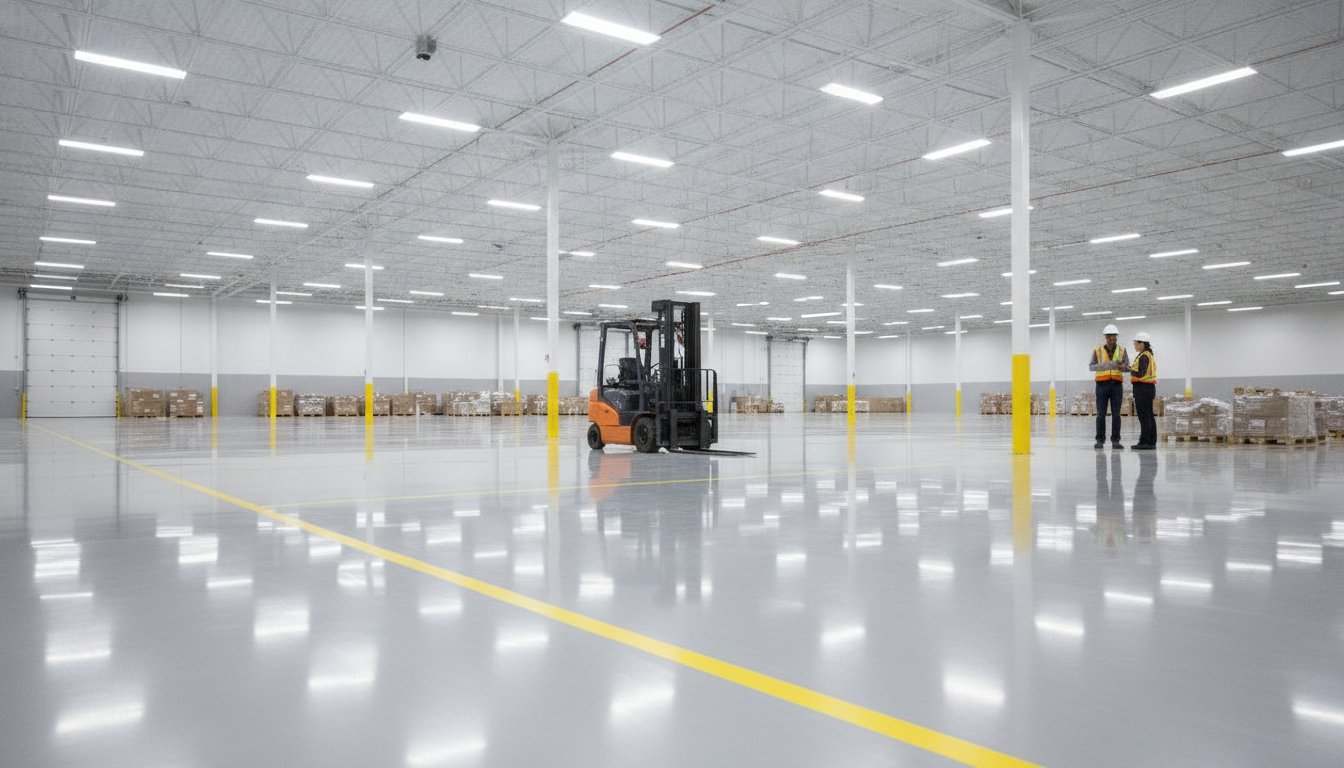
Industrial environments demand extreme specifications. In Mississauga warehouses or Brampton manufacturing plants, floors must withstand the relentless pressure of heavy forklift traffic and pallet jacks. Our systems are engineered for high compressive strength, often exceeding the strength of the underlying concrete itself. This ensures the floor doesn’t crush or rut under localized weight.
Impact resistance is equally vital. In active facilities, dropped tools or heavy components can easily crack unprotected concrete. A high-build epoxy system acts as a shock absorber, distributing the force of the impact to prevent substrate damage. Beyond physical durability, these systems offer a significant safety advantage through light reflectivity. A high-gloss finish increases ambient brightness, making it easier for staff to spot hazards and reducing the energy requirements for facility lighting. This combination of technical resilience and functional aesthetics is why industrial-grade epoxy remains the standard for high-traffic Canadian facilities.
The Three Main System Types: Coatings, Slurries, and Mortars
Thickness dictates performance. When selecting industrial epoxy flooring, the most common mistake facility managers make is under-specifying the system to save on initial capital costs. This approach is a myth that often leads to premature failure and triple the expense in repairs. An engineered floor must be matched to the specific mechanical and chemical loads of the facility, whether it’s a light assembly plant in Vaughn or a heavy manufacturing centre in Brampton. Choosing a system based on price rather than “mil” thickness is the fastest way to ensure your floor peels within the first year of service.
Thin-Film Epoxy Coatings (4-30 mils)
Thin-film systems provide an economical solution for areas with light foot traffic or basic dust control needs. These coatings are typically applied in two to three layers, reaching a total thickness of up to 30 mils. They’re excellent for colour-coding safety aisles or implementing line marking to organize warehouse logistics. However, they lack the body to withstand heavy wheeled traffic or abrasive impact. If your facility operates high-reach forklifts or handles heavy pallets, a thin-film coating will likely succumb to “point loading” stress, causing the resin to crack and peel from the concrete substrate. Understanding the full spectrum of epoxy coatings available for industrial facilities is essential before committing to a specification.
Epoxy Slurry and Mortar Systems (30-250+ mils)
Slurry systems represent the middle ground of resinous flooring. By broadcasting fine silica sand into the wet resin, we create a self-levelling layer that offers significantly higher impact and abrasion resistance than a standard coating. These systems are ideal for moderate industrial environments where durability is a priority but floor grades are relatively level.
For the most demanding environments, epoxy mortar systems are the definitive choice for industrial epoxy flooring. Often referred to as the “tank” of flooring, mortars are applied at thicknesses ranging from 125 mils to over 250 mils. These systems utilize a high aggregate loading, typically a 5:1 aggregate-to-resin ratio, which provides enough mass to resurface badly damaged or spalled concrete. This thickness allows the floor to absorb massive mechanical shocks without transferring that energy to the bond line. Because these high-build systems involve complex chemical reactions, adhering to strict health and safety protocols during installation is non-negotiable for the protection of both the applicators and your facility staff.
Specifying the right system requires a deep understanding of your facility’s operational reality. If you aren’t sure which mil thickness your environment demands, we can help you select a high-performance system that is built to last.
Durability in the Canadian Environment: Chemical and Thermal Resistance
Canadian winters destroy floors. In the Greater Toronto Area, industrial bays face a relentless assault from calcium chloride and road salts tracked in by heavy transport. These corrosive agents penetrate bare concrete, crystallizing within the pores and causing rapid spalling and structural degradation. Industrial epoxy flooring acts as an impermeable shield against these environmental stressors, preventing salt from reaching the reinforcement steel. Beyond winter weather, high-performance systems are essential for secondary containment and tank lining, where chemical-resistant floor coatings must withstand prolonged exposure to acids, alkalis, and solvents without softening or failing. Before committing to a system, facility managers in the region should consult a comprehensive resource like the GTA industrial epoxy flooring buyer’s guide for vetting qualified contractors and verifying that specifications align with Ontario Building Code requirements.
Safety remains the primary objective in any high-traffic facility. By utilizing durable resins, we can integrate permanent safety markings that adhere to OSHA safety color standards, ensuring that hazard zones and pedestrian aisles remain visible even under heavy wear. This is particularly critical in facilities with significant UV exposure, such as loading docks or warehouses with skylights. Without UV-resistant additives, standard epoxy will amber and chalk, losing its aesthetic value and compromising the visibility of safety markings. We specify tailored topcoats to ensure your facility maintains its brightness and compliance for years.
Anti-Static and ESD Flooring for Critical Tech
In Brampton’s growing electronics and aerospace sectors, static electricity is a catastrophic risk. A single electrostatic discharge (ESD) can destroy sensitive components or ignite volatile vapours. We install specialized anti-static flooring that provides a controlled path to ground, preventing the buildup of static charges. These conductive and dissipative systems are essential for maintaining the operational integrity of cleanrooms and assembly lines. For facilities handling hazardous materials, our Chemical & Anti-Static Solutions for Critical Environments provide a standard-setting level of protection that generic coatings simply cannot match.
Thermal Shock and Urethane Concrete Hybrids
Thermal shock is the primary cause of resinous floor failure in food processing plants. When hot-water washdowns hit a floor kept at 4°C, the rapid temperature swing causes the concrete and the epoxy to expand at different rates. Traditional epoxy is often too rigid to handle this movement, leading to immediate cracking and delamination. To solve this, we utilize urethane concrete hybrids. These mortars have a coefficient of thermal expansion similar to concrete, allowing the entire floor system to move in unison during extreme temperature fluctuations.
Identifying high-risk thermal zones is vital during the specification phase. You should check for the following conditions in your facility:
- Frequent high-pressure steam cleaning or hot-water washdowns.
- Proximity to industrial ovens, fryers, or blast chillers.
- Cold storage areas that share a wall with heated production zones.
- Loading docks exposed to extreme Canadian temperature swings.

Why Industrial Epoxy Fails: The Truth About Surface Preparation
Preparation determines longevity. At Epoxy Solutions™, we operate on a single, non-negotiable mantra: a floor is only as good as its bond to the substrate. Most industrial epoxy flooring failures are entirely preventable. They aren’t caused by product defects but by shortcuts taken before a single drop of resin hits the ground. If you see a floor peeling in large sheets, the installer likely failed to remove laitance. Laitance is the weak, milky layer of cement paste that rises to the surface during concrete pouring. Applying premium resin over laitance is like building a skyscraper on sand; the bond will eventually snap under mechanical stress.
Dust, oils, and deep-seated contaminants are silent killers of high-performance systems. Even a microscopic layer of dust acts as a bond breaker. While some contractors still suggest “acid etching” as a preparation method, it is fundamentally insufficient for industrial-grade specifications. Acid cannot create the mechanical profile needed for high-build systems. It merely cleans the surface without providing the “teeth” required for a permanent chemical bond. Relying on acid in a heavy-duty environment is a guarantee of future delamination. Knowing how to evaluate industrial epoxy flooring contractors in the GTA on their preparation standards is one of the most important steps a facility manager can take before signing any contract.
Moisture vapour transmission (MVT) remains the #1 enemy of epoxy. Even if a slab looks dry, hydrostatic pressure can push moisture through the concrete pores. This creates osmotic blistering, where moisture gets trapped under the resin and forces it to bubble and pop. Identifying these risks before the first coat is applied is what separates a professional installation from an amateur failure.
Mechanical Preparation Methods
Shot blasting is the gold standard for achieving the correct Concrete Surface Profile (CSP). This process involves firing steel shot at the floor to strip away laitance and open the concrete pores. We use diamond grinding for specific finishes or when a smoother profile is required for thin-film applications. Concrete Surface Profile (CSP) is a standardized measure of the “roughness” of the prepared concrete, and a CSP 3-5 is typically required for heavy industrial mortars to ensure the resin anchors itself deep into the substrate.
Moisture Testing and Mitigation
We treat moisture as a technical hurdle, not a deal-breaker. Before installation, we perform Calcium Chloride and In-Situ Relative Humidity (RH) tests to measure the exact moisture levels within the slab. If levels exceed safe limits, we utilize specialized moisture-mitigating primers. These primers are engineered to withstand high hydrostatic pressure, preventing the osmotic blistering that ruins lesser installations. If your last floor failed, it was likely a preparation issue. We can fix your failing industrial floor using standard-setting preparation techniques that ensure a permanent bond.
Specifying Success: The Epoxy Solutions™ Advantage in the GTA
Results matter most. For facilities in Toronto, Mississauga, and Vaughn, the choice of a contractor is the difference between a decade of performance and a month of headaches. Epoxy Solutions™ has been setting the industry standard since 1981. Founded by Roger Hildebrand, our company carries over four decades of experience in the most demanding environments across North America. We don’t just install industrial epoxy flooring; we engineer it to meet the specific mechanical and chemical realities of your operation.
Every facility has a unique fingerprint of stress. A food processing plant in the GTA requires different chemistry and thermal resilience than a heavy machinery shop or a logistics centre. We analyze your specific traffic patterns, chemical exposure, and load requirements to specify a system that won’t peel or fail. The long-term ROI of a professionally installed system is undeniable. While a cheap coating might look acceptable on day one, it quickly becomes a liability. A premium, high-performance floor is a capital asset that eliminates the need for constant repairs and prevents the nightmare of unscheduled facility shutdowns.
Beyond Installation: Safety and Compliance
Safety is non-negotiable. We integrate Industrial Safety & Precision Line Marking Services to ensure your warehouse remains compliant with provincial regulations and internal safety protocols. Our systems include tailored slip-resistant textures that are essential in wet or oily environments, reducing workplace accidents and liability. Precision line marking isn’t just about aesthetics; it’s about defining workflow, designating hazard zones, and protecting your personnel in high-traffic areas.
The Epoxy Solutions™ Process
Efficiency minimizes disruption. Our process starts with a rigorous site audit to identify substrate issues like moisture vapour transmission or deep-seated oil contamination. From the initial mechanical preparation to the final cure, our expert application teams manage every technical detail to ensure a seamless transition. We understand that facility downtime is expensive. We utilize proven project management strategies and high-performance materials to return your floor to service as quickly as possible without compromising the quality of the bond. We are the partner who steps in to fix what others failed to install correctly.
Contact Epoxy Solutions™ for a Professional Flooring Evaluation. Let us help you realize a maintenance-free floor that stands the test of time.
Protect Your Infrastructure with Standard-Setting Durability
A high-performance floor is the foundation of a safe, compliant facility. Success in industrial epoxy flooring is 90% preparation and 10% chemistry. Shortcuts in surface profiling or moisture testing always lead to expensive, unscheduled downtime. By specifying a system tailored to your specific chemical and mechanical loads, you transform a vulnerable concrete slab into a durable asset that withstands the harshest Canadian environments.
Epoxy Solutions™ has provided specialized technical expertise in ESD and chemical containment since 1981. With over 40 years of leadership across North American industrial hubs, we’re the partner who fixes what others failed to install correctly. Our team is ready to ensure your next project meets the highest standards of craftsmanship and longevity. Request a Professional Site Audit and Quote today. Your facility deserves a floor that works as hard as your business does.
Frequently Asked Questions
How long does industrial epoxy flooring typically last in a high-traffic facility?
A professionally specified industrial epoxy flooring system typically lasts 10 to 15 years in high-traffic environments. This longevity depends entirely on the thickness of the system and the quality of the initial surface preparation. While thin-film coatings might require a topcoat refresh every few years, heavy-duty mortar systems are engineered to withstand decades of mechanical abuse without structural failure.
Can industrial epoxy be installed over old or damaged concrete?
Industrial epoxy can be installed over old or damaged concrete provided the substrate is structurally sound. We use mechanical shot blasting or diamond grinding to remove contaminants and reach healthy concrete. For severely spalled or pitted floors, high-build epoxy mortar systems are used to resurface the slab, filling in cracks and voids to create a level surface that is often stronger than the original concrete.
What is the difference between an epoxy coating and an epoxy mortar?
The primary difference lies in thickness and aggregate loading. An epoxy coating is a thin-film application, usually 10 to 30 mils thick, designed for dust control and light traffic. In contrast, an epoxy mortar is a heavy-duty system applied at 125 to 250 mils. Mortars are mixed with a high ratio of silica sand or quartz, providing the mass necessary to absorb heavy impacts and support forklift loads that would crush a thin coating.
How long is the downtime required for a professional epoxy installation?
Most professional installations require a window of 72 to 96 hours to complete the preparation, application, and curing phases. While the resin may feel dry to the touch within 24 hours, it requires additional time to reach full chemical and mechanical hardness. We coordinate closely with facility managers to phase installations, often utilizing weekend windows or fast-curing formulations to minimize production interruptions.
Is industrial epoxy flooring slippery when wet, and can texture be added?
Smooth epoxy can be slippery when wet, but we integrate specialized aggregates to meet specific slip-resistance requirements. We tailor the texture based on your facility’s needs, whether you require a fine non-slip finish for a dry warehouse or a coarse, high-traction surface for oily production zones. These additives ensure your floor meets safety standards without compromising the ease of cleaning or the floor’s durability.
What is the typical cost per square foot for industrial epoxy in Toronto?
The cost of industrial epoxy flooring in the Greater Toronto Area varies based on the condition of the concrete, the required mil thickness, and the complexity of the installation. Factors such as moisture mitigation needs and specialized requirements for chemical resistance or anti-static properties also influence the final investment. We recommend a professional site audit to determine the exact technical specifications required for your facility before providing a project estimate.
How do I maintain and clean my new industrial epoxy floor?
Maintaining an epoxy floor is straightforward and requires no specialized waxing or stripping. Daily maintenance should involve dust mopping to remove abrasive grit and occasional damp mopping with a pH-neutral cleaner. You should avoid using acidic or highly alkaline cleaners that can dull the finish over time. For large facilities, automatic scrubbers with soft brushes are highly effective at maintaining the floor’s brightness and safety characteristics.
Does industrial epoxy flooring smell during installation, and are there low-VOC options?
Traditional solvent-based epoxies carry a strong odour, but modern high-performance systems utilize 100% solids formulations with low or zero VOCs. These premium products allow for installation in sensitive environments, such as food processing plants or pharmaceutical labs, without the risk of solvent taint or hazardous fumes. We prioritize these low-odour systems to ensure facility safety and compliance with Canadian environmental regulations while maintaining maximum durability.