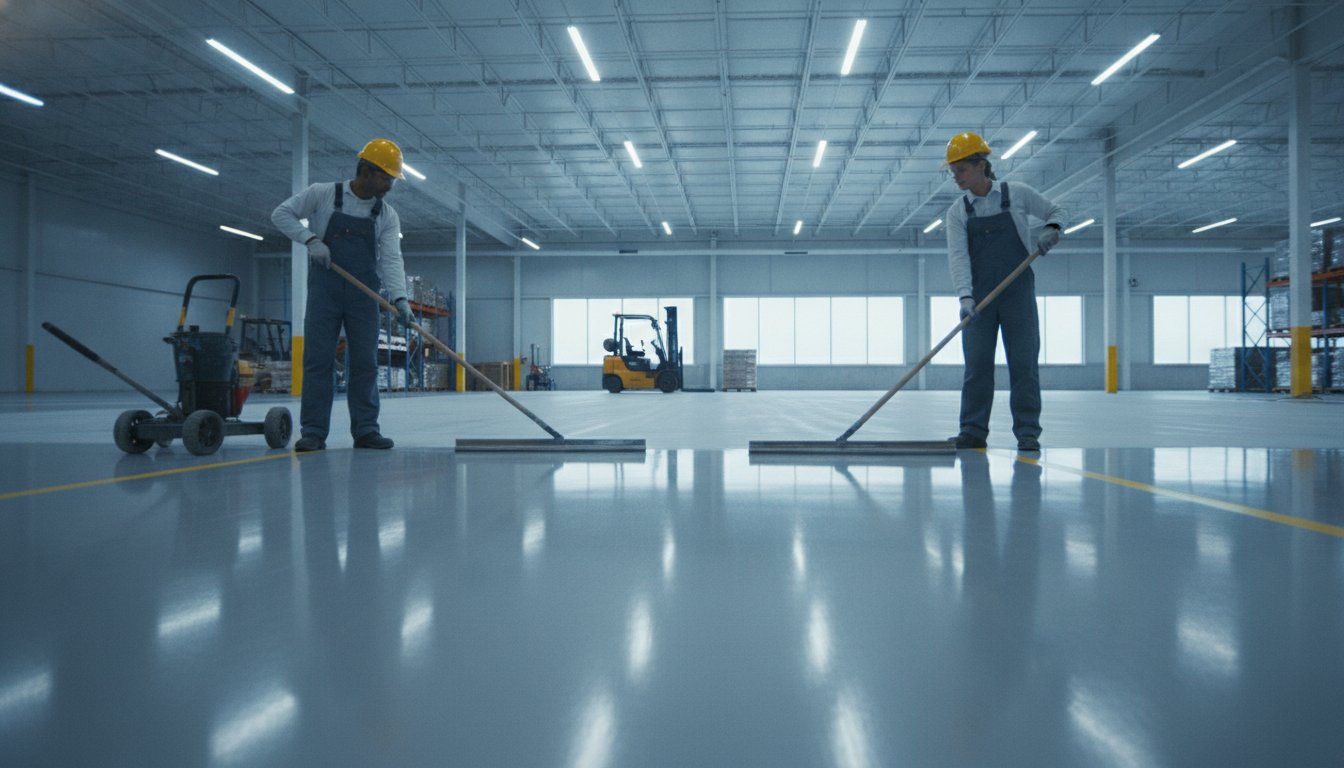
Most industrial flooring failures in the GTA aren’t caused by bad resin; they’re caused by contractors who treat a heavy-duty facility like a residential garage. It’s a blunt reality that costs Ontario facility managers thousands in unnecessary downtime and remedial repairs. You’ve likely seen the results of poor execution: premature peeling, failed cures, or surfaces that simply can’t handle the heat of chemical washdowns or heavy forklift traffic. It’s frustrating to invest in a solution only to watch it delaminate under pressure.
This 2026 buyer’s guide provides the technical framework you need to vet industrial epoxy flooring contractors and select a high-performance system that actually survives your facility’s specific operational loads. We’ll show you how to identify accurate specifications that meet the latest Ontario Building Code and ensure your investment delivers a seamless, durable finish. From understanding the necessity of shot-blasting to evaluating chemical resistance, you’ll learn how to secure a floor that reduces maintenance costs and protects your bottom line for the long term.
Key Takeaways
- Understand why industrial flooring requires a multi-layered engineering approach to prevent the delamination common with thin-film “paint” applications.
- Identify the technical benchmarks used to vet industrial epoxy flooring contractors in the GTA to ensure your substrate is properly prepared for extreme mechanical loads.
- Learn how to select between high-build systems and specialized chemical-resistant coatings based on your facility’s primary environmental stressors.
- Navigate local safety regulations and optimize warehouse traffic through precision line marking and high-visibility flooring layouts.
- Recognize the long-term ROI of professional execution that prioritizes durability and safety over the lowest initial bid.
Beyond the Surface: Why Industrial Flooring Is an Engineering Project, Not a Paint Job
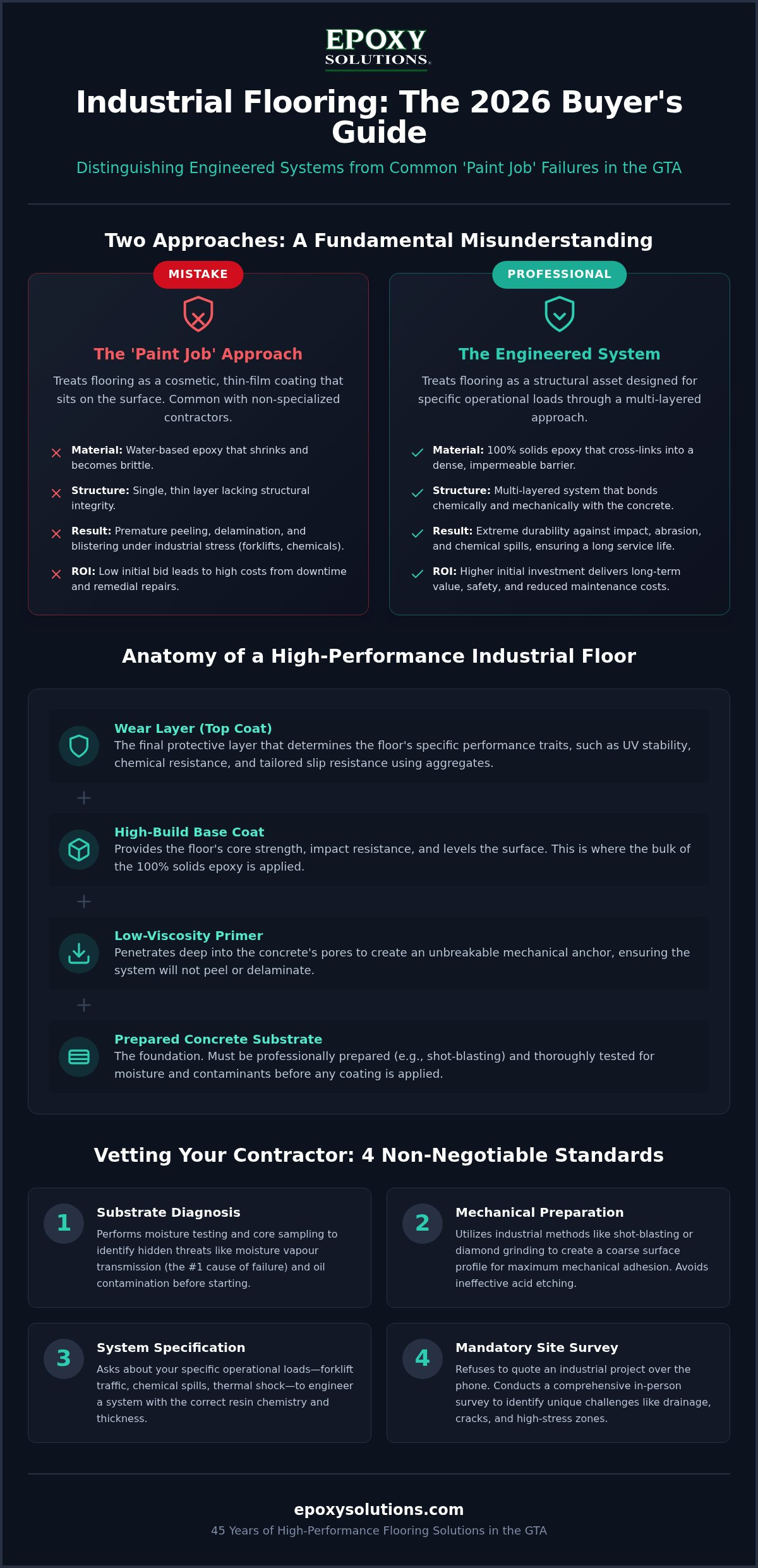
Industrial flooring isn’t a cosmetic choice. It’s an engineering requirement. Too many facility managers in the GTA treat floor coatings as a finishing touch, similar to painting a wall. This is a fundamental misunderstanding of substrate science. A high-performance floor is a multi-layered resinous system designed to become part of the concrete itself through mechanical and chemical bonding. If the bond isn’t permanent, the floor is a failure.
When you hire generic painters instead of specialized industrial epoxy flooring contractors, you’re often getting a thin-film coating that simply sits on the surface. These “paint” jobs fail because they lack the structural integrity to handle industrial stressors. Forklift traffic, aggressive chemical spills, and thermal shock will tear a thin coating apart within months. Professional systems are engineered to withstand specific mechanical loads and chemical exposures that would dissolve standard retail-grade products. The blunt reality is that most industrial floor failures occur because the project was treated as a cosmetic upgrade rather than a structural necessity.
The Anatomy of a High-Performance Industrial Floor
A durable floor isn’t a single coat. It’s a hierarchy of layers. It begins with a low-viscosity primer that penetrates the concrete pores to create a mechanical anchor. This is followed by a high-build base coat that provides impact resistance and levels the surface. The final wear layer determines the floor’s specific performance traits, such as UV stability or chemical resistance.
The difference often lies in the material choice. Low-tier contractors use water-based epoxies that shrink as they dry, leaving a brittle, thin film. We utilize 100% solids epoxy. This material doesn’t evaporate; it undergoes a complex cross-linking reaction that creates a dense, impermeable barrier. Understanding the chemistry of epoxy resins is vital for ensuring the floor doesn’t just look good, but performs under extreme duress. We also integrate specialized aggregates into these layers to provide tailored slip resistance and enhanced durability in high-traffic zones.
Identifying Common Substrate Failures
Adhesion is everything. In Canada, moisture vapour transmission is the primary cause of industrial floor failure. If moisture is trapped beneath the resin, it creates osmotic pressure that forces the coating to blister and peel. This isn’t a product failure; it’s a failure of the contractor to accurately diagnose the concrete health before beginning the installation.
Contaminants like oils and grease are equally dangerous. In Mississauga’s manufacturing sector, decades of industrial activity often leave concrete saturated with hydrocarbons. Professional industrial epoxy flooring contractors don’t just guess at the condition of your slab. We perform moisture testing and core sampling to identify these hidden threats before a single drop of resin is mixed. We solve the problem at the substrate level to ensure the finished system lasts for decades, not just until your next safety audit.
Vetting Industrial Epoxy Flooring Contractors: 4 Non-Negotiable Standards
Don’t hire a painter for an engineer’s job. In Mississauga and the broader GTA, the market is saturated with residential contractors who have rebranded themselves as industrial specialists. Vetting industrial epoxy flooring contractors requires looking past a glossy portfolio and examining their technical process. If a contractor doesn’t ask about your forklift traffic, chemical spill history, or point-load requirements, they aren’t qualified to specify your floor system.
A comprehensive site survey is mandatory. You cannot accurately quote an industrial floor over the phone or via email photos. A true professional identifies “extreme environments,” such as battery charging stations or high-heat washdown bays, that require specialized resin chemistries. This meticulous approach prevents the premature peeling and delamination that plague low-bid installations. If you’re managing a complex facility, it’s best to partner with an expert fixer who prioritizes long-term ROI over a quick sale.
The lowest bid is often the most expensive. When a contractor cuts corners on surface preparation or material quality, the result is a failed cure that halts your production. In 2026, the cost of facility downtime far outweighs the initial savings of a cheap quote. Vetting for safety is equally vital. Your contractor must understand provincial workplace safety standards and should be familiar with OSHA safety color standards to ensure your facility remains compliant and organized during and after the installation process.
Step 1: Verify Mechanical Preparation Methods
Mechanical preparation is the only way to achieve a permanent bond. Demand diamond grinding or shot-blasting to create the correct Concrete Surface Profile (CSP) for your specific coating thickness. Acid etching is for residential garages; it’s entirely insufficient for industrial slabs. Additionally, verify the contractor owns and operates high-capacity dust-collection systems. You don’t want concrete dust contaminating your sensitive machinery, inventory, or ventilation systems during the project.
Step 2: Technical Specification Accuracy
Accuracy in specification is non-negotiable. Ensure the contractor provides commercial epoxy flooring Canada systems tailored to your specific chemical exposure and mechanical loads. Whether you need UV-resistant coatings for loading docks or anti-static systems for electronics assembly, demand technical data sheets (TDS) and safety data sheets (SDS) for every product. This standard-setting documentation proves the materials meet the required performance benchmarks for your industry.
Selecting the Right System: High-Build Epoxy vs. Chemical-Resistant Coatings
System selection is a technical calculation, not a matter of personal preference. No single flooring solution can resolve every industrial challenge. Your facility’s primary stressor, whether it’s heavy impact, aggressive acids, or extreme temperature fluctuations, dictates the resin chemistry required. Professional industrial epoxy flooring contractors evaluate these variables to prevent the “one-size-fits-all” approach that leads to premature floor failure.
For standard warehouse environments in the GTA, high build epoxy systems are the benchmark. These systems are designed for impact resistance and heavy load bearing, providing a thick, durable barrier against constant forklift traffic. However, in food processing plants, epoxy often fails due to thermal shock from steam cleaning. In these environments, urethane mortar is the superior choice. It expands and contracts at a rate similar to the concrete substrate, preventing delamination during rapid temperature shifts. For facilities handling hazardous materials, specialized epoxy coatings are engineered for secondary containment and chemical lining, ensuring your infrastructure remains impermeable and compliant with environmental regulations.
Chemical and Anti-Static Solutions
Laboratories and chemical manufacturing plants require a higher standard of protection. Standard resins will soften or discolour when exposed to aggressive solvents or acids. We specify chemical-resistant systems that maintain structural integrity under constant exposure. In electronics assembly or data centres, the priority shifts to static control. Anti-static ESD flooring is essential to protect sensitive components from electrostatic discharge. Furthermore, our expertise extends to precision tank lining, which provides a standard-setting barrier against corrosion in critical industrial storage units.
Traffic Toppings and UV Resistance
Outdoor exposure and high-traffic ramps demand specialized traffic toppings. In Mississauga and Brampton, parking decks and loading docks face the dual threat of heavy mechanical wear and Canadian freeze-thaw cycles. These surfaces require flexible, waterproof membranes that can bridge small cracks while maintaining a slip-resistant profile. UV-resistant flooring is equally critical for facilities with significant natural light; without it, standard epoxy will amber and become brittle over time. While polished concrete is a viable option for high-traffic commercial zones, experienced industrial epoxy flooring contractors will advise that resinous systems offer superior protection against liquid penetration and chemical staining in true industrial settings.
Local GTA Compliance: Safety Line Marking and Environmental Considerations
Safety isn’t a suggestion. In the GTA, industrial safety is a regulated necessity that directly impacts your liability and operational efficiency. Competent industrial epoxy flooring contractors don’t just apply a coating; they design a comprehensive safety system. This involves ensuring the finished surface meets specific slip-resistance coefficients to prevent workplace accidents. If your floor is too slick for your specific environment, it’s a legal and physical hazard that can lead to costly insurance claims.
The Canadian climate presents unique challenges. In regions like Vaughn, Milton, and Mississauga, seasonal humidity and temperature swings significantly affect resin cure times. An amateur contractor will often ignore the dew point, leading to failed cures, amine blush, or cloudy finishes. We monitor environmental conditions meticulously to ensure every high-performance system bonds and hardens correctly. This precision ensures your facility remains on schedule regardless of the weather outside.
Safety Flooring and Precision Line Marking
Precision matters for traffic flow. We integrate safety aisle marking directly into the resinous system rather than painting them on top as an afterthought. This makes the markings permanent and resistant to the abrasive wear of heavy forklifts and industrial scrubbers. It’s a standard-setting approach that keeps your facility organized for years.
- Standardized colour-coding for hazard zones, loading bays, and forklift paths.
- Emergency exit routes that remain high-visibility in low-light conditions.
- High-visibility, chemical-resistant pigments that won’t fade under aggressive cleaning cycles.
This methodical approach to organization optimizes your warehouse traffic and protects your personnel. If you need a facility that meets the highest safety benchmarks, contact us for a professional site assessment to see how we can integrate these standards into your next project.
Environmental and Regulatory Standards
Indoor air quality is a major concern during any industrial installation. We strictly adhere to VOC (Volatile Organic Compound) regulations to ensure a safe environment for your staff and the surrounding community. By utilizing 100% solids, low-odour resins, we can organize installations that minimize disruption to nearby office personnel or ongoing production lines. You don’t have to shut down your entire operation for a floor upgrade.
For those in the food and beverage sector, meeting CFIA (Canadian Food Inspection Agency) standards is non-negotiable. Our food-grade industrial flooring systems are seamless and non-porous. This prevents the bacterial growth and organic absorption that leads to audit failures. Industrial epoxy flooring contractors who understand these specific Canadian regulations are essential for maintaining your facility’s operational permit and professional reputation.
The Epoxy Solutions™ Advantage: 45 Years of High-Performance Flooring
Experience isn’t just a number on a balance sheet. It’s the difference between a floor that lasts decades and one that peels within eighteen months. Since 1981, Epoxy Solutions™ has set the standard for industrial flooring across North America. For 45 years, we’ve focused on one thing: delivering high-performance resinous systems that survive the most demanding industrial environments. We’ve seen every possible substrate failure and developed the technical expertise to prevent them before they occur.
We’ve earned our reputation as the “Authoritative Expert Fixer.” A significant portion of our work involves correcting the catastrophic failures left behind by low-bid industrial epoxy flooring contractors who lacked the equipment or the engineering knowledge to handle heavy industrial loads. From Mississauga warehouses to complex manufacturing plants in Toronto, we provide premium, tailored solutions that solve problems rather than just covering them up. We don’t just install floors. We engineer surfaces that protect your infrastructure and your bottom line.
Our Proven Process for Industrial Success
Success in industrial flooring is predictable if you follow a rigorous technical process. We leave nothing to chance. Our approach is methodical and designed to ensure a permanent bond between the resin and the concrete substrate. We prioritize long-term durability over shortcuts, ensuring your facility remains operational and compliant.
- Comprehensive Site Analysis: We perform moisture testing and substrate health checks to identify potential adhesion killers like osmotic pressure or deep-seated oil contamination.
- Industrial-Grade Preparation: We utilize high-capacity diamond grinding and shot-blasting equipment to achieve the precise Concrete Surface Profile (CSP) required for your specific system.
- Expert Specification: Our team applies premium resinous chemistries, ranging from anti-static ESD flooring to high build epoxy systems with chemical-resistant coatings tailored to your stressors.
Partnering with the GTA’s Flooring Experts
Facility managers in Brampton, Milton, and Vaughn realize that a cheap floor is the most expensive mistake they can make. They choose Epoxy Solutions™ because they value a premium specification backed by a 45-year legacy of reliability. We provide a no-nonsense professional execution that minimizes your facility’s downtime and eliminates the need for remedial repairs. Our brand is built on rugged craftsmanship and a deep-seated pride in setting the benchmarks that others merely try to follow.
You don’t have to settle for “good enough” when it comes to your facility’s safety and durability. Whether you’re dealing with chemical exposure, heavy forklift traffic, or strict regulatory audits, we have the specialized expertise to deliver a permanent solution. Contact Epoxy Solutions™ today to discuss your facility’s specific flooring challenges and secure a high-performance system that stands the test of time.
Secure Your Facility’s Operational Future with High-Performance Standards
A cheap industrial floor is a persistent liability. Throughout this guide, we’ve established that high-performance flooring is an engineering requirement, not a cosmetic choice. Success depends on accurate substrate diagnosis, meticulous mechanical preparation, and the selection of resin chemistries tailored to your specific mechanical and chemical loads. By prioritizing technical accuracy over the lowest initial bid, you protect your facility from the costly downtime associated with delamination and failed cures.
Since 1981, Epoxy Solutions™ has specialized in high-performance specifications across North America. We bring no-nonsense, expert execution to GTA facilities, correcting the mistakes of less experienced industrial epoxy flooring contractors. Our 45-year legacy is built on standard-setting results that withstand the most extreme industrial environments. Don’t settle for a temporary fix when you can invest in a permanent asset.
Ready to eliminate flooring failures in your facility? Request a Professional Site Survey from Epoxy Solutions™ today. Let’s build a floor that actually works as hard as your business does.
Frequently Asked Questions
How long does industrial epoxy flooring typically last in a high-traffic facility?
A professionally installed system typically lasts between 10 and 20 years. This longevity depends entirely on the accuracy of the initial specification and the quality of the mechanical bond to the substrate. High-traffic zones require thicker high-build systems to withstand constant abrasion. If the floor is specified correctly for the mechanical load, it won’t require replacement for a decade or more.
What is the difference between diamond grinding and shot-blasting for surface prep?
Diamond grinding uses rotating abrasive discs to smooth and open the concrete pores, while shot-blasting propels steel beads to create a more aggressive profile. industrial epoxy flooring contractors select the method based on the required Concrete Surface Profile (CSP). Thick coatings usually require the deeper anchor pattern provided by shot-blasting to prevent delamination under heavy forklift traffic.
Can industrial epoxy be installed over existing oil-contaminated concrete?
It can, provided the contractor uses specialized oil-stop primers after intensive degreasing. Standard epoxies will delaminate if applied over hydrocarbons. We utilize technical-grade penetrants that create a barrier between the oil-saturated concrete and the new resinous system to ensure a permanent bond. This prevents the peeling common in older Mississauga automotive or manufacturing plants.
How much downtime should I expect during a professional epoxy installation?
Most industrial projects require a window of three to five days for installation and a full chemical cure. This timeline includes mechanical preparation, priming, and the application of multiple resin layers. While fast-cure resins can reduce this window, we prioritize a complete cross-linking process to ensure the floor meets its maximum performance rating. Rushing the cure often leads to soft spots.
Is anti-static ESD flooring necessary for my electronics manufacturing plant?
It is vital for any facility handling sensitive microchips or volatile chemicals. Anti-static flooring prevents electrostatic discharge from damaging expensive components or igniting flammable vapours. Without an ESD system, your facility remains at high risk for equipment failure and safety violations during provincial audits. It’s a non-negotiable standard for modern electronics assembly and data centres in Ontario.
How do I choose between polished concrete and a high-build epoxy system?
Choose polished concrete for dry environments where aesthetics and low maintenance are the priority. Select a high-build epoxy system if your facility faces chemical spills, frequent washdowns, or heavy mechanical impact. Resinous coatings provide an impermeable barrier that polished concrete cannot match in aggressive industrial settings. Epoxy is the correct choice for facilities requiring slip resistance and chemical containment.
What are the maintenance requirements for a chemical-resistant floor coating?
Maintenance involves regular sweeping and mopping with pH-neutral cleansers. While these floors are engineered for chemical resistance, you shouldn’t allow aggressive acids or solvents to dwell on the surface indefinitely. Promptly cleaning spills and avoiding abrasive metal brushes will preserve the integrity of the wear layer for decades. A simple, consistent cleaning schedule is all that’s required to maintain the premium finish.
Does Epoxy Solutions™ provide services in Mississauga, Brampton, and Vaughn?
Yes, we serve the entire Greater Toronto Area, including Mississauga, Brampton, Vaughn, Milton, and Toronto. Our team of industrial epoxy flooring contractors has 45 years of experience managing complex industrial specifications across these regions. We specialize in delivering high-performance results for local manufacturing, warehousing, and food processing facilities that require durable, safety-compliant surfaces.