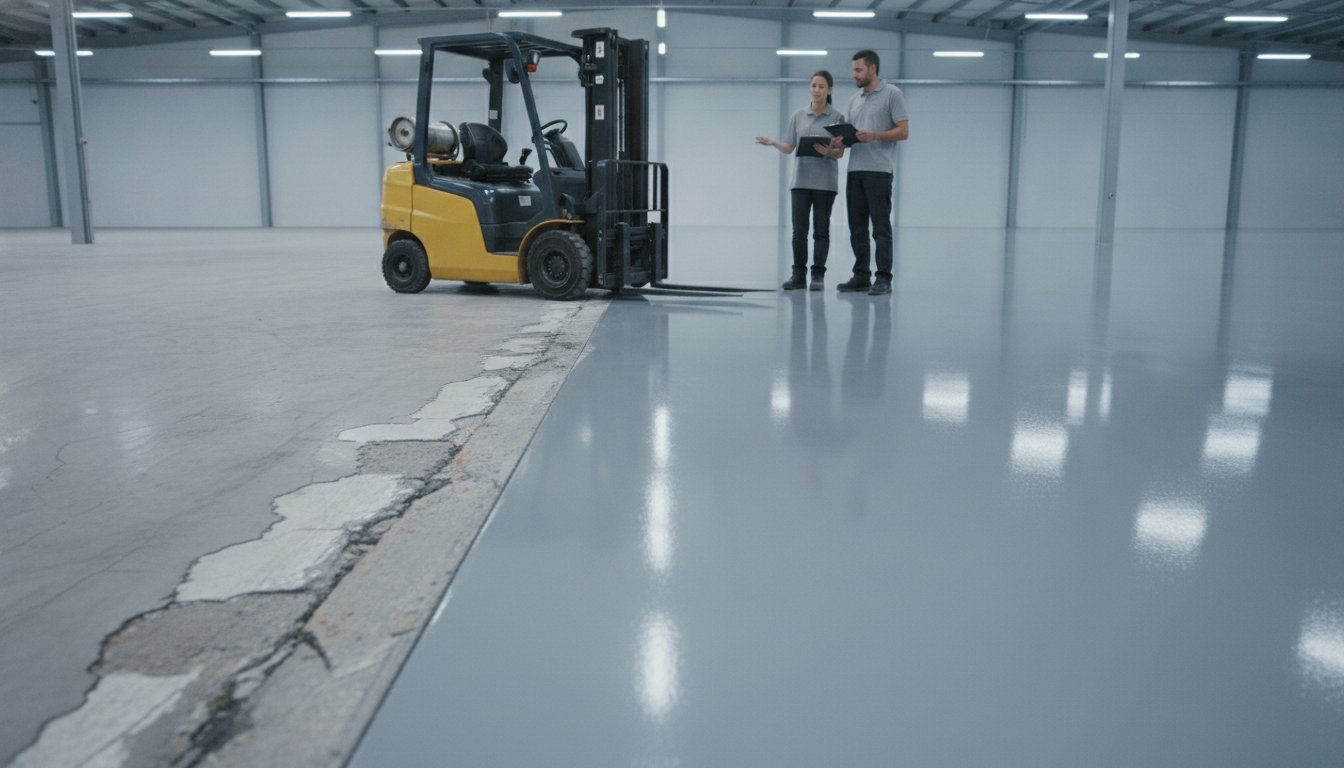
Standard patches always fail. Most facility managers in the Greater Toronto Area are caught in a costly cycle of temporary concrete repair that crumbles under the weight of daily operations. You’ve likely seen the results: spalling surfaces and deep cracks that reappear shortly after a fix is completed, creating safety hazards and slowing down your forklift traffic. It’s an exhausting process that drains your maintenance budget without ever actually solving the underlying structural problem.
This guide changes that. You’ll discover why standard cement-based patches are fundamentally incapable of bonding with an old slab and how professional resinous systems ensure long-term structural integrity for your commercial facility. We’ll break down the science of high-performance bonding agents and provide a clear path toward a floor that finally meets safety regulations and stands up to the heaviest industrial loads. It’s time to stop patching symptoms and start implementing permanent engineering solutions.
Key Takeaways
- Understand why traditional cement patches fail under Toronto’s 40-50 annual freeze-thaw cycles and how to address the root causes of spalling and joint deterioration.
- Learn the technical advantages of resinous concrete repair systems, which offer superior compressive strength and thermal expansion compatibility compared to standard grout.
- Discover why mechanical surface preparation, including diamond grinding, is the critical factor in achieving a permanent bond that withstands heavy forklift traffic.
- Identify the specific Concrete Surface Profile (CSP) standards required to ensure your floor restoration meets industrial safety and performance regulations.
- Move beyond temporary maintenance by implementing engineered solutions that end the recurring cycle of floor failure in high-traffic GTA facilities.
Industrial Concrete Repair: Addressing the Root Cause of Floor Failure
Industrial concrete repair is the systematic restoration of a slab’s structural integrity and surface profile. It isn’t a cosmetic touch-up. Many facility managers in Toronto mistake “filling a hole” for a legitimate repair. Real restoration addresses the fundamental causes of concrete deterioration to ensure the surface can withstand the specific stresses of a commercial environment. When we identify common failure points like spalling, deep-seated cracks, or joint deterioration, we’re looking at symptoms of a slab that’s losing its capacity to support your business operations. We don’t just patch; we re-engineer the bond.
The High Cost of Surface Neglect
Neglect is expensive. Ignoring a small defect today leads to catastrophic slab failure and increased liability tomorrow. In a high-volume warehouse, a single spalled joint can destroy a forklift tire in weeks. This results in recurring mechanical repair costs and unnecessary operational downtime that eats into your bottom line. Beyond equipment damage, uneven floor surfaces in the GTA present significant safety compliance risks under Ontario’s strict workplace regulations. Unaddressed cracks also allow for moisture intrusion. In Canadian facilities, this triggers a “snowball effect” where water enters the slab, freezes, and expands, rapidly widening the damage during our frequent freeze-thaw cycles. What starts as a hairline fracture quickly becomes a structural hazard that requires total section replacement.
Resinous vs. Cementitious: Choosing the Right Material
Standard grout is brittle. It lacks the tensile strength required to move with a building’s natural shifts or the heavy vibration of industrial machinery. Most retail-grade cementitious patches fail because they cannot bond to the existing substrate effectively, leading to delamination under heavy traffic. Resinous solutions offer a superior alternative. High-performance epoxy and resinous systems provide the impact resistance and flexibility that cement simply cannot match. We employ a standard-setting approach to material selection, choosing premium resins that fuse with the concrete rather than just sitting on top of it. This ensures:
- High-performance chemical resistance for industrial spills and cleaning agents.
- Superior bond strength that exceeds the original concrete’s tensile capacity.
- Tailored flexibility to handle thermal expansion and heavy forklift loads without cracking.
- Accurate surface profiling that restores the floor to its original intended level.
Choosing the right material is the difference between a permanent fix and a recurring maintenance headache. While “all-purpose” kits might work for a residential garage, they have no place in a professional facility where durability and safety are non-negotiable.
The Science of Concrete Deterioration: Why Patches Frequently Fail
Physics doesn’t compromise. Most concrete repair attempts fail because the installer ignores the fundamental physical differences between an old slab and a new patching material. Toronto experiences an average of 40 to 50 freeze-thaw cycles every year. This constant fluctuation creates internal pressure that standard, rigid cement patches cannot withstand. When water trapped in the pores of the concrete freezes, it expands by approximately 9 per cent, exerting massive force that pops inferior materials right out of the slab. This is a scientific inevitability, not a matter of bad luck.
Canadian Climate and Concrete Longevity
Toronto winters are exceptionally harsh on industrial floors. The heavy application of salt and de-icing chemicals accelerates concrete rot by allowing chloride ions to penetrate the slab and attack the reinforcing steel. As the rebar rusts, it expands and forces the surface to spall from the inside out. In the industrial corridors of Mississauga and Brampton, we frequently encounter vapour pressure issues. Moisture from the ground is drawn upward through the porous slab, causing non-breathable coatings to blister and peel. Facilities with high sun exposure must also account for UV degradation, which turns standard binders brittle and leads to premature surface chalking. Without addressing these environmental stressors, any repair is merely a countdown to the next failure.
Mechanical Stress and Point Loading
High-reach trucks and heavy machinery pulverize weak repair compounds. Most off-the-shelf patches are too rigid; they don’t transfer loads effectively to the surrounding slab. Instead, they crack at the edges under the intense point loading of a forklift’s wheels. You can often identify a failing patch by the “hollow sound” it produces when tapped, which indicates that the material has delaminated from the substrate. To prevent this, we utilize high-build epoxy systems that provide the necessary tensile strength to move with the slab under heavy traffic. If your facility is currently trapped in a cycle of recurring damage, it’s time to invest in high-performance resinous flooring that actually bonds to the concrete matrix. We also account for carbonation, a process where atmospheric CO2 lowers the pH of the concrete and weakens its structural integrity. Real restoration requires an understanding of these chemical shifts to ensure the new surface exceeds the performance of the original pour.
Resinous Repair vs. Traditional Grout: A Durability Comparison
Standard grout is a liability in a heavy-duty environment. While a typical industrial floor might be poured with 30MPa concrete, these surfaces are designed for broad distribution of weight rather than the intense, localized stress of a patch. High-performance resinous systems often reach a compressive strength exceeding 80MPa, effectively creating a repair that is nearly three times stronger than the host slab. This ensures that the concrete repair doesn’t become the next weak link in your facility’s floor, but rather a reinforced zone capable of handling extreme point loading.
Matching the Coefficient of Thermal Expansion is equally vital for Canadian facilities. When temperatures fluctuate between the loading dock and the warehouse interior, different materials expand and contract at different rates. If a rigid cementitious patch cannot move in harmony with the surrounding slab, the bond will shear and delaminate. Professional resinous repairs are engineered to mirror the thermal movement of concrete, maintaining a permanent connection through every seasonal shift. Speed of service also sets these materials apart. While traditional mortar requires days of hydration to reach traffic-bearing strength, specialized resins cure in hours, allowing your team to resume operations without the high cost of extended downtime.
Bond Strength: The Key to Permanent Repair
Bond strength is the technical measure of a repair’s resistance to delamination under tension or shear forces. Unlike traditional grout, which relies on a superficial mechanical bond, low-viscosity primers penetrate deep into the concrete capillaries to create a chemical weld. This deep-rooting action ensures the concrete repair becomes an integral part of the structural slab. By saturating the substrate, these primers eliminate the air pockets and weak zones where moisture typically gathers, preventing the internal pressures that lead to surface failure.
Chemical and Abrasion Resistance
Industrial fluids and cleaning agents act as solvents on standard cementitious materials. In manufacturing plants or food processing facilities, constant exposure to oils, fats, and acids will erode traditional grout in months. Resinous systems provide an impenetrable barrier that resists chemical attack and heavy abrasion. For facilities utilizing polished concrete, we integrate specialized densifiers during the restoration process to harden the concrete matrix and improve its wear resistance. This tailored approach ensures the floor remains seamless and non-porous, meeting strict hygiene standards while providing a surface that is significantly easier to maintain than porous concrete.

The Professional Concrete Restoration Process: From Surface Prep to Final Seal
Preparation is 90 per cent of the job. Most failed concrete repair projects in the Greater Toronto Area are not the result of inferior materials; they are the result of negligent surface preparation. We frequently act as the “Authoritative Expert Fixer” for facilities where a previous contractor’s patch has delaminated within months. Our process begins where others stop, ensuring the substrate is mechanically capable of supporting a high-performance resinous system. We don’t just clean the surface. We re-engineer it.
Mechanical Surface Preparation
Surface preparation is not a cleaning exercise. We utilize heavy-duty diamond grinding and shot blasting to remove “laitance,” which is the weak, brittle layer of cement paste that rises to the top during the original pour. This mechanical process exposes the aggregate and opens the concrete’s capillaries. Acid etching is an outdated and unreliable method that has no place in an industrial facility. It introduces moisture and hazardous chemicals into the slab, often leading to bond failure. For structural cracks, we perform “routing,” where we mechanically widen the fracture to create a clean, stable channel. This increases the available surface area, allowing our resin to “weld” the two sides of the slab together permanently.
Every professional restoration must adhere to specific Concrete Surface Profile (CSP) standards. Depending on the thickness of the final coating, we prepare the slab to a CSP level between 3 and 9 as defined by the International Concrete Repair Institute. This ensures a mechanical “tooth” that allows the resin to lock into the slab. Without this precise profiling, even the most expensive epoxy will eventually peel under the stress of forklift traffic.
Application and Curing Protocols
Precision continues through the application phase. We maintain strict climate control to manage dew points and surface temperatures, ensuring the resin cures according to its chemical design. Our multi-layer approach is methodical and purposeful:
- Primer: A low-viscosity resin that saturates the concrete capillaries to create a deep mechanical bond.
- Base Coat: The structural layer that fills voids and levels the surface profile.
- Broadcast: The addition of specialized aggregates for slip resistance and impact durability.
- Topcoat: A high-performance seal that provides chemical resistance and UV stability.
For high-wear areas like parking decks or loading docks, we integrate specialized traffic toppings to handle extreme mechanical shear. If you are currently dealing with the failure of a previous concrete repair, it is time to invest in a professional restoration that prioritizes technical accuracy over the lowest bid.
Standard-Setting Concrete Solutions for Toronto and the GTA
Since 1981, Epoxy Solutions™ has served as the definitive authority for high-performance resinous flooring and concrete restoration across North America. We specialize in the “Extreme Capability” projects that demand more than a simple bucket of mortar. Whether you’re operating a high-tech facility in Mississauga or a heavy manufacturing plant in Brampton, we bring decades of technical expertise to every slab. We don’t just fix floors; we provide engineered systems that eliminate the need for recurring maintenance.
A cheap retail patch is a liability. It’s a temporary fix that will eventually fail, leading to more downtime and higher long-term costs. Our approach focuses on long-term ROI. By utilizing premium materials like chemical resistance flooring and anti-static systems, we ensure your facility remains compliant and operational for years, not months. Our services extend beyond concrete repair to include precision line marking and UV resistance flooring, providing a comprehensive solution for any industrial environment.
Why GTA Facility Managers Trust Epoxy Solutions™
The 45-year legacy of Roger Hildebrand is built on technical accuracy and a refusal to cut corners. We understand the specific demands of the Greater Toronto Area’s industrial landscape where concrete repair must withstand extreme temperature swings and heavy-duty usage. Our team provides local service coverage across Toronto, Mississauga, Brampton, Milton, and Vaughn, ensuring that help is always within reach. We offer a no-nonsense guarantee on durability because we know our mechanical preparation and material selection are the best in the industry. We’re the partner you call when you realize that “good enough” is no longer an option for your facility’s safety and performance.
Your Next Steps to a Permanent Floor
Every industrial environment is different. A food processing plant has different requirements than a parking garage or a chemical warehouse. Our consultation process is designed to evaluate your specific industrial flooring specifications, accounting for factors like UV exposure, chemical spills, and heavy forklift traffic. We tailor our resinous systems to meet these exact needs, ensuring a permanent fix that ends the patch-and-fail cycle. Stop wasting your maintenance budget on temporary solutions. Contact Epoxy Solutions™ for a professional site evaluation and secure the long-term structural integrity of your facility today.
Secure Your Facility’s Future with Engineered Restoration
Temporary fixes are a drain on your bottom line. Technical accuracy is the only way to end the cycle of failing patches and recurring maintenance. A permanent concrete repair requires rigorous mechanical preparation through diamond grinding and the use of high-performance resinous systems that weld to the substrate. Since 1981, Epoxy Solutions™ has provided the Greater Toronto Area with these standard-setting industrial solutions, ensuring every slab we treat withstands the heaviest operational loads.
Stop letting deteriorating floors compromise your safety standards or mechanical equipment. By prioritizing engineered durability over retail-grade compounds, you protect your infrastructure and your budget. Our team applies decades of expertise to resolve your specific facility challenges with precision and reliability. Get a Professional Concrete Repair Assessment to establish a new benchmark for your industrial surfaces. It’s time to invest in a floor that works as hard as your business does.
Frequently Asked Questions
How long does professional concrete repair take to cure?
Cure times vary based on the specific resin system required for your facility’s operational needs. Rapid-cure polyaspartic systems often allow for foot traffic in as little as two to four hours, while our high-performance industrial epoxies typically require 12 to 24 hours before they can withstand heavy forklift loads. We coordinate the application schedule to minimize your downtime, ensuring the floor reaches its full mechanical strength as quickly as possible.
Can you repair concrete that is already peeling or delaminating?
Yes, we specialize in restoring slabs where previous coatings or inferior patches have failed. The process requires the total mechanical removal of the delaminating material and the underlying “laitance” layer to reach sound, solid concrete. We act as the authoritative fixer for failed third-party installs, utilizing diamond grinding to create a fresh surface that ensures the new concrete repair achieves a permanent, structural bond.
What is the difference between epoxy and polished concrete for repairs?
Epoxy is a high-build resinous system that adds a protective, chemical-resistant layer over the slab, whereas polished concrete is a mechanical refinement of the existing surface. For structural concrete repair, epoxy is generally superior because it fills deep voids and reinforces crumbling joints. Polished concrete is an excellent aesthetic choice for retail spaces, but it doesn’t offer the same level of impact or chemical protection as a resinous coating.
Is it possible to perform concrete repair in cold storage or freezer environments?
We possess the extreme capability to perform repairs in sub-zero conditions using specialized low-temperature resins. These materials are engineered to cure chemically in environments where standard materials would remain liquid. This allows us to restore your freezer floors or cold storage loading docks without the massive energy costs and logistical headaches associated with a complete facility warm-up.
Why is diamond grinding better than acid etching for surface prep?
Diamond grinding is a superior mechanical process that removes surface contaminants and opens the concrete’s pores to create a specific profile for bonding. Acid etching is an unreliable method that often fails to remove oils or deep-seated dirt; it also introduces unwanted moisture and hazardous chemicals into your facility. We utilize heavy-duty grinding equipment to ensure a precise mechanical “tooth” that guarantees the longevity of the restoration.
How do I know if my concrete floor needs structural repair or just a new coating?
Structural repair is required if you observe deep-seated cracks, spalling at the joints, or “hollow sounds” when heavy equipment passes over the slab. These symptoms indicate that the integrity of the concrete itself is compromised. If the slab is solid but shows surface staining or minor dusting, a high-performance coating may be sufficient. Our technical assessment identifies the root cause of the damage to determine the most effective restoration path.
Does Epoxy Solutions™ provide services in Mississauga and Brampton?
Our team provides full service coverage across the entire Greater Toronto Area, including Toronto, Mississauga, Brampton, Milton, and Vaughn. We’ve been operating across these regions since 1981, handling everything from small commercial repairs to massive industrial floor installations. We understand the local industrial requirements and the heavy-duty demands of the region’s manufacturing and logistics corridors.
What are the safety benefits of precision line marking after a floor repair?
Precision line marking is a critical component of a safe industrial environment. It organizes your facility by clearly defining pedestrian walkways, forklift lanes, and hazardous zones, which significantly reduces the risk of workplace accidents. High-visibility markings also ensure your facility remains in total compliance with Ontario safety regulations, creating a more efficient and professional workspace for your entire team.