Cheap floor coatings are a liability. If your facility deals with thermal shock, aggressive wash-downs, or constant forklift traffic, a standard epoxy will eventually delaminate. Most industrial floors fail because they were never properly engineered for the specific stresses of a Canadian production environment. Investing in urethane cement flooring Brampton isn’t just about aesthetics; it’s a structural upgrade designed to eliminate recurring maintenance and costly downtime. You likely realize that every hour of production lost to floor failure is profit you can’t recover.
You need a surface that works as hard as your team. This 2026 industrial buying guide provides the technical clarity required to specify a system that survives extreme temperatures and heavy impacts. We’ll show you why this material is the definitive choice for Brampton’s heavy-duty facilities and how to specify the right system for your specific operation. You’ll learn how urethane cement outperforms traditional options in cold storage while meeting the latest Canadian food safety standards. We will explore the long-term ROI of premium materials and provide a roadmap for selecting a tailored solution that secures your facility’s operational future.
Key Takeaways
- Identify why urethane cement is the critical specification for Brampton facilities facing thermal shock and aggressive chemical wash-downs.
- Compare the moisture-breathability and impact resistance of urethane mortar against traditional epoxy to determine the best fit for your slab conditions.
- Avoid the “thin-film trap” by learning how to match system thickness to heavy forklift traffic and industrial load requirements.
- Understand how professional mechanical preparation and rapid-cure urethane cement flooring Brampton installations minimize downtime while ensuring compliance with Canadian food safety regulations.
- Leverage over four decades of engineering expertise to select a long-term flooring solution that eliminates recurring maintenance and prevents premature delamination.
What is Urethane Cement Flooring and Why Brampton Facilities Need It?
Standard epoxy is a compromise. In a high-intensity industrial environment, a compromise is a failure waiting to happen. Urethane cement, often categorized as urethane mortar, is a high-performance hybrid system that combines polyurethane polymers with Portland cement and specialized aggregates. This isn’t a mere coating that sits on the surface. It’s a resurfacing technology that deep-cleans the concrete pores and becomes a structural part of the slab itself. For facilities that cannot afford downtime, this distinction is everything.
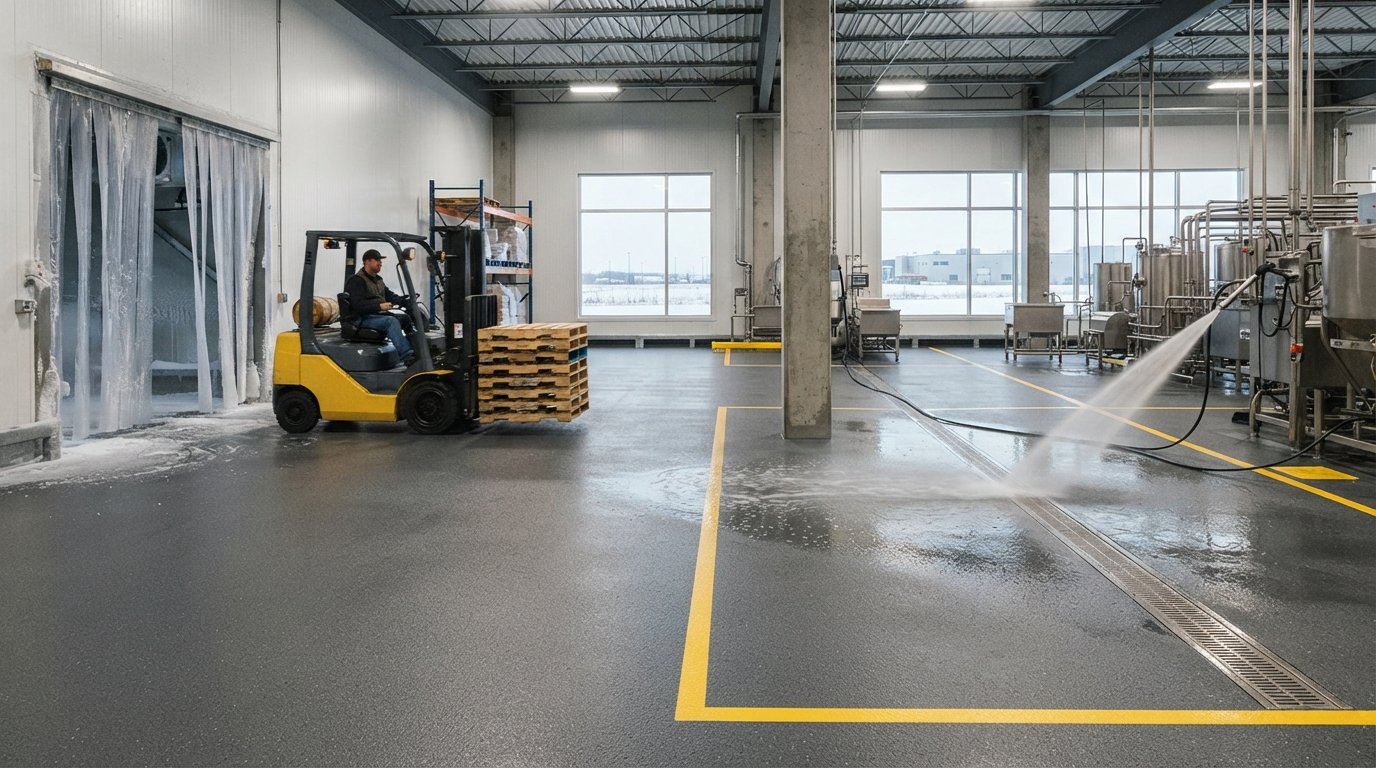
Most Brampton facility managers have seen epoxy peel like tape in wash-down areas or cold storage zones. This occurs because epoxy is rigid and moisture-intolerant, leading to delamination when the environment gets demanding. Urethane cement flooring Brampton installations are the gold standard for food, beverage, and pharmaceutical plants because they thrive where other resins fail. They withstand the brutal impact of heavy forklift traffic and the constant abrasion of industrial carts without cracking or losing their grip on the substrate. It’s the definitive answer for environments where hygiene and durability aren’t optional.
The Science of the Bond
Concrete moves. As temperatures shift, concrete expands and contracts at a specific rate. Urethane cement is engineered with a thermal expansion coefficient that mimics the concrete beneath it. This prevents the floor from “popping” or buckling during thermal shock, such as when a cold storage floor is steam-cleaned or hit with boiling water. The chemical reaction during installation creates a cross-linked molecular bond that fuses the urethane mortar to the concrete substrate, making them virtually inseparable.
Brampton’s Industrial Landscape
Brampton is Canada’s logistics powerhouse. The older industrial slabs found across the GTA often suffer from high moisture vapour transmission (MVT). Since many of these slabs lack modern vapour barriers, rising moisture can blow the cap off a standard epoxy floor, leading to bubbles and blisters. Urethane cement flooring Brampton systems are breathable, allowing moisture vapour to pass through the material without causing delamination. Local humidity and the extreme freeze-thaw cycles of Ontario winters demand a floor that can breathe while remaining completely impermeable to liquids from the surface. For facilities operating 24/7 in Brampton’s manufacturing hub, this level of engineering ensures that your floor remains an asset rather than a recurring repair bill.
Urethane Cement vs. Epoxy: A Technical Comparison for Facility Managers
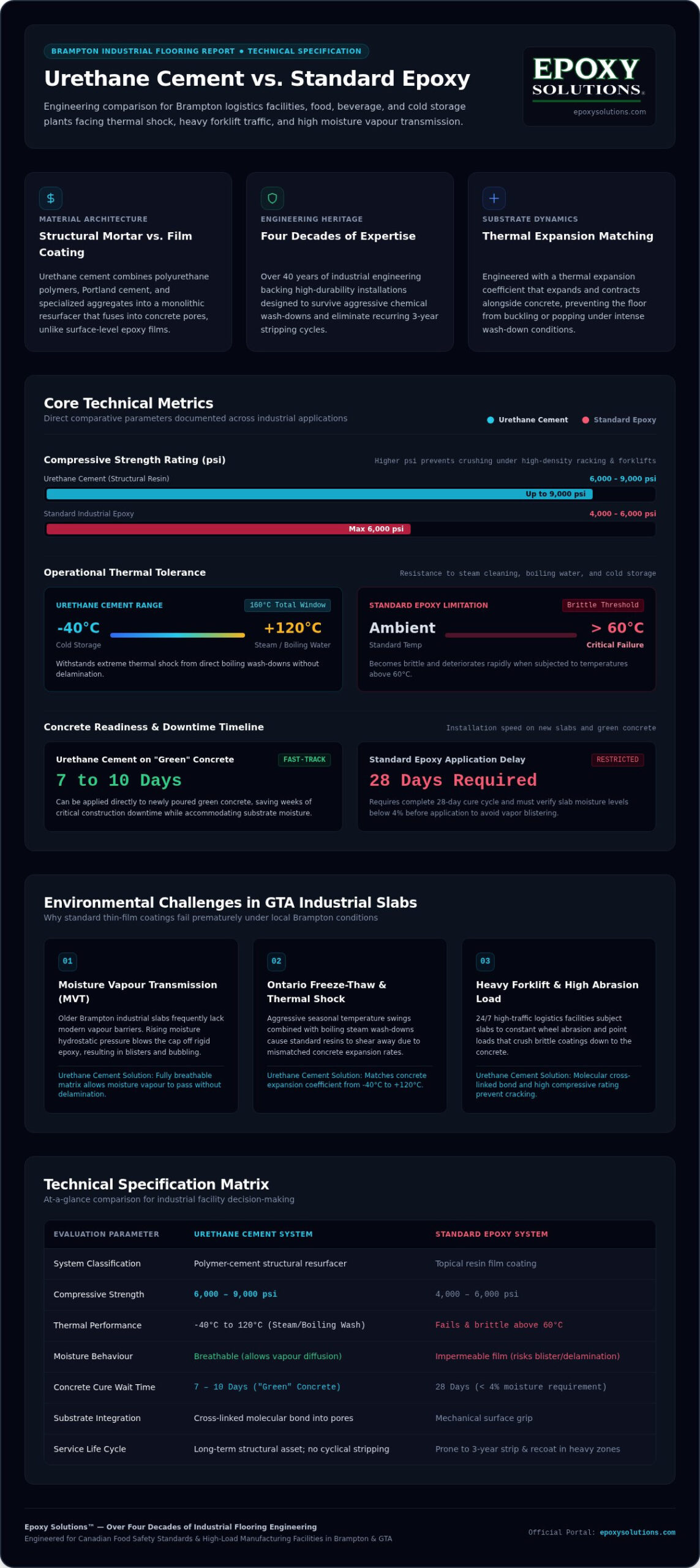
Epoxy is a coating. Urethane cement is a structural solution. While high-build epoxy serves well in light commercial spaces, it often fails in the punishing conditions of a Brampton industrial plant. The primary difference lies in the resin’s ability to handle physical and environmental stress. Urethane cement typically offers a compressive strength between 6,000 and 9,000 psi, which significantly exceeds the 4,000 to 6,000 psi range found in most industrial epoxies. For facilities utilizing heavy forklift traffic or high-density racking, this added strength prevents the floor from crushing or pulverizing under load.
Installation speed is another critical differentiator. Standard epoxy requires concrete to cure for a full 28 days and reach a moisture content below 4% before application. In contrast, urethane cement flooring Brampton projects can often proceed on “green” concrete as early as 7 to 10 days after the pour. This breathability allows the system to manage moisture vapour without delaminating, saving weeks of construction time. While the initial material cost is higher than epoxy, the cost-to-longevity ratio is far superior. You avoid the cycle of stripping and recoating every three years, which is common when epoxy is misapplied in heavy-duty zones.
Thermal Shock and Chemical Resistance
Temperature extremes destroy rigid floors. Most epoxy systems become brittle and fail when exposed to temperatures above 60°C. Urethane cement remains stable from -40°C up to 120°C, making it the only viable choice for facilities using steam cleaning or boiling water wash-downs. This resilience ensures compliance with Ontario Regulation 851 for Industrial Establishments, which mandates safe, liquid-tight surfaces. It also provides superior resistance to organic acids and harsh sanitizers that would otherwise eat through a standard resin finish.
Moisture Vapour Transmission (MVT)
Osmotic blistering is the silent killer of Brampton industrial floors. When moisture trapped in the slab tries to escape, it creates pressure that blows the cap off non-breathable epoxy coatings. Urethane cement acts as a high-performance moisture mitigator, capable of handling upwards of 20 lbs of pressure per 1,000 sq ft. This makes it an essential specification for older GTA slabs lacking modern vapour barriers. To ensure your facility meets these rigorous standards, you should review our industrial flooring specifications to match the right system to your slab’s moisture profile. Choosing the correct material now prevents a total floor failure later. Our team can help you evaluate your current slab conditions to determine if a breathable mortar system is required for your next upgrade.
Selecting the Right Specification: Thickness, Finish, and Safety
Thin coatings are a gamble you’ll lose. While a 20-mil epoxy might look acceptable on day one, it lacks the physical mass to survive the vertical loading and shear forces of a Brampton production line. Specifying urethane cement flooring Brampton requires a shift from thinking about “paint” to thinking about “pavement.” A 1/4-inch mortar system provides the structural depth needed to absorb impact and resist the delamination caused by heavy machinery. If you specify a system that’s too thin for your traffic, you’re merely scheduling a future failure.
Hygiene starts at the wall. Integrated cove bases are a non-negotiable specification for food and pharmaceutical facilities. By creating a seamless, radiused transition from the floor to the wall, you eliminate the 90-degree corners where bacteria, moisture, and debris congregate. This makes the entire room easier to sanitize and ensures your facility remains compliant with Canadian food safety standards.
Thickness Matters: 1/8″ to 3/8″ Systems
The choice between a slurry-broadcast and a trowel-applied mortar depends entirely on your operational profile. For areas with moderate traffic and occasional spills, a 1/8″ to 3/16″ slurry system offers a reliable balance of durability and installation speed. However, if your facility uses steam cleaning or handles heavy forklift loads, a 1/4″ to 3/8″ trowel-applied system is the only professional specification. Greater thickness provides superior insulation against thermal shock, preventing the bond line from shearing when temperatures fluctuate rapidly. Engineering the floor for the specific load-bearing requirements of Brampton warehouses ensures the slab remains protected for the long term.
Slip Resistance and Safety Compliance
Safety is a legal requirement, not a suggestion. In wet processing environments, a smooth floor is a liability that leads to expensive WSIB claims. We utilize quartz or aluminium oxide broadcasts to create a high-traction surface that remains safe even when saturated with oils or water. Following the CCOHS slip and fall prevention guidelines is essential for protecting your workforce and staying within Ontario building codes. To further enhance facility safety, you should integrate clear traffic management patterns. You can see our guide on durable epoxy floor striping for safety zoning to learn how to organize your workflow effectively. Matching the right texture to your specific cleaning protocol ensures the floor stays safe without becoming impossible to sanitize.
The Installation Reality: Preparation and Local Brampton Compliance
Preparation determines longevity. Most floor failures occur because the contractor treated the installation like a painting project rather than an engineering task. Mechanical surface preparation, specifically diamond grinding or shot blasting, is non-negotiable for achieving the required Concrete Surface Profile (CSP). Without this mechanical tooth, the resin cannot fuse with the slab. If a contractor suggests chemical etching as a shortcut, they are setting your facility up for eventual delamination.
Downtime is the enemy of profit. In Brampton’s 24/7 manufacturing corridor, shutting down a production line for a week is rarely an option. Rapid-cure urethane cement flooring Brampton systems allow for foot traffic in as little as six hours and full operational loading within a day. This efficiency requires precise climate control. High humidity or extreme temperatures during the curing phase can compromise the chemical cross-linking of the polymers. We meticulously manage these environmental variables to ensure the floor reaches its full design strength without delay.
Professional Surface Preparation
Achieving a CSP of 4 or 5 is the baseline for heavy-duty mortar applications. We aggressively repair cracks and spalled joints using high-modulus resins before the main application to ensure a monolithic surface. Chemical etching is an inferior alternative to mechanical shot blasting because it fails to open the concrete pores deeply enough to create a permanent mechanical bond. This technical step is where the 45-year legacy of a veteran installer becomes your greatest asset in preventing premature floor failure.
Regulatory and Hygiene Standards
Compliance is mandatory. For pharmaceutical Grade A environments or food processing plants, the floor must be completely non-porous and seamless to meet Safe Food for Canadians Regulations (SFCR). While some marketing suggests antimicrobial additives are a magic bullet, they are no substitute for a properly sealed, easy-to-clean surface. Our systems are engineered to meet Brampton-specific zoning and safety bylaws, ensuring your facility passes every health inspection. If you want to avoid the risks of a failed audit, consult with our industrial flooring experts to specify a compliant system that meets all provincial and federal standards.
Engineering Longevity: Why Epoxy Solutions™ is the Brampton Choice
Bad floors are a drain on your bottom line. Since 1981, Epoxy Solutions™ has engineered high-performance resinous floors that stand up to the most aggressive industrial environments. We aren’t just another contractor; we are the authoritative expert fixers who are frequently called in to resolve the failures left behind by less experienced crews. When it comes to urethane cement flooring Brampton facilities require a partner that understands the chemistry of the bond and the physics of the load. We prioritize performance over the lowest bid because a cheap floor that fails in two years is the most expensive mistake a facility manager can make. Our 45-year legacy is built on setting the benchmark for industrial reliability.
The Premium Advantage
Technical accuracy is our baseline. Our commitment to meticulous execution ensures that every component of your floor is installed to exact specifications, regardless of the environmental challenges. By choosing premium materials specifically engineered for the Canadian climate, we significantly reduce your total cost of ownership. While some might consider alternative finishes for lighter-duty areas, you should compare polished concrete vs epoxy flooring cost to understand which system truly meets your facility’s long-term durability needs. We design for decades of performance, ensuring your investment remains a structural asset rather than a recurring maintenance liability.
Your Brampton Flooring Partner
The Brampton industrial corridor is our home turf. We understand the specific challenges of local GTA slabs, from high moisture vapour transmission to the impact of extreme winter freeze-thaw cycles on concrete integrity. Our reliability is proven in heavy-duty environments across North America, where we have demonstrated an extreme capability to perform under pressure in the most difficult conditions. We don’t just follow industry standards; we define them through a rugged, no-nonsense approach to quality and craftsmanship. Contact Epoxy Solutions™ for a professional consultation and secure a long-term solution that eliminates recurring maintenance once and for all.
Secure Your Facility’s Operational Future
Industrial floors fail when they’re under-specified for the environment. You’ve seen the technical evidence: urethane cement isn’t just a coating; it’s a structural necessity for Brampton’s heavy-duty environments. Choosing the right system means matching mortar thickness to your specific traffic patterns and ensuring your slab can breathe through high moisture vapour transmission. By prioritizing long-term performance over the lowest initial bid, you eliminate the cycle of recurring maintenance and protect your bottom line. Investing in urethane cement flooring Brampton ensures your facility meets strict safety standards while surviving the most brutal thermal shocks and chemical exposures.
Epoxy Solutions™ has served Brampton and the GTA since 1981. We are specialists in high-performance industrial flooring engineered for extreme durability and chemical resistance. Our team provides the technical accuracy required to install systems that last for decades, even in conditions where other materials have failed. Don’t settle for a temporary fix when you can have a permanent solution. Request a Technical Specification and Quote from Epoxy Solutions™ today. Let’s build a floor that works as hard as your operation does.
Frequently Asked Questions
How long does urethane cement flooring take to cure in a Brampton facility?
Urethane cement systems are engineered for rapid turnaround to minimize facility downtime. In a typical climate-controlled Brampton facility, the floor is usually ready for foot traffic within 6 to 8 hours of application. Full operational loading, including heavy forklift traffic, can often resume within 12 to 24 hours. These timelines vary based on the specific resin chemistry and the ambient humidity levels present during the curing phase of the project.
Is urethane cement flooring really better than standard epoxy?
Urethane cement is a superior structural upgrade for heavy-duty industrial environments. While standard epoxy is a rigid coating that can peel under stress, urethane mortar provides a breathable bond that resists osmotic blistering. It offers significantly higher compressive strength and handles extreme temperature fluctuations that would cause epoxy to delaminate. For urethane cement flooring Brampton installations, the long-term ROI is far higher because you avoid the frequent repairs associated with cheaper, non-breathable resin systems.
Can urethane cement be applied over old, contaminated concrete?
Successful application over old concrete is possible only after aggressive mechanical surface preparation. We utilize shot blasting or diamond grinding to remove surface contaminants and achieve a Concrete Surface Profile of 4 or 5. If the slab is heavily saturated with oils or chemicals, specialized degreasers and moisture-tolerant primers are required to ensure a permanent bond. We never apply over loose or unsound substrates, as the integrity of the finish depends on the concrete beneath it.
What is the typical lifespan of a urethane cement floor in a high-traffic plant?
A professionally specified urethane cement system typically lasts between 10 and 15 years in a high-traffic manufacturing environment. This lifespan depends heavily on the thickness of the system and the frequency of heavy impact or chemical exposure. While thin coatings might fail within 3 years, a 1/4-inch mortar system provides the physical mass needed to absorb mechanical energy and resist abrasion. Proper maintenance and choosing the correct specification for your load requirements are essential for maximizing longevity.
Does urethane cement flooring meet CFIA and food safety standards?
Yes, these systems are specifically designed to exceed CFIA and Safe Food for Canadians Regulations (SFCR) standards. The seamless, non-porous finish prevents the growth of bacteria and pathogens in cracks or joints. Because the material is liquid-tight and can be integrated with cove bases, it creates a completely washable environment. This makes it the preferred choice for pharmaceutical Grade A spaces and food processing plants across the GTA that require rigorous hygiene compliance.
How do I clean and maintain my urethane cement floor to ensure longevity?
Maintenance is straightforward but must be consistent to preserve the floor’s slip resistance. You can utilize high-pressure power washing or steam cleaning because the material is impervious to thermal shock. For daily cleaning, use neutral detergents and avoid highly abrasive tools that could wear down the aggregate profile over time. Removing grit and debris promptly prevents surface scratching, ensuring the floor remains safe and visually professional throughout its entire operational life in your facility.
What is the difference between urethane mortar and urethane topcoats?
Urethane mortar is a high-build system, usually 1/8″ to 3/8″ thick, that provides structural durability and impact resistance. Urethane topcoats are thin-film sealers, typically measured in mils, used primarily for UV resistance or aesthetic finishing. A topcoat alone cannot handle the thermal shock or heavy forklift traffic that a full mortar system survives. Understanding this distinction is critical when specifying urethane cement flooring Brampton to ensure the system meets your facility’s actual physical demands.
Can urethane cement flooring handle thermal shock from steam cleaning?
Thermal shock resistance is the primary advantage of this flooring technology. Urethane cement is engineered with a thermal expansion coefficient that closely matches the concrete slab. This allows the floor to expand and contract at the same rate as the substrate when exposed to boiling water or steam cleaning. Standard resins would crack or buckle under these conditions, but urethane mortar remains fused to the concrete, preventing delamination and maintaining a liquid-tight seal.