
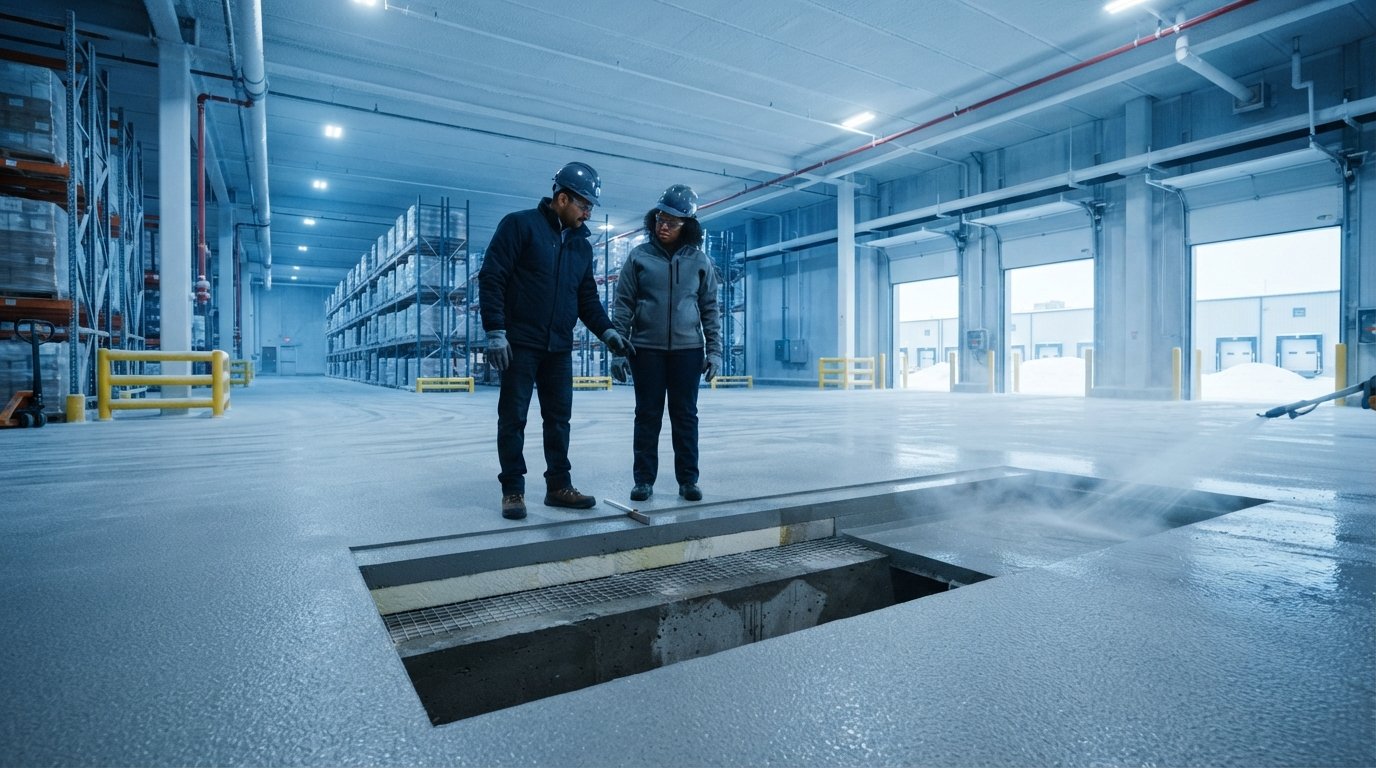
A freezer floor doesn’t fail just because it’s cold. It fails because it cannot handle the violent expansion and contraction caused by thermal shock. You’ve likely seen the results: hairline cracks that quickly turn into deep fissures, or resinous layers that peel away after a single hot-water washdown. Selecting the right industrial flooring for cold storage is a high-stakes decision where the wrong specification leads to frost heaving and costly production shutdowns.
We understand that downtime isn’t an option for your facility. You need a surface that meets strict CFIA requirements while standing up to the brutal reality of sub-zero environments. This guide provides the technical roadmap to specifying and installing high-performance urethane mortars designed for extreme thermal cycling. We will also cover innovative installation methods that allow for floor repairs without turning off the refrigeration, ensuring your facility remains operational, safe, and compliant for the long term. This is about more than aesthetics; it’s about protecting your critical infrastructure from the ground up.
Key Takeaways
- Understand why standard epoxy fails in sub-zero environments and how to account for the Coefficient of Thermal Expansion to prevent delamination.
- Compare MMA, urethane mortars, and polyaspartic systems to identify which resin technology best suits your facility’s specific temperature and odour requirements.
- Learn how to specify industrial flooring for cold storage that can be installed without decommissioning freezers, avoiding costly production downtime.
- Ensure long-term CFIA compliance by choosing seamless systems that withstand the extreme thermal shock of hot-water washdowns without cracking.
- Discover how tailored specifications from industry veterans can resolve persistent floor heaving and peeling in high-traffic GTA cold storage centres.
The Failure of Standard Epoxy in Cold Storage Environments
Standard epoxy is a liability. Selecting the wrong industrial flooring for cold storage often starts with the misuse of general-purpose epoxy coatings that aren’t engineered for sub-zero temperatures. It is not a matter of if these systems will fail in a freezer, but when. Most standard resinous coatings lose their necessary flexibility once temperatures drop below 5°C. When this happens, the material reaches its glass transition temperature. This is the critical point where the polymer shifts from being relatively resilient to being as brittle as glass. If you study epoxy resin properties and limitations, you’ll see that these materials simply cannot withstand the aggressive thermal stresses found in a Canadian cold storage facility.
The result of this brittleness is inevitable delamination. Because the coating cannot move in tandem with the concrete slab during temperature shifts, it shears off at the bond line. This leaves the underlying concrete exposed and vulnerable to physical wear and chemical saturation. When choosing industrial flooring for cold storage, relying on standard epoxy is a recipe for expensive, long-term failure that compromises your entire operation. These systems are rigid, and in a environment that demands constant movement, rigidity leads to ruin.
Why Brittle Floors Lead to Structural Concrete Damage
Cracks in a cold room floor are gateways for disaster. They allow moisture from condensation or routine washdowns to penetrate deep into the substrate. Once water reaches the area beneath the slab and freezes, it expands with immense force. This triggers the frost heave cycle, a destructive process that can physically lift sections of the floor and cause massive structural cracking. In facilities across the GTA, where high-volume traffic is the norm, this structural degradation can halt operations entirely. Beyond the structural damage, these heaved sections create dangerous transitions for forklift operators. A pallet jack hitting a 5mm lip at speed isn’t just a maintenance issue; it’s a workplace safety hazard that leads to tipped loads and operator injury.
The High Cost of Frequent Patching
Attempting to fix these issues with “off-the-shelf” kits is a waste of capital. These quick-fix patches rarely bond to frozen concrete and often fail within weeks because they cannot cure in the cold. You’re then forced into a cycle of constant repairs that drive up labour costs and cause unnecessary production downtime. Peeling floors are also a magnet for microbial growth. In any food-grade facility, these defects make it impossible to meet CFIA compliance standards. A seamless, high-performance system is the only way to ensure your facility remains sanitary and operational without the constant need for intervention.
Understanding Thermal Shock: The Physics of Freezer Flooring
Thermal shock is the rapid, extreme change in temperature that occurs during routine washdowns. In a typical Canadian cold storage facility, a floor might sit at -20°C before being blasted with +80°C water for sanitation. This 100-degree delta happens in seconds. For industrial flooring for cold storage, this isn’t just a surface issue; it’s a structural challenge that tests the molecular bond of the resin to the concrete. If the system isn’t engineered to handle this movement, the floor will fail immediately.
The Coefficient of Thermal Expansion (CTE) is the measure of how much a material expands or contracts per degree of temperature change. Most floor coatings fail because their CTE does not match the concrete substrate. When the temperature spikes, the resin tries to expand while the concrete remains relatively stable. This creates a physical tug-of-war where the coating is almost always the loser. Matching these expansion rates is the only way to ensure the floor stays attached to the building’s foundation.
The Expansion Gap Problem
When resin expands faster than the concrete beneath it, immense shear stress develops at the bond line. This stress physically tears the coating away from the slab. Without specialized joint treatments to manage these movements, the floor will eventually buckle or delaminate. It’s essential to address these transitions during the design phase to prevent catastrophic failure. If your current floor shows signs of lifting at the joints, it’s time to consult with a specialist about high-performance alternatives that actually bond to the substrate.
Urethane Mortar: The Engineered Solution
Urethane mortar is the industry standard because its chemical structure allows it to remain flexible even in sub-zero temperatures. Unlike rigid epoxies, urethane mortar has a CTE that closely mimics that of concrete, allowing the two materials to move in unison. This synchronicity prevents the bond failure that plagues lower-tier systems. To survive thermal shock, a thickness of 6mm to 9mm is required to provide the necessary thermal mass and durability. The Coefficient of Thermal Expansion is a numerical value representing the rate at which a material changes in length or volume in response to temperature fluctuations, and matching this value between the floor and the slab is critical for Canadian facility longevity.
Seamless systems are also vital for meeting FDA cold storage facility compliance requirements and CFIA standards. Without seams, there is no place for bacteria to hide when the floor expands and contracts. This ensures a hygienic environment even under the most demanding thermal cycles found in GTA food processing centres.
Comparing Cold Storage Systems: MMA vs. Urethane vs. Polyaspartic
Selecting the correct industrial flooring for cold storage requires a precise balance between installation speed and long-term mechanical resistance. You cannot apply a warehouse-grade epoxy in a freezer and expect it to survive. Instead, you must choose between three primary resin technologies: Methyl Methacrylate (MMA), Urethane Mortar, and Polyaspartic. Each system serves a distinct purpose, and the wrong choice often leads to premature delamination or contamination of food products due to odour transfer.
Performance varies wildly across these categories. While cure times are a priority for minimizing downtime, you must also consider the temperature thresholds and impact resistance required for heavy forklift traffic. In high-volume GTA distribution centres, the cost-to-performance ratio is determined by how many years the floor remains seamless and CFIA-compliant without requiring a return visit for repairs.
Methyl Methacrylate (MMA): The Sub-Zero Speed King
MMA is built for speed. It is one of the few resins capable of curing at temperatures as low as -30°C, making it the definitive choice for rapid repairs in active blast freezers. Most MMA systems reach full mechanical and chemical cure within one hour of application. This speed allows you to repair a high-traffic aisle during a single shift change without ever turning off the refrigeration units.
The trade-off is the smell. MMA has an exceptionally high VOC profile and a pungent, solvent-like odour that can easily taint open food products. If you are operating a facility with unsealed inventory, the ventilation requirements become a massive logistical hurdle. We typically reserve MMA for specific, high-speed repair scenarios where the refrigeration cannot be compromised, rather than as a total facility solution.
Polyaspartic Coatings: Versatility and UV Stability
Polyaspartic systems offer a middle ground for facilities that need fast return-to-service times with significantly better odour control than MMA. These coatings cure quickly even in cold temperatures, though they generally require the substrate to be at least -10°C or higher for optimal bonding. They are also highly resistant to UV yellowing, which is a common issue near loading docks and entry points where sunlight is prevalent.
However, polyaspartics have limitations. They are typically applied as thin-film coatings, which means they lack the heavy-duty impact resistance and thermal mass of a 9mm urethane mortar. We often specify polyaspartic systems for cold storage loading docks and refrigerated staging areas where traffic is high but the extreme thermal shock of a deep-freeze washdown is less frequent. For the main freezer slab, the engineered durability of a urethane mortar remains the benchmark for industrial flooring for cold storage in the Canadian market.
- MMA: Best for -30°C repairs; high odour; 1-hour cure.
- Polyaspartic: Best for loading docks; low odour; 4-6 hour cure.
- Urethane Mortar: Best for main freezer floors; handles extreme thermal shock; 8-12 hour cure.

Installation Logistics: Curing Floors Without the Downtime
Shutting down a freezer for a week is a financial catastrophe. Most facility managers assume they must empty the room, decommission the refrigeration, and wait days for the slab to reach room temperature before any work can begin. This is a choice, not a requirement. By utilizing a “Chiller-On” strategy, we install industrial flooring for cold storage while the temperature remains sub-zero. This approach uses specialized resins, such as MMA or specific low-temperature urethane mortars, that are chemically engineered to reach full cure in environments where traditional products would never harden.
The primary challenge in these environments is moisture management. When warm air hits a cold slab during the installation window, it creates condensation. This dew point must be monitored with surgical precision. Any moisture trapped beneath the resin will turn to ice, expand, and blow the coating off the floor within weeks. We use advanced climate control and monitoring tools to ensure the substrate remains dry throughout the application process.
Surface Prep in Freezers
Concrete must be dry and “open” to accept a resinous bond. In cold storage, the biggest enemy is ice within the pores of the concrete. If moisture freezes inside the slab, it creates a bond-breaking layer that causes immediate delamination. We prioritize mechanical profiling to ensure the resin has a physical “tooth” to grab onto. Shot-blasting is usually the preferred method in large freezer slabs because it aggressively removes surface paste and exposes the aggregate without creating the heat that diamond grinding can produce, which risks triggering condensation. In food-sensitive GTA facilities, we utilize high-performance vacuum systems to maintain total dust control and protect inventory.
Phased Installation for Active Facilities
You don’t have to sacrifice revenue to fix your floors. We specialize in phased installations, where we tackle high-traffic aisles or specific bays during scheduled downtime or off-peak shifts. By using fast-cure resins, we can often return a floor to full forklift service in as little as four to six hours. This ensures that your supply chain remains moving without the need for a total facility shutdown.
Safety is the most critical factor during these rapid restarts. We integrate precision line marking services immediately after the floor cures to ensure clear traffic flow and pedestrian safety. Managing these logistics requires a seasoned team that understands the physiological strain of working in -20°C conditions and the technical precision needed to manage vapour drive and condensation windows. If your facility cannot afford a week of lost revenue, contact Epoxy Solutions™ today to discuss a tailored “Chiller-On” installation plan.
Custom Cold Storage Specifications by Epoxy Solutions™
Standardized kits are for amateurs. In the high-stakes world of cold chain logistics, a generic specification is a liability that leads to delamination and safety violations. We approach every facility in Toronto, Mississauga, and Brampton with the mindset of a seasoned industry veteran. Our process begins with a direct, no-nonsense assessment of your specific temperature cycles and traffic patterns. We don’t provide off-the-shelf solutions; we engineer tailored systems that adhere to the most rigorous industrial flooring specifications for 2026.
Local expertise matters for logistics. Operating across the GTA requires a deep understanding of regional building codes and the specific environmental pressures of the Canadian climate. We coordinate every aspect of the installation to ensure your facility remains operational. This includes the seamless integration of precision line marking services. These markings aren’t just paint; they are high-performance resinous stripes designed to bond permanently with your industrial flooring for cold storage, ensuring long-term safety and traffic organization.
CFIA Compliance and Food Safety Standards
Sanitation is the cornerstone of food-grade industrial flooring for cold storage. We engineer floors that meet the most stringent Canadian sanitation audits without compromise. This involves more than just a smooth surface. We focus on critical detail work, such as integral cove bases and seamless transitions between different zones. These features eliminate bacteria harbourage points where pathogens could otherwise thrive during temperature swings. By prioritizing these high-performance, long-term specifications, we ensure your facility remains audit-ready and safe for food handling at all times.
The Epoxy Solutions™ Advantage in the GTA
Reliability is earned. Since 1981, Epoxy Solutions™ has set the standard for resinous flooring across North America. We have seen every possible failure mode in cold storage environments and have developed the specific expertise required to resolve them. Our personality is that of the expert fixer. We step in where others have failed, providing a grounded, matter-of-fact delivery that prioritizes durability over the lowest price point. We take deep-seated pride in our craftsmanship and the longevity of our installations. If you’re tired of patching brittle floors and dealing with constant downtime, it’s time for a professional solution. Request a professional specification for your cold storage facility and secure the future of your infrastructure.
Secure the Future of Your Cold Chain Infrastructure
Standard epoxy is a liability in sub-zero temperatures. You need a system that survives the violent tug-of-war between the slab and the resin during thermal cycles. We’ve proven our performance in the most demanding GTA industrial environments since 1981. By specifying specialized urethane mortar and MMA systems, you ensure a sub-zero cure that maintains structural integrity without the need for a total facility shutdown. This is how you protect your investment and maintain strict CFIA compliance.
Selecting the right industrial flooring for cold storage isn’t just about durability; it’s about operational continuity. Our tailored approach eliminates the risks of frost heaving and delamination that plague off-the-shelf products. Don’t wait for the next washdown to cause a catastrophic failure. Get a Professional Cold Storage Flooring Specification and realize the benefits of a standard-setting floor. Your facility deserves a surface that remains resilient under pressure. We are ready to help you set a new standard for safety and performance in your cold storage centre.
Frequently Asked Questions
Can you install epoxy flooring while the freezer is still running?
Yes, but not with standard epoxy systems. You must use specialized resins like Methyl Methacrylate (MMA) or specific low-temperature urethane mortars that are chemically engineered to cure in sub-zero conditions. Standard industrial flooring for cold storage often requires the room to be warmed; however, our “Chiller-On” strategy allows for installation at temperatures as low as -30°C. This prevents the massive revenue loss associated with decommissioning refrigeration units in busy GTA distribution centres.
What is the best flooring for a food-grade cold storage facility in Canada?
Urethane mortar is the industry benchmark for food-grade facilities across Canada. It provides a seamless, non-porous surface that meets strict CFIA sanitation requirements while resisting the extreme thermal cycles common in Mississauga and Brampton food processing plants. Unlike standard coatings, these high-performance mortars match the thermal expansion of concrete, preventing the cracks and peeling that lead to bacterial harbourage. It is a premium solution designed for long-term compliance and durability.
How long does MMA flooring take to cure at sub-zero temperatures?
MMA flooring typically reaches full mechanical and chemical cure within one hour of application, even at temperatures reaching -30°C. This rapid return-to-service is why many facility managers in Toronto choose it for high-traffic aisle repairs. While the speed is unmatched, the installation requires expert handling due to high VOC levels. This fast cure cycle allows your logistics team to resume forklift operations during a single shift change, effectively minimizing operational downtime.
Why is my cold storage floor peeling near the loading dock doors?
Peeling near loading docks is usually caused by vapour drive and extreme temperature fluctuations. When dock doors open in Milton or Vaughan, warm, humid air hits the cold floor, creating condensation that standard resins cannot handle. This cycle of thermal shock weakens the bond between the coating and the concrete. Without a tailored industrial flooring for cold storage specification that accounts for these specific environmental pressures, delamination at the threshold is inevitable.
What is thermal shock, and how does it affect resinous flooring?
Thermal shock is the rapid expansion or contraction of flooring materials caused by sudden temperature changes, such as hot-water washdowns in a -20°C freezer. If the resin’s coefficient of thermal expansion does not match the concrete slab, the materials pull apart. This leads to immediate cracking or delamination at the bond line. We specify urethane mortars because they move in unison with the concrete, absorbing the stress of these violent thermal cycles without failing.
Are urethane mortars more expensive than standard industrial epoxy?
Urethane mortars typically require a higher initial investment than standard epoxy coatings due to their advanced chemistry and increased thickness. However, the long-term cost is significantly lower. Standard epoxy often fails within months in cold environments, leading to repeated repair costs and production downtime. In demanding North American climates, a premium urethane mortar provides a much better return on investment by lasting years rather than months, ultimately reducing your total maintenance budget.
How do you handle floor joints in a cold storage environment?
Joints in cold storage must be treated with specialized, low-temperature polyurea or flexible joint fillers that stay resilient in the cold. Standard rigid fillers will crack as the slab contracts. We ensure all joints are properly cleaned and filled with materials engineered for sub-zero flexibility. This prevents moisture from penetrating the slab and causing frost heaving, which is a major concern for structural integrity in GTA industrial facilities.
Does cold storage flooring require special slip-resistance additives?
Yes, slip resistance is a critical safety requirement due to the frequent presence of frost, ice, or condensation on freezer floors. We integrate specific aggregate blends into the resin to provide a tailored texture that ensures operator safety without compromising cleanability. In high-traffic areas across Mississauga and Brampton, these additives are essential for preventing forklift skidding and pedestrian slips, especially in zones where temperature transitions create slick surface conditions.