
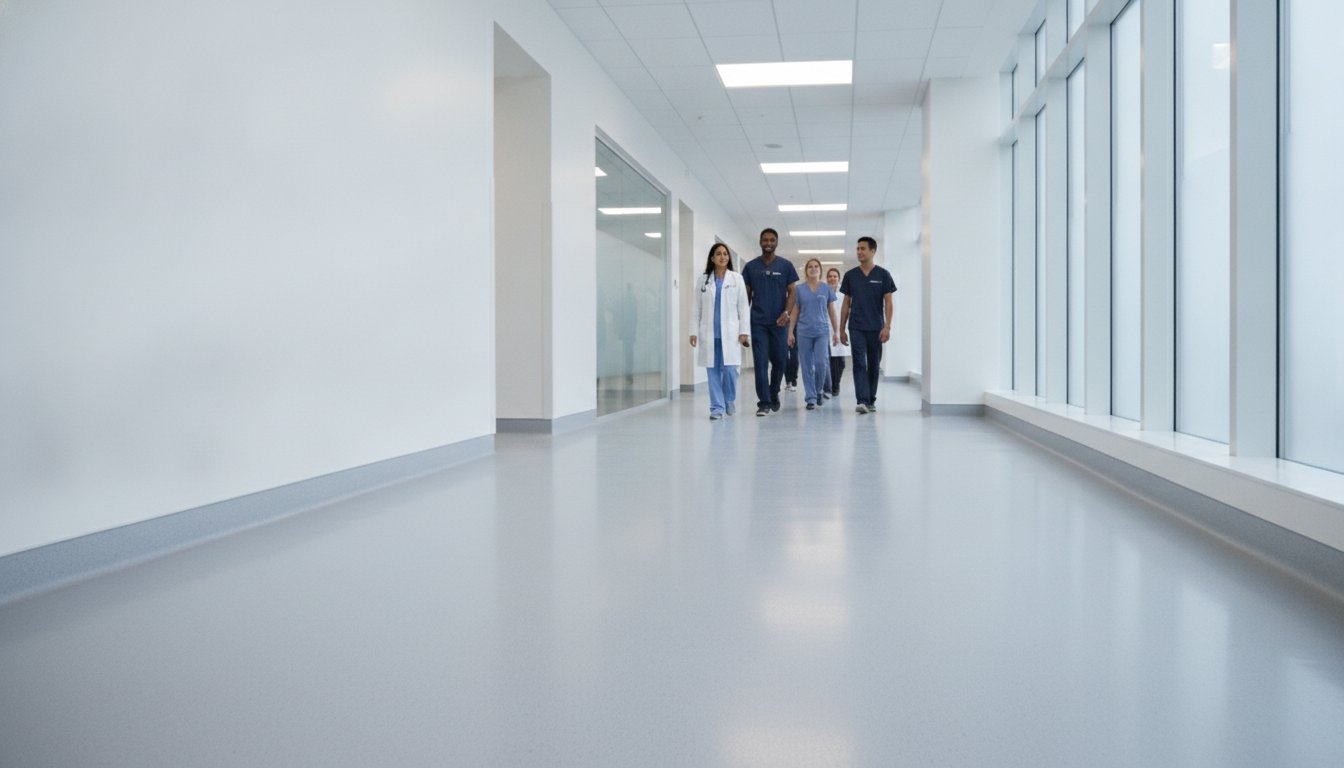
In a clinical environment, a floor isn’t just a surface; it’s a medical device. If your Milton medical facility still relies on traditional tile or heat-welded vinyl, you’re likely battling cracking grout lines and failing joints that harbour dangerous bacteria. These structural failures don’t just look unprofessional; they compromise your ability to pass Halton Region health inspections and meet the rigorous CSA Z8000 standards. Selecting the correct seamless flooring for healthcare Milton clinics is a critical decision for patient safety and operational longevity.
We understand the pressure of maintaining a sterile environment while managing heavy medical equipment traffic that destroys inferior surfaces. This 2026 guide explores how clinical-grade resinous flooring systems deliver a 100% non-porous surface that resists hospital-grade disinfectants and lasts over two decades. You’ll discover the technical specifications required for provincial compliance, the benefits of silver-ion antimicrobial additives, and why meticulous mechanical surface preparation is the only way to ensure your investment doesn’t peel or fail prematurely. We’ll also examine how these systems eliminate the dirt-trapping joints that lead to infection control liabilities.
Key Takeaways
- Understand why monolithic resinous systems are mandatory for 2026 IPAC compliance by eliminating bacteria-harbouring grout lines and failing joints.
- Identify the specific chemical compositions of seamless flooring for healthcare Milton facilities that withstand harsh sporicidal cleaners without surface degradation.
- Learn to navigate the 2026 installation checklist, focusing on critical ASTM moisture testing and mechanical surface preparation to prevent premature floor failure.
- Compare high-build epoxy, polyurethane, and MMA systems to ensure a 20-year lifespan under the constant traffic of heavy medical equipment and stretchers.
- Realize the importance of integral sanitary coving and zero-VOC formulations for meeting Halton Region health inspections and CSA Z8000 design standards.
Why Seamless Flooring is Mandatory for Milton Healthcare Facilities
Hygiene is non-negotiable. In a medical setting, your floor is either a sterile barrier or a biological liability. Traditional flooring choices like Vinyl Composition Tile (VCT) or ceramic tile rely on seams and grout lines that eventually fail. Once these joints crack or curl, they become inaccessible breeding grounds for pathogens. Seamless flooring for healthcare Milton facilities eliminates these risks by creating a monolithic, non-porous surface that bonds directly to the concrete substrate. This system utilizes advanced epoxy resin chemistry to ensure there are no gaps where bacteria can hide. It’s a high-build solution designed for environments where “clean” is the absolute minimum standard.
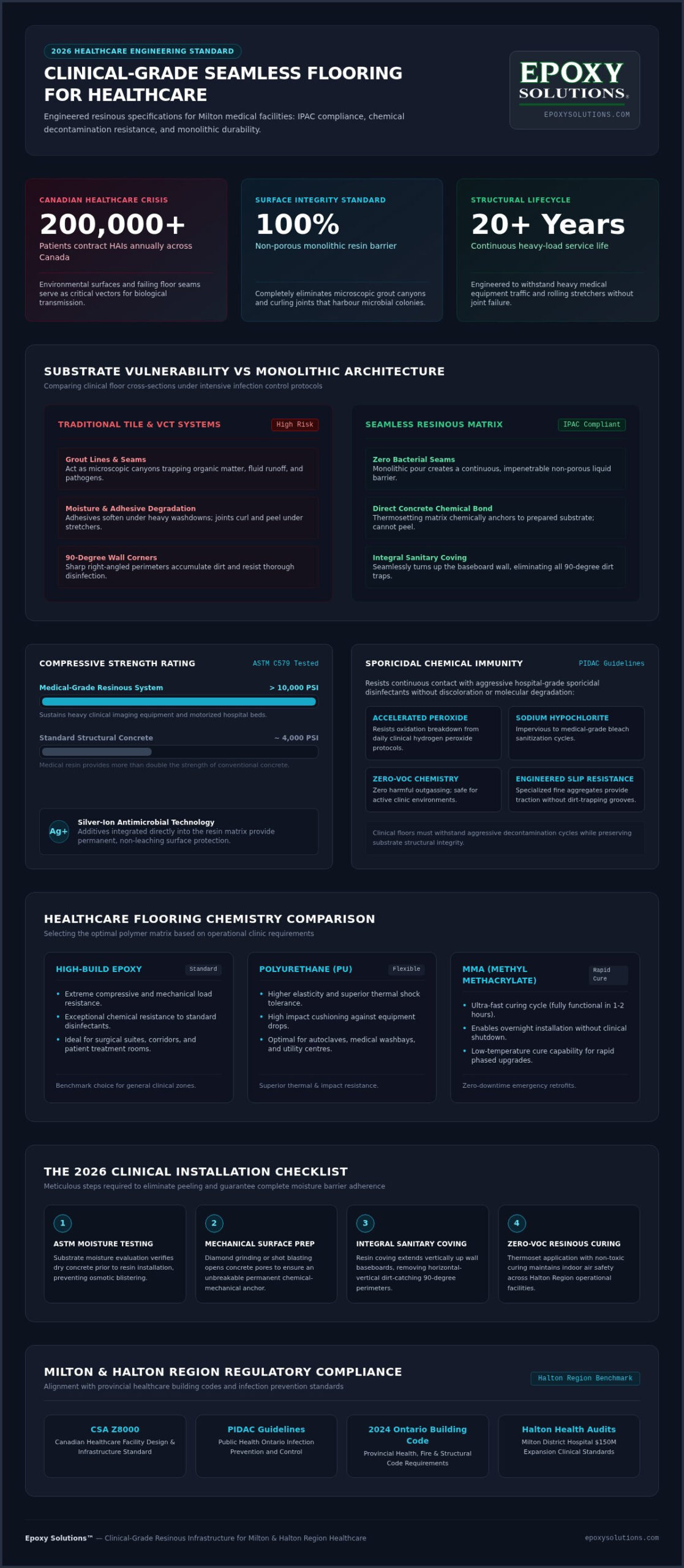
The recent growth in the Halton Region, specifically the $150M expansion at Milton District Hospital, has set a new benchmark for local clinical standards. Facility managers are no longer just looking for a floor; they’re looking for an infection control system. A poured resinous floor provides a continuous surface from wall to wall, often including integral sanitary coving that extends up the baseboard. This configuration removes the 90-degree corner where dust and microbes accumulate, making the entire room easier to disinfect with hospital-grade sporicidal cleaners.
The Infection Control Crisis in Porous Flooring
Porous floors are a primary failure point in clinical settings. Every grout line in a tiled floor is a microscopic canyon where moisture and organic matter settle. Over time, these areas colonize pathogens that are resistant to standard mopping protocols. In Canada, more than 200,000 patients contract a Healthcare-Associated Infection (HAI) annually, and environmental surfaces are a critical factor in transmission. Standard commercial flooring isn’t built to withstand the rigorous scrubbing and chemical exposure required in a 2026 medical environment. When VCT seams fail under the weight of heavy imaging equipment or rolling stretchers, the exposed adhesive becomes a magnet for bacteria. A seamless resinous system prevents this degradation entirely.
Regulatory Compliance in the Halton Region
Halton Region health inspections are becoming increasingly stringent regarding surface decontaminability. Public Health Ontario’s PIDAC guidelines are clear: if a surface cannot be effectively cleaned, it shouldn’t be in a clinical zone. Seamless systems simplify the audit process by providing a visible, impenetrable barrier that meets CSA Z8000 standards. These installations must follow strict industrial flooring specifications to ensure they can handle the compressive loads of medical machinery without micro-fracturing. By choosing a monolithic resinous system, Milton clinics ensure they remain compliant with the 2024 Ontario Building Code while providing a safe, sterile environment for both staff and patients.
Resinous Flooring Systems: Engineering Hygiene and Durability
Engineering matters. High-performance resinous flooring isn’t a simple coat of paint; it’s a sophisticated polymer matrix designed to function as a structural component of your facility. These systems utilize liquid-applied thermosetting resins that cure into a solid, monolithic shield. This dense, non-porous surface is the foundation of effective seamless flooring for healthcare Milton clinics. To bolster this barrier, we integrate silver-ion antimicrobial technology directly into the resin matrix, ensuring that the protection is permanent and won’t leach out over time. According to the Public Health Ontario environmental cleaning guidelines, clinical surfaces must withstand aggressive decontamination without structural degradation. Our systems are specifically formulated to resist the corrosive effects of accelerated hydrogen peroxide and sodium hypochlorite.
Safety must coexist with cleanability. We engineer slip-resistance into the finish by using fine, specialized aggregates that provide necessary traction for staff and patients without creating deep textures that trap dirt. These medical-grade systems provide compressive strengths exceeding 10,000 psi (ASTM C579), which is more than double the strength of standard structural concrete. This ensures the floor won’t crack or micro-fracture under the immense weight of rolling diagnostic equipment or patient stretchers, maintaining a sterile environment for decades.
High-Build Epoxy vs. Urethane Mortar
Standard patient rooms and high-traffic corridors usually rely on high-build epoxy systems for their exceptional bond strength and clarity. However, specialized zones like sterile reprocessing or central kitchens face thermal shock from frequent steam cleaning. These areas require urethane mortar, which possesses a coefficient of thermal expansion similar to concrete, preventing delamination. Engineering high-performance seamless flooring for healthcare Milton facilities also requires addressing electronic interference. For MRI or CT suites, installing anti-static flooring is mandatory to protect sensitive medical electronics from electrostatic discharge.
Thermal and Chemical Resilience
Durability in a hospital is defined by chemical resilience. Standard commercial coatings often fail when exposed to the 24/7 sterilization cycles required in 2026. High-performance resins maintain their molecular bond even under high-pressure washing and harsh sporicidal cleaners. In sun-drenched areas like main lobbies or waiting rooms, standard resins can yellow and become brittle due to UV exposure. Consulting our UV resistant epoxy guide explains how aliphatic coatings maintain their colour and structural integrity in these environments. If you’re designing a new clinical space or upgrading an existing facility, speaking with an expert flooring consultant can ensure you select the correct chemistry for your specific operational needs.
Comparing Healthcare Flooring Chemistries for Milton Clinics
Chemistry dictates performance. Selecting the right seamless flooring for healthcare Milton facilities requires a technical understanding of how different resins react to clinical stressors. Methyl Methacrylate (MMA) is the gold standard for rapid turnaround. It achieves a full chemical cure in just one to two hours, allowing surgical suites to return to service the same day. However, MMA carries a distinct odour during application that requires specialized negative-air ventilation. In contrast, 100% solids epoxy systems are virtually odourless and provide the high-build thickness necessary for heavy traffic areas. Adhering to CDC guidelines for environmental infection control means selecting a material that won’t degrade under constant exposure to harsh sporicidal disinfectants.
Tailored specifications beat one-size-fits-all products. Every zone in a medical facility has unique technical demands. While polyurethane systems offer superior impact resistance and flexibility, they might be overkill for a standard administrative wing. When comparing these chemistries, facility managers must balance cure times against VOC limits and chemical resistance profiles to ensure long-term reliability. We don’t believe in generic solutions; we believe in engineering a floor that matches the specific biological and mechanical loads of your clinic.
Zone-Specific Flooring Selection
Operating Rooms require MMA for its ability to withstand frequent sterilization and its unmatched return-to-service speed. Patient Corridors benefit from high-build decorative epoxy, which offers a balance of aesthetics and extreme durability against the constant movement of stretchers. Laboratories require specialized chemical-resistant coatings specifically engineered to withstand reagent and solvent spills that would blister or stain standard commercial finishes. By matching the chemistry to the zone, you realize a significantly higher return on investment.
The Myth of the Low-Price Floor
The cheapest option is often the most expensive failure. Many facility managers consider the polished concrete vs epoxy flooring cost debate when planning renovations. While polished concrete appears cost-effective initially, it’s inherently porous. In a sterile environment, porosity is a liability. It allows pathogens to penetrate the substrate, making it impossible to meet 2026 IPAC standards. A premium resinous system is an investment in infection control that prevents the catastrophic costs of facility-wide shutdowns or healthcare-associated infections. Don’t settle for a floor that only looks clean; invest in one that is engineered to be sterile.
The 2026 Milton Healthcare Flooring Installation Checklist
Success starts before the first drop of resin touches the floor. In Milton, where medical facilities are expanding rapidly, the difference between a 20-year floor and a two-year failure is the installation protocol. A professional installation of seamless flooring for healthcare Milton clinics follows a rigid technical sequence. This isn’t a standard commercial job. It’s a high-stakes engineering project that must account for patient safety and facility uptime. We don’t just follow industry norms; we set the benchmark for how medical surfaces should be installed in the Halton Region.
Meticulous Surface Preparation
Preparation is everything. We don’t rely on chemical etching; it’s ineffective and dangerous in a clinical setting. Instead, we use mechanical shot blasting or diamond grinding to achieve the specific ICRI Concrete Surface Profile (CSP) required for a permanent bond. In many aging buildings across Milton’s Derry Road corridor, concrete slabs often harbour hidden moisture that can lead to delamination. We conduct mandatory ASTM F2170 in-situ relative humidity testing to ensure the substrate won’t cause osmotic blistering later. An Infection Control Risk Assessment (ICRA) is a mandatory protocol used to identify and mitigate potential risks like dust, debris, or noise that could compromise patient safety during the construction process.
Managing Odour and VOCs During Installation
Healthcare facilities can’t just shut down for a week. We utilize 100% solids, zero-VOC chemistries that allow for installation in occupied buildings without migrating toxic fumes into clinical air handling units. For 24/7 environments like Milton District Hospital, we often specify Methyl Methacrylate (MMA) or rapid-cure polyaspartic systems that reach full chemical cure within hours rather than days. Our team employs sealed HEPA-filtered vacuum systems to ensure that crystalline silica dust never enters the sterile field. This “Expert Fixer” approach ensures that your facility remains operational while we upgrade your environment to modern standards.
Project managers should realize that a typical clinical room turnaround takes 48 to 72 hours, depending on the chosen chemistry. This timeline includes the time for mechanical profiling, moisture mitigation primers, base coats, and the final high-performance topcoat. Planning for these windows ensures your facility meets the 2026 IPAC standards without compromising patient care. If you’re ready to secure your facility’s hygiene with a standard-setting installation, contact our Milton engineering team for a technical consultation.
Why Epoxy Solutions™ is the Healthcare Standard in Milton
Results define reputation. For over 45 years, Epoxy Solutions™ has provided the technical expertise required to solve the most demanding flooring challenges in North America. We don’t offer fluff or sales pitches. We deliver clinical-grade surfaces that function as a critical barrier against infection. As Milton undergoes a massive healthcare expansion, selecting the right partner for seamless flooring for healthcare Milton projects is the difference between a compliant facility and a constant maintenance headache. We’ve seen every industry failure, from peeling coatings to contaminated grout, and we possess the specialized knowledge to prevent them. We’re the authoritative expert fixers who step in when quality is the only acceptable outcome.
Proven Performance Since 1981
Specialized expertise is non-negotiable. General contractors often treat flooring as an afterthought, but in a medical setting, that’s a recipe for disaster. Since 1981, we’ve focused exclusively on high-performance resinous systems. This specialization means we understand the microscopic details of bond strength and chemical resistance. We realize that a surgical suite requires a different molecular profile than a laboratory or a sterile reprocessing room. Our “Problem-First” approach ensures that we identify potential substrate issues, like moisture vapour or poor concrete integrity, before they become costly liabilities. We take deep pride in craftsmanship and longevity, ensuring every specification is tailored to the extreme conditions of a 24/7 medical environment.
Expert Installation for Local Facilities
We’re the reliable partner for the GTA. Our commitment to Milton healthcare facilities is rooted in a legacy of setting standards rather than just following them. We provide a premium installation that focuses on long-term ROI and safety. We don’t cut corners on surface preparation or material quality. Instead, we deliver a floor that lasts 20 plus years without peeling or degrading under harsh disinfectants. This is the standard-setting quality that Milton’s medical community expects and deserves. Our team is equally comfortable in a boardroom or on a demanding job site, providing a grounded delivery that suggests we’ve seen and resolved every possible challenge. If you’re ready to secure your facility with a professional assessment and a standard-setting installation, Contact Epoxy Solutions™ for a Healthcare Flooring Consultation today.
Future-Proof Your Milton Medical Facility
A floor that fails in a clinical setting is more than a maintenance issue; it’s a risk to patient safety. You now understand how monolithic resinous systems eliminate the bacteria-harbouring joints found in traditional materials. By selecting the correct chemistry and ensuring meticulous mechanical preparation, you protect your clinic against the rigorous demands of 2026 health standards. Investing in high-performance seamless flooring for healthcare Milton facilities ensures your environment remains sterile, compliant, and durable for over two decades. It’s about choosing long-term reliability over a quick, inferior fix.
With 45 years of specialized resinous flooring experience, Epoxy Solutions™ remains the definitive partner for high-performance GTA medical installations. We don’t just follow safety and compliance standards; we set the benchmark for the entire industry. Our team is ready to help you realize a facility that prioritizes hygiene and structural integrity. Take the first step toward a standard-setting clinical environment by securing an expert assessment for your next project. We look forward to helping you build a safer, more resilient space for your patients and staff.
Request a Professional Healthcare Flooring Specification
Frequently Asked Questions
Is seamless resinous flooring truly 100% waterproof?
Yes, clinical-grade resinous systems are 100% waterproof and impermeable to liquids. Unlike VCT or tile, these monolithic surfaces bond directly to the concrete substrate to prevent moisture from seeping into the slab. This non-porous barrier is essential for maintaining sterility in Milton medical clinics. It ensures that blood, chemicals, and cleaning agents cannot penetrate the surface. This prevents the growth of deep-seated bacteria or mould that often destroys traditional flooring systems.
How long does a healthcare epoxy floor take to cure in Milton facilities?
Cure times vary significantly based on the specific chemistry selected for your facility. Standard 100% solids epoxy systems typically require 24 to 72 hours for a full chemical cure. However, specialized Methyl Methacrylate (MMA) systems can reach full structural strength in just one to two hours. This rapid turnaround is ideal for active Milton healthcare environments where minimal downtime is mandatory. We tailor the cure schedule to match your operational requirements and facility goals.
Can resinous flooring be installed over existing tile in a medical clinic?
While it’s technically possible, we generally advise against installing over existing tile. Grout lines and loose tiles create structural weaknesses that lead to premature floor failure. For a standard-setting installation, we recommend removing the tile and performing mechanical surface preparation on the concrete substrate. This ensures a permanent bond and a truly monolithic surface. Meticulous preparation is the only way to guarantee the 20 plus year lifespan expected of seamless flooring for healthcare Milton projects.
What are the cleaning requirements for seamless healthcare floors?
Cleaning requirements are straightforward because the surface is entirely non-porous. Daily maintenance involves sweeping and mopping with standard hospital-grade disinfectants or sporicidal cleaners. The absence of grout lines means there are no crevices to trap organic matter. For larger Milton facilities, mechanical scrubbers can be used without damaging the high-performance topcoat. These systems are engineered to withstand aggressive sterilization cycles without yellowing or losing their structural integrity over time.
Are there low-odour options for flooring installation in occupied hospitals?
Yes, we specialize in 100% solids epoxy systems that are virtually odourless and contain zero VOCs. These formulations allow for installation in occupied Milton medical buildings without migrating toxic fumes through the HVAC system. This ensures that patient care and staff safety are never compromised during the upgrade. We also utilize sealed HEPA-filtered dust containment systems during the mechanical grinding phase to maintain a sterile environment and protect sensitive diagnostic electronics from debris.
How does slip-resistance work on a seamless medical floor?
Slip-resistance is engineered into the floor by integrating specialized fine aggregates into the resin matrix. We calibrate the texture to provide necessary traction for staff and patients while ensuring the surface remains easy to disinfect. This balance is critical for safety in areas prone to spills, such as laboratories or scrub rooms. Unlike generic coatings, our tailored approach ensures that the slip-resistance doesn’t create deep pits that could harbour microscopic pathogens.
What is the expected lifespan of a clinical-grade epoxy system?
A premium, clinical-grade resinous system typically lasts 20 years or more when installed correctly. The longevity depends heavily on the quality of the initial surface preparation and the thickness of the high-build application. Cheap, thin-film alternatives often fail within three years under heavy medical traffic. By installing high-performance seamless flooring for healthcare Milton clinics, facility managers realize a much higher return on investment through reduced repair costs and extended service life.
Does Epoxy Solutions™ provide anti-static flooring for MRI or X-ray rooms?
Yes, we provide specialized anti-static flooring systems designed specifically for diagnostic imaging suites and MRI rooms. These floors safely dissipate electrostatic discharge to protect sensitive medical electronics from interference or damage. This is a core part of our high-performance offerings for the GTA medical community. We ensure that these systems meet all technical requirements for electronic safety while maintaining the seamless, easy-to-clean properties required for strict infection control and IPAC compliance.