Most industrial floor failures in the GTA aren’t caused by the coating itself, but by a fundamental misunderstanding of the concrete substrate beneath it. You’ve likely experienced the frustration of recurring peeling, inconsistent quality from generalist painters, or the massive downtime that follows a botched installation. It’s a costly cycle that disrupts production and compromises safety. Relying on high-performance concrete protective coating specialists is the only way to break this pattern and realize true longevity. These professionals don’t just apply a product; they engineer a tailored solution for long-term asset protection. You’ll discover how specialized coatings defend your facility against chemical spills, thermal shock, and mechanical failure in the harsh Canadian climate. This article examines the technical necessity of mechanical profiling, the reality of Ontario safety compliance, and the precision required to meet modern sanitization codes. We provide the technical context you need to move from a state of concern to total confidence in your facility’s infrastructure.
Key Takeaways
- Understand why concrete protection is a specialized engineering discipline focused on preventing carbonation and chemical ingress rather than a simple aesthetic upgrade.
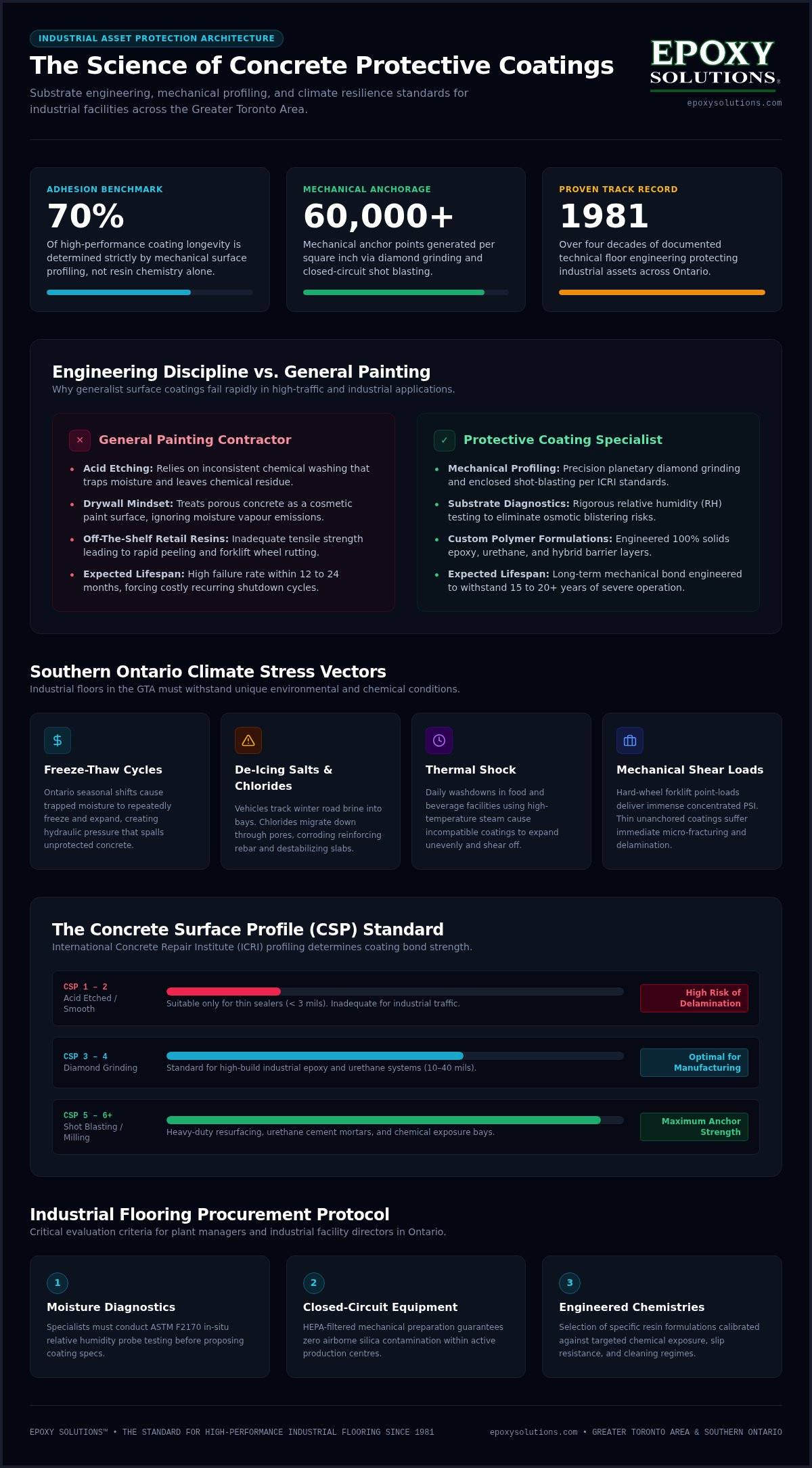
- Recognize that mechanical surface preparation accounts for 70% of a coating’s success and is the only way to prevent premature delamination.
- Identify the high-performance resinous systems required to withstand the specific thermal and chemical stressors found in Ontario industrial environments.
- Use a professional procurement checklist to evaluate concrete protective coating specialists based on technical site assessments and mandatory moisture testing.
- Discover how over four decades of industry expertise helps GTA facilities maintain compliance with strict safety codes while maximizing asset lifespan.
Defining Concrete Protective Coating Specialists: Beyond the Surface
Concrete protection is an engineering discipline. It isn’t a maintenance task or a simple aesthetic upgrade for your facility. True concrete protection involves a systematic approach designed to prevent carbonation and chemical ingress from compromising the structural integrity of your slab. For industrial facilities in the Greater Toronto Area, the stakes are high. A failing floor leads to more than just peeling paint; it leads to substrate degradation, safety hazards, and massive remediation costs. High-performance concrete protective coating specialists understand that the coating is merely the final step in a complex technical process. The goal is to transform a porous, vulnerable material into an impenetrable barrier that defends against the specific mechanical and chemical loads of your operation.
The Difference Between a General Contractor and a Specialist
Generalist painting crews often treat concrete as if it were drywall. They miss the critical nuances of concrete porosity and moisture vapour emission rates. When a generalist applies a retail-grade product without proper testing, failure is almost guaranteed. Specialists operate differently. They utilize heavy-duty mechanical preparation equipment, such as enclosed shot-blasters and planetary diamond grinders, to achieve a specific Concrete Surface Profile (CSP). This mechanical anchor is what ensures a permanent bond that can withstand heavy forklift traffic and impact. Instead of “out-of-the-box” solutions, concrete protective coating specialists provide tailored specifications based on your facility’s unique environment, ensuring the resin chemistry matches the substrate’s needs.
Critical Asset Protection in the Canadian Climate
The Southern Ontario environment presents unique challenges for industrial concrete. We manage extreme temperature fluctuations and high humidity levels that wreak havoc on unprotected slabs. Toronto’s freeze-thaw cycles cause moisture to expand and contract within the concrete’s pores, leading to spalling and deep cracks if the surface isn’t properly sealed. For loading docks and parking decks, salt and chloride resistance are non-negotiable. Road salts tracked in during winter months penetrate the concrete and corrode reinforcing rebar, which can eventually lead to structural failure. This is why industrial flooring specifications must be engineered to withstand these local environmental stressors. By hiring specialists, you ensure your facility is equipped with industrial-grade resins that maintain their bond despite the harshest Canadian weather conditions and heavy de-icing chemical exposure.
The Science of Adhesion: Why Surface Preparation is Non-Negotiable
Adhesion is the single most critical factor in the longevity of any industrial floor. A coating is only as strong as its bond to the concrete substrate. In the industrial sector, surface preparation accounts for roughly 70% of the success of any resinous flooring system. If you ignore substrate health, you’re essentially inviting delamination and peeling. Experienced concrete protective coating specialists don’t just clean the floor; they engineer the surface to accept a permanent bond. They use International Concrete Repair Institute (ICRI) standards to define specific Concrete Surface Profiles (CSP) that match the thickness and type of the specified material. Without this mechanical anchor, even the most expensive resin will eventually fail under the stress of heavy loads or thermal shifts.
Mechanical Profiling vs. Chemical Cleaning
Many general contractors still rely on acid etching. This is a dangerous and inconsistent practice that often leaves behind chemical residues and trapped moisture. For professional results, mechanical grinding is the industry standard. It involves using planetary diamond grinders or shot-blasters to physically remove laitance, oils, and previous failed coatings. This process reveals sound concrete and creates the necessary “tooth” for high-build epoxy coatings to grip. Achieving the correct CSP is the difference between a floor that lasts two years and one that lasts twenty. Proper profiling creates over 60,000 mechanical anchor points per square inch, providing a level of security that chemicals simply cannot match.
Moisture Vapour Emission Control (MVEC)
Moisture is the invisible killer of resinous floors. Even a slab that looks dry can harbour high levels of moisture vapour that creates osmotic pressure, leading to blisters and total bond failure. Concrete protective coating specialists utilize rigorous testing protocols, including in-situ Relative Humidity (RH) probes and Calcium Chloride tests, to measure the slab’s internal environment. If RH levels exceed 80% to 85%, a dedicated moisture-mitigating primer is required to act as a barrier. This step is non-negotiable for facilities in the GTA where high humidity and slab-on-grade construction are common. If you aren’t sure about your substrate’s health, it’s best to consult with a specialist who can perform a professional site assessment before proceeding with any installation.
Specialized Coating Systems for Industrial and Commercial Environments
Generic coatings fail because they aren’t engineered for specific stressors. In industrial environments, a “one size fits all” approach is a recipe for premature delamination. High-performance concrete protective coating specialists begin by evaluating the specific mechanical and environmental loads your facility faces. This includes calculating compressive strength requirements, assessing thermal shock potential from steam cleaning, and identifying every chemical agent present on site. Epoxy Solutions™ utilizes a “Problem-First” approach, ensuring the resin chemistry matches the unique operational reality of your facility rather than just following a manufacturer’s standard brochure. Whether your operation requires high-build epoxies, urethanes, or specialized resinous blends, the system must be selected based on performance data, not price points.
Chemical and Corrosion Resistance for Critical Assets
Industrial tanks and secondary containment areas require more than basic protection. They need a barrier that can withstand aggressive acids, alkalis, and solvents without softening or leaking. For high-concentration chemical environments, novolac epoxies are the professional standard due to their dense cross-linking and superior resistance. In the GTA, ensuring regulatory compliance for hazardous material storage is mandatory to prevent environmental contamination and legal liability. Specialists ensure these systems are seamless and non-porous, protecting both the concrete substrate and the surrounding environment from catastrophic leaks. This level of protection is essential for maintaining the long-term value of industrial assets that handle corrosive materials daily.
UV Resistance and Traffic Toppings for High-Exposure Areas
Standard epoxy resins have a fatal flaw: they yellow and chalk when exposed to sunlight. This UV degradation isn’t just aesthetic; it compromises the physical integrity of the coating over time. For facilities with large windows or exterior exposure, UV resistant epoxy flooring provides a stable solution that maintains its colour and strength. Areas like parking decks and exterior walkways require polyaspartic or urethane topcoats to handle both UV rays and extreme mechanical abrasion. These traffic toppings are engineered to withstand the constant friction of heavy transport and forklifts, providing a rugged surface that doesn’t crack under the weight of industrial logistics. By choosing the right topcoat, concrete protective coating specialists ensure your investment remains durable despite constant exposure to the elements and heavy vehicle traffic.
Evaluating Specialists in Toronto and the GTA: A Procurement Checklist
Procurement is about risk management. When you evaluate concrete protective coating specialists in Toronto or Mississauga, you’re looking for a partner who understands the high stakes of industrial downtime. A low bid is rarely a bargain; it’s a warning sign of insufficient surface preparation or low-grade materials. True specialists prioritize long-term performance over the lowest initial cost. They act as an “Authoritative Expert Fixer,” identifying substrate weaknesses and environmental stressors before providing a bid. If a contractor skips the mandatory moisture testing or site assessment phase, they aren’t a specialist. They’re a risk to your infrastructure. You need a team with a proven track record of managing large-scale industrial projects across Southern Ontario, where the environmental conditions are notoriously difficult.
Safety Compliance and Precision Line Marking
Safety isn’t an afterthought. Integrating durable epoxy floor striping into the protective coating system is essential for meeting Ontario Ministry of Labour safety standards. These markings define pedestrian zones and forklift aisles, and they must remain visible despite heavy mechanical wear. In wet or oily manufacturing environments, specialists also specify non-slip additives. These tailored textures ensure your facility remains compliant and your workforce stays safe. A professional installation ensures these safety features are chemically bonded to the floor, preventing them from chipping or fading under heavy traffic.
Assessing Technical Specifications and Warranty Realities
Technical data doesn’t lie. You must analyze the Technical Data Sheet (TDS) for every product proposed for your facility. Focus on the solids content; 100% solids systems offer superior durability compared to solvent-borne products that shrink during curing. High VOC levels are also a red flag, as they can lead to odour transfer in occupied facilities. You should also clarify the difference between a manufacturer’s material warranty and a contractor’s installation warranty. A manufacturer’s warranty won’t help you if the coating peels due to poor preparation. True reliability comes from a contractor who stands behind their labour and has the historical presence to honour that commitment. If you want a floor that stands up to the rigours of GTA industry, consult with the experts at Epoxy Solutions™ for a professional specification.
Epoxy Solutions™: The Standard for High-Performance Flooring Since 1981
Legacy matters in this industry. Since 1981, Epoxy Solutions™ has been solving the most complex concrete protection challenges across North America. We’ve spent over four decades refining our processes to ensure every facility we touch receives a standard-setting installation. Our approach is fundamentally no-nonsense; we prioritize long-term asset protection and facility longevity over the easiest or cheapest path. As seasoned concrete protective coating specialists, we’ve seen every possible substrate failure and possess the technical expertise to resolve them. Whether your facility requires high-performance resinous flooring, anti-static systems, or precision-polished concrete, we deliver results that withstand the rigours of demanding industrial sectors.
Tailored Resinous Solutions for Complex Facility Needs
One size never fits all. We customize our systems to meet the specific requirements of electronics manufacturing, food processing, and heavy fabrication plants. Each of these environments demands a different chemical and mechanical profile. For instance, an electronics facility requires precise anti-static properties to protect sensitive components, while a food processing plant mandates seamless, non-porous surfaces that comply with strict sanitization codes. Our commitment to quality means we only use premium materials that consistently exceed industry benchmarks. This “Extreme Capability” allows us to succeed in difficult environments where others have failed. We take pride in engineering systems that don’t just look professional but perform under extreme pressure.
From Mississauga to Vaughn: Local Expertise, Global Standards
Local knowledge is a strategic advantage. Working with concrete protective coating specialists who understand Ontario’s specific building codes and environmental regulations ensures your project remains compliant from start to finish. We serve the entire GTA, including Toronto, Mississauga, Brampton, Milton, and Vaughn, with a network of experienced installers who maintain our high standards on every job site. We don’t outsource our quality. Our team understands how to manage the logistical hurdles of local facility retrofits while adhering to global performance standards. If you’re ready to break the cycle of floor failures and invest in a solution that lasts, contact Epoxy Solutions™ today to discuss your facility’s concrete protective needs.
Secure Your Facility’s Future with Engineered Concrete Protection
Concrete protection is a long-term investment. You’ve seen how mechanical surface preparation and precisely engineered resin chemistry are the only ways to prevent the cycle of peeling and floor failure. For industrial operations in Toronto, Mississauga, and Brampton, navigating the Canadian climate requires a partner who understands the technical demands of thermal shock, chemical ingress, and heavy mechanical loads. Relying on concrete protective coating specialists ensures your assets remain compliant with safety codes while maximizing their working lifespan. Since 1981, Epoxy Solutions™ has set the industry standard as an authoritative expert fixer for high-performance resinous flooring. We don’t provide out-of-the-box fixes; we deliver tailored solutions that stand up to the most demanding environments in the GTA. Don’t leave your infrastructure to chance with generalist contractors who overlook substrate health. It’s time to prioritize reliability and precision for your next project. Take the first step toward a durable, low-maintenance facility by reaching out to a team that values technical accuracy. Request a Professional Site Assessment from Epoxy Solutions™ today and ensure your facility is built to last.
Frequently Asked Questions
What is the difference between a concrete sealer and a protective coating?
A concrete sealer is a thin, penetrating treatment designed primarily for dust-proofing and light water repellency. In contrast, a protective coating is a high-build, resinous system engineered by concrete protective coating specialists to provide a thick, impenetrable barrier. These coatings defend against heavy mechanical loads, aggressive chemical spills, and thermal shock. While sealers require frequent reapplication, industrial-grade coatings offer long-term structural protection for high-value assets in GTA facilities.
How long does a professional industrial concrete coating typically last?
A professionally engineered industrial coating typically lasts between 15 and 20 years. This longevity is only possible when the installation follows strict mechanical preparation and moisture testing protocols. Lower-quality applications often fail within 12 to 24 months due to poor substrate bonding. By prioritizing high-performance resins and accurate surface profiling, facility managers in Toronto and Mississauga ensure their flooring investment withstands decades of heavy forklift traffic and industrial use.
Can you apply protective coatings to old, oil-saturated concrete?
Yes, but the process requires specialized decontamination. Old, oil-saturated slabs must undergo deep mechanical cleaning and chemical emulsification to remove hydrocarbons from the concrete pores. Concrete protective coating specialists use enclosed shot-blasting to reveal sound, uncontaminated concrete before applying oil-tolerant primers. This rigorous preparation ensures the new resinous system achieves a permanent bond. Skipping these steps leads to immediate delamination, making professional assessment essential for aging GTA industrial sites.
What is the typical downtime required for an industrial epoxy floor installation?
Typical installations require three to five days for a full multi-coat epoxy system. This timeline includes mechanical surface preparation, priming, base coats, and final topcoats. However, we offer fast-cure polyaspartic and urethane mortar systems that allow for a return to heavy traffic within 12 to 24 hours. These rapid-cure solutions are ideal for logistics hubs in Brampton and Vaughn that don’t want to afford lengthy shutdowns during busy production cycles.
Why is moisture testing necessary before applying a concrete coating?
Moisture testing is mandatory because invisible water vapour is the primary cause of floor failure. We use in-situ relative humidity probes and calcium chloride tests to measure the moisture vapour emission rate. If levels exceed the manufacturer’s limits, osmotic pressure will eventually force the coating to blister and peel. Identifying these risks early allows us to specify moisture-mitigating primers, ensuring the structural integrity of the installation despite Ontario’s high humidity levels.
Are your coating systems compliant with Canadian food safety and environmental regulations?
Every system we install meets or exceeds current Canadian regulatory standards. For food and beverage facilities, our seamless, non-porous surfaces comply with Section 57 of the Safe Food for Canadians Regulations (SFCR). We also ensure our coatings stay well below the VOC concentration limits set by Environment and Climate Change Canada. This commitment to compliance protects your facility from legal liabilities while maintaining a safe, sanitizable environment for your workforce and products.
Do you provide line marking and safety striping as part of the coating process?
We integrate precision line marking and safety flooring directly into our protective coating process. These markings aren’t just painted on top; they’re chemically bonded to the floor system for maximum durability. This ensures your aisle markings, pedestrian zones, and forklift paths remain visible despite constant mechanical abrasion. By coordinating these services, we help GTA facilities maintain Ministry of Labour safety standards without the need for separate contractors or additional downtime.
How do I choose between polished concrete and an epoxy coating for my warehouse?
Polished concrete is an excellent choice for high-traffic warehouses that require low maintenance and high light reflectivity. However, if your facility handles chemicals, oils, or frequent washdowns, a resinous epoxy coating is necessary. Epoxy provides a waterproof, chemical-resistant barrier that polished concrete can’t match. We evaluate your specific operational stressors, such as impact resistance and liquid exposure, to help you determine which high-performance system best protects your concrete infrastructure.