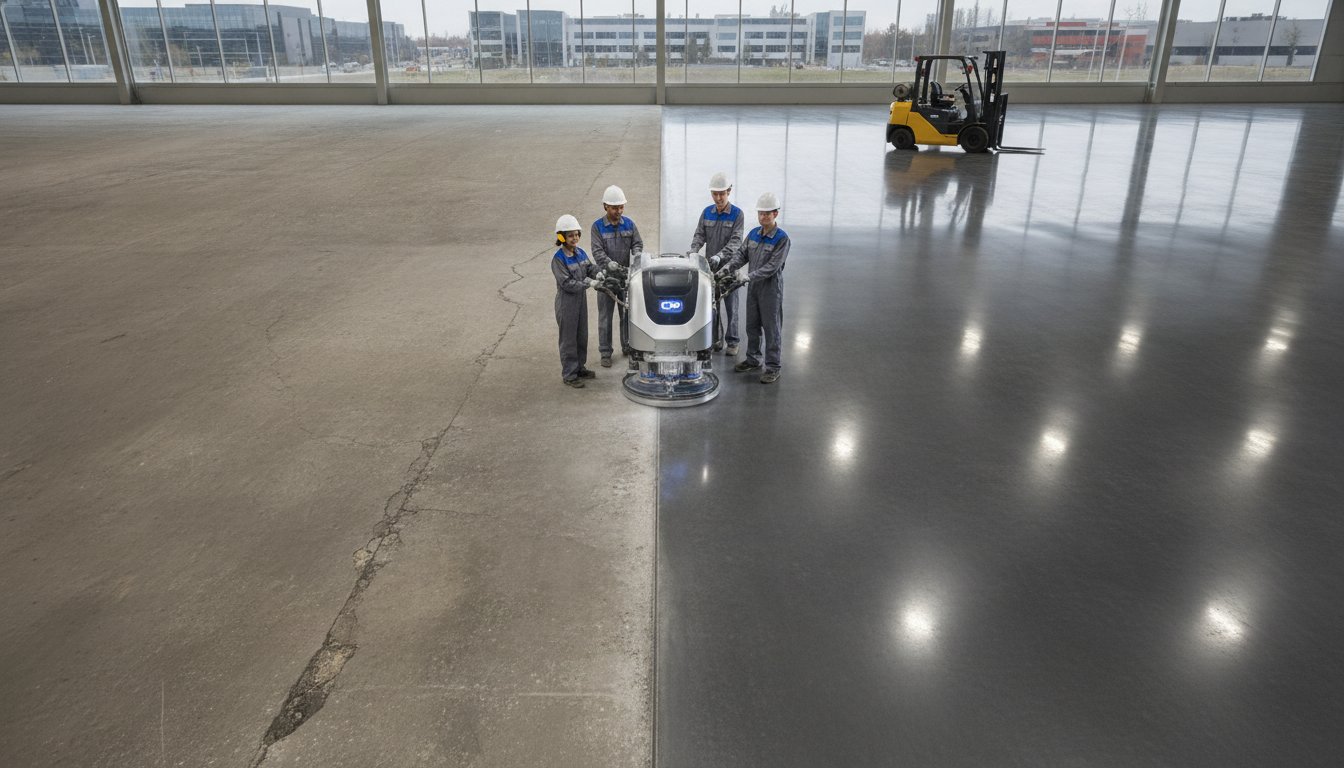
A standard concrete floor is often a liability disguised as a surface. In the high-stakes industrial environments of the Greater Toronto Area, untreated slabs inevitably fail under the relentless pressure of heavy machinery and constant logistics. You’ve likely dealt with the fallout: fine concrete dust settling on expensive inventory, painted coatings that peel under forklift traffic, and slippery patches that threaten workplace safety. These failures aren’t just inconveniences; they’re significant operational drains that inflate maintenance budgets and cause avoidable downtime.
Professional industrial polished concrete services provide the definitive fix by transitioning from temporary topical covers to permanent structural refinement. By utilizing mechanical grinding and chemical densification, we transform porous slabs into high-performance assets that are both dust-free and exceptionally durable. This guide explores how to achieve a high-gloss, abrasion-resistant finish that exceeds safety standards and lowers long-term costs. You will learn about the engineering process that turns a basic GTA warehouse floor into a sophisticated, low-maintenance foundation that supports your facility’s bottom line.
Key Takeaways
- Professional industrial polished concrete services represent a permanent mechanical refinement of the slab rather than a superficial coating that is prone to peeling or failure.
- Chemical densification is the essential engineering phase that eliminates surface dusting and increases floor hardness by filling microscopic pores with calcium silicate hydrate.
- Proper grit progression and meticulous surface preparation are mandatory to achieve a high-performance finish that withstands heavy forklift traffic and industrial wear.
- Facility managers must balance light reflectivity with safety by selecting a gloss level that maintains a high Dynamic Coefficient of Friction for wet or demanding conditions.
- Investing in polished concrete provides superior long-term ROI for GTA facilities through significantly reduced maintenance requirements and lower material waste.
Defining Industrial Polished Concrete Services for GTA Facilities
Surface appearance is secondary. In the industrial sector, performance is the only metric that matters. Many facility managers in the Greater Toronto Area mistakenly believe that any shiny floor qualifies as polished. It’s a costly misunderstanding. Professional industrial polished concrete services represent a rigorous, multi-step mechanical refinement process that fundamentally alters the slab’s characteristics. Unlike a “grind and seal” method, which simply applies a film-forming sealer over a roughly sanded surface, true polishing uses progressively finer diamond-impregnated disks to hone the concrete. Industrial polishing is a permanent densification of the concrete substrate.
This process is more than a cleaning routine. Polished concrete involves the use of heavy-duty grinding machines and chemical densifiers to create a surface that is integral to the slab itself. For Toronto’s heavy manufacturing sectors, this structural integrity is non-negotiable. A sealed floor will eventually flake, peel, or wear through in high-traffic lanes; a refined slab cannot. We don’t just add a layer to your floor. We engineer the existing concrete to work harder.
Beyond Aesthetics: The Structural Advantage
Concrete dusting is a silent operational killer. It’s the result of weak calcium hydroxide in the concrete breaking down into a fine powder that infiltrates machinery and inventory. Mechanical refinement eliminates this at the source. By closing the surface pores and increasing the density of the top layer, we significantly improve impact resistance. GTA warehouses prioritize these densified slabs because they withstand the relentless shear forces of heavy forklift traffic without gouging or shedding. It’s about turning a soft, porous material into a hard, impenetrable asset.
The Role of Industrial Standards in 2026
Precision defines high-performance flooring. In 2026, adhering to American Concrete Institute (ACI) and Concrete Polishing Association of America (CPAA) guidelines is the baseline, not the exception. Generic contractors often fail because they lack the heavy equipment and technical knowledge to meet these specific gloss and DOI (Distinction of Image) requirements. We follow strict industrial flooring specifications to ensure every project meets the rigorous demands of modern logistics and manufacturing. If the refinement process isn’t measured against these standards, the floor isn’t actually polished; it’s just temporarily shiny. We provide the technical accuracy required to pass even the most stringent facility audits.
The Engineering Behind High-Performance Densification and Hardening
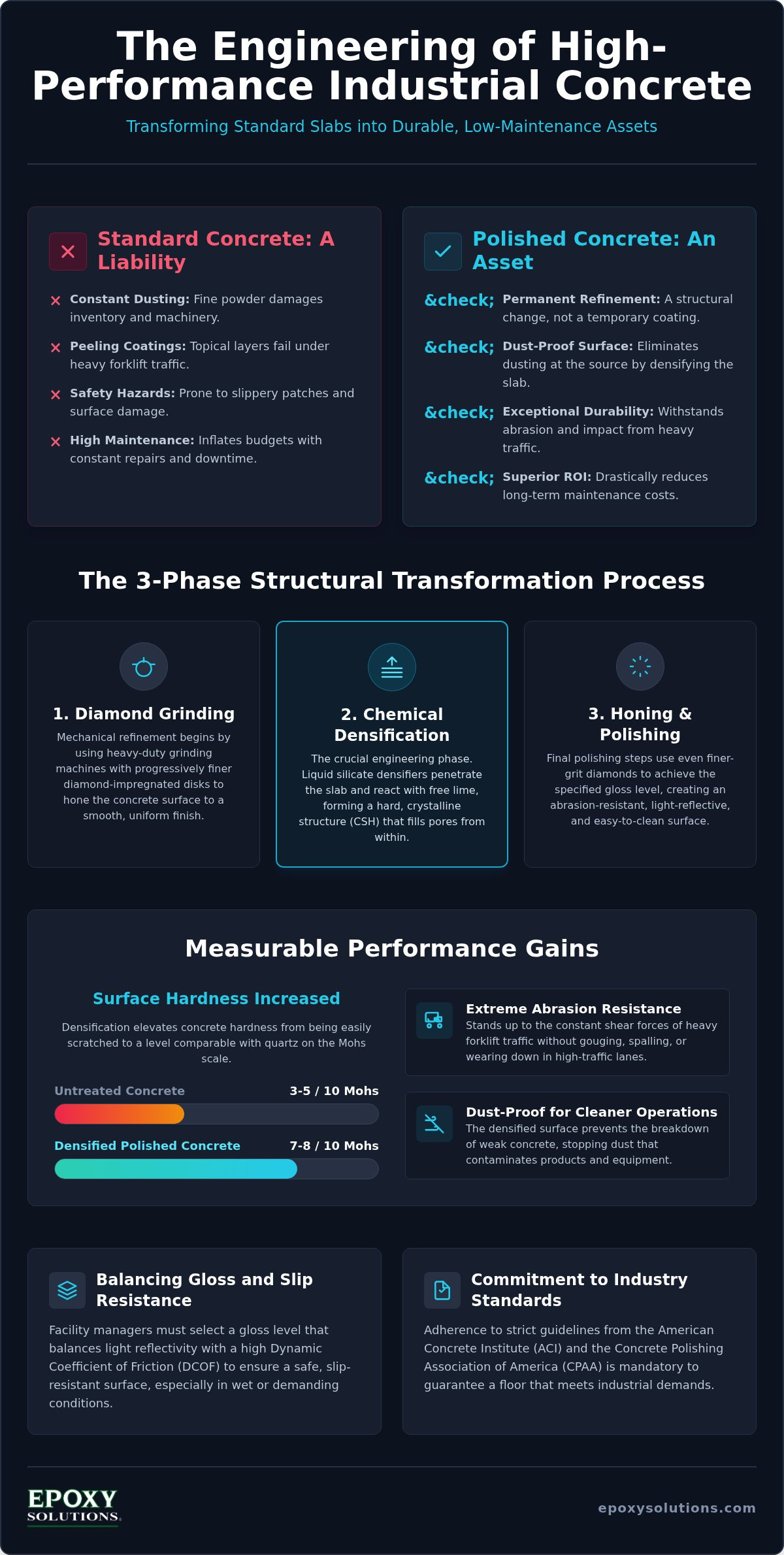
Surface shine is a byproduct. Structural density is the goal. For industrial polished concrete services to deliver on the promise of high durability, the process must go beyond mechanical abrasion. Concrete is naturally porous, containing microscopic voids and weak calcium hydroxide. Without chemical intervention, these voids remain points of failure. High-performance polishing relies on a specific chemical reaction between silicate densifiers and the free lime in the slab. This interaction creates calcium silicate hydrate (CSH), a hard, crystalline structure that fills the pores of the concrete matrix from within.
This internal reinforcement significantly alters the floor’s physical properties. On the Mohs scale of mineral hardness, untreated concrete typically sits between a 3 and 5. Once the densification process is complete, the surface hardness often reaches a 7 or 8, comparable to quartz. This isn’t just a surface layer; it’s a fundamental change to the substrate. Achieving this requires chemical mastery. An “Expert Fixer” understands that every slab is unique, requiring a tailored chemical approach rather than a one-size-fits-all application. If you’re dealing with a deteriorating surface, you may need to consult with a specialist to determine the exact densification requirements for your specific slab.
Chemical Densifiers: Sodium vs. Lithium
Not all silicates are equal. Sodium silicates were the industry standard for decades, but they often struggle with inconsistent penetration and the risk of efflorescence. In high-traffic Mississauga facilities, we prefer lithium densifiers. Lithium molecules are significantly smaller, allowing them to penetrate deeper into the concrete pores for a more uniform hardening effect. The timing of this application is critical. Applying the densifier too early or too late in the diamond grinding progression can result in a surface that looks polished but lacks the internal strength to resist heavy forklift shear forces.
Eliminating Concrete Dusting Forever
Concrete dusting is more than a nuisance. It’s a sign of a failing surface. When the top layer of a slab breaks down, it releases fine particles that can destroy sensitive electronics or contaminate food-grade environments. Densification solves this by binding the concrete surface into a monolithic, non-porous structure. This science-led approach reduces maintenance labour by preventing the microscopic breakdown of the concrete. You won’t just have a cleaner facility; you’ll have an environment where your inventory and equipment are protected from the abrasive effects of concrete dust.
Diamond Grinding and Surface Preparation: The Foundation of Longevity
Shortcuts lead to failure. In the world of industrial polished concrete services, the final shine is often a distraction from the real work happening beneath the surface. Most generic contractors rush the mechanical grinding phase, leaving behind a floor that looks acceptable on day one but degrades rapidly under industrial stress. We take a different approach. At Epoxy Solutions™, we recognize that the quality of the prep work determines 90% of the floor’s final performance.
Older GTA buildings, particularly in established industrial hubs like Etobicoke or North York, frequently present “soft” concrete challenges. These slabs have often suffered from decades of carbonation or poor original finishing, resulting in a weak surface layer that cannot support a high-performance polish. We identify these issues early, using specialized heavy-duty equipment and aggressive metal-bond diamonds to strip away the compromised material until we reach the sound, structural concrete underneath. Without this aggressive initial step, the densifiers mentioned earlier cannot penetrate effectively, leading to a floor that remains prone to dusting and abrasion.
The Step-by-Step Refinement Process
Refinement is a methodical grit progression. We begin with metal-bond diamonds, typically starting at a 30 or 40 grit, to remove surface contaminants and open the pores for chemical treatment. Once the slab is open, we move into the honing stages using transitional diamonds ranging from 100 to 400 grit. This stage is critical for removing the deep scratches left by initial grinding and preparing the surface for the densification phase. The final polishing stages utilize resin-bond diamonds, which can reach up to 3000 grit depending on the desired Light Reflectivity Value (LRV). Each step is necessary to ensure the surface is smooth enough to reflect light without sacrificing the grip required for a safe workplace.
Slab Repair and Joint Restoration
A polished floor is only as good as its weakest joint. Toronto loading docks and high-traffic corridors often suffer from spalled joint edges and deep structural cracks. We don’t just polish over these defects. We restore them using semi-rigid joint fillers that support the edges of the slab under heavy wheel loads, preventing further breakdown. This is especially vital in cold-storage environments where extreme temperature fluctuations cause concrete to expand and contract. Skipping this restoration phase leads to premature floor failure and increased equipment maintenance costs as forklifts bounce over uneven, damaged joints.
Selecting the Right Gloss Level and Slip Resistance for Industrial Use
Visual appeal should never compromise operational safety. Many facility managers in Brampton or Vaughn believe that a high-gloss floor is inherently dangerous. This is a myth perpetuated by inexperienced contractors who fail to understand the relationship between surface refinement and friction. Professional industrial polished concrete services allow for precise control over both the aesthetic finish and the grip of the surface. We categorise these finishes into four distinct levels, ranging from a functional matte to a mirror-like high gloss, each serving a specific industrial purpose. Choosing the wrong level doesn’t just look bad; it can create unnecessary maintenance hurdles or safety liabilities.
We don’t guess at safety; we measure it. Every industrial plant has unique environmental factors, from the type of lubricants used in machinery to the specific tires on your forklift fleet. Tailoring the final grit progression ensures the floor meets your operational needs while adhering to strict safety protocols. If you’re unsure which specification fits your facility, contact our technical team for a site-specific evaluation.
Gloss Level Comparison for Industrial Facilities
Function dictates the finish. Level 1 and 2 gloss levels provide a matte to satin appearance that is ideal for heavy-duty warehouses and logistics centres. These lower levels hide slab imperfections and require less frequent burnishing to maintain their look. Conversely, Level 3 and 4 finishes are reserved for showrooms, aircraft hangars, and high-precision manufacturing plants. These high-gloss options significantly increase the Light Reflectivity Value (LRV), which can lower energy costs by reducing the need for artificial overhead lighting. The decision depends entirely on your existing lighting and the intensity of your daily traffic.
Safety and Traction Standards
Grip is a result of engineering. A common concern is whether polished surfaces meet the Static Coefficient of Friction (SCOF) requirements for worker safety. Properly refined concrete often exceeds these standards, even when polished to a high shine. Unlike topical coatings that can become skates when wet, polished concrete remains slip-resistant because the refinement process maintains the mechanical “tooth” of the slab. In environments prone to oil spills or frequent washdowns, we can further engineer the surface with specialised treatments to maintain traction without sacrificing the floor’s durability or ease of cleaning. We ensure your facility remains compliant with all Ontario safety standards while delivering a premium, high-performance finish.
Specifying Polished Concrete for Toronto’s Industrial Environments
Operational efficiency starts at the floor level. For facility managers across the Greater Toronto Area, selecting industrial polished concrete services is a strategic investment in long-term asset management. While many contractors treat flooring as a recurring expense, we view it as a permanent structural refinement. The decision to specify polished concrete over traditional coatings often comes down to a balance of durability, environmental impact, and financial performance. By repurposing the existing slab, facilities achieve a high-performance finish that eliminates the need for sacrificial layers that eventually fail under industrial stress.
Long-Term ROI and Maintenance Savings
Maintenance costs are often the largest hidden expense in any facility. Traditional painted or coated floors require frequent stripping, waxing, and re-application, all of which cause operational downtime. Polished concrete eliminates these requirements. You’ll realize a significant reduction in the need for aggressive cleaning chemicals and specialized scrubbing equipment. The smooth, densified surface also reduces vibration for forklifts and pallet jacks, which directly lowers maintenance costs for your material handling fleet by reducing tire wear and mechanical strain. Additionally, the high reflectivity of the surface can lower lighting energy costs by maximizing the efficiency of existing overhead fixtures. For a detailed breakdown of these financial variables, consult our polished concrete vs epoxy flooring cost guide.
Environmental stewardship is another critical factor in modern industrial specifications. Polished concrete is a sustainable choice that frequently contributes to LEED credits by utilizing the existing building material and eliminating the waste associated with replacing floor coverings. It produces zero VOCs (Volatile Organic Compounds), ensuring that your facility maintains high indoor air quality for your workforce. By choosing a permanent mechanical finish, you prevent thousands of kilograms of epoxy or urethane waste from entering Ontario landfills over the building’s lifecycle.
The Epoxy Solutions™ Standard
Experience is the ultimate differentiator. Since 1981, Epoxy Solutions™ has engineered flooring systems that set the benchmark for the Ontario market. We don’t offer generic fixes. We provide tailored solutions that address the specific logistical and environmental challenges of Toronto, Mississauga, and the surrounding GTA. Our legacy is built on solving the complex failures that other providers ignore. When you specify our industrial polished concrete services, you aren’t just buying a floor; you’re securing a partnership with a veteran team that prioritizes technical accuracy and long-term performance. Partner with Epoxy Solutions™ for your next project to ensure your facility foundation is built to last.
Securing the Foundation of Your GTA Industrial Facility
A high-performance facility demands a floor that works as hard as your machinery. Professional industrial polished concrete services are not a cosmetic luxury; they’re a structural necessity for facilities that prioritize longevity and safety. By moving beyond superficial coatings and embracing mechanical refinement and chemical densification, you eliminate concrete dusting at the source and significantly increase surface hardness. This engineering-first approach ensures your slab withstands the relentless pressure of heavy logistics while reducing long-term maintenance costs and lighting energy consumption.
Epoxy Solutions™ has been the authoritative choice for critical environments since 1981. With over 40 years of industrial flooring expertise serving Toronto, Mississauga, and the GTA, we provide the technical accuracy required to meet the most demanding high-performance specifications. Don’t settle for contractors who prioritize speed over structural integrity. It’s time to realize the full potential of your facility’s foundation with a partner that sets the industry standard. Request a Professional Floor Evaluation from Epoxy Solutions™ to secure your facility’s future.
Frequently Asked Questions
Is polished concrete too slippery for an industrial warehouse?
Polished concrete is not inherently slippery and often exceeds standard safety requirements for slip resistance. The mechanical refinement process maintains the slab’s natural traction while increasing its density. In Mississauga or Vaughn facilities where floors are prone to spills, we can apply specialized anti-slip treatments during the final polishing stages. This ensures a high-gloss finish remains safe for workers and compliant with Ontario safety protocols even in demanding industrial environments.
How long does the industrial concrete polishing process take?
Timeline depends on the slab’s condition and the total square footage involved. A standard 10,000-square-foot facility in Brampton typically requires three to five business days for a full multi-step refinement. This includes surface preparation, grinding, densification, and final polishing. We work to minimize operational downtime, but rushing the grit progression compromises the floor’s longevity. Accurate scheduling ensures chemical densifiers have sufficient time to react properly with the concrete substrate.
Can any concrete floor be polished, regardless of its condition?
Most slabs are candidates for polishing, but structural integrity is the ultimate deciding factor. Extremely soft, porous, or heavily spalled concrete in older Toronto buildings may require extensive repairs before the refinement process begins. If a slab is too compromised, we may recommend high-performance epoxy coatings instead. Our industrial polished concrete services start with a thorough assessment to determine if the existing substrate can support the mechanical refinement required for a durable finish.
What is the difference between polished concrete and a grind and seal?
Polished concrete is a mechanical refinement process that uses diamond abrasives and chemical densifiers to harden the slab itself. A grind and seal is a topical application where a clear film-forming sealer is placed over a roughly ground surface. While a grind and seal is faster, it will eventually peel or flake under heavy forklift traffic. Professional polishing creates a permanent, monolithic surface that won’t delaminate or require frequent re-coating over time.
Does polished concrete require waxing or stripping?
Polished concrete never requires waxing or stripping to maintain its appearance. The high-gloss finish is achieved through mechanical refinement, not a sacrificial topical layer that eventually fails. This eliminates the recurring costs of labour and chemicals associated with traditional floor maintenance. For Milton facilities, this means a significant reduction in long-term operational expenses. You simply maintain the surface with routine cleaning using a neutral pH cleaner and occasional high-speed burnishing to refresh the shine.
How does industrial polished concrete affect facility lighting costs?
Polished surfaces significantly increase the Light Reflectivity Value (LRV) of an industrial facility. By refining the slab to a Level 3 or 4 gloss, you maximize the efficiency of your existing overhead lighting. This often allows GTA warehouse managers to reduce the number of active fixtures or switch to lower-wattage bulbs without compromising safety. It’s a sustainable way to lower energy consumption while creating a brighter, more professional work environment for your production team.
What maintenance is required for a high-traffic polished concrete floor?
Maintenance is straightforward but must be consistent to preserve the surface. High-traffic floors in Toronto require daily dust mopping to remove abrasive grit that can dull the finish over time. Regular wet scrubbing with a neutral pH cleaner is necessary to remove oils and contaminants. Unlike epoxy, you don’t need to worry about the surface peeling. Occasional burnishing with specialized diamond-impregnated pads will maintain the high-performance gloss and keep the surface densified.
Can industrial polished concrete handle heavy forklift traffic?
Polished concrete is specifically engineered to withstand the relentless shear forces of heavy forklift traffic. The densification process increases the slab’s surface hardness to a 7 or 8 on the Mohs scale, making it highly resistant to gouging and tire marks. In busy Mississauga logistics hubs, this durability is a primary operational advantage. Because the finish is integral to the concrete, there is no coating to fail or bubble under constant material handling equipment use.