Surface preparation is not a cleaning step; it is a structural engineering requirement that dictates the mechanical bond of every industrial floor. If your facility is struggling with delaminating coatings or unscheduled downtime for repairs, the issue likely started before the first drop of epoxy was even mixed. Professional concrete surface preparation Toronto requires more than a quick sweep or a light sand. It demands a precise mechanical profile that allows high-performance resins to anchor deep into the substrate.
You probably realize that a floor is only as reliable as its bond to the concrete, yet conflicting advice on grinding versus shot blasting often leads to expensive mistakes. This guide will help you master the technical standards and mechanical methods required to ensure your Toronto facility’s floor withstands heavy forklift traffic and harsh chemicals without peeling. We will examine the International Concrete Repair Institute (ICRI) standards, break down the specific Concrete Surface Profile (CSP) levels for your industry, and explain how industrial-grade equipment turns a vulnerable slab into a permanent asset.
Key Takeaways
- Mechanical bonding is the structural foundation that prevents premature coating failure and delamination in demanding industrial environments.
- Select the right mechanical method, from diamond grinding to shot blasting, to meet the specific concrete surface preparation Toronto standards for your facility.
- Utilize the ICRI 10-level CSP scale to accurately match your substrate profile to the technical requirements of your high-performance coating.
- Protect your investment by addressing the unique moisture vapour transmission challenges caused by the Greater Toronto Area’s seasonal humidity and salt exposure.
- Implement industrial-grade preparation protocols to ensure your floor remains resilient under heavy forklift traffic and aggressive chemical contact.
The Foundation of Durability: Why Surface Preparation Determines Flooring Lifespan
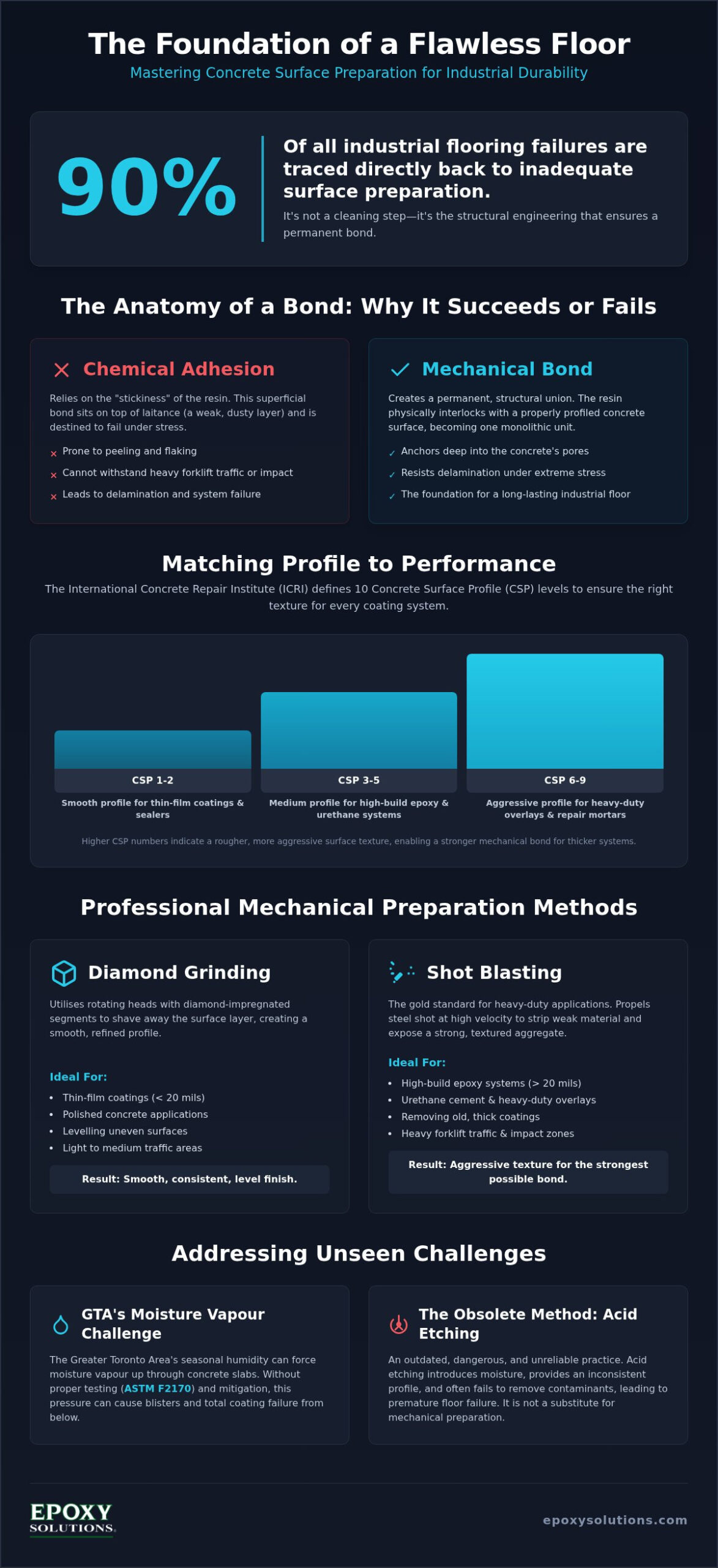
Preparation dictates performance. It’s the single most critical factor in the success of any industrial resinous flooring system. In Toronto’s industrial corridors, approximately 90% of epoxy floor failures are traced back to inadequate preparation. Many contractors simply “clean” the floor, but professional concrete surface preparation Toronto requires a fundamental change to the substrate’s profile. Without removing the laitance, which is the weak, milky layer of cement paste on top of new or old concrete, your coating is merely sitting on a foundation of dust.
Mechanical bonding vs. chemical adhesion is where most projects succeed or fail. Chemical adhesion relies on the “stickiness” of the resin, which is never enough to withstand heavy forklift traffic. Mechanical bonding ensures the resin physically interlocks with the concrete, creating a permanent anchor that resists delamination even under extreme stress.
The Mechanics of the Bond
Mechanical preparation creates “teeth” in the concrete, providing a high-surface-area landscape for the resin to grip. When a slab is mechanically ground, honed and polished or shot blasted, it alters the surface tension, allowing the coating to penetrate deep into the open pores rather than beading on the surface. A mechanical bond is the structural union between the slab and the polymer. This deep penetration ensures that the floor functions as a single, monolithic unit capable of handling thermal shock and heavy impacts without the risk of the layers separating.
Consequences of Inadequate Prep
Poor preparation manifests quickly through peeling, flaking, or the appearance of “fish-eyes” where the coating has retracted from surface contaminants. These aren’t just aesthetic flaws; they’re signs of a total system failure that leads to unscheduled facility downtime. The true cost of failure includes the expense of material removal, the price of re-installation, and the massive operational losses during repairs. While some still suggest acid etching, it’s an obsolete and dangerous method that introduces unnecessary moisture and fails to provide the consistent profile required for modern industrial standards. Reliable results require industrial-grade mechanical equipment, not chemical shortcuts.
Mechanical Preparation Methods: Shot Blasting vs. Diamond Grinding
Equipment selection isn’t a preference; it’s an engineering requirement. The success of industrial flooring depends on choosing the specific mechanical method that matches your coating’s thickness and the slab’s condition. Professional concrete surface preparation Toronto requires a methodical approach to ensure the substrate is ready for a permanent bond. Before we deploy any heavy machinery, we verify the slab’s internal conditions using ASTM F2170 standards to ensure moisture levels won’t compromise the installation.
When to Choose Diamond Grinding
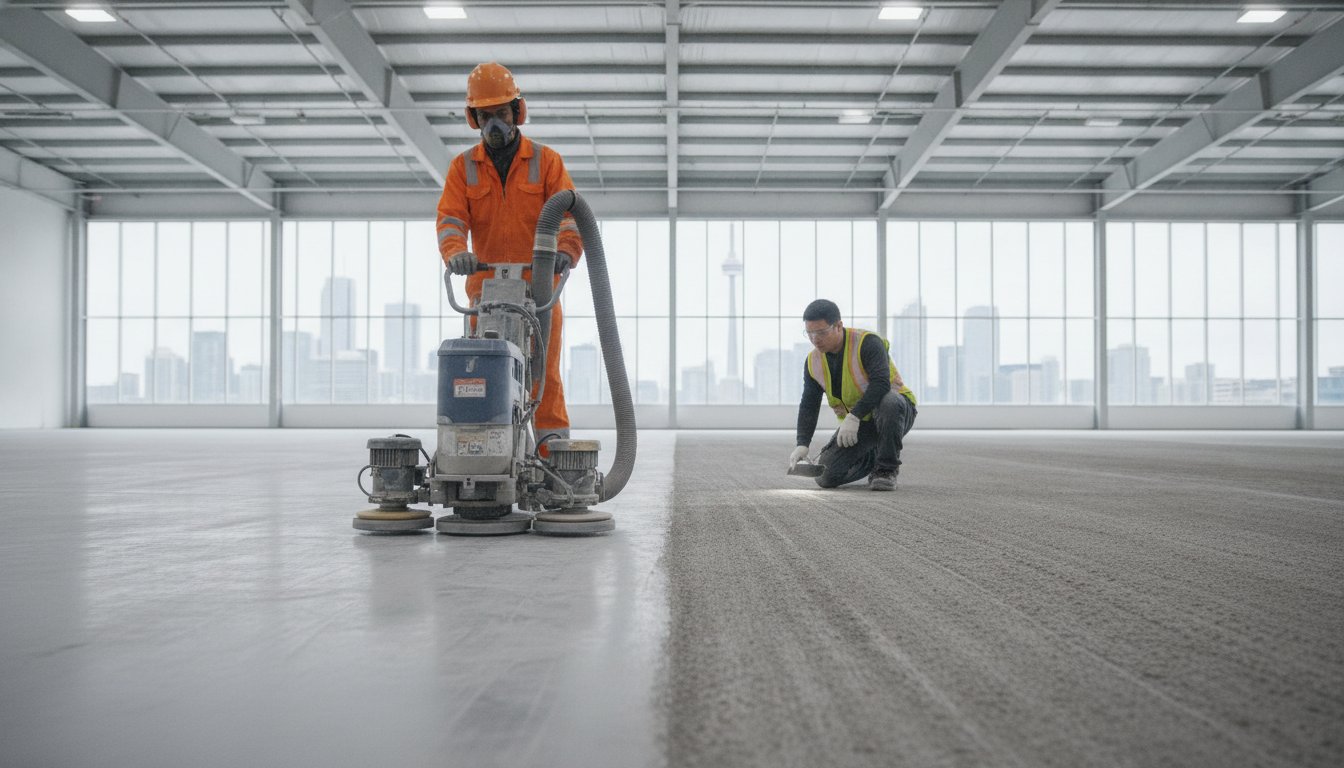
Diamond grinding is the standard for thin-film coatings and polished concrete applications. This method utilises rotating heads fitted with diamond-impregnated segments to shave away the top layer of laitance and contaminants. We control the surface profile by varying the grit level of the diamonds, moving from aggressive metal-bond segments to finer resins. In active Toronto facilities, we utilise dust-free grinding technology with high-efficiency particulate air (HEPA) filtration to maintain air quality and prevent cross-contamination in sensitive environments. It’s the ideal choice for warehouses with light traffic or commercial showrooms where a smooth, level finish is the priority.
The Power of Shot Blasting
Shot blasting is the gold standard for high-build systems and heavy-duty industrial environments. This process uses centrifugal force to propel steel shot at the concrete, stripping away weak material to reveal a sound, textured aggregate. It’s a mandatory step for high-performance epoxy guide specifications because it creates the most aggressive mechanical bond possible. While shot blasting is incredibly efficient for large open areas, it may leave “lap lines” or tracks. We often follow shot blasting with secondary grinding to ensure a perfectly uniform surface for thinner coatings. For facilities dealing with thick overlays or heavy chemical contamination, we may even employ scarifying, which uses a drum-mounted milling tool to aggressively remove up to 1/4 inch of concrete.
Precision matters at the perimeter. While large machines handle the bulk of the floor, hand grinding is essential to ensure the bond is consistent at edges, corners, and around drains. Skipping these details leads to edge peeling, which is where most floor failures begin. If you’re unsure which method fits your facility’s needs, consult with a team that provides tailored industrial flooring solutions based on decades of field experience.
Understanding Concrete Surface Profile (CSP) Levels
Vague descriptions like “rough enough” don’t belong in a professional facility. The International Concrete Repair Institute (ICRI) defines 10 distinct CSP levels to eliminate guesswork from concrete surface preparation Toronto projects. These levels provide a technical framework that ensures the mechanical bond is proportional to the coating system being installed. Without a specific CSP target, you’re essentially gambling with your facility’s long-term durability.
Matching the profile to the system is an engineering necessity, as different materials require different levels of mechanical “grip.”
- CSP 1-2: Achieved through light grinding; best for thin-film urethanes and sealers where a smooth aesthetic is required.
- CSP 3-5: The standard for high-build epoxy and self-levelling systems, typically requiring professional shot blasting.
- CSP 6-9: Reserved for the most demanding environments, requiring aggressive scarification for heavy-duty urethane mortars and traffic toppings.
Specifying the Right Profile
Detailed industrial flooring specifications must include a CSP mandate to ensure all bidding contractors are quoting the same level of mechanical effort. There is a direct relationship between the “mil” thickness of the coating and the required surface profile; thicker systems need deeper “valleys” to provide adequate surface area for the polymer to anchor. A CSP 3 is the minimum requirement for most industrial environments. Using this standard in your RFP prevents “low-ball” quotes from contractors who intend to skip necessary mechanical steps to save on labour and equipment costs.
Visualizing the Surface
Verification shouldn’t be a matter of opinion. We use ICRI rubber comparator chips on-site to match the prepared concrete against standardised tactile samples. This ensures the mechanical profile is consistent across the entire slab, including edges and corners. A surface that is “too smooth” is the most common cause of commercial floor failure. If the substrate lacks the necessary texture, the coating will merely sit on top, leading to delamination the moment it’s subjected to heavy forklift traffic or thermal changes. Achieving the correct CSP is the only way to realise a permanent bond that withstands industrial abuse.
Moisture Mitigation and Vapour Testing in the GTA Climate
Toronto’s climate is brutal on industrial concrete. High summer humidity and winter salt tracking don’t just sit on the surface; they penetrate the slab and alter its chemistry over time. Moisture Vapour Transmission (MVT) is the “invisible killer” of resinous floors. It occurs when moisture within or beneath the slab moves toward the surface, creating hydrostatic pressure that can easily exceed the bond strength of standard epoxies. If your concrete surface preparation Toronto protocol ignores the slab’s internal moisture, you are essentially building on a foundation that is designed to fail.
Older industrial facilities in Mississauga and Brampton are particularly prone to osmotic blistering. Many of these structures were built without modern vapour barriers, allowing ground moisture to migrate freely through the porous concrete. When a non-breathable coating is applied over these slabs, the trapped moisture forms high-pressure bubbles that eventually burst, leading to delamination and expensive repairs. We utilize rigorous testing protocols to identify these risks. While some contractors still rely on Calcium Chloride tests, we prioritize In-situ Relative Humidity (RH) probes. These probes measure the moisture deep within the slab’s core, providing a much more accurate picture of the long-term risk than superficial surface tests.
Addressing High Moisture Slabs
Southern Ontario’s freeze-thaw cycles further complicate ground-level slab stability. When testing reveals high RH levels, we specify moisture-mitigating primers designed to withstand intense hydro-static pressure. This step is non-negotiable for ensuring your UV resistant epoxy or anti-static floor is protected from below. These specialized primers act as a permanent barrier, allowing you to install high-performance systems on slabs that would otherwise be considered uncoatable.
Chemical Contamination Removal
Contamination is the second half of the moisture equation. Automotive shops and food processing plants often deal with deeply embedded oils that grinding alone cannot reach. We employ specialized degreasing protocols to draw these contaminants out of the concrete pores before the mechanical preparation begins. Failure to address these oils leads to “out-gassing” during the coating application phase. This occurs when escaping gasses create pinholes or “craters” in the wet resin, compromising both the aesthetic and the chemical resistance of the final floor. Professional degreasing ensures the substrate is chemically neutral and ready for a permanent bond.
If your facility shows signs of moisture damage or persistent oil contamination, request a professional moisture assessment to determine the correct mitigation strategy before your next installation.
The Epoxy Solutions™ Approach: Precision Preparation for Toronto Industries
Experience matters in a field where the difference between success and failure is measured in microns. Established in 1981, Epoxy Solutions™ has spent decades refining the science of concrete surface preparation Toronto. We don’t just follow industry trends; we set the standards for high-performance resinous flooring across North America. Our approach is fundamentally different because we prioritize the long-term mechanical bond over short-term cost savings. While other contractors might offer a lower price by cutting corners on grinding or shot blasting, we refuse to compromise on the structural integrity of your floor.
We view surface preparation as an engineering discipline. Every project begins with a tailored specification that accounts for your industry’s specific traffic patterns and chemical exposures. There is no one-size-fits-all solution for a Toronto manufacturing plant versus a pharmaceutical cleanroom. Before the first drop of resin is ever mixed, we perform a rigorous final check to ensure the slab is chemically clean, bone-dry, and profiled to the exact CSP required for the system. This “No-Nonsense” commitment to mechanical standards is why we are the partner of choice for facilities that cannot afford unscheduled downtime.
Standard-Setting Execution
Precision requires the right tools. We utilize industrial-grade HEPA filtration systems on every job site to maintain a clean, dust-controlled environment. This is critical for active facilities where contamination can halt production or compromise worker safety. Our expertise extends into highly sensitive environments, including data centres and food processing plants, where we integrate technical prep with specialized systems like industrial safety aisle marking. Major GTA brands trust our team because they know a floor installed by Epoxy Solutions™ is a floor installed for the life of the building.
Next Steps for Your Facility
Don’t wait for your floor to peel before seeking an expert opinion. We provide professional slab assessments and moisture testing to identify potential issues before they become catastrophic failures. Whether you’re planning a new construction project or a complex retrofit of an existing warehouse, our team consults on long-term performance specifications that protect your investment. We fix the floors that others installed incorrectly by applying the technical rigour that the industry demands. Our goal is to move you from a state of concern to total confidence in your facility’s infrastructure.
Contact Epoxy Solutions™ for a technical consultation on your Toronto project.
Secure Your Facility’s Operational Future
Industrial flooring represents a significant capital investment that should only be performed once. Its long-term success depends entirely on the rigorous transition from a contaminated slab to a structurally sound substrate. By adhering to the ICRI-defined CSP levels and conducting precise moisture vapour testing discussed earlier, you eliminate the variables that lead to premature peeling or delamination. High-performance resinous flooring requires more than a superficial clean; it demands the deep mechanical bond that only specialized, industrial-grade equipment can provide.
Investing in professional concrete surface preparation Toronto ensures your floor withstands the heavy forklift traffic and chemical exposure common across GTA industrial sectors. Epoxy Solutions™ has been serving the Greater Toronto Area since 1981, bringing specialized ICRI-certified preparation techniques to every job site. We are the high-performance resinous flooring experts who fix the structural failures that others leave behind. Don’t leave your facility’s safety and longevity to chance. Request a Professional Slab Assessment and Quote to secure a floor that performs as hard as your business does. Your facility deserves a foundation that lasts.
Frequently Asked Questions
Can I skip mechanical preparation if the concrete looks clean?
No, skipping mechanical preparation is the most common cause of industrial floor failure. Even if a slab looks clean, it likely has a layer of laitance or surface tension that prevents resin from penetrating. Professional concrete surface preparation Toronto requires creating a specific mechanical profile. Without this physical bond, your coating is merely sitting on top of the concrete and will eventually delaminate under the weight of heavy forklift traffic.
What is the difference between shot blasting and diamond grinding for epoxy floors?
Shot blasting and diamond grinding serve different engineering purposes. Shot blasting uses steel shot to aggressively strip away weak concrete and reveal sound aggregate, making it ideal for high-build systems. Diamond grinding uses rotating diamond segments to shave the surface, creating a smoother profile for thin-film coatings or polished concrete. We select the method based on the required Concrete Surface Profile (CSP) level specified for your facility’s unique operational needs.
How long does concrete surface preparation take for a standard Toronto warehouse?
Preparation timelines vary based on the slab’s condition and the facility’s square footage. A standard warehouse in Mississauga or Brampton typically requires one to two days for thorough concrete surface preparation Toronto protocols and moisture testing. This phase is critical and cannot be rushed. Factors like existing coating removal or deep oil contamination in older industrial buildings can extend the schedule, but we prioritize precision to ensure the final installation remains permanent.
Is dust a major concern during the concrete grinding process?
Dust is not a concern when using industrial-grade equipment equipped with high-efficiency particulate air (HEPA) filtration. Our “dust-free” grinding systems capture 99.9% of airborne particles at the source. This is essential for active Toronto facilities that must maintain strict air quality standards or protect sensitive machinery. We ensure the workspace remains clean throughout the process, preventing cross-contamination in food processing plants, data centres, or pharmaceutical environments where cleanliness is a requirement.
How do I know if my concrete slab has a moisture problem?
Visual signs like dark damp spots, white powdery efflorescence, or peeling coatings suggest moisture issues, but only technical testing provides a definitive answer. We use in-situ Relative Humidity (RH) probes to measure the moisture deep within the slab. This is far more accurate than surface-level calcium chloride tests. Identifying high moisture vapour transmission early allows us to specify moisture-mitigating primers that prevent osmotic blistering and ensure the long-term bond of your industrial floor.
Can you repair cracks and pits during the surface preparation phase?
Yes, repairing structural defects is a core part of the preparation process. Once the mechanical profiling is complete, we address cracks, spalled joints, and pits using high-strength polymer fillers or mortars. This ensures the final epoxy or anti-static flooring system has a perfectly level and stable foundation. Repairing these issues during the preparation phase prevents them from telegraphing through the finished coating, resulting in a safer and more durable surface for your facility.
What CSP level is required for a high-build industrial epoxy coating?
High-build industrial epoxy systems generally require a CSP level between 3 and 5. This specific profile provides the necessary surface area for the resin to anchor deep into the concrete substrate. For even thicker systems like urethane mortars or heavy traffic toppings, we may move to a CSP 6 or higher. Matching the profile to the coating thickness is a technical requirement that dictates whether your floor will withstand the daily rigours of an industrial environment.
Why is acid etching no longer recommended for commercial concrete preparation?
Acid etching is an obsolete method that fails to meet modern industrial performance standards. It often introduces excessive moisture into the slab and provides an inconsistent profile that doesn’t remove the laitance layer effectively. The chemical runoff is also environmentally hazardous and difficult to manage in a commercial setting. Professional mechanical preparation is the only reliable way to achieve the precise, repeatable profile required for high-performance resinous flooring systems in Toronto’s demanding climate.