A failed floor is a failed facility. When delamination or chemical corrosion begins to compromise your workspace, the result is more than a maintenance headache; it’s a direct threat to your bottom line and regulatory standing. You recognize that downtime for repairs is a luxury your operation cannot afford, especially when facing strict CFIA inspections or rigorous health and safety audits. Installing seamless resinous flooring systems requires more than just a bucket of resin and a roller. It demands an engineered approach that accounts for moisture vapour transmission and mechanical load.
This article provides the technical specifications and installation requirements necessary to ensure long-term durability in demanding Canadian industrial environments. We will detail how to comply with the 2024 Ontario Building Code requirements and master ASTM standards like F2170 for moisture testing. By the end of this guide, you will possess the knowledge to select and maintain a high-performance surface that resists peeling and withstands extreme conditions. We cover everything from substrate preparation to specialized chemical resistance, moving your facility from a state of vulnerability to total operational confidence.
Key Takeaways
- Understand why seamless resinous flooring systems are a functional engineering requirement for creating monolithic, sanitary, and high-performance industrial environments.
- Compare the distinct performance profiles of epoxy, urethane, and polyaspartic chemistries to ensure your floor survives specific chemical and thermal stresses.
- Prevent costly delamination and peeling by mastering the technical requirements for mechanical surface preparation and moisture vapour transmission testing.
- Ensure facility compliance with CFIA and health regulations by specifying non-porous surfaces designed to withstand aggressive cleaning protocols.
- Discover how leveraging over 40 years of industry expertise in the GTA ensures your flooring project meets the highest standards of durability and safety.
The Engineering Behind Seamless Resinous Flooring Systems
Precision engineering defines performance. Unlike modular tiles or rolled mats, seamless resinous flooring systems are fluid-applied, multi-component solutions that cure into a single, monolithic layer. This isn’t a cosmetic choice; it’s a structural upgrade. These systems consist of premium resins, chemical hardeners, and specialized aggregates or reinforcements that we tailor to the specific mechanical demands of your facility. By transforming a liquid into a solid, high-performance shield, we eliminate the inherent weaknesses found in traditional flooring materials.
Seamlessness is a functional necessity. In a demanding industrial setting, every joint is a potential point of failure. By removing seams, we eliminate the vulnerabilities where moisture, chemicals, and debris typically congregate. Seamless polymer flooring systems provide a continuous, impermeable barrier that protects the concrete substrate while ensuring the entire surface performs as a unified whole. This monolithic structure is essential for resisting the heavy traffic and thermal shock common in Canadian warehouses and manufacturing plants.
Why Seamless Surfaces are Essential for Compliance
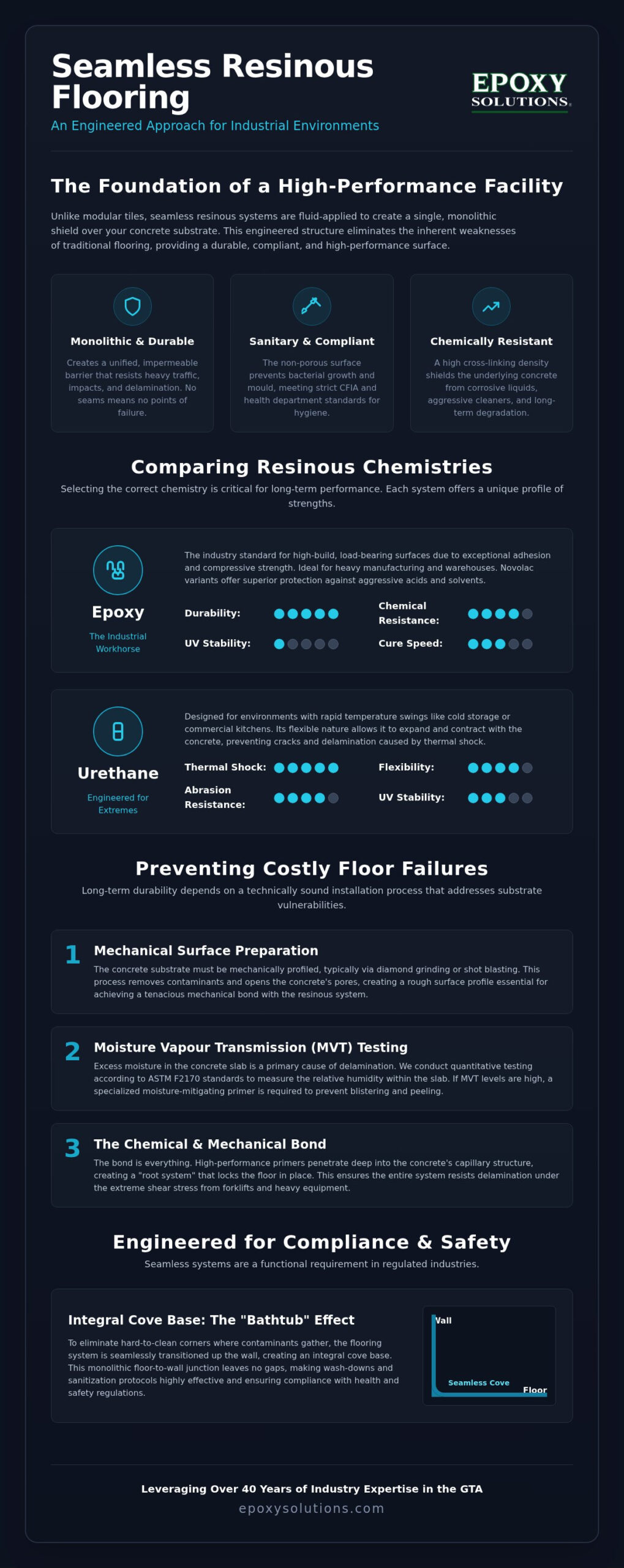
Grout lines are liabilities. In food processing centres or pharmaceutical labs, the gaps in traditional tiling act as breeding grounds for bacterial growth and mould. Meeting CFIA and local health department standards requires surfaces that are entirely non-porous and capable of withstanding aggressive sanitization protocols. We integrate integral cove bases to create a “bathtub” effect for wash-downs, transitioning the floor directly onto the wall. This leaves no corners or gaps for contaminants to hide, ensuring your facility remains compliant and safe for operation.
The Mechanics of the Chemical Bond
The bond is everything. Long-term durability depends on the chemical and mechanical lock between the resin and the concrete. High-performance resins penetrate deep into the concrete’s capillary structure before the curing process begins. This creates a mechanical root system that resists delamination and peeling, even under extreme shear stress from forklifts or heavy machinery. We focus on maximizing the bond strength to prevent the failures we often see from lower-tier installations.
Cross-linking density refers to the concentration of chemical bonds between polymer chains that dictates the final floor’s hardness, chemical resistance, and overall structural integrity. A higher cross-linking density results in a tighter molecular matrix. This dense network prevents corrosive liquids from penetrating the surface, shielding the underlying concrete from long-term degradation. It’s this level of molecular precision that separates an industrial-grade floor from a standard garage coating.
Comparing Resinous Chemistries: Epoxy, Urethane, and Beyond
Chemistry dictates longevity. Selecting the correct binder is the difference between a floor that lasts decades and one that fails in months. While there are dozens of formulations, most seamless resinous flooring systems rely on three primary chemistries: epoxy, polyurethane, and polyaspartic. Each serves a specific mechanical purpose. You must weigh trade-offs between cure speed, UV stability, and chemical resistance to ensure your investment survives the environment it’s placed in. Picking the wrong system for a specific load or exposure level is the most common reason for premature industrial floor failure.
Epoxy Systems: The Industrial Workhorse
Epoxy remains the industry standard for high-build, load-bearing surfaces. Its exceptional adhesion and compressive strength make it ideal for heavy manufacturing and warehouses. However, standard epoxies are prone to yellowing when exposed to sunlight. Selecting UV-resistant flooring is critical for spaces with high natural light exposure to prevent aesthetic and structural degradation. For environments involving aggressive acids or solvents, we specify Novolac epoxies, which feature a higher cross-linking density for superior chemical protection. To understand how these systems integrate into your facility, consult our High-Performance Epoxy: Guide for Industrial Facilities.
Urethane Mortars: Engineering for Thermal Shock
Concrete moves. In cold storage or commercial kitchens, rapid temperature swings cause the substrate to expand and contract. If the flooring doesn’t match the thermal expansion coefficient of the concrete, it will shear off and delaminate. Urethane mortars are engineered to mirror concrete’s movement, providing immunity to thermal shock during high-temperature steam cleaning. This is the premium standard for food-grade environments where hygiene and durability are non-negotiable. These systems offer a level of impact resistance that standard thin-film coatings simply cannot match.
Polyaspartic and MMA: Rapid Return to Service
Downtime is expensive. When a facility cannot shut down for a typical seven-day cure cycle, polyaspartic and Methyl Methacrylate (MMA) systems offer a 24-hour return to service. These seamless resinous flooring systems cure quickly even in unheated Canadian facilities, allowing for winter installations that would stall other projects. While MMA has a distinct odour requiring specialized ventilation during the application, its ability to cure in sub-zero temperatures makes it indispensable for specific logistical challenges. You gain speed without sacrificing the high-performance standards required for industrial use.
Selecting the right chemistry is a technical decision that shouldn’t be left to guesswork. If you need an accurate assessment of your facility’s requirements, contact our team to discuss a tailored solution.
The Authoritative Fixer: Why Resinous Floors Fail in Ontario
Bad floors aren’t bad luck. They’re the result of poor engineering and cut corners. Most seamless resinous flooring systems fail because the installer prioritized speed over science. The “low-bid trap” is a recurring theme in Ontario’s industrial sector; contractors win jobs by omitting critical testing phases, only for the client to face peeling and delamination within months. A high-performance floor is only as durable as the concrete profile it’s bonded to. If the mechanical bond is weak, the most expensive resin in the world won’t save it.
The Critical Nature of Surface Preparation
Preparation is a mechanical process, not a chemical one. You cannot simply clean a floor and expect a professional-grade coating to adhere. We must remove “laitance”, the fragile, powdery layer of cement paste that rises to the top during curing, along with deep-seated contaminants like oils or old adhesives. This requires specialized equipment. Diamond grinding is often sufficient for thin-film applications, but heavy-duty systems require shot-blasting to create the necessary “tooth” in the concrete. CSP is a standardized numerical scale from 1 to 9 that determines the specific roughness required for a resinous system to achieve a permanent mechanical lock with the substrate. Without the correct profile, the system remains a temporary topping rather than a permanent solution.
Moisture Vapour Mitigation: A Canadian Necessity
Ontario’s climate creates unique challenges for concrete slabs. High humidity and seasonal temperature shifts drive Moisture Vapour Transmission (MVT) from the ground through the porous concrete. When this moisture hits an impermeable resinous barrier, it builds hydrostatic pressure. The result is osmotic blistering, where the floor literally bubbles and detaches. In the GTA, ignoring MVT is an invitation for disaster.
Testing protocols must be rigorous. We don’t rely on guesswork or surface-level observations. While the anhydrous calcium chloride test measures moisture at the surface, we prefer in-situ RH probes to determine the relative humidity deep within the slab. If the data shows internal humidity levels above 75%, we deploy moisture-tolerant primers. These specialized resins are engineered to bond to damp concrete and suppress vapour pressure. It’s a standard-setting approach that ensures longevity in an environment where others typically fail. When your operation can’t afford a second attempt, getting the moisture mitigation right the first time is the only option.
Specifying Systems for Performance and Safety
Performance is engineered. Successful specification requires a comprehensive evaluation of mechanical load, chemical exposure, and thermal range. We don’t just look at the surface; we look at the entire operational cycle of your facility. Choosing a system based on the lowest bid rather than technical requirements is the most common path to failure. To see how these variables influence modern facility design, consult our Industrial Flooring Specs: Engineering Guide for 2026. We ensure the chemistry matches the physical demands of your environment.
Chemical Resistance and Secondary Containment
Chemical processing environments demand extreme resilience. Aggressive acids, alkalis, and solvents will rapidly degrade unprotected concrete, leading to structural instability and regulatory fines. Seamless resinous flooring systems act as the primary line of defence in secondary containment and tank lining applications. These leak-proof barriers are essential for environmental compliance, ensuring that hazardous spills are contained and easily remediated without penetrating the substrate. We provide specialized Novolac formulations that maintain integrity even under constant immersion in corrosive substances.
Static Control for Critical Environments
Static control is a requirement for high-tech infrastructure. In electronics plants or data centres, uncontrolled electrostatic discharge (ESD) can result in catastrophic equipment failure or data loss. We tailor our seamless resinous flooring systems to be either conductive or dissipative based on your specific grounding requirements. Securing your facility with Anti-Static Flooring for Critical Environments provides the reliability needed for sensitive Canadian manufacturing sectors. These systems provide a controlled path to ground, protecting both your hardware and your staff.
Safety and Traffic Management
Safety must be integrated into the floor’s design. Precision line marking isn’t just paint; it’s a vital safety component that defines pedestrian aisles and forklift zones to prevent workplace accidents. In wet processing areas, we specify the aggregate load to achieve a precise coefficient of friction (COF), ensuring slip resistance without compromising cleanability. For high-wear environments like parking decks or loading ramps, we apply specialized traffic toppings designed to withstand constant mechanical abrasion and seasonal temperature fluctuations. This comprehensive approach ensures your facility remains both efficient and compliant with Ontario’s rigorous safety standards.
If you’re ready to eliminate flooring failures and optimize your facility’s safety, contact us today for a high-performance specification tailored to your operation.
Professional Installation: The Epoxy Solutions™ Standard
Experience isn’t just a number; it’s a safeguard against facility failure. Since 1981, Epoxy Solutions™ has specialized in resolving the most complex industrial flooring challenges across North America. We don’t guess. We diagnose. Our “Problem-First” approach ensures we understand the specific environmental stressors of your facility before a single drop of resin is mixed. This strategy identifies the root cause of previous failures, such as chemical seepage or poor substrate integrity, allowing us to specify seamless resinous flooring systems that actually last. This meticulous execution guarantees a long-term ROI that low-bid contractors simply cannot provide.
Local expertise is non-negotiable for logistical success in the Greater Toronto Area. Operating out of Toronto, Mississauga, and Brampton, our teams understand the unique interplay between Ontario’s humidity and industrial concrete slabs. We manage the logistics of large-scale installations with precision, ensuring that material delivery and surface preparation align with your facility’s operational schedule. By choosing a partner with deep roots in the GTA, you eliminate the risks associated with installers who don’t realize how local climate variables impact the curing process.
Extreme Capability in Demanding Environments
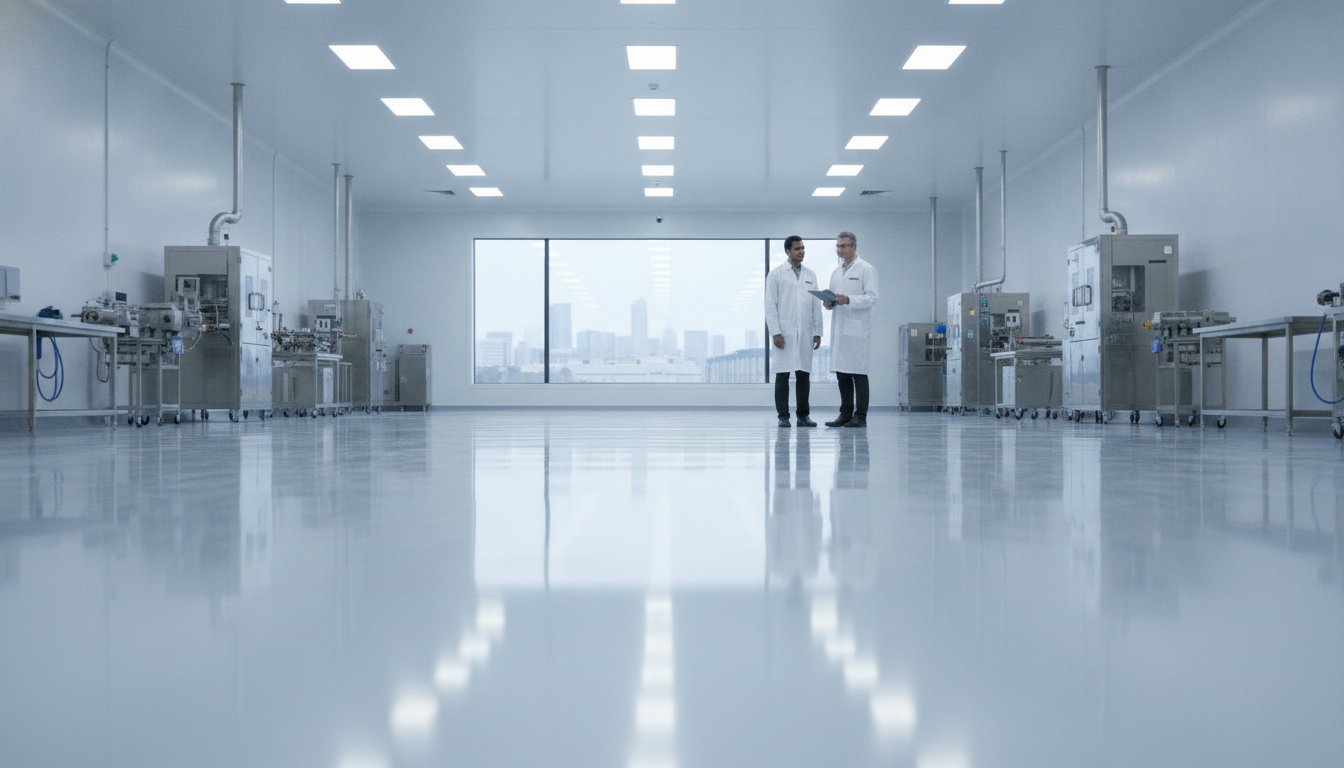
We thrive where others fail. Our portfolio includes high-pressure industrial sites and extreme temperature environments that would compromise standard coatings. From the rigid hygiene requirements of pharmaceutical cleanrooms to the massive mechanical loads found in aircraft hangars, we’ve set the industry standard for durability. As the “expert fixer” partner, we are frequently called in to remediate delaminated or non-compliant surfaces installed by less experienced crews who skipped the engineering phase. We don’t just apply a product; we engineer a permanent bond that withstands the harshest conditions.
Your Next Steps: Engineering Your Facility Floor
A durable floor starts with data, not a sales pitch. Moving from a broad specification to a tailored solution requires a professional site audit and rigorous core testing. We analyze the concrete’s integrity, pull-off strength, and moisture levels to eliminate the risk of osmotic blistering or bond failure. This level of technical accuracy is the only way to ensure your facility remains compliant and operational for the long haul. We provide the certainty that your investment will meet every safety and health regulation required in the Canadian market.
Contact Epoxy Solutions™ for a technical consultation.
Secure Your Facility with Engineered Durability
Industrial flooring is an investment in your operational future. Success depends on moving beyond the lowest bid to prioritize technical specifications and meticulous surface preparation. You now understand that seamless resinous flooring systems aren’t just coatings; they’re engineered bonds designed to withstand chemical corrosion, thermal shock, and heavy mechanical loads. By addressing moisture vapour transmission and selecting the correct resin chemistry, you eliminate the risk of peeling and delamination that plagues substandard installations.
Epoxy Solutions™ has been the standard-setting partner for North American facilities since 1981. As local GTA installation experts, we possess the specialized knowledge to resolve even the most demanding environmental challenges. We don’t just follow industry standards; we set them. If you’re ready to secure your facility with a high-performance surface that ensures regulatory compliance and long-term durability, it’s time to partner with a seasoned veteran. Request a Technical Quote from Epoxy Solutions™ to begin engineering a floor that performs under pressure. Your facility deserves a solution that lasts.
Frequently Asked Questions
What is the difference between a seamless resinous floor and a simple epoxy coating?
A seamless resinous floor is a multi-layered, engineered system, while a simple coating is often just a thin-film application. Professional seamless resinous flooring systems involve structural builds that penetrate the concrete substrate to create a permanent monolithic bond. Coatings typically lack the thickness and aggregate reinforcement required for heavy industrial loads. We focus on building a resilient surface that withstands mechanical stress rather than just painting over concrete.
How long does a seamless resinous flooring system typically last in an industrial setting?
A properly specified and installed system can last 10 to 20 years, depending on the environment and maintenance. Durability is a function of the chemical bond and the mechanical load it faces daily. In the GTA, where seasonal temperature shifts and heavy traffic are common, we engineer systems to resist delamination and wear. Longevity is ensured by matching the specific resin chemistry to your facility’s unique operational stressors and cleaning protocols.
Can resinous flooring be installed over old or damaged concrete?
Resinous flooring can be installed over damaged concrete provided the substrate is structurally sound and properly prepared. We specialize in repairing spalled or cracked slabs before applying the resin. This involves filling voids and ensuring the surface is free of contaminants like oils and old adhesives. If the concrete is severely compromised, we may recommend a high-build mortar system to level the surface and restore structural integrity before the final application.
How long is the downtime for a professional resinous floor installation?
Downtime varies by chemistry, typically ranging from 24 hours to seven days. While standard epoxy requires several days to reach full chemical cure, we offer rapid-cure polyaspartic and MMA systems for facilities in Mississauga and Brampton that cannot afford long shutdowns. These fast-track solutions allow for a return to service in as little as one day. We coordinate closely with your production schedule to minimize operational disruptions during the installation process.
Are seamless resinous floors easy to maintain and clean?
These floors are exceptionally easy to maintain because they lack grout lines where dirt and bacteria congregate. A simple regimen of sweeping and mopping with a pH-neutral cleaner is usually sufficient. In food processing or pharmaceutical centres, the non-porous surface withstands aggressive steam cleaning and chemical sanitizers. This seamless nature is a functional requirement for meeting CFIA standards, ensuring a sanitary environment that is far easier to manage than tiled or porous surfaces.
What industries benefit most from anti-static (ESD) flooring?
Electronics manufacturing, data centres, and pharmaceutical labs benefit most from anti-static systems. These environments contain sensitive components that can be destroyed by a single electrostatic discharge. We install conductive and dissipative seamless resinous flooring systems to provide a controlled path to ground. This protects expensive hardware and ensures facility safety in Vaughan and Toronto’s growing tech sectors, where reliability is the benchmark for operational success and equipment longevity.
How do you determine the correct slip resistance level for an industrial floor?
We determine slip resistance by assessing the Coefficient of Friction (COF) required for your specific workspace. If your facility involves wet processing or oil exposure, we integrate specialized aggregates into the resin to increase traction. The goal is to balance safety with cleanability; a floor that is too rough will trap dirt, while one that is too smooth poses a hazard. We tailor the texture to meet Ontario’s rigorous safety standards.
Why is surface preparation the most expensive part of a flooring quote?
Surface preparation is the most critical and labour-intensive phase because it dictates the bond’s success. We must mechanically remove laitance and contaminants to reach a clean concrete profile. This requires heavy machinery and technical expertise to achieve the correct CSP rating. Skipping this step is why low-bid floors fail. Investing in preparation ensures the resin penetrates the slab, creating a permanent lock that prevents peeling and delamination for decades to come.