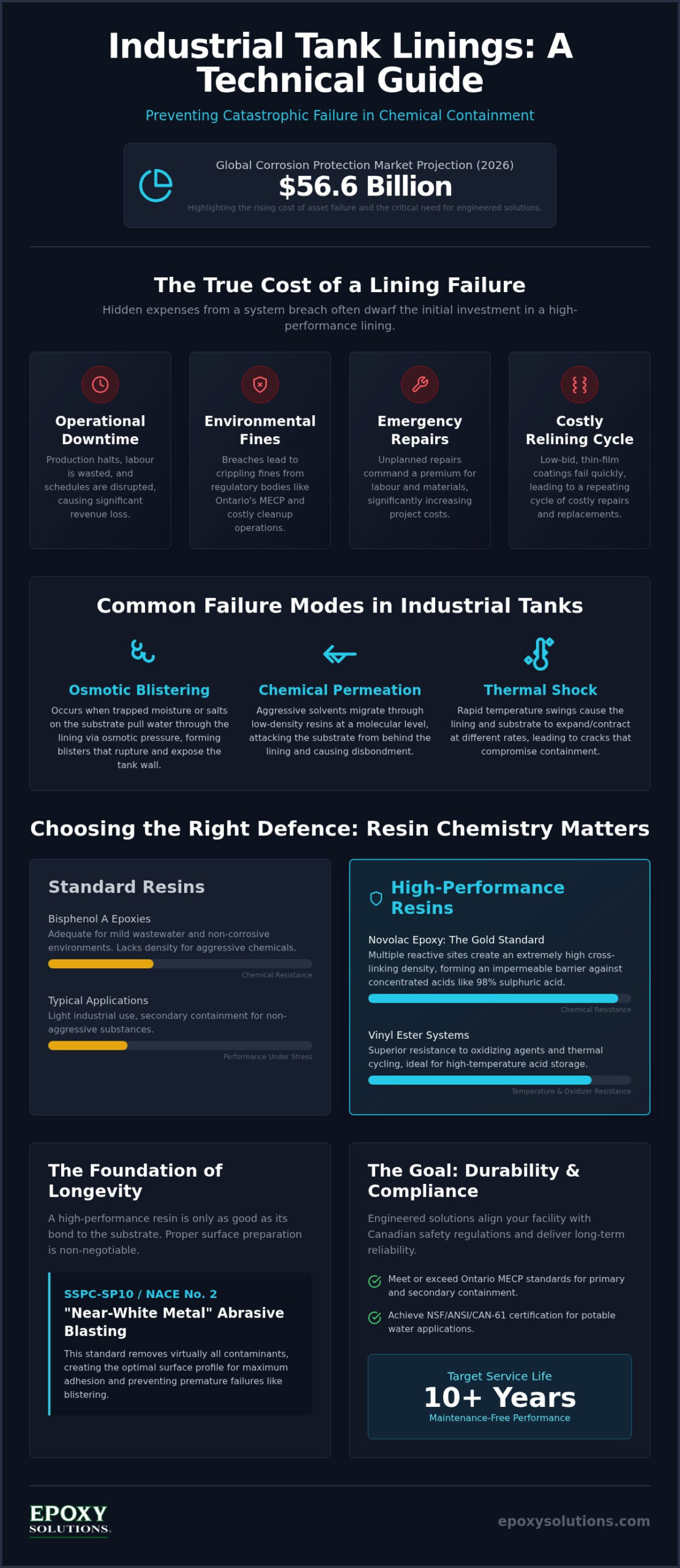
The global market for corrosion protection and acid-proof lining is projected to reach $56.6 billion in 2026. This staggering figure highlights a harsh reality for industrial operators; the cost of failure is rising, and the margin for error in chemical containment has vanished. Selecting a chemical resistant tank lining is no longer a matter of picking a product from a catalogue. It’s a high-stakes engineering decision that dictates whether your facility stays operational or faces crippling environmental fines and safety violations.
You likely realize that a lining failure is rarely about the material alone, but rather a breakdown in specification or surface preparation. It’s frustrating to deal with frequent downtime for repairs when you need a system that simply works without constant oversight. This article provides the technical roadmap to master industrial lining requirements, ensuring you prevent catastrophic failures and maintain full compliance with Canadian environmental regulations. We’ll examine specific resin chemistries for aggressive acids, the critical SSPC-SP10 surface standards, and the installation protocols necessary to achieve a maintenance-free service life of 10 years or more.
Key Takeaways
- Identify how the hidden costs of operational downtime and environmental fines often far exceed the initial investment of a high-performance lining system.
- Learn to differentiate between standard resins and high-density Novolacs to select the most durable chemical resistant tank lining for your specific acid or solvent profile.
- Establish a rigorous specification framework that accounts for both chemical concentration and fluctuating process temperatures to ensure long-term containment integrity.
- Recognize why abrasive blasting to near-white metal standards is a non-negotiable requirement for achieving a maintenance-free service life of 10 years or more.
- Align your facility with Canadian safety and environmental regulations by implementing engineered solutions that prioritize reliability over the lowest initial price point.
The High Cost of Corrosion: Why Tank Linings Fail
Corrosion destroys assets. It’s the primary reason industrial containment fails, leading to safety hazards that no facility manager can afford to ignore. While the material cost of a chemical resistant tank lining is a known variable, the hidden costs of a breach are far more volatile. Operational downtime often dwarfs the initial installation price. When a tank goes offline unexpectedly, production halts, labour is wasted, and emergency repairs command a premium. Many operators fall into the “lowest bid” trap, opting for thin-film coatings that look adequate on day one but disintegrate within 24 months. These short-term fixes result in a cycle of constant relining that bleeds capital and compromises the structural integrity of the substrate.
Common Failure Modes in Industrial Tanks
Failed linings usually stem from predictable physical and chemical stressors that were ignored during the specification phase. Understanding these modes is the first step toward prevention.
- Osmotic Blistering: This occurs when soluble salts or moisture remain on the substrate before application. The resulting osmotic pressure pulls water through the lining, creating blisters that eventually rupture and expose the tank wall.
- Chemical Permeation: Aggressive solvents can migrate through low-quality resins at a molecular level. While materials like Polytetrafluoroethylene (PTFE) offer extreme resistance in specialized applications, many standard industrial epoxies fail because they lack the cross-linking density required to block smaller molecules.
- Thermal Shock: Rapid temperature swings cause the substrate and the lining to expand at different rates. If the lining lacks sufficient flexibility, it cracks, allowing corrosive chemicals to reach the metal or concrete underneath.
Regulatory Compliance in Ontario
Operating in the Greater Toronto Area requires strict adherence to provincial mandates that prioritize environmental safety. The Ministry of the Environment, Conservation and Parks (MECP) enforces rigorous standards for secondary containment and primary vessel integrity. Facilities in Mississauga, Brampton, and Toronto must ensure their chemical resistant tank lining systems are documented and inspected to prevent leaks that lead to staggering environmental fines. Compliance isn’t just about the lining; it’s about the entire containment strategy. For instance, linings for potable water must meet NSF/ANSI/CAN-61 standards, while industrial chemical storage requires specific resistance profiles to prevent soil contamination. Regular audits in GTA facilities demand precise documentation of lining thickness and holiday testing to prove the barrier is continuous and defect-free.
Materials Science: Choosing the Right Chemical Resistance
Selection is a technical challenge, not a shopping trip. A chemical resistant tank lining isn’t a generic paint; it’s a high-build resinous barrier engineered to withstand specific pH levels, chemical concentrations, and fluctuating operating temperatures. While standard bisphenol A epoxies provide adequate protection for mild wastewater, they lack the molecular density required to repel concentrated acids or aggressive solvents. The performance of these systems depends entirely on the resin’s cross-linking density, which determines how well the lining blocks chemical molecules from reaching the substrate.
Vinyl ester systems are often the correct choice for high-temperature acid storage, as they offer superior resistance to oxidizing agents and thermal cycling. For fuel and solvent containment, phenolic epoxies remain the industry benchmark due to their tight molecular structure. However, most industrial failures occur because the wrong resin was selected for the specific chemical cocktail in the tank. You don’t need a one-size-fits-all product; you need a system tailored to your specific process chemistry.
Novolac Epoxy: The Industrial Gold Standard
Novolac resins are the heavy lifters of the industrial world. Unlike standard commercial epoxies that have only two reactive sites per molecule, Novolac resins have multiple functional groups. This creates a significantly higher cross-linking density during the curing process. This dense molecular web is why Novolac is the preferred choice for Mississauga chemical plants handling 98% sulphuric acid and other aggressive reagents. It provides a level of impermeability that standard coatings can’t match, making it the definitive answer for long-term protection in harsh environments.
Secondary Containment vs. Primary Lining
Requirements for the tank interior differ vastly from the surrounding pit or secondary containment area. While the primary chemical resistant tank lining must handle constant immersion, the secondary containment system often faces different environmental stressors, such as UV exposure and physical impact. For exterior assets in the GTA, integrating UV resistant epoxy flooring is essential to prevent the lining from chalking or degrading under the sun.
Compliance with EPA hazardous waste tank standards dictates that these liners must be completely impermeable to prevent environmental migration. If you’re managing hazardous materials, ensuring your secondary containment is as robust as your primary vessel is the only way to avoid regulatory scrutiny. If your current containment looks weathered or cracked, a professional assessment is the first step toward securing your facility’s future.
Lining Specification: A Comparison Framework
Engineering a lining system requires more than a cursory glance at a data sheet. It demands a rigorous “if-then” framework that aligns resin chemistry with the harsh operational reality of your facility. A chemical resistant tank lining must be specified based on the highest possible concentration of the reagent, not just the average. Temperature is the second critical variable; a resin that survives ambient storage might delaminate or soften at a process temperature of 60°C. We also account for physical stresses. Mixing tanks equipped with agitators require high-build systems with superior abrasion resistance to prevent erosion at the vortex. To ensure the tank design itself supports a successful lining, we follow NACE SP0178-2007, which dictates the necessary weld smoothing and corner radiusing for industrial vessels.
Material Selection Matrix
Resin choice depends on the specific molecular interaction between the stored chemical and the polymer chain. For pH extremes, such as concentrated hydrochloric acid or caustic soda, vinyl esters or high-density Novolacs provide the necessary barrier to prevent substrate attack. Solvents and hydrocarbons present a different challenge; they can cause standard resins to swell or soften, leading to total bond failure. In these environments, phenolic-modified epoxies are the standard. For food and beverage processing in the GTA, any chemical resistant tank lining must also meet CFIA and FDA standards to ensure zero toxic leaching and maintain product purity throughout the production cycle.
Concrete Tank Challenges
Concrete is a living substrate that presents unique difficulties compared to steel. In Brampton facilities, where temperature fluctuations are common, managing outgassing is a priority. As the concrete warms, air trapped in the pores expands, creating pinholes in the wet lining that eventually lead to failure. We utilize specialized primers to seal the substrate and prevent moisture vapour transmission from blistering the finish. Crack bridging is equally vital; the lining must possess enough tensile strength and flexibility to span minor structural movements without rupturing. For a deeper look at substrate requirements, our guide on industrial flooring specifications details the mechanical preparation standards essential for resinous adhesion on Canadian concrete. This ensures that the foundation of your containment system is as reliable as the chemical barrier itself.
The Installation Standard: Surface Prep and Application
Preparation dictates performance. You can specify the most advanced chemical resistant tank lining in the world, but it will fail prematurely if the substrate isn’t properly engineered to receive it. Most industrial lining failures are not caused by chemical attack, but by a lack of adhesion resulting from poor surface preparation. We treat the substrate as the foundation of the entire system. For steel vessels, this means achieving a specific anchor profile through abrasive blasting. For concrete tanks, it requires mechanical profiling to create a “mechanical lock” that ensures the resin becomes part of the substrate rather than just a film sitting on top of it.
Environmental control is the second pillar of a successful installation. We monitor humidity and dew point with precision throughout the application process. If the substrate temperature isn’t at least 3°C above the dew point, moisture will condense on the surface, leading to flash rust on steel or osmotic blistering in the finished lining. We don’t guess at these conditions; we document them to ensure every layer cures in a controlled environment that supports long-term durability.
Abrasive Blasting and Profile Checks
Achieving the correct anchor profile, typically measured in mils, is essential for high-build linings to bond correctly. Before any coating is applied, we test for soluble salts and non-visible contaminants that can cause osmotic failure even under a perfect-looking finish. The SSPC-SP10 Near-White Metal blast standard requires the removal of all visible contaminants and mill scale, allowing only light shadows or streaks to remain on no more than 5% of each square inch of the surface. This level of cleanliness is the industry benchmark for high-performance containment systems in demanding environments.
Quality Control and Spark Testing
Our quality control process is designed to eliminate human error and identify microscopic defects before the tank returns to service. High-voltage holiday detection, or spark testing, is a non-negotiable step where we pass an electrode over the entire lining surface to find “pinholes” that are invisible to the naked eye. We also conduct rigorous Dry Film Thickness (DFT) monitoring to ensure the lining meets the engineered specification at every point. Finally, pull-off adhesion testing verifies the bond strength, proving that the chemical resistant tank lining will remain intact under the pressure of constant immersion and thermal cycling. If you want to ensure your facility meets these rigorous installation standards, consult with our technical specialists before your next shutdown.
Why Epoxy Solutions™ is the GTA Authoritative Choice
Experience counts in containment. Since 1981, we have specialized in high-performance resinous systems that stand up to the most aggressive industrial environments in North America. We don’t offer fluff or vague promises. Instead, we provide a direct, solution-oriented approach that prioritizes long-term reliability over the lowest initial price point. Our team has seen every failure mode in the field and possesses the technical expertise to resolve them before they lead to a breach. When other systems fail within 24 months, we are the partner that steps in to set the standard. Our chemical resistant tank lining specifications are engineered to be the benchmark against which the rest of the industry is measured.
We pride ourselves on extreme capability. Whether it’s a demanding industrial site in the heart of Toronto or a complex chemical processing plant in Mississauga, we perform under pressure. Our reputation is built on a legacy of craftsmanship and a no-nonsense attitude toward quality. We don’t just follow industry codes; we define them through meticulous execution and a commitment to durability that few can match.
Local Expertise in Toronto and Mississauga
Operating in the Greater Toronto Area requires a deep understanding of local environmental standards and the specific needs of Ontario’s industrial sector. We provide rapid response and expert consultation for facility managers in Brampton, Milton, and Vaughn, ensuring that your critical assets remain compliant and operational. Our capability extends beyond the tank itself. We can integrate high-performance epoxy across your entire facility, from secondary containment pits to high-traffic production floors. This holistic approach ensures that every square inch of your plant is protected by a unified, durable barrier that meets MECP requirements and provincial safety codes.
The Long-Term ROI of Quality
Cheap linings are expensive. When you calculate the total cost of ownership, the initial price of a chemical resistant tank lining is only one part of the equation. Frequent downtime, emergency relining, and potential environmental fines for containment breaches can quickly turn a budget choice into a financial disaster. We focus on premium performance that delivers a maintenance-free service life of 10 years or more. This level of durability protects your workforce, secures your environment, and ensures your facility stays in total compliance with Canadian regulations. Don’t settle for a temporary fix when you can invest in a permanent solution. Consult with an expert fixer for your tank lining needs and secure your facility’s future today.
Securing Your Industrial Assets for the Long Term
Containment failure is preventable. A successful chemical resistant tank lining is the result of technical precision, not just material selection. You’ve seen how the hidden costs of downtime and environmental non-compliance can cripple a facility. By prioritizing high-density resin chemistries and non-negotiable surface preparation standards, you move away from the “lowest bid” cycle and toward a decade of maintenance-free containment.
Epoxy Solutions™ has been serving North America since 1981, specializing in high-performance resinous systems that stand up to the harshest industrial stressors. Our GTA-based expert installation teams understand the specific MECP requirements and climate challenges unique to Toronto, Mississauga, and Brampton. We don’t provide temporary fixes; we engineer benchmarks for reliability that protect both your workforce and your bottom line.
Get a Professional Tank Lining Specification for Your Facility. Protecting your infrastructure is a high-stakes decision, but with the right engineering partner, it’s a challenge you can solve permanently. Your facility deserves the security of a standard-setting installation.
Frequently Asked Questions
What is the most chemical resistant tank lining for sulphuric acid?
Novolac epoxy systems are the most reliable choice for concentrated sulphuric acid containment. While standard epoxies fail at lower concentrations, Novolac’s dense molecular structure resists the aggressive oxidation of 98% sulphuric acid. In Mississauga chemical plants, we specify these high-build systems to ensure long-term integrity. The final choice depends on the specific concentration and temperature, as vinyl esters may also be considered for oxidizing environments with frequent thermal cycling.
How long does a typical industrial tank lining installation take?
A typical industrial tank lining installation generally requires five to ten business days from start to finish. This timeline includes mechanical surface preparation, multiple coating applications, and the mandatory curing period. For facilities in Brampton or Toronto, we prioritize efficient execution to minimize operational downtime. Factors such as tank size, substrate condition, and environmental humidity can influence the schedule, but we never compromise on the curing time required for maximum resistance.
Can you reline a tank that has already failed?
Relining a failed tank is possible provided the underlying substrate maintains its structural integrity. We begin by removing the failed coating and performing a thorough inspection for corrosion or pitting. If the metal or concrete is sound, we use abrasive blasting to reach a clean profile before applying a new chemical resistant tank lining. This fixer approach is common for aging GTA assets where the original lining was under-specified or poorly installed.
What is the difference between epoxy and Novolac tank linings?
The primary difference lies in the cross-linking density and the number of reactive sites per molecule. Standard epoxies are suitable for mild chemicals and water, but they lack the molecular tightness to block aggressive solvents or acids. Novolac resins feature multiple functional groups that create a much denser chemical barrier. This makes Novolac the authoritative choice for high-concentration chemical storage where standard commercial coatings would simply soften or delaminate over time.
Do tank linings require specific certifications in Canada?
Tank linings in Canada must meet specific standards based on the stored substance. For potable water, NSF/ANSI/CAN-61 certification is mandatory to prevent toxic leaching. Food processing facilities in the GTA must adhere to CFIA and FDA regulations for direct contact surfaces. For industrial chemicals, the focus shifts to MECP compliance for secondary containment, ensuring that the lining system meets provincial environmental protection mandates for hazardous waste and spill prevention.
How often should industrial tank linings be inspected?
Industrial tank linings should undergo a professional inspection at least once every twelve to twenty-four months. High-use vessels or those containing aggressive reagents may require more frequent checks to identify early signs of blistering or erosion. In Milton and Vaughn, we recommend annual holiday testing and thickness checks during scheduled shutdowns. Proactive monitoring identifies minor defects before they evolve into catastrophic failures, significantly extending the service life of the lining system.
What is holiday detection and why is it necessary?
Holiday detection is a high-voltage spark test used to locate microscopic pinholes or voids in a cured lining. Even a single holiday allows chemicals to reach the substrate, leading to rapid corrosion underneath the coating. By passing an electrode over the surface, we ensure the chemical resistant tank lining is completely continuous and defect-free. This quality control step is non-negotiable for primary containment vessels where a single leak can result in massive environmental fines.
Is secondary containment lining required by law in Ontario?
Secondary containment is legally required in Ontario for tanks storing hazardous materials, as mandated by the Ministry of the Environment, Conservation and Parks (MECP). These regulations ensure that any primary vessel failure is contained within a leak-proof barrier to prevent soil or groundwater contamination. We design and install secondary containment systems for GTA facilities that meet all provincial safety codes, providing a critical safety net that protects both the environment and the operator.