

A single 100-volt discharge is enough to cripple a modern server rack and compromise years of proprietary data. This spark is so small that a human cannot even feel it, yet its impact on your bottom line is immediate. You understand that your hardware is the lifeblood of your GTA facility. You likely worry about dust from deteriorating surfaces and the constant threat of electrostatic discharge that standard floors cannot mitigate. Choosing specialized anti-static flooring for server rooms is a technical necessity rather than a cosmetic choice. Substandard flooring is a liability you cannot afford when uptime is the only metric that matters.
Discover how specialized ESD resinous flooring protects mission-critical hardware from catastrophic static discharge while ensuring long-term durability in Canadian data centres. This guide explains why your facility must exceed the latest ANSI/ESD S20.20-2021 standards to remain effective. We will explore how seamless resinous systems eliminate the dust-borne contaminants found in carpeted spaces and provide the structural integrity needed to support heavy server racks. You will learn how professional, local installation ensures your facility meets rigorous IBM recommendations for resistance and safety while standing up to the demands of a high-traffic environment.
Key Takeaways
- Latent hardware failure often stems from static events well below human perception. You will learn how to identify these risks before they compromise your data centre’s uptime.
- Fibrous flooring materials like carpet are primary sources of dust that clog cooling systems. We explain why seamless resinous surfaces are the superior choice for maintaining air quality and hardware health.
- Implementing professional anti-static flooring for server rooms ensures your facility can handle the extreme weight of modern server racks without losing electrical continuity.
- Navigating ANSI/ESD S20.20-2021 standards requires an understanding of how local humidity levels in the GTA impact static generation. This guide details the necessary specifications for Canadian compliance.
- A successful installation relies on a “problem-first” diagnostic approach. Learn why veteran expertise is required to specify a tailored system that guarantees long-term protection.
The Hidden Risk of Static Discharge in Mission-Critical IT
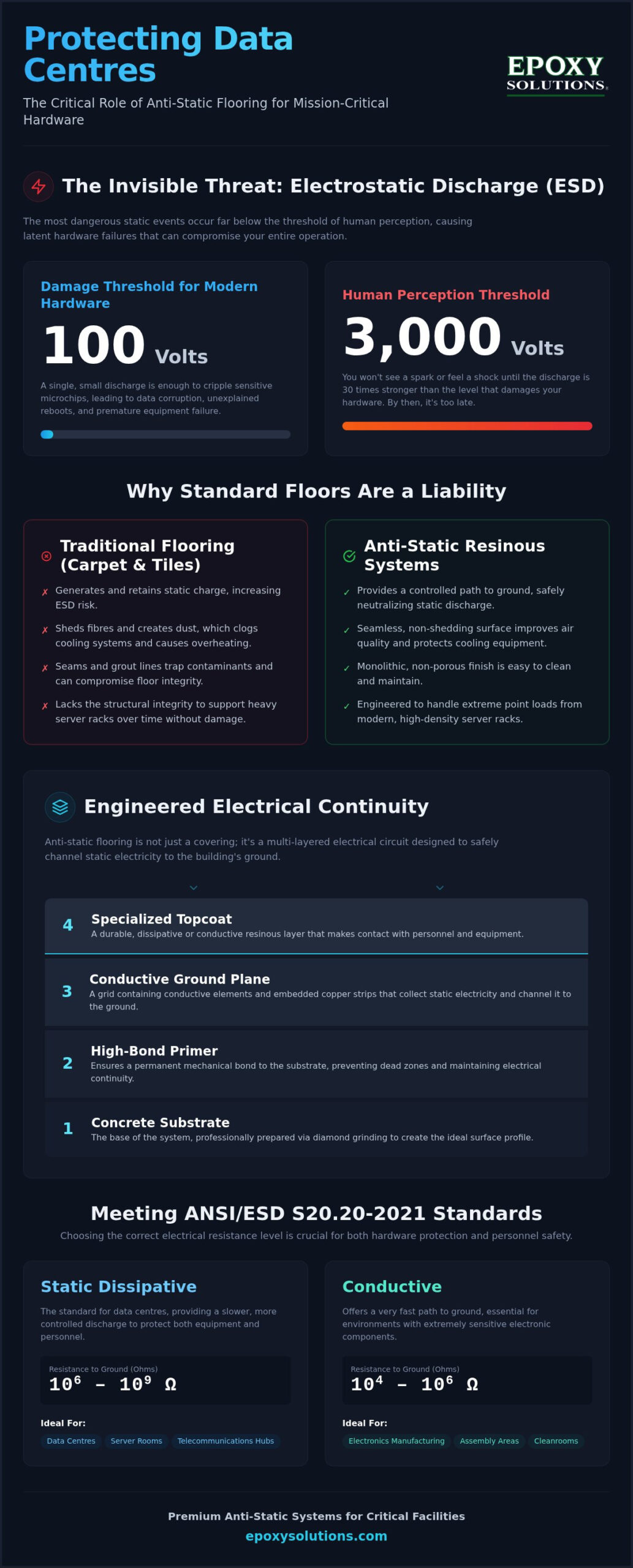
Static kills hardware. In high-density IT environments, Electrostatic Discharge (ESD) represents a silent, constant threat to operational integrity. While most people associate static with a visible spark, the most dangerous events occur far below the threshold of human perception. You won’t feel a discharge until it reaches roughly 3,000 volts. By then, the damage is already done. Modern microchips are sensitive to charges as low as 100 volts, meaning your equipment is likely suffering from “latent failures” that standard commercial flooring cannot prevent. These invisible events lead to unexplained data corruption, hardware reboots, and significant yield loss in sensitive telecommunications hubs.
Understanding ESD Hazards: Product Loss and Process Instability
Precision is non-negotiable. Random ESD damage is a primary driver of process instability and premature equipment retirement. When a server rack experiences a sub-perceptual discharge, the component might not fail instantly. Instead, it develops a “wound” that causes it to malfunction weeks or months later under heavy load. This creates a nightmare for IT managers who must diagnose “ghost” errors that have no clear origin. ESD flooring provides a permanent grounding solution for critical infrastructure by creating a controlled path for static to safely reach the earth. Relying on “good enough” flooring is a business risk that eventually manifests as expensive downtime.
Beyond Static: The Importance of Air Quality and Dust Control
Dust destroys cooling. Traditional flooring materials like carpet or low-grade tiles are major contributors to particulate matter. These fibres break down over time and are pulled into high-velocity cooling fans, coating heat sinks and causing thermal throttling. Many facilities utilize a Raised access computer floor to manage cabling and airflow, but the finish on these panels must be non-porous to maintain air quality. Resinous anti-static flooring for server rooms offers a seamless, non-shedding surface that protects cooling systems from airborne debris. By combining electrical continuity with superior air quality control, these high-performance floors eliminate the environmental variables that compromise mission-critical hardware.
Engineering Electrical Continuity: How Anti-Static Resinous Systems Work
High-performance anti-static flooring for server rooms is an engineered electrical circuit, not just a floor covering. Reliability depends on a layered system that manages the flow of static electricity from the surface to the building’s ground. A standard installation consists of a high-bond primer, a conductive ground plane, and a specialized topcoat. Unlike modular tiles that rely on interlocking joints, this resinous stack creates a monolithic path for electrons. Copper grounding strips are embedded into the conductive grid layer and connected directly to the facility’s electrical earth. This ensures that any charge generated by movement is immediately neutralized before it can reach sensitive hardware.
Surface preparation is the single most critical factor in maintaining electrical continuity. If the resin does not achieve a mechanical bond with the concrete, the electrical path is compromised. We utilize diamond grinding to achieve a specific concrete surface profile (CSP) before any material is applied. Without this meticulous preparation, the floor may delaminate under the weight of equipment, leading to “dead zones” where the anti-static properties fail entirely. A professional installation ensures that every square centimetre of your facility remains within the safe resistance range defined by the ANSI/ESD S20.20 standard.
Conductive vs. Dissipative: Selecting the Right Resistance Level
Selecting the correct resistance level is a balance between safety and protection. Conductive flooring typically measures between 2.5 x 10^4 and 1.0 x 10^6 ohms, offering a very fast path to ground. While essential for certain electronics manufacturing, most data centres specify dissipative ranges between 1.0 x 10^6 and 1.0 x 10^9 ohms. This range is optimal for preventing rapid discharges while providing a safer environment for technicians working around high-voltage power supplies. Consistent readings across the entire surface are mandatory to prevent localized static build-up that could jump to a server rack.
The Resinous Advantage: Seamless Grounding for Heavy Loads
Modern server racks exert massive point loads that can exceed the structural limits of standard tile systems. Resinous anti-static flooring for server rooms is designed to handle these weights without cracking or shifting. Because the system is seamless, there are no “weak links” at the joints where electrical continuity often fails in carpet or vinyl installations. This permanent solution does not require the use of topical anti-static waxes, which are temporary and often leave behind residues that compromise air quality. If you are designing a high-density facility, consulting with Epoxy Solutions during the specification phase ensures your floor meets both load-bearing and electrical requirements for the long term.
Resinous vs. Carpet Tiles: Why Server Rooms Demand Seamless Surfaces
Carpet is a liability. While common in general offices, it has no place in mission-critical IT environments. The primary issue is the “Dust Factor.” Carpet tiles are fibrous by nature and shed microscopic particles every time a technician walks across the floor. These fibres are immediately drawn into high-velocity server cooling fans, coating internal heat sinks and driving up operating temperatures. Resinous anti-static flooring for server rooms is a monolithic, non-shedding surface that eliminates this risk entirely. It ensures that your cooling infrastructure remains efficient and your hardware stays clean.
Structural integrity is another differentiator. Modern server racks often exceed 2,000 lbs in a very small footprint. This concentrated point load causes carpet tiles to compress, indent, and eventually shift, which breaks the electrical continuity required for ESD protection. Resinous systems are bonded directly to the concrete substrate, providing a high-performance surface that handles massive weight without deformation. Additionally, UPS rooms require protection against battery acid leaks. While a chemical spill would permanently ruin a carpeted floor, our chemical-resistant resinous coatings provide a durable barrier that protects the slab and simplifies cleanup.
Maintenance Realities: Beyond the Vacuum
Cleanliness impacts compliance. In ISO-rated cleanrooms or high-density centres, maintaining the EOS/ESD Association standards requires regular testing of the floor’s resistance to ground. Carpet tiles trap dirt and skin cells within the pile, which can insulate the conductive fibres and lead to inconsistent readings. Resinous floors are non-porous and easy to decontaminate with simple, approved cleaners. This ensures the floor remains “testable” and fully compliant year after year, avoiding the hidden labour costs associated with deep-cleaning fibrous materials.
The Myth of Low-Cost Carpet: Long-Term ROI Analysis
Initial savings are deceptive. A standard ESD carpet might last five to seven years before wear patterns and adhesive failure necessitate a full replacement. This cycle requires moving active server racks, a high-risk operation that most IT managers want to avoid at all costs. Epoxy Solutions™ specifies resinous systems designed for 20+ year lifecycles. When you factor in the cost of replacement, the risk of hardware failure, and the loss of productivity, the initial investment in resinous anti-static flooring for server rooms is easily justified. Professional installation is the only way to guarantee a permanent, standard-setting result.
Specifying ESD Flooring in the GTA: Compliance and Climate
Compliance in the Canadian market requires more than a basic understanding of electrical resistance. For facilities in Toronto and the surrounding Golden Horseshoe, meeting the ANSI/ESD S20.20-2022 standard is the baseline. However, local operators must also navigate Ontario-specific building codes, fire safety regulations, and strict VOC (Volatile Organic Compound) standards. A failure to account for these local variables during the specification phase leads to permit delays and potential safety liabilities. We ensure that every installation of anti-static flooring for server rooms aligns with both international ESD requirements and provincial environmental mandates.
The Impact of Canadian Humidity on Static Control
Toronto’s climate presents a unique technical challenge for static management. During the winter months, indoor humidity levels in the GTA can drop significantly as heating systems work to combat the exterior cold. Dry air is a primary catalyst for electrostatic accumulation. If your flooring system is not engineered to compensate for these seasonal fluctuations, its dissipative performance will degrade exactly when you need it most. Selecting systems that perform regardless of HVAC fluctuations is essential for year-round hardware protection. Standard-Setting installation is required for GTA climate stability to ensure the floor’s conductive properties remain constant through every seasonal cycle.
Local Installation Logistics: Minimizing Facility Downtime
Data centres in Mississauga, Brampton, and Vaughan operate on a zero-downtime mandate. Installing anti-static flooring for critical environments requires a contractor who understands the logistical constraints of high-density industrial zones and high-rise IT hubs. We utilize phased installation strategies that allow your facility to remain partially active while we work. This methodical approach minimizes disruption and ensures that the transition to a high-performance surface is seamless. Our team manages the specific zoning requirements and site access challenges common to the GTA, moving your project from a state of risk to total compliance without unnecessary delays. If you are planning a facility upgrade, you can contact our GTA experts to schedule a technical site assessment.
Epoxy Solutions™: Premium Anti-Static Systems for Critical Facilities
Generic flooring specifications lead to expensive failures. At Epoxy Solutions™, we utilize a “Problem-First” approach that begins with a technical diagnosis of your specific environment before a single drop of resin is poured. We understand that a data centre in the GTA faces different stresses than a standard industrial warehouse. Since 1981, our team has engineered reliability into critical infrastructure across North America. We don’t just sell coatings; we provide a standard-setting foundation that ensures your mission-critical hardware remains protected from the invisible threat of electrostatic discharge.
Experience matters in a high-stakes environment. Our legacy of over 40 years in the resinous flooring industry has allowed us to refine our systems to meet the evolving needs of modern IT hubs. We specialize in creating tailored anti-static flooring for server rooms that balances electrical dissipative properties with extreme mechanical durability. This commitment to high-performance results has made us the trusted partner for facility managers in Toronto and the wider GTA who cannot afford the risk of substandard work.
Why Our ESD Systems Outperform the Competition
Reliability is built from the substrate up. Most anti-static floors fail because the installer prioritized speed over surface preparation. We utilize meticulous diamond grinding to create a mechanical bond that ensures permanent electrical grounding. Our high-build systems are specifically engineered to withstand the constant point-load traffic of heavy server racks without cracking or losing continuity. For a deeper look at the technical requirements of these environments, you can review our industrial flooring specifications to see how we set the benchmark for quality.
- Permanent Grounding: Our systems do not rely on temporary topical treatments.
- Impact Resistance: Engineered to handle the weight of high-density hardware.
- Seamless Hygiene: Eliminates the dust and debris traps found in tile systems.
Your Partner for Mission-Critical Reliability
Local expertise is essential for complex GTA projects. From the high-tech corridors of Mississauga to the growing industrial hubs in Vaughn, we understand the logistical and regulatory demands of the Ontario market. Our approach is fundamentally blunt: we prioritize longevity and safety over the lowest price point. This no-nonsense attitude toward quality ensures that your facility meets all current standards while providing a 20+ year lifecycle. When uptime is the only metric that matters, you need an authoritative partner who has seen every possible challenge and possesses the expertise to resolve it. Contact Epoxy Solutions™ for a professional assessment of your server room floor to begin securing your critical infrastructure.
Securing Your Critical Infrastructure for the Long Term
Protecting your hardware requires more than a superficial floor covering. The evidence is clear: sub-perceptual static events cause latent failure, and fibrous materials like carpet are the primary enemy of server cooling fans. Selecting high-performance anti-static flooring for server rooms is a decision that impacts your facility’s uptime and your company’s bottom line for decades. Resinous systems provide the seamless durability and electrical continuity that modular alternatives simply cannot match, especially when facing the dry winter climate of the GTA.
Epoxy Solutions™ has served the GTA since 1981. We specialize in high-performance resinous systems and provide expert installers for mission-critical environments. We don’t just follow industry standards; we set them. Our team is ready to help you navigate the complexities of ANSI/ESD S20.20-2022 compliance and ensure your facility remains safe, clean, and operational. Request a Technical Consultation for Your GTA Facility today to begin your upgrade. We look forward to engineering a permanent solution for your data centre.
Frequently Asked Questions
What is the difference between anti-static and ESD flooring for server rooms?
Anti-static is a general descriptor for materials that inhibit the initial build-up of static electricity. ESD (Electrostatic Dissipative) flooring is a technical system designed to ground charges safely by providing a controlled path to the earth. In your Mississauga or Toronto facility, you need a system that meets specific ohm-range requirements. Standard anti-static flooring for server rooms might only prevent a human from feeling a shock, but a true ESD resinous floor protects the internal circuitry of your hardware.
Does anti-static flooring really protect server hardware from data corruption?
It is a technical reality that sub-perceptual discharges cause the most damage. These events don’t always kill a server instantly; they create latent defects that lead to unexplained reboots and data corruption. By maintaining a consistent resistance to ground, our resinous systems eliminate the environmental variables that trigger these discharges. This level of protection is essential for GTA data centres that manage mission-critical information where even a single bit-flip can have catastrophic consequences.
How long does it take to install a resinous ESD floor in an existing data centre?
A standard installation usually requires three to five days. This timeline accounts for meticulous surface preparation, the application of conductive layers, and the curing of the high-performance topcoat. We often utilize phased strategies for active facilities in Brampton or Vaughn to minimize operational downtime. While the resin needs time to reach full chemical maturity, our efficient process ensures your server racks are back in service as quickly as possible without compromising the floor’s electrical integrity.
Can I install anti-static resinous flooring over an existing concrete slab?
We almost exclusively install these systems over existing concrete slabs. The success of the project depends entirely on surface preparation. We use diamond grinding to remove contaminants and open the concrete pores, ensuring the resin achieves a permanent mechanical bond. If the slab has cracks or moisture issues, we resolve those failures first. A properly prepared concrete base is the only way to guarantee the long-term performance and electrical continuity of your anti-static flooring for server rooms.
How often do I need to test my server room floor for ESD compliance?
Industry standards like ANSI/ESD S20.20-2021 suggest annual testing at a minimum. However, high-traffic centres in Toronto may benefit from bi-annual audits to ensure the floor’s resistance remains within the specified range. Testing involves measuring the resistance from the surface to the ground at various points across the floor. Regular verification proves that your facility remains compliant and that your hardware is still protected from the seasonal humidity shifts common in the Ontario climate.
Does the colour or finish of the floor affect its anti-static properties?
The colour of your floor is purely aesthetic and does not impact its electrical performance. We engineer the conductivity into the primer and isolation layers, meaning you can choose a finish that improves visibility or matches your brand without sacrificing safety. Whether you prefer a high-gloss grey or a light-reflective cream, the electrical dissipative properties remain constant. This allows GTA facility managers to create a professional environment that still meets the most rigorous technical specifications for static control.
Is anti-static flooring required by law for Canadian data centres?
While no specific “anti-static law” exists, compliance is often mandatory to meet Ontario building codes, fire safety regulations, and insurance requirements. Most mission-critical IT contracts also dictate adherence to ANSI/ESD standards to mitigate risk. Operating a data centre in the GTA without proper static control is considered a major liability. Failing to meet these industry benchmarks can lead to the loss of facility certification and significant financial exposure in the event of a hardware failure.
What is the typical lifespan of a premium ESD resinous floor in a high-traffic facility?
A premium resinous system is designed for a 20+ year lifecycle. Unlike carpet tiles that fray or modular vinyl that loses its bond, a monolithic resinous floor remains structurally sound under the weight of heavy server racks. We have been installing these systems since 1981 and have seen them outlast multiple generations of server hardware. This longevity provides a superior return on investment compared to cheaper, short-term flooring options that require frequent replacement and high-risk facility shutdowns.