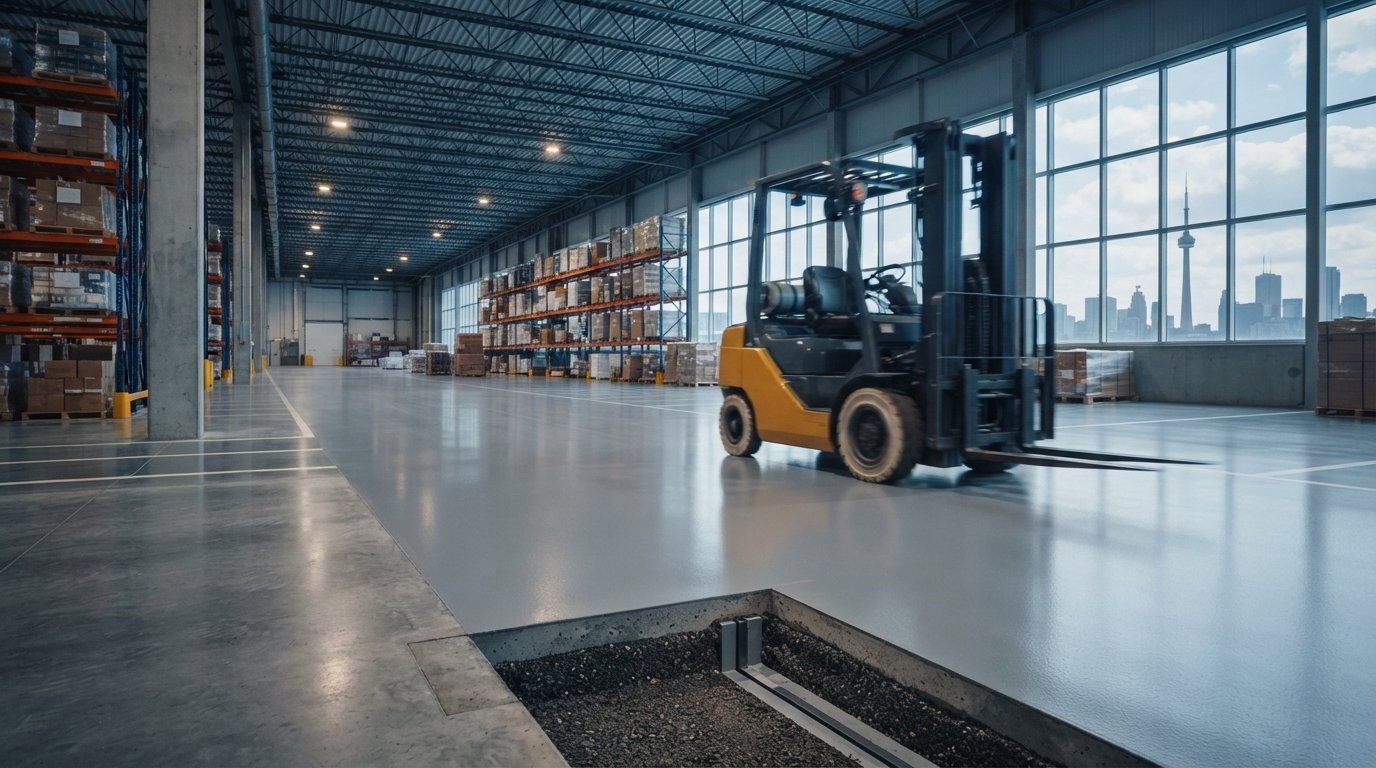
Most industrial floors in the GTA aren’t designed to survive a forklift; they’re merely waiting to fail under the weight of a three-tonne machine. A standard warehouse slab undergoes a relentless mechanical assault every time a solid polyurethane wheel traverses its surface. When you’re searching for durable flooring for forklift traffic Toronto facility managers often find that generic coatings peel or crack within months, leading to expensive downtime and safety violations.
You likely realize that a floor is only as strong as its bond to the substrate. It’s frustrating to watch a significant investment deteriorate because the specification didn’t account for 2,000 PSI point loads. This guide ensures you master the technical requirements to survive heavy forklift traffic and shear stress in demanding GTA industrial environments. We will examine the critical role of compressive strength, the science of joint armoring, and the precise mechanical preparation needed to achieve a ten-year lifespan. By the end, you’ll have the expertise to choose a system that exceeds Ontario safety standards while minimizing long-term maintenance costs.
Key Takeaways
- Understand the physics of point loads and why standard concrete slabs fail under the 2,000 PSI pressure exerted by solid forklift wheels.
- Master the technical specifications for durable flooring for forklift traffic Toronto logistics hubs require to handle constant rotational shear stress.
- Evaluate the life-cycle costs and performance trade-offs between polished concrete and high-performance resinous coatings in high-traffic zones.
- Learn to assess your facility’s specific needs based on shift volume, substrate condition, and current Ontario safety regulations.
- Discover why industry-leading mechanical surface preparation is the only way to prevent delamination and achieve a floor lifespan exceeding 10 years.
The Physics of Failure: Why Forklift Traffic Destroys Standard Floors
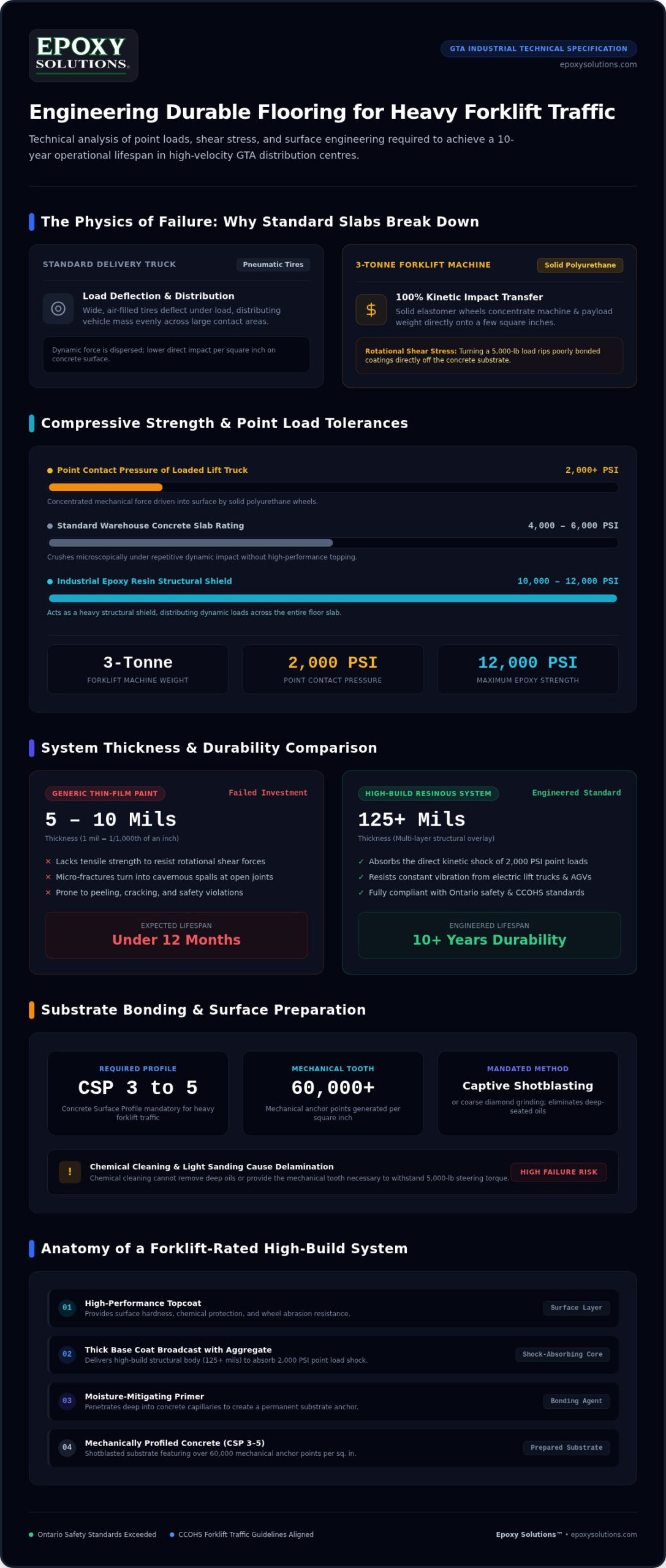
Forklifts are mechanical wrecking balls. While a standard delivery truck distributes its weight across wide, air-filled tires, a forklift concentrates its entire mass, plus the payload, onto a few square inches of solid polyurethane. This is the primary reason facility managers struggle to find durable flooring for forklift traffic Toronto logistics hubs can actually rely on. Most thin-film coatings simply don’t have the tensile strength to resist these forces. They peel, crack, and delaminate within a year because they weren’t engineered for the shear stress of a turning forklift. When a rigid wheel crosses an open joint, it slams into the leading edge of the slab, causing micro-fractures that eventually turn into cavernous spalls. We’ve seen this failure pattern across thousands of GTA warehouses that opted for the lowest price over proper engineering.
Understanding Point-Loading and PSI Requirements
Standard warehouse slabs typically offer a compressive strength between 4,000 and 6,000 PSI. This sounds sufficient until you calculate the point contact pressure of a loaded lift truck, which often exceeds 2,000 PSI directly into the surface. Unlike pneumatic tires that deflect under load, solid elastomer wheels transfer 100 percent of the kinetic impact into the floor. Without a high-performance topping, the concrete eventually crushes at the microscopic level. We specify industrial epoxy resin systems that reach 10,000 to 12,000 PSI to act as a structural shield. By distributing the dynamic load across a wider area of the slab, these systems prevent the substrate from fracturing under repetitive stress. If your floor isn’t rated for these specific pressures, it is effectively a disposable surface.
The Role of Surface Preparation in Bond Strength
A floor is only as good as its mechanical bond. We’ve seen countless Toronto industrial sites where coatings failed because the installer relied on chemical cleaning or light sanding. These methods don’t create an anchor. For heavy forklift traffic, we mandate a Concrete Surface Profile (CSP) of 3 to 5, achieved through captive shotblasting or coarse diamond grinding. This process creates over 60,000 mechanical anchor points per square inch. It’s the difference between a coating that sits on top of the concrete and one that becomes part of the slab’s molecular structure. Chemical cleaning is insufficient for GTA industrial sites because it cannot remove deep-seated oils or create the physical “tooth” required to resist rotational torque. When an operator steers a 5,000-pound load, the resulting shear stress will rip a poorly bonded floor right off the concrete.
Engineering for Durability: Materials That Survive the GTA Logistics Sector
Selecting the right material is a technical decision, not an aesthetic one. In the high-velocity distribution centres of Brampton and Mississauga, the difference between a floor that lasts ten years and one that peels in twelve months comes down to chemical composition and build thickness. While many contractors offer “industrial paint,” true durable flooring for forklift traffic Toronto facilities require is a multi-layered, engineered system. These systems must balance impact resistance with surface hardness to withstand the constant vibration of heavy electric lift trucks and AGVs.
High-Build Epoxy Systems: The Heavyweight Champion
High-build epoxy isn’t just a coating; it’s a structural overlay. A professional installation involves a moisture-mitigating primer, a thick base coat often broadcast with aggregate for strength, and a high-performance topcoat. We measure these systems in mils, where one mil is 1/1,000th of an inch. While a basic floor paint might be 5 or 10 mils thick, a forklift-rated system typically starts at 125 mils or more. This thickness is vital because it provides the “body” necessary to absorb the shock of a 2,000 PSI point load. For a deeper dive into these requirements, consult our Industrial Flooring Specs: Engineering Guide for 2026. These specifications align with CCOHS forklift traffic management guidelines, ensuring your floor supports safe, high-speed operations without surface degradation.
Urethane Mortars for Extreme Conditions
Some environments demand more than standard epoxy can provide. Urethane mortars are the definitive choice for loading dock aprons, chemical charging areas, and zones subject to thermal shock or extreme impact. Unlike standard coatings, these seamless resinous flooring systems are trowel-applied at thicknesses up to 3/8 of an inch. They possess a coefficient of thermal expansion similar to concrete, meaning they move with the slab during Toronto’s drastic temperature swings. This prevents the delamination commonly seen in unheated staging areas. These systems also offer superior chemical resistance against battery acid and hydraulic fluids, which are common floor killers in logistics hubs. If you’re dealing with failing concrete in high-impact zones, we can help you specify a high-performance system that provides the durable flooring for forklift traffic Toronto operators expect.
Safety depends on visibility. Colour stability is often overlooked, but it’s essential for maintaining permanent line marking and safety zones. Standard epoxies can amber or fade when exposed to UV light near loading dock doors. We utilize UV-resistant topcoats to ensure that safety boundaries remain crisp and visible for years, reducing the risk of accidents. This focus on long-term performance over the lowest initial price is what separates a professional industrial floor from a temporary fix.
Polished Concrete vs. Resinous Coatings for Toronto Warehouses
Choosing between polished concrete and resinous coatings isn’t a matter of preference; it’s a matter of application. In the high-velocity logistics hubs of Mississauga and Brampton, facility managers often ask if polished concrete is truly “tough enough” for three-shift forklift operations. The blunt reality is that while polished concrete excels in high-speed travel lanes, it can still pit and scale under extreme impact or chemical exposure. There is no universal solution for an entire facility. A standard-setting warehouse often utilizes a hybrid approach, matching the flooring technology to the specific mechanical assault of each zone. We prioritize long-term performance over the lowest initial price point because the cost of a failed floor far exceeds the original installation fee.
The Case for Industrial Polished Concrete
Industrial polished concrete is the preferred choice for bulk storage areas and high-speed logistics lanes where dust reduction is a priority. We don’t focus on the high-gloss shine found in retail centres; we prioritize molecular density. By using lithium or colloidal silica densifiers, we transform the porous concrete surface into a hard, non-dusting substrate that resists tire marking. This system offers a lower initial cost, typically between $3.00 and $8.00 CAD per square foot for large industrial slabs. It provides a durable surface that withstands the repetitive wheel paths of AGVs without the risk of topical peeling. For a detailed breakdown of 10-year life-cycle expenses, see our guide on Polished Concrete vs. Epoxy Flooring Cost.
When Resinous Coatings Are Non-Negotiable
Some environments make resinous systems mandatory. If your facility handles battery acids, lubricants, or requires high-visibility safety demarcation, polished concrete will fail you. Resinous coatings provide an impervious barrier that concrete alone cannot match. These systems are essential for compliance with OSHA powered industrial truck safety standards, which mandate specific surface conditions for safe equipment operation. In wet or oily staging areas, we integrate specialized slip-resistance additives to maintain traction without sacrificing cleanability. This is why resinous systems remain the definitive durable flooring for forklift traffic Toronto managers specify for loading docks and chemical charging stations. You can learn more about these specifications in our High-Performance Epoxy: Guide for Industrial Facilities.
Operating forklifts over deteriorated or unsuitable surfaces increases fleet maintenance costs by 15% to 30% annually. Shattered polyurethane tires and damaged axle assemblies are the direct results of choosing the wrong floor system. Whether you opt for the breathability of polished concrete or the chemical armour of a resinous coating, the goal remains the same: a floor that supports your operation instead of hindering it. We evaluate the current state of your concrete to ensure the selected system can survive the specific shear stress of your facility’s traffic patterns.
Buying Guide: Selection Criteria for GTA Facility Managers
Selecting an industrial floor is a forensic exercise. You aren’t merely choosing a colour; you’re matching a polymer to a specific mechanical assault. In the GTA, where industrial vacancy rates sit near 4.0 percent, facilities are pushed to their absolute limit. You must evaluate the concrete’s age and moisture content before a single drop of resin touches the slab. Older industrial buildings in Toronto often lack modern vapour barriers, leading to hydrostatic pressure that can pop a cheap coating right off the surface. If your operation runs three shifts a day, your material selection must prioritize rapid cure times without sacrificing the bond strength required for durable flooring for forklift traffic Toronto hubs demand.
Local Environmental Considerations in Ontario
Toronto’s climate creates unique challenges for industrial slabs. Large warehouses in Mississauga and Brampton experience significant thermal shifts that cause concrete to expand and contract. If your flooring system is too rigid, it will crack at the expansion joints. We utilize semi-rigid polyurea joint fillers that move with the building while remaining flush enough to prevent forklift wheel impact. Winter salt tracking is another critical factor. Delivery trucks and yard shunters constantly track de-icing chlorides onto the floor. Unsealed concrete rapidly undergoes salt scaling, which is why a chemical-resistant barrier is vital for any loading dock apron. In these sun-exposed areas, we specify UV-resistant topcoats to prevent the ambering and embrittlement that leads to surface failure.
Maintenance and Long-Term Performance
A floor is an asset that requires a realistic maintenance schedule to survive its ten-year design life. Abrasive wear is the primary silent killer of industrial coatings. Grit and dust act like sandpaper under the 2,000 PSI point load of a forklift wheel. We recommend a daily mechanical scrubbing routine to remove these abrasives before they can score the surface. You should also train your team to identify early signs of delamination, such as small “fish-eyes” or hairline cracks near high-traffic turns. Addressing these micro-failures early prevents them from becoming cavernous spalls that shatter polyurethane tires. DIY “hardware store” kits are a recipe for disaster in these environments; they simply lack the high-solids content and mechanical bond strength required for heavy logistics. For a floor that stands up to the GTA’s toughest conditions, you should consult with a high-performance flooring expert to ensure your specification is technically sound.
Specifying Your System with Epoxy Solutions™
Quality requires time. Since 1981, Epoxy Solutions™ has set the benchmark for high-performance industrial flooring across Canada. We don’t just apply coatings; we engineer structural overlays that survive the most demanding logistics environments. While competitors often prioritize speed to win low-bid contracts, we prioritize the mechanical bond. We’ve seen the results of rushed preparation: delamination, cracking, and wasted capital. We are the partners who step in when others have failed, transforming a peeling liability into a high-performance industrial asset that supports your bottom line.
Our approach is fundamentally solution-oriented. We understand that every GTA facility has a unique profile of traffic volume, chemical exposure, and substrate condition. We don’t believe in one-size-fits-all specifications. Instead, we leverage our decades of experience to tailor a system that addresses your specific pain points. Whether you’re dealing with spalled joints in a Mississauga warehouse or salt-scaled concrete in a Toronto loading dock, we provide a definitive answer rooted in technical accuracy and meticulous execution.
The Installation Process: What to Expect
Our methodology is steady and purposeful. It begins with a comprehensive site assessment to identify substrate contamination and moisture levels that could compromise the bond. We then move to mechanical preparation, achieving the precise CSP profile required for a permanent anchor. Safety is integrated into the design from the first layer. Our Industrial Safety & Precision Line Marking Services ensure that your facility complies with Ontario health and safety regulations while maintaining efficient traffic flow. Every project concludes with a final walkthrough to verify that the installation meets our standard-setting requirements for durability and slip resistance.
Realize Your Facility’s Potential
A floor is a long-term investment in operational safety and efficiency. By specifying durable flooring for forklift traffic Toronto operators can trust, you reduce equipment repair costs and eliminate the hazards of uneven surfaces. We provide high-performance systems that last ten years or more under the most punishing 24-hour shift cycles. Stop managing floor failures and start focusing on your core logistics business. Contact Epoxy Solutions™ for a technical consultation to discuss your facility’s specific requirements and secure an industrial asset that performs as hard as your team does. Our commitment to reliability and high standards ensures your investment is protected for the long term.
Secure Your Industrial Asset
A failed floor is an operational bottleneck that your facility cannot afford. We’ve established that standard concrete and thin-film coatings are simply overmatched by the 2,000 PSI point loads of modern equipment. Achieving durable flooring for forklift traffic Toronto logistics hubs require demands a move away from the lowest-bid mentality and toward engineered, high-build systems. Success relies on meticulous mechanical surface preparation and a deep understanding of local environmental factors like thermal shifts and winter salt tracking.
As industry veterans since 1981, we’ve spent decades serving Toronto, Mississauga, and the wider GTA. We are specialists in high-performance resinous systems that turn problematic slabs into long-term assets. You don’t have to settle for a cycle of constant repairs and safety hazards. By prioritizing technical specifications over generic solutions, you ensure your facility remains compliant, safe, and efficient for the next decade of heavy-duty operation. It’s time to stop patching problems and start installing a standard-setting floor that works as hard as your fleet.
Get a Professional Specification for Your Toronto Facility and build a foundation that lasts.
Frequently Asked Questions
How long does durable industrial flooring last under heavy forklift traffic?
A professionally specified industrial floor should last between 10 and 15 years even under constant forklift traffic. This lifespan depends entirely on the initial specification and the quality of the mechanical bond. If the system is engineered to exceed 10,000 PSI, it won’t crush under repetitive wheel loading. Regular cleaning to remove abrasive grit is the most effective way to prevent premature surface wear in high-velocity Toronto distribution centres.
Can I install epoxy flooring over old, oil-soaked concrete in Toronto?
Installation over oil-contaminated slabs is possible but requires aggressive mechanical preparation. We use captive shotblasting to remove the top layer of concrete and specialized oil-stop primers to prevent bond failure. Simply cleaning the surface with chemicals will lead to delamination. If the oil has penetrated too deeply, the slab may require a specific resinous mortar system to ensure long-term stability in older GTA industrial facilities.
What is the best floor coating for a warehouse with 24/7 forklift operations?
For 24/7 operations, we recommend high-build durable flooring for forklift traffic Toronto facilities can depend on, such as 100% solids epoxy or urethane mortars. These systems offer the highest compressive strength and impact resistance. Because there is no downtime for repairs in a round-the-clock environment, the focus must be on a solution that withstands constant rotational shear stress without chipping or peeling.
How much does industrial flooring for forklift traffic cost in the GTA?
In the GTA, industrial flooring costs vary based on the system’s complexity. Standard solid colour epoxy typically ranges from C$4.00 to C$6.00 per square foot. High-performance quartz or flake systems often fall between C$5.00 and C$10.00. For the most demanding forklift zones, heavy-duty urethane cements or resinous mortars can range from C$8.50 to C$18.00 per square foot installed, reflecting the increased material volume and labour required.
Is polished concrete or epoxy better for heavy-duty forklift use?
The choice depends on your specific operational needs. Polished concrete is excellent for high-speed logistics and reducing dust, but it lacks the chemical resistance of resinous systems. Epoxy coatings provide a seamless, impervious barrier that protects against battery acid and hydraulic fluids. Many Brampton facility managers utilize a hybrid strategy: polished concrete in bulk storage aisles and heavy-duty epoxy in loading docks and staging areas.
How do I minimize downtime during a floor installation in Mississauga?
Minimizing downtime requires a combination of strategic planning and material selection. We often recommend a phased installation approach, allowing your operation to remain active in one zone while we work in another. Utilizing fast-cure resin systems can also reduce the time before a floor is ready for full forklift traffic. Precise scheduling ensures that the preparation and application steps align with your facility’s lowest activity periods.
What safety standards should my warehouse floor meet in Ontario?
Warehouse floors in Ontario must comply with Regulation 851 of the Occupational Health and Safety Act. This requires surfaces to be kept free of hazards and finish materials that could make the floor slippery. The 2024 Ontario Building Code mandates specific load-bearing capabilities for industrial slabs. For wet slip resistance, the current standard is a Dynamic Coefficient of Friction (DCOF) of 0.42 or higher to ensure operator safety.