
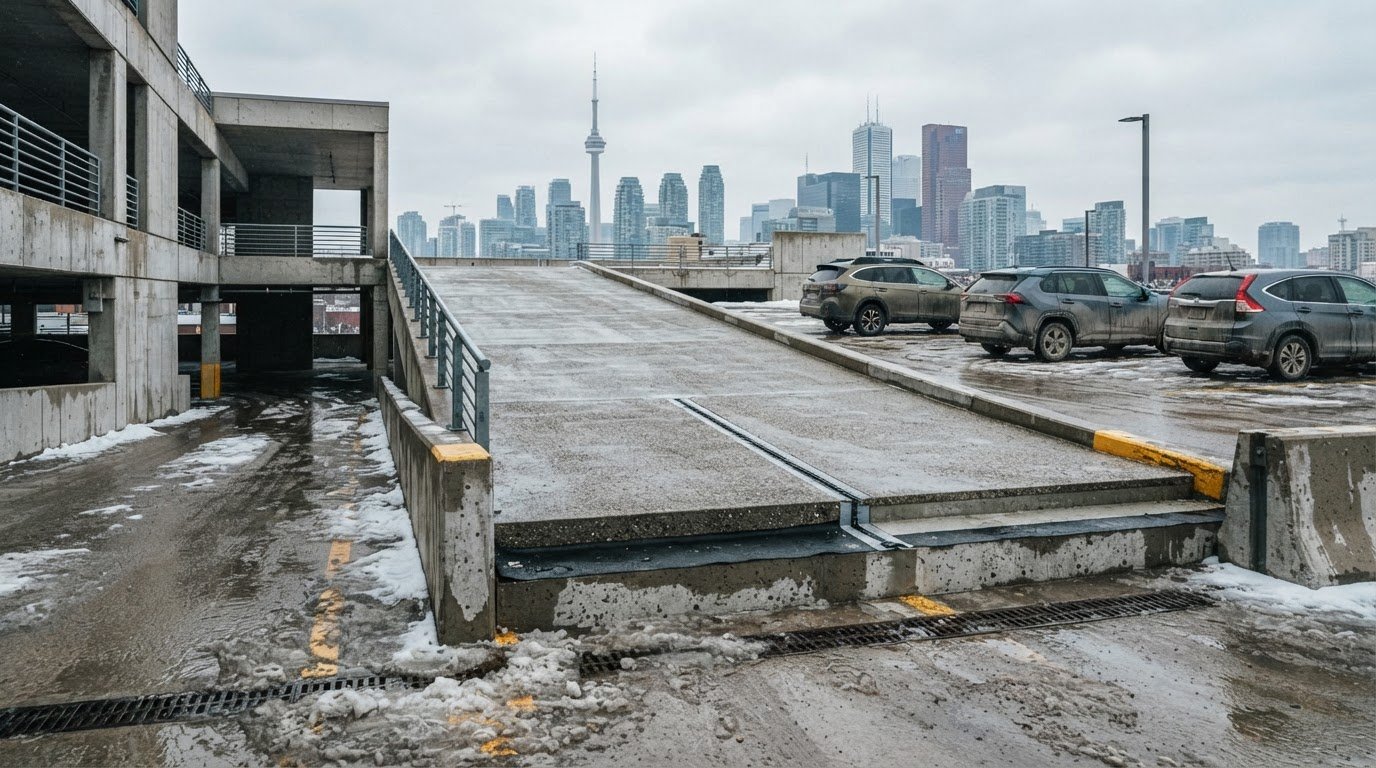
A parking deck doesn’t need a tougher-looking coat; it needs a system designed to manage water, wear and vehicle traffic. In Toronto, Mississauga, Brampton, Milton and Vaughn, water and de-icing salts can reach the concrete beneath the surface, putting the deck at risk of deterioration. Choosing traffic topping for parking decks means looking beyond the topcoat to how the full system protects the slab and performs under real operating conditions.
It’s reasonable to focus on waterproofing, abrasion resistance and traction, but no single feature guarantees a suitable result. The existing concrete, exposure, traffic demands and compatibility of system components all matter. A traffic topping can help protect concrete, but it doesn’t replace an assessment of existing damage or correct problems that haven’t been addressed.
This guide explains what a traffic topping system does, which performance criteria to compare and how to plan an installation around your facility’s needs. You’ll also learn what to cover in a site assessment, how preparation and installation affect performance, and what to coordinate to limit disruption while work is underway.
Key Takeaways
- Specify traffic topping for parking decks as a complete system, and confirm the role of each component in the project documentation.
- Match performance requirements to the deck’s exposure, traffic patterns, traction needs, maintenance plan and operating constraints.
- Before tendering, document occupied areas, access routes, operating hours and weather exposure to support realistic project planning.
- Assess the concrete and confirm required repairs before finalizing the system specification.
- Ask installers to explain their system selection, surface preparation, detailing and quality controls for your specific deck.
Traffic Topping for Parking Decks: What the System Protects
A parking deck’s surface has a demanding job. It must withstand vehicle movement while helping shield the concrete below from wear and, where the specified system is designed to do so, water and vehicle-borne contaminants.
A traffic topping is a purpose-designed system for vehicular concrete decks that combines surface protection and a driving or parking surface. Waterproofing is provided only when it’s included in the specification. That’s different from a basic decorative coating, which may be selected mainly for appearance and isn’t automatically suitable for vehicle loading or deck exposure.
How a parking-deck traffic topping differs from a basic coating
Traffic-rated performance depends on more than the visible finish. Vehicles apply repeated loads, turn across the surface and brake at ramps, entrances and tight corners. Pedestrian paths add another requirement: suitable traction where people walk.
These demands should guide system selection. A coating that looks sound in a sample area may not be appropriate for the deck as a whole if its specification doesn’t account for the concrete substrate, exposure, traffic patterns and installation conditions. Suitability comes from matching those factors to a documented system, not from relying on a generic product label.
What traffic toppings can and cannot address
Depending on the specified assembly, a traffic topping may help protect the concrete surface from wear and limit water entry. This distinction matters in the Greater Toronto Area, where seasonal moisture, freeze-thaw conditions and de-icing products can expose decks to challenging service conditions. The actual risk varies by site. Assess whether the deck is exposed or enclosed, how water moves across it, and where vehicles bring in salts.
Water penetration and corrosion of reinforcing steel are among the processes associated with concrete degradation. A traffic topping may form part of a protection strategy, but it doesn’t restore damaged concrete or resolve the cause of deterioration on its own.
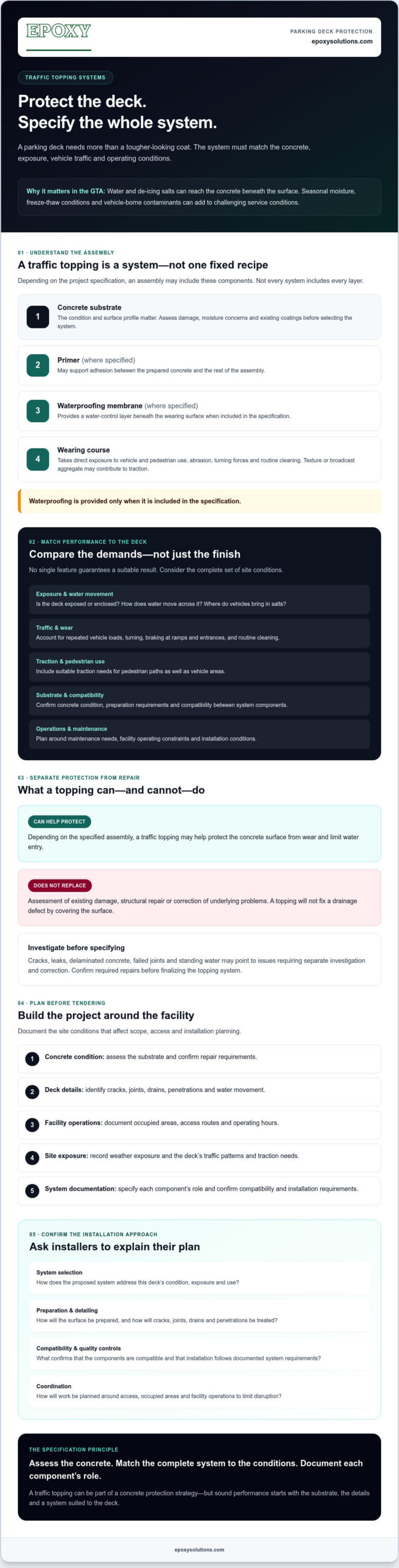
Coating work isn’t structural repair. Cracks, leaks, delaminated concrete, failed joints or standing water may point to issues that require separate investigation and correction. A topping won’t fix a drainage defect by covering the surface, and applying it over an unsuitable substrate can compromise performance. Have qualified professionals assess visible damage and confirm repair requirements before the topping system is selected and installed.
How Parking-Deck Traffic Topping Systems Work
A traffic topping isn’t one fixed recipe. The assembly must suit the deck, its condition and the demands placed on it. Depending on the project specification, it may include a primer to support adhesion, a waterproofing membrane to help control water entry, and a wearing course designed for vehicle and pedestrian use. Some systems may not include every component.
For broader specification considerations, see this industrial flooring specifications guide. For traffic toppings, document what each layer is intended to do and confirm the system’s requirements against project-specific conditions. Don’t assume every product follows the same sequence.
Waterproofing membrane and wearing course: separate jobs
Where included, a membrane’s role is to provide a water-control layer beneath the wearing surface. The wearing course takes direct exposure to abrasion, turning forces and routine cleaning. Texture or broadcast aggregate may contribute to traction, but the result depends on the system’s design and documented performance, not texture alone. The ASTM C957 standard covers certain cold liquid-applied elastomeric waterproofing membranes used with a separate wearing course. Confirm whether it applies to the proposed assembly, and follow the manufacturer’s documented compatibility and installation requirements.
Concrete, joints, drainage, and surface preparation
Before installation, the project team should assess the concrete’s condition and surface profile, check for moisture concerns, and identify existing coatings that could affect adhesion. Cracks, joints, drains and penetrations need details suited to their function and movement. For example, a rigid coating detail at a moving joint may not accommodate the joint’s behaviour. The specified treatment must account for that location.
Surface preparation and substrate condition directly affect coating-system adhesion and performance. Preparation should follow the selected system’s requirements and address contaminants, weak concrete and incompatible coatings. Drainage also needs attention: a topping can’t correct poor slope or a blocked drain by itself. Record these conditions before specifying the assembly, then confirm repair and detailing responsibilities in the project documents.
Clear specifications reduce guesswork. Identify the intended role of each layer, required surface preparation, treatment at transitions and joints, and the documentation needed to verify installation. A project-specific review can help align those details with the deck’s condition and use. To discuss traffic topping installation, consult an experienced contractor.
Compare Parking-Deck Traffic Toppings by Exposure and Use
There’s no universal ranking of traffic topping systems. The right choice depends on documented system performance and how each part of the deck is exposed and used. An enclosed level and an open rooftop can face different conditions, while ramps, entrances and pedestrian routes can have distinct demands within the same facility.
Match system performance to deck exposure
Assess sunlight, precipitation, standing water, temperature shifts and de-icing products before comparing specifications. An enclosed deck may have limited direct weather exposure, but areas near openings and ramps can still encounter moisture and contaminants. Outdoor decks in Toronto, Mississauga, Brampton, Milton and Vaughn need a project-specific review of local seasonal conditions. For sunlight-related considerations, consult this UV-resistant flooring engineering guide.
Balance traction, wear, cleaning, and appearance
Texture and aggregate can influence surface feel and traction, but more texture isn’t automatically better. It may also make routine cleaning more demanding. Specify traction needs for the deck’s actual use, and request applicable test data for the proposed system and conditions. Don’t rely on a general “slip-resistant” description as proof of performance.
Use a zone-by-zone comparison to make the specification practical:
| Deck area or condition | Exposure and traffic to document | Specification considerations |
|---|---|---|
| Enclosed parking areas | Moisture brought in by vehicles, de-icing products, routine vehicle movement | Confirm cleaning practices, wear needs and whether the specified assembly provides water protection. |
| Exposed upper levels | Sunlight, precipitation, temperature changes and possible standing water | Verify weather and UV suitability against project documentation, and review drainage conditions. |
| Ramps, entrances and turning areas | Repeated braking, acceleration and turning; water or contaminants may collect at transitions | Review wear and traction requirements, detailing and how the surface will be maintained. |
| Pedestrian routes and transitions | Foot traffic, changes in surface or elevation, cleaning methods | Define suitable texture and traction expectations, and confirm any test evidence applies to the specified surface. |
Use this comparison to identify what the specification must prove, not to assume one system category will suit every zone. Confirm system components and performance claims against project-specific documentation, including the manufacturer’s requirements. Reviewing exposure, traffic, maintenance and operating constraints helps facility teams compare options on relevant criteria rather than appearance alone.
Plan a Parking-Deck Traffic Topping Project in the GTA
A reliable project starts before the coating is selected. A clear assessment and scope help bidders price comparable work and give facility teams a practical plan for access, repairs and installation.
- Assess the deck. Record the concrete condition, existing coatings, drainage, joints, cracks and areas of visible deterioration. Seek a qualified assessment where damage or leaks are present.
- Define performance needs. Document traffic types, operating hours, occupied areas, access routes, pedestrian zones and weather exposure. Note where ramps, entrances, turning areas or transitions may need distinct performance requirements.
- Confirm repairs. Establish what concrete repairs or other corrective work must happen before the topping is applied. Assign responsibility for joints, drains and related details rather than leaving gaps in the scope.
- Specify the system. Describe the substrate and use conditions, then request project-specific system documentation, layer details, preparation requirements, application conditions and maintenance guidance.
- Schedule the work. Plan staging and phased access around facility operations. For projects in Toronto, Mississauga, Brampton, Milton and Vaughn, account for site logistics and seasonal weather, then confirm timing after technical assessment and review of system requirements.
Prepare a clear performance-based specification
Give bidders the same basis for their proposals: deck exposure, vehicle and pedestrian use, defined use zones, known deterioration and operating constraints. Ask them to identify the proposed assembly, preparation method, detailing approach and required quality checks. Confirm applicable standards and test methods with the design professional, and verify current requirements and system claims against project-specific documentation.
Compare proposals by scope and documented performance, not surface appearance alone. Check whether each response clearly states what’s included, what substrate conditions are assumed, and how preparation, application and inspection will be handled.
Reduce uncertainty before installation begins
Set out access, staging, ventilation, curing requirements and reopening criteria with the installer before work starts. Agree on who is responsible for concrete repairs, joint and drain details, and any associated work. This prevents assumptions from becoming delays or disputes once the deck is restricted.
Occupied facilities also need a communication plan. Map the work zones, temporary access routes and restrictions, then share the schedule with tenants, visitors and operations teams. Phasing may help maintain access, but the sequence must suit the installation requirements and site conditions. A specification for traffic topping for parking decks should support both technical performance and workable facility coordination.
For project-specific information about traffic topping installation, visit Epoxy Solutions™.
Choose an Experienced Traffic Topping Installer for Your Parking Deck
A traffic topping system is only as dependable as the assessment, specification and installation behind it. Look for a contractor with direct traffic-topping experience who can explain how the proposed system suits your deck, what substrate preparation it requires, and how the work will be coordinated in an occupied facility. A generic product description isn’t enough.
Epoxy Solutions™ has operated since 1981 and lists traffic toppings among its specialized flooring installation services. For facilities in Toronto, Mississauga, Brampton, Milton and Vaughn, discuss the site and project scope with the company.
Questions to ask a traffic topping contractor
Ask for clear, project-specific answers before comparing proposals. The discussion should cover:
- How will the concrete condition, moisture concerns, joints, drainage and existing coatings be assessed?
- What system components are proposed, and what preparation and installation conditions do they require?
- How will cracks, transitions, drains and other deck details be handled in the specified scope?
- What quality checks and maintenance guidance will be provided, and what documentation supports the proposed system?
- How will the work sequence manage vehicle access, pedestrian routes and day-to-day operations in an occupied facility?
Strong answers are specific, documented and consistent with the system manufacturer’s requirements. If an issue is outside the installer’s scope, such as structural concerns or drainage correction, ask who is responsible for addressing it before installation.
What to include in a site assessment request
Give the contractor enough information to prepare a relevant review. Include the deck’s location and approximate area, current surface condition, known leaks or repair history, weather exposure, vehicle use and operating schedule. Identify occupied areas, access routes and any phasing requirements. Photos or existing project documents may help explain conditions, but they don’t replace an appropriate site review.
Request a site-specific recommendation rather than assuming a standard system will fit every deck. The response should connect the proposed traffic topping for parking decks to the substrate, use zones, exposure, preparation work, detailing and quality controls. Compare proposals on those details and stated scope, not simply on the finish or product label.
To discuss your facility’s requirements, contact Epoxy Solutions™ about your parking-deck traffic topping project.
Specify the Right System for Your Deck
A durable traffic topping for parking decks starts with a clear understanding of the concrete, exposure, and vehicle and pedestrian use. Specify the full system based on site conditions, and confirm how preparation, joints, drainage, traction and maintenance requirements will be addressed. A topping can help protect a deck, but it won’t replace needed repairs or correct drainage problems.
Planning matters as much as product selection. Document operating hours, access routes, occupied areas and weather exposure before tendering, then coordinate the work sequence and reopening requirements with the installer. Comparing proposals by documented performance and scope helps reduce uncertainty before installation begins.
For parking-deck projects in Toronto, Mississauga, Brampton, Milton and Vaughn, Epoxy Solutions™ installs specialized flooring systems, including traffic toppings. Discuss your parking-deck traffic topping project and the requirements of your facility.
Frequently Asked Questions
What is a traffic topping for a parking deck?
A traffic topping is a system designed for vehicular concrete decks that provides a surface for driving or parking and helps protect the concrete from wear. Depending on the specification, it may also include a waterproofing component to help limit water entry. A traffic topping for parking decks isn’t simply a decorative coating, and it won’t repair structural damage or correct drainage problems by itself.
How long does a parking-deck traffic topping last?
There isn’t one dependable lifespan that applies to every parking-deck traffic topping. Service life depends on the specified system, concrete condition, surface preparation, installation quality, traffic, exposure and ongoing maintenance. Ask the contractor for the system’s documented service-life expectations and the conditions those expectations assume. Also request maintenance guidance, since inspection and timely attention to damage can help identify issues before they worsen.
Can traffic topping stop water from leaking through a parking deck?
A traffic topping may help control water entry if the specified assembly includes a waterproofing membrane and the system is suitable for the deck. It can’t be assumed to stop every leak. Cracks, joints, drains, penetrations, poor drainage or deteriorated concrete may need separate assessment and corrective work. Have the source of water entry investigated, then confirm how the proposed system addresses the relevant details before installation.
How is a traffic topping installed on a parking deck?
Installation depends on the selected system and the deck’s condition. Typically, the project begins with assessment and specified surface preparation, which may include addressing existing coatings or weak concrete. The installer then applies the components required by the documented assembly, such as a primer, membrane or wearing course where specified. Joints, cracks, drains and transitions need project-specific detailing, followed by required curing and quality checks.
Can a parking deck remain open during traffic topping installation?
Sometimes access can be maintained in unaffected areas, but the deck shouldn’t be assumed to remain fully open. The work area, preparation method, application conditions and curing requirements determine when sections must close and reopen. Ask the installer to propose a work sequence, identify temporary vehicle and pedestrian restrictions, and state reopening criteria. Share the plan with tenants, visitors and operations staff before work begins.
How do I choose a traffic topping system for an exposed Canadian parking deck?
Match the documented system performance to the deck’s exposure and use. Review sunlight, precipitation, standing water, temperature changes and de-icing products, along with vehicle traffic, turning areas, ramps and pedestrian routes. For exposed facilities in Toronto, Mississauga, Brampton, Milton and Vaughn, assess seasonal conditions at the specific site. Request applicable test data and confirm system suitability and installation requirements with the design professional and manufacturer.
What should a parking-deck traffic topping proposal include?
A useful proposal describes the system components, intended performance, substrate assumptions, surface preparation, application conditions and detailing for joints, drains and transitions. It should clarify what repairs are included, who handles other corrective work, what quality checks will be performed, and what maintenance the system requires. It should also identify phasing, access restrictions and reopening criteria. Compare proposals by documented scope and performance, not finish appearance alone.