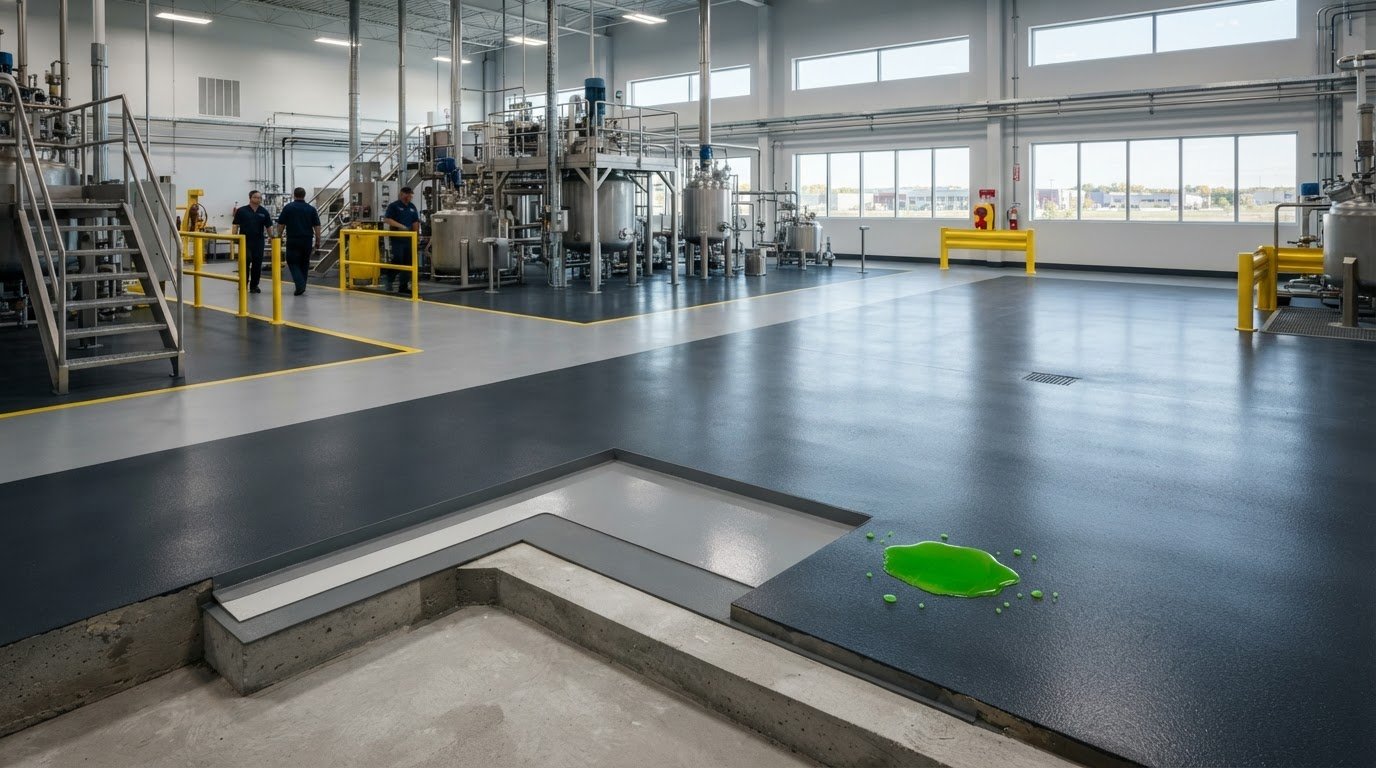
A “chemical-resistant” label is not a specification. Choose a floor based on that claim alone, and the concrete may still be vulnerable to staining, peeling or deterioration. For facilities assessing chemical resistant coatings Milton, the right system depends on the specific chemicals and cleaning agents, their concentration and contact time, and the floor’s traffic and operating conditions. A coating that performs under one type of exposure may not suit another.
That uncertainty is real. Even a high-performance resin system can underperform if it’s incompatible with the exposure or applied over concrete that hasn’t been properly assessed and prepared. The coating is only one part of the flooring system.
This guide explains how to identify relevant exposures, assess concrete condition and compare coating systems against documented performance requirements rather than broad marketing claims. You’ll also learn what to clarify with an installer about technical specifications, surface preparation and project constraints before work begins. Epoxy Solutions™ has provided commercial and industrial flooring since 1981, including chemical-resistant flooring and tank lining. Its local coverage includes Milton, Toronto, Mississauga, Brampton and Vaughn.
Key Takeaways
- Use Safety Data Sheets and process records to identify chemicals, concentrations, cleaning agents and likely contact times.
- Assess the concrete and facility operations before comparing chemical resistant coatings Milton, so the system selection reflects actual site requirements.
- Compare resinous flooring options by documented exposure compatibility, traffic demands, cleaning needs and repair considerations, not broad resistance claims.
- Make concrete condition, surface preparation and installation steps explicit in the project scope to reduce specification surprises.
- When evaluating contractors, look for relevant commercial flooring experience, a clear assessment process and manufacturer documentation for the proposed system.
Chemical-Resistant Floor Coatings in Milton: Identify the Facility Risk First
A generic “chemical-resistant” label doesn’t prove a coating is compatible with every substance used on site. A sound specification starts with the actual exposure and operating conditions, then identifies a flooring system that can be assessed against them. For a Milton facility, look beyond the coating material to the concrete, installation details and maintenance practices that affect performance.
A search for chemical resistant coatings Milton is only the starting point. The useful question is whether the proposed system’s documented performance suits the facility’s specific chemicals, cleaning routine and traffic. Coatings can serve protective functions, as outlined in this overview of functional coatings, but broad descriptions don’t establish compatibility with a named substance.
What does chemical-resistant flooring actually mean?
Chemical-resistant flooring is a selected and installed system matched to stated exposure conditions. Resistance isn’t universal: it can depend on the system components, concrete condition, preparation, chemical concentration, contact time, temperature and maintenance. A brief splash may create a different demand from repeated contact or a spill that remains on the floor. Before specifying a system, request current manufacturer documentation confirming compatibility with each relevant substance and the conditions of use.
Which site conditions can put a Milton floor at risk?
Start an exposure inventory before comparing options. Include process chemicals, cleaning agents and foreseeable spills, using Safety Data Sheets and process records to identify substances accurately. For each one, record concentration, temperature, how often contact occurs and how long liquid may remain before it’s removed. These details give the installer and manufacturer a practical basis for technical review.
Then describe how the floor operates day to day. Routine drips near a work area, washdown across a larger zone and a concentrated spill are distinct exposure scenarios. Production traffic adds another demand: forklifts, carts or other equipment may abrade or impact areas already exposed to chemicals. Cleaning procedures matter too, since the agents and methods used to remove residues are part of the floor’s service conditions.
- Concrete: Note visible deterioration, cracks, previous coatings and areas that need assessment.
- Water and drainage: Identify washdown zones, standing water and how liquids are directed away.
- Operations: Record traffic patterns, work-zone boundaries and downtime constraints that affect installation planning.
This initial site brief makes the risk specific. It also helps distinguish a coating that sounds suitable from a proposed system whose compatibility, substrate requirements and operating fit can be checked before the project scope is finalized.
How to Match a Chemical-Resistant Coating to Actual Exposure
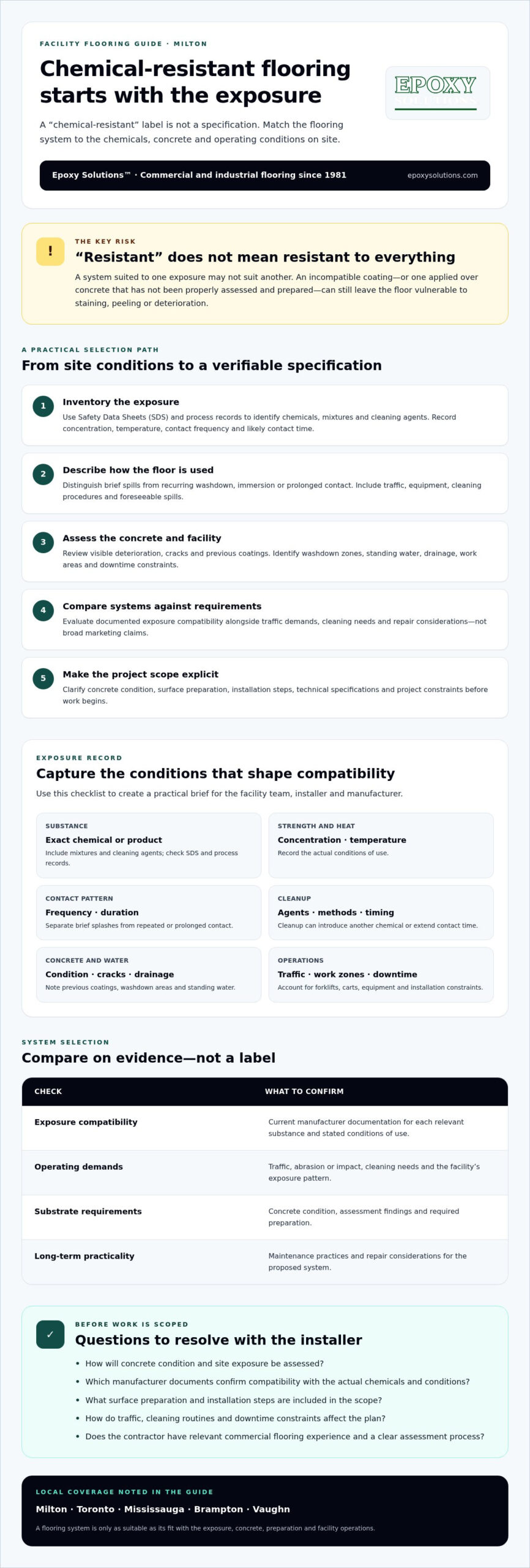
Translate the exposure record into a specification, not a guess. A practical sequence is to inventory chemicals, document how they contact the floor, assess the concrete, define operating demands, then verify the proposed system against current technical data. This gives installers and facility teams a shared basis for comparing options and resolving unknowns before work is scoped.
Build a usable chemical exposure inventory
Collect current Safety Data Sheets (SDS) and process documentation for chemicals, mixtures and cleaning agents. Record the exact substance or product, stated concentration, temperature, contact frequency and likely duration. Include how residues are cleaned up, since the cleanup method may introduce another chemical or extend contact time. Ask the facility’s technical team to identify planned process changes and any substances that aren’t fully documented.
Separate a brief, occasional spill from recurring washdown, immersion or prolonged contact. These aren’t interchangeable conditions, and a system’s suitability for one doesn’t establish performance under another. Compatibility must be checked against the exact chemical and the actual concentration, temperature, contact time and cleanup conditions. Verify the proposed system’s current manufacturer documentation for each relevant exposure, and resolve any gaps with the manufacturer or a qualified flooring professional.
Assess concrete and operating conditions before specifying
The coating can’t be evaluated apart from its substrate. Document visible cracking, previous coatings, contamination and deteriorated areas, then have qualified professionals assess surface and moisture conditions using methods appropriate to the slab and project. These findings can affect preparation requirements and whether the proposed system is suitable for the existing concrete.
Define the operating conditions alongside the exposure data. Include vehicle and pedestrian traffic, impact or abrasion concerns, cleaning routines, wet areas, drainage and any safety needs. Set out operational downtime constraints early so the project scope can account for access and installation sequencing without assuming a schedule before the site is assessed.
For a Milton facility, this disciplined process turns a search for chemical resistant coatings Milton into a comparison of documented systems against real site requirements. OSHA’s walking-working surface requirements are a U.S. reference, not Ontario law, but they illustrate why spills and surface hazards belong in a facility’s safety review. Confirm applicable Canadian and Ontario requirements with the appropriate authority for your site.
Epoxy Solutions has provided commercial and industrial flooring since 1981, including chemical-resistant flooring. A site-specific assessment can help clarify exposure, substrate and operating requirements before a system is selected. Review chemical-resistant flooring options as part of your planning.
Compare Chemical-Resistant Flooring Systems by Performance Requirements
Product labels don’t settle the choice. Compare proposals against the facility’s documented exposures, concrete condition and operating demands, then confirm performance claims with current manufacturer documentation. An epoxy coating or other resinous flooring system may be worth assessing, but no category is a universal winner. Suitability depends on the particular system and project conditions.
What to compare in an epoxy or resinous flooring proposal
Review the written scope, not just the product name. It should identify the proposed system, how the concrete will be assessed and prepared, the installation requirements, and the manufacturer data supporting relevant chemical-resistance claims. Broader specification considerations are covered in this industrial flooring specifications guide.
| Comparison point | What to verify |
|---|---|
| Exposure fit | Does documentation address the named chemicals, concentrations, temperatures and contact conditions? |
| Substrate and preparation | Does the proposal explain how concrete condition affects preparation and the specified system build-up? |
| Traffic | Does the stated performance information address the facility’s vehicle and pedestrian traffic demands? |
| Cleaning | Are the facility’s cleaning agents and methods considered in the system’s documented compatibility? |
| Repair needs | Does the scope explain how damage would be assessed and what repair approach is appropriate for the system? |
These are questions for technical review, not assumptions about any coating category. The OSHA general requirements for safe flooring provide a U.S. workplace reference related to walking-working surfaces, not a statement of Ontario requirements. Confirm applicable Canadian and Ontario obligations separately.
When specialized lining or other floor requirements matter
Tank lining is a distinct service for tanks, not an automatic substitute for a floor coating. Likewise, anti-static, safety and UV-resistance needs should be identified as separate criteria where they apply, then evaluated alongside chemical exposure. A proposal should make clear which requirements the specified system addresses and which need separate consideration. For related system factors, see this high-performance epoxy flooring guide.
For facilities comparing chemical resistant coatings Milton, the sound choice is the system whose documented compatibility, preparation plan and operating fit align with the site assessment. Compare scope and evidence, not broad labels or unsupported rankings.
Plan Chemical-Resistant Coating Installation for a Milton Facility
A dependable floor project is planned before materials arrive on site. The sequence should move from a site review and exposure documentation to concrete assessment, surface preparation, installation and handover. Each stage needs to reflect the facility’s actual operations. A schedule, performance outcome or disruption level shouldn’t be promised until site conditions, system requirements and operating constraints have been confirmed.
Questions to resolve during a Milton site assessment
Confirm where work will take place, how crews and materials can access those areas, and what existing floor layers or damage may affect the work. Review the chemical inventory and cleaning practices with the facility team, then define the required floor performance. Record production constraints, access restrictions and any areas that must remain operational. Before approving a proposal, clarify anticipated repairs, preparation requirements and exclusions to avoid unplanned scope assumptions.
Operational planning matters. Identify possible production interruptions, how work areas will be isolated, and how people, equipment and materials will move around the site. Discuss ventilation and safe work coordination with the installer, considering the specific materials, application requirements and facility procedures. The project team should confirm these details rather than assume the work can proceed without disruption.
What a clear installation scope should explain
The written scope should describe the concrete assessment, preparation method, repairs included, specified system components and application sequence. Surface preparation isn’t a minor detail: it establishes the condition the coating will be applied to. The scope should explain how the existing floor will be addressed and define responsibilities, work-area access, protection measures and project exclusions.
Before work begins, agree on the handover information the facility will receive. This may include the installed system details, relevant manufacturer documentation, care and maintenance guidance, and chemical compatibility information for the exposures reviewed. Confirm how questions about future process changes or cleaning products will be handled. Compatibility shouldn’t be assumed for chemicals that weren’t part of the original assessment.
Use this checklist to review the proposal:
- Site conditions: Existing layers, concrete condition, repairs and preparation are described.
- Project coordination: Access, work-area boundaries, ventilation planning and operational constraints are addressed.
- Installation and handover: System components, application sequence, responsibilities and documentation are clear.
For facilities evaluating chemical resistant coatings Milton, a precise scope helps align the selected system with site conditions and makes assumptions visible before approval. Epoxy Solutions™ has provided commercial and industrial flooring since 1981, including chemical-resistant flooring and epoxy coatings. Its local coverage includes Milton, Toronto, Mississauga, Brampton and Vaughn. Discuss a chemical-resistant flooring project with the team and confirm coverage and requirements for your specific Milton site.
Choose a Chemical-Resistant Coating Contractor in Milton with Confidence
A strong proposal explains why a flooring system fits the site. Broad claims such as “chemical-proof” or “industrial grade” aren’t enough on their own. For chemical resistant coatings Milton, compare contractors by how they assess exposure, concrete and daily operations, and whether their written scope connects those findings to the proposed system.
Questions to ask before selecting an installer
Ask each contractor the same questions so you can compare their approach clearly:
- How will you assess our exposure? Ask how the chemical inventory, concentrations, contact conditions and cleaning agents will inform system selection.
- How will you assess the floor? Request an explanation of how concrete condition, existing coatings and preparation needs will be reviewed.
- What supports the recommendation? Ask for current manufacturer documentation relevant to the site’s named chemicals and operating conditions.
- What does the scope include? Look for specified system components, preparation, repairs, application steps, responsibilities and exclusions.
- Can you confirm Milton coverage? Verify current availability for the specific site, along with relevant commercial or industrial flooring experience.
Compare the quality of the assessment and the clarity of the preparation plan, not just the product category or a confident sales claim. If a proposal doesn’t explain how documented exposures and substrate condition support the recommendation, ask for that reasoning before making a decision.
How Epoxy Solutions™ can support a project
Epoxy Solutions provides industrial and commercial flooring installation, including epoxy coatings, chemical-resistant flooring and tank lining. The company has operated since 1981 and serves Milton as part of its local coverage. Its local coverage also includes Toronto, Mississauga, Brampton and Vaughn. This background provides useful context, but every proposed system still needs to be checked against the facility’s actual exposure, concrete condition and performance requirements.
Before discussing a project, gather the chemical inventory and relevant Safety Data Sheets, note cleaning practices and operating constraints, and record visible floor concerns. This makes the initial conversation more specific and gives the project team a clearer basis for assessing scope, technical documentation and next steps.
For a site-specific discussion, discuss a chemical-resistant flooring project with Epoxy Solutions. Confirm project coverage for your Milton facility and review the exposure information and requirements that will guide the assessment.
Specify a Floor Built Around Your Facility
The right floor starts with a clear account of what it will face. Identify the chemicals, concentrations and contact conditions, then assess the concrete, traffic, cleaning practices and operating constraints. Use current manufacturer documentation to check whether the proposed system fits those requirements. A coating label alone isn’t proof of compatibility.
For chemical resistant coatings Milton, compare proposals by their exposure assessment, preparation plan and clearly defined scope, not broad performance claims. These details help your team make an informed decision and reduce surprises during planning and installation.
Epoxy Solutions has operated since 1981 and provides commercial and industrial flooring, including chemical-resistant flooring and tank lining. Milton is included in the company’s stated service area, alongside Toronto, Mississauga, Brampton and Vaughn. Confirm project coverage for your specific site, then discuss your chemical-resistant flooring requirements with Epoxy Solutions™.
With the right information and a professionally assessed plan, you can move forward with greater confidence in your facility’s flooring choice.
Frequently Asked Questions
What are chemical-resistant floor coatings?
Chemical-resistant floor coatings are resinous flooring systems selected and installed to suit defined chemical exposures and operating conditions. The term alone doesn’t confirm compatibility with a particular substance. Performance depends on the specified system, concrete condition, preparation, chemical concentration, contact time, temperature and maintenance. Check current manufacturer documentation for the named chemicals and conditions at your facility before treating a coating as suitable.
Can epoxy flooring resist acids and other chemicals?
Some epoxy flooring systems may be suitable for particular acids and chemicals, but epoxy isn’t universally resistant. Compatibility varies by formulation and exposure conditions, including concentration, temperature and duration of contact. A short spill and recurring contact can place different demands on the floor. Review current manufacturer documentation for each substance and confirm that the proposed system addresses your facility’s actual cleaning and process conditions.
How do I choose a chemical-resistant coating for a Milton facility?
Start with an inventory of process chemicals, cleaning agents and foreseeable spills, using current Safety Data Sheets and process records. Document concentration, contact frequency, duration and temperature, then assess the concrete, traffic, cleaning routine and operating constraints. Compare proposals by preparation scope and manufacturer documentation for the exact exposures. For chemical resistant coatings Milton facilities need, confirm the contractor’s current site coverage and relevant commercial or industrial experience.
What happens if a chemical spill reaches a coated floor?
The result depends on the chemical, its concentration, how long it remains in contact, and the compatibility of the installed system. Follow your facility’s spill procedures and the chemical’s Safety Data Sheet for safe handling and cleanup. Don’t assume the coating is unaffected because it carries a chemical-resistant label. After cleanup, check for visible damage and consult the system documentation or a qualified flooring professional if you’re unsure.
Does concrete need special preparation before a chemical-resistant coating is installed?
Yes. Concrete condition and preparation are critical to a coating’s suitability and adhesion. Existing coatings, contamination, cracks, deterioration and moisture conditions should be assessed before the system is specified. The written project scope should explain the required preparation and any included repairs. A qualified professional can determine appropriate assessment methods for the slab and project. Don’t treat preparation as optional or rely on a coating applied over an unassessed surface.
How long does a chemical-resistant floor coating last?
There isn’t one reliable lifespan for every chemical-resistant floor coating. Service life depends on system selection, substrate condition, preparation and installation, as well as chemical exposure, traffic, cleaning practices and maintenance. A floor facing repeated spills or heavy equipment may experience different wear from one with limited exposure. Ask the installer to explain the relevant manufacturer guidance and maintenance requirements for the proposed system, without assuming a guaranteed service life.
How much do chemical-resistant coatings cost in Milton?
The cost of a chemical-resistant flooring project in Milton depends on site-specific factors, so a reliable price requires an assessment and defined scope. Concrete condition, preparation and repairs, the selected system, work area and operational constraints can all affect the project. Provide the contractor with your exposure inventory and site details, then compare written proposals for preparation, system components, application and exclusions. Don’t judge proposals on a headline figure alone.