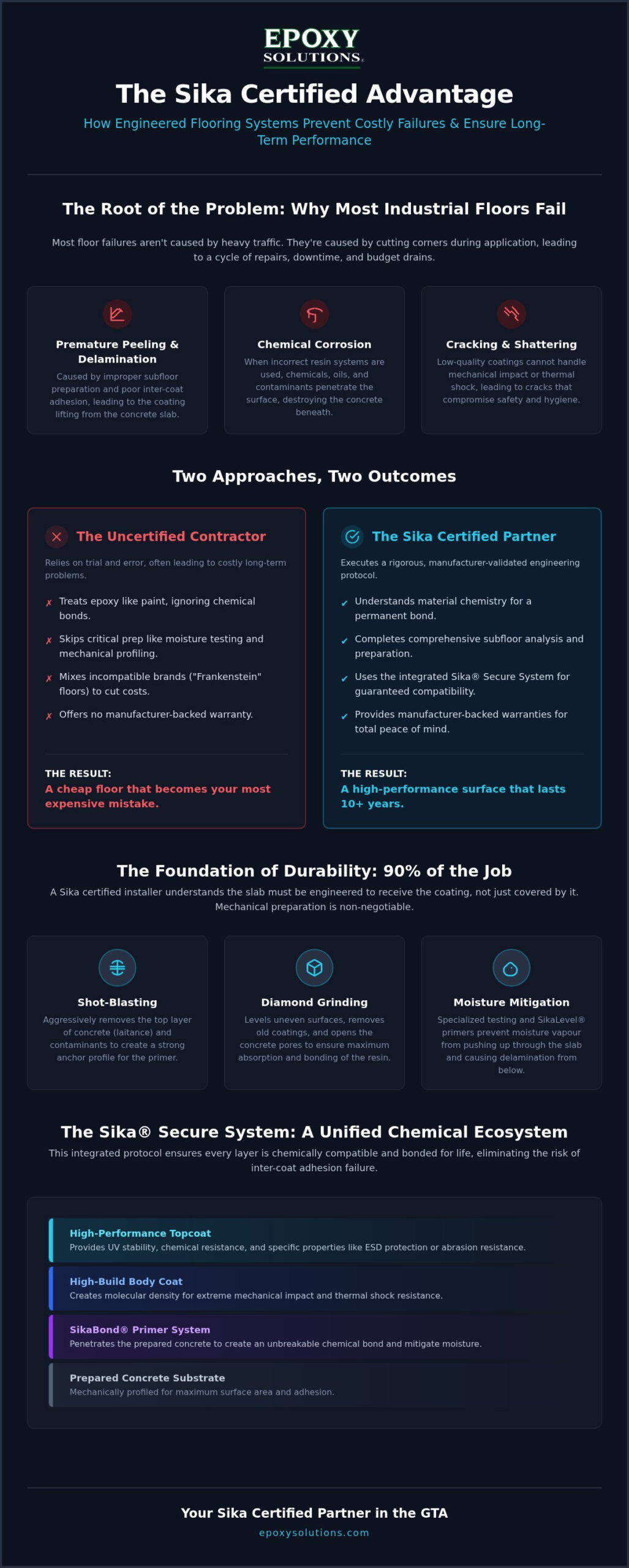
A cheap floor is the most expensive mistake a facility manager can make. Most industrial floor failures aren’t caused by heavy traffic; they’re caused by the corners cut during the application process. You’ve likely dealt with the fallout: premature peeling, delamination, or chemical corrosion that eats through your investment. It’s a cycle of repair and downtime that drains your budget and compromises safety. You need a surface that performs under pressure without demanding constant attention.
Sika certified flooring installations eliminate the variables that lead to these failures. By following a rigorous engineering protocol, these systems provide a level of durability that standard epoxy contractors simply cannot match. This article explores why Sika certification is the benchmark for long-term performance and how to choose the right resinous system for your Toronto or GTA facility. You’ll discover how to achieve a floor that lasts 10+ years while optimizing your facility’s safety and remaining in full compliance with environmental regulations. We’ll show you how to secure a high-performance finish with minimal disruption to your daily operations.
Key Takeaways
- Understand why technical validation and material chemistry are the only ways to prevent premature floor delamination in high-traffic GTA facilities.
- Explore the Sika® Secure System approach to realize how a cohesive resinous strategy from primer to topcoat ensures total surface integrity.
- Identify the specific performance requirements for your sector to choose the most effective Sika certified flooring installations for manufacturing, food processing, or commercial spaces.
- Learn why mechanical preparation, including shot-blasting and diamond grinding, is the critical 90% of the job that determines long-term durability.
- Leverage a 45-year legacy of industry expertise to eliminate the risks of poor labour and ensure your installation meets global performance standards.
Beyond the Badge: What Sika Certified Flooring Installations Mean for You
A certificate is only as good as the standards behind it. In the resinous flooring industry, many contractors claim expertise while relying on trial and error. Sika certification represents a rigorous technical validation that bridges the gap between laboratory chemistry and job-site execution. When you choose systems from Sika AG, you are investing in over a century of chemical engineering. However, the performance of these materials is entirely dependent on the hands that apply them.
Most industrial floor failures in the GTA aren’t the result of defective products. They are the result of poor labour. Uncertified contractors often treat epoxy like paint, ignoring the complex chemical bonds required for a permanent finish. Sika certified flooring installations provide facility managers with insurance against these common human errors. By hiring a certified partner, you gain access to manufacturer-backed warranties that uncertified installers simply cannot provide. This is about more than a badge; it is about technical accountability.
The core problem lies in the invisible steps. Uncertified teams frequently skip critical subfloor preparation, such as moisture testing or mechanical profiling. They hope the resin will mask a contaminated or damp slab. It won’t. Eventually, the floor will peel, and the contractor will be nowhere to be found. A certified installer understands that the slab must be engineered to receive the coating, not just covered by it.
The Sika Technical Education Program (STEP) Explained
The Sika Technical Education Program, or STEP, is a comprehensive training clinic designed to eliminate guesswork from the installation process. The curriculum focuses heavily on subfloor preparation and moisture mitigation. These are the two most common points of failure in resinous systems. Installers are trained to use SikaBond® and SikaLevel® technologies with mathematical precision. This specialized training creates a sharp contrast between professional specialists and bucket-and-roller contractors who lack the technical depth to manage complex chemical reactions.
Risk Mitigation in High-Stakes Environments
In heavy-traffic zones or processing areas, the cost of a floor failure is measured in thousands of dollars of lost productivity. Certification significantly reduces the likelihood of delamination by ensuring every layer of the system is bonded correctly. For facilities requiring ESD (Electrostatic Discharge) protection or high-level chemical resistance, technical accuracy is non-negotiable. Sika certified flooring installations ensure that these specialized systems meet their exact performance ratings. Certified teams also have a direct line to Sika’s global engineering support. This provides a definitive safety net for unique environmental challenges that would baffle a standard contractor.
The Technical Edge of Sika® Resinous Flooring Systems
Materials aren’t just products; they’re parts of a chemical ecosystem. The Sika® Secure System represents a holistic engineering strategy that covers every stage of the installation, from the initial primer to the final high-performance topcoat. This integrated approach ensures that every layer is chemically compatible and bonded for life. Facility managers often make the mistake of approving “Frankenstein” floors, where a contractor mixes different brands to shave costs. This is a recipe for inter-coat adhesion failure. Sika certified flooring installations eliminate this risk by using a single-manufacturer protocol that guarantees structural integrity.
Durability is a function of molecular density. Sika’s high-build epoxy and polyurethane systems create a surface that prevents oils, acids, and contaminants from penetrating the substrate. These systems are built to handle extreme mechanical impact and thermal shock that would shatter standard industrial coatings. For a deeper look at specific performance metrics, you can consult our High-Performance Epoxy: Guide for Industrial Facilities. UV resistance is also a core feature of these specifications, preventing the yellowing or chalking that typically occurs when floors are exposed to sunlight near loading docks or skylights.
Seamless Integration: The Sika® Secure Protocol
Chemical rejection is a silent killer of industrial floors. Using a unified system prevents the delamination that occurs when primers and topcoats don’t bond at a molecular level. In older GTA industrial buildings, moisture vapour is the primary enemy. Without a robust moisture vapour barrier, hydrostatic pressure will eventually force the coating off the slab. Sika systems are engineered for “Extreme Capability,” meaning they maintain their bond strength even during the drastic temperature swings common in Ontario. If you’re concerned about your current slab conditions, our team can help you specify a tailored solution that addresses these environmental variables.
Engineering for Chemical and Thermal Resistance
Industrial environments demand more than just a clean look. They require surfaces that meet OSHA standards for walking-working surfaces by resisting degradation from harsh cleaning agents. For food processing plants in Vaughn, floors must survive daily hot-water washdowns. Standard epoxy cannot handle this thermal shock; it will crack and peel under the stress. Sika’s urethane mortars are the definitive answer for these high-stakes zones. These materials expand and contract at a rate similar to the concrete beneath them, ensuring the floor remains intact during rapid temperature changes. This technical precision is what separates a professional installation from a temporary fix.
Matching Sika Systems to GTA Industrial and Commercial Needs
Generic specifications lead to premature failure. A floor designed for a light commercial showroom in Vaughn will disintegrate in a Brampton heavy manufacturing plant. Sika certified flooring installations require a precise match between the chemical system and the operational reality of the facility. We don’t just apply coatings; we engineer surfaces that align with the specific mechanical and chemical stressors of your industry.
Consider the technical gap between Sikafloor® 264 and Sikafloor® 22 N PurCem®. Sikafloor® 264 is a versatile, high-build epoxy coating ideal for general-purpose areas with medium-duty traffic. It’s the standard for clean, durable surfaces in Toronto tech hubs or commercial showrooms where aesthetics matter. Conversely, Sikafloor® 22 N PurCem® is a heavy-duty polyurethane cement mortar. It’s engineered for the harshest conditions, such as food processing plants in Mississauga that face thermal shock and constant heavy impact. Choosing the wrong one results in a floor that either fails under pressure or wastes your capital on unnecessary over-engineering.
Heavy Manufacturing and Warehousing in Mississauga & Brampton
High-volume logistics hubs in Mississauga and Brampton demand floors that survive relentless forklift traffic and pallet jack impact. These slabs must be prepared according to standards set by the American Concrete Institute (ACI) to ensure the resin bonds effectively to the structural concrete. For facilities managing high-load capacities, we specify high-build systems that distribute stress across the substrate. You can find detailed load-bearing data in our Industrial Flooring Specs: Engineering Guide for 2026. Safety is also a non-negotiable factor. These environments require precision line marking to maintain safety compliance and organize high-speed traffic flow.
Critical Environments: Anti-Static and Chemical Control
Electronics manufacturing and data centres in Toronto require specialized Sika ESD (Electrostatic Discharge) systems to protect sensitive equipment. A standard epoxy floor generates static electricity that can destroy microchips or cause server failures. Our installations ensure total conductivity control to ground these charges safely. Similarly, chemical storage facilities in Milton must adhere to strict secondary containment regulations. Sika’s chemical-resistant coatings provide a seamless, impermeable barrier that prevents hazardous leaks from reaching the soil. For more information on maintaining reliability in these zones, see our guide on Anti-Static Flooring for Critical Environments. We specialize in these high-stakes environments where a single failure can result in catastrophic data loss or environmental fines.
The Precision Installation Process: From Surface Prep to Final Coat
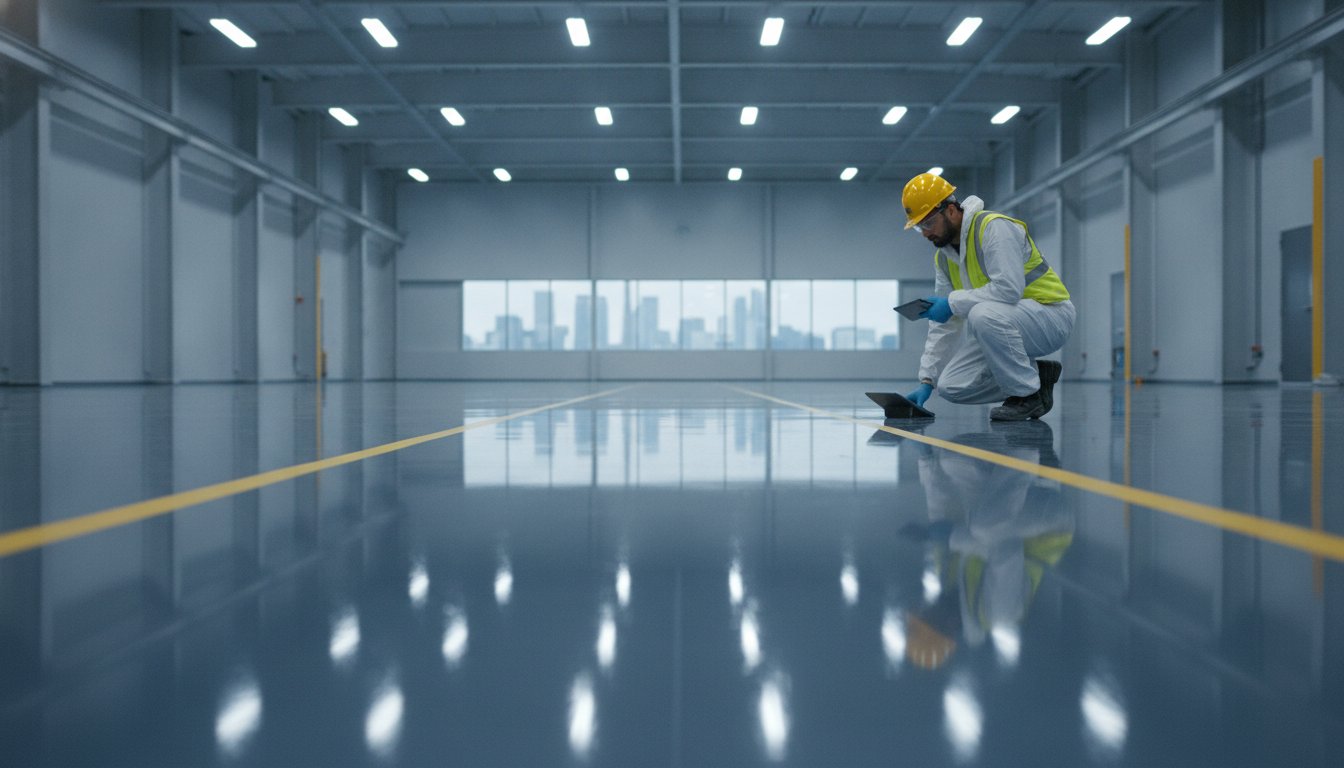
Preparation is 90% of the job. This isn’t a suggestion; it’s an engineering reality. Most floor failures occur because a contractor treated the substrate as a passive surface rather than a critical component of the system. Sika certified flooring installations demand a level of mechanical preparation that standard epoxy crews often bypass. Without a properly profiled slab, the resin has nothing to grip. We don’t just “clean” the floor. We re-engineer the surface to ensure a permanent bond.
Mechanical diamond grinding or shot-blasting is mandatory for every project we undertake. This process removes the weak top layer of concrete, known as laitance, and opens the pores of the slab. We then move into a rigorous testing phase. This includes monitoring ambient temperature, humidity, and moisture vapour emission rates. We also perform pull-off tests to verify the tensile strength of the concrete. If the substrate isn’t ready, the pour doesn’t happen. This level of technical accuracy is why our floors last decades while others fail in months.
Substrate Analysis and Preparation
Older Toronto factories present unique challenges, such as oil-saturated slabs or “soft” concrete that has degraded over time. Identifying these issues before the first drop of resin hits the floor is what separates an expert from an amateur. We use specialized equipment to achieve the exact Concrete Surface Profile (CSP) required by Sika specifications. For active commercial environments, our preparation is entirely dust-free. We use high-efficiency industrial vacuums to ensure your operations can continue without contamination or air quality concerns.
The Multi-Layer Application Sequence
The Sika® Secure protocol follows a methodical application sequence where timing is everything. Each layer, from the moisture-tolerant primer to the high-performance topcoat, must be applied within a specific window to ensure a chemical bond. Our certified installers are trained to manage “pot life” and environmental variables with extreme precision. We monitor the chemical reaction in real-time, adjusting for the humidity levels typical of a GTA summer or the dry air of winter. Once the final coat is applied, we conduct a comprehensive inspection to verify thickness and finish. If you want a floor installed to these rigorous standards, contact our technical team for a site assessment.
Epoxy Solutions™: Your Sika Certified Partner in the GTA
Experience isn’t just a number on a page; it is a repository of solutions. Since 1981, Epoxy Solutions™ has operated as a North American leader in high-performance resinous flooring. We’ve spent decades stepping onto job sites to rectify the failures left behind by uncertified contractors who lacked the technical discipline required for industrial environments. We serve the entire GTA, providing expert service to the massive logistics hubs in Mississauga and Brampton and the high-tech corridors of Toronto, Milton, and Vaughn.
We don’t just sell a floor. We engineer a solution. Sika certified flooring installations require a deep understanding of both chemical properties and site-specific variables. Our team provides tailored specifications that account for every mechanical stressor and environmental condition present in your facility. This ensures that your investment remains a high-performance asset rather than a recurring maintenance liability. We prioritize long-term results over the lowest price point because we know the true cost of a floor failure.
Why 1981 Matters: Experience in Extreme Conditions
Operating since 1981 gives us a unique historical perspective. We’ve watched how different flooring systems age over forty years in extreme conditions across North America. This legacy fosters a level of craftsmanship that is rare in the modern market. We take pride in being a standard-setting installer that other companies attempt to follow. You should view your industrial floor as a long-term asset, not a short-term expense. A floor that lasts over a decade without maintenance issues is the only acceptable outcome for a professional facility.
Next Steps for Facility Managers
The path to a durable floor starts with a technical assessment. Our consultation process is methodical, moving from a detailed site visit to a precise technical specification. Before committing to a system, you can compare the Polished Concrete vs. Epoxy Flooring Cost to determine which approach suits your space and budget. Once you understand the technical requirements of your slab, our team will provide a definitive roadmap for your installation. Contact Epoxy Solutions™ today to book a technical assessment and secure a floor that meets the highest global standards.
Secure Your Facility’s Future with Engineering Excellence
A floor is the foundation of your operation. When it fails, your entire facility stops. We’ve established that the technical edge of Sika systems lies in their molecular density and chemical compatibility; however, these benefits are only realized through precise execution. Sika certified flooring installations represent the only way to eliminate the variable of human error and ensure your substrate is engineered for long-term performance. Whether you are managing a high-volume warehouse in Mississauga or a critical data centre in Toronto, the standard of your installation determines the lifespan of your asset.
Epoxy Solutions™ has been setting these standards across the GTA since 1981. We specialize in high-performance industrial specifications that survive thermal shock, chemical corrosion, and relentless mechanical impact. Don’t settle for a temporary fix that will peel within two years. It’s time to invest in a surface that meets global safety and durability benchmarks. Request a Sika Certified Technical Assessment for Your Facility today to ensure your next installation is your last for a decade or more. We look forward to helping you realize a safer, more efficient work environment.
Frequently Asked Questions
What are the main benefits of Sika certified flooring installations?
Sika certified flooring installations provide facility managers with a technical guarantee of inter-coat adhesion and chemical resistance. These systems are engineered to prevent common failures like delamination and osmotic blistering. By utilizing a certified installer, you ensure the application follows strict manufacturer protocols for substrate preparation and material mixing. This leads to a floor that withstands heavy mechanical impact and thermal shock while maintaining a seamless surface for over a decade.
How long does a Sika epoxy floor installation typically take in a GTA facility?
Most industrial installations in the GTA require three to five days to complete, depending on the extent of necessary substrate repairs. The process involves mechanical preparation, priming, base coat application, and a final topcoat. While high-performance systems require specific cure times before they can handle heavy forklift traffic, some rapid-cure Sika options allow for faster return-to-service. We provide a detailed project timeline during the technical assessment to minimize your facility’s operational downtime.
Are Sika flooring systems compliant with Canadian LEED v4 standards?
Many Sika flooring systems are engineered to meet or exceed Canadian LEED v4 requirements for low-emitting materials. These resinous coatings feature low VOC content, which is critical for maintaining indoor air quality in occupied buildings. Using these compliant systems helps your facility achieve environmental certifications while ensuring a safer environment for your staff. We can provide specific technical data sheets for products that contribute to your project’s green building goals.
Can Sika coatings be applied over existing damaged epoxy floors?
Applying a new coating over failing epoxy is a mistake that leads to secondary delamination. We don’t recommend “capping” damaged floors. Instead, the existing coating must be mechanically removed via shot-blasting or diamond grinding to reach sound concrete. This ensures the new Sika system bonds directly to the substrate. Only by starting with a clean, profiled surface can we guarantee the long-term structural integrity and performance of the new installation.
What industries in Toronto most commonly require Sika certified installers?
Food processing, pharmaceutical manufacturing, and high-tech data centres are the primary sectors requiring Sika certified flooring installations in Toronto. These environments demand rigorous hygiene standards and chemical resistance that standard commercial coatings cannot provide. Additionally, the massive logistics and warehousing corridor in Mississauga and Brampton relies on these systems to handle the constant mechanical stress of heavy machinery. We tailor each specification to meet the unique regulatory needs of these industries.
How does Sika certification affect the warranty of my industrial floor?
Sika’s manufacturer warranty is typically only valid when the system is applied by a certified professional. Certification proves the installer has the technical training to manage the material chemistry and substrate preparation correctly. If an uncertified contractor applies the product and it fails due to poor preparation, the manufacturer will not honour the warranty. Our certified status provides you with a definitive safety net, ensuring both the materials and the labour meet global standards.
What is the difference between Sika Sikafloor and standard commercial epoxy?
Standard commercial epoxy is often a generic resin with limited chemical resistance and poor UV stability. In contrast, Sika Sikafloor is a suite of engineered systems designed for specific industrial stressors. These systems include moisture vapour barriers, high-build primers, and specialized topcoats that work together as a single unit. This holistic approach prevents the chemical rejection and brittle cracking often seen in “bucket-and-roller” applications, providing a superior return on investment over time.
Does Epoxy Solutions™ provide Sika certified installations for outdoor traffic toppings?
Epoxy Solutions™ provides Sika certified installations for traffic toppings designed for parking decks and outdoor ramps. These systems are engineered to survive the harsh Canadian freeze-thaw cycle and the corrosive effects of road salt. Unlike standard indoor epoxy, these coatings maintain flexibility and slip resistance in extreme weather conditions. We specify these high-performance toppings for GTA facilities that require durable protection for multi-level parking structures and exposed concrete pedestrian walkways.