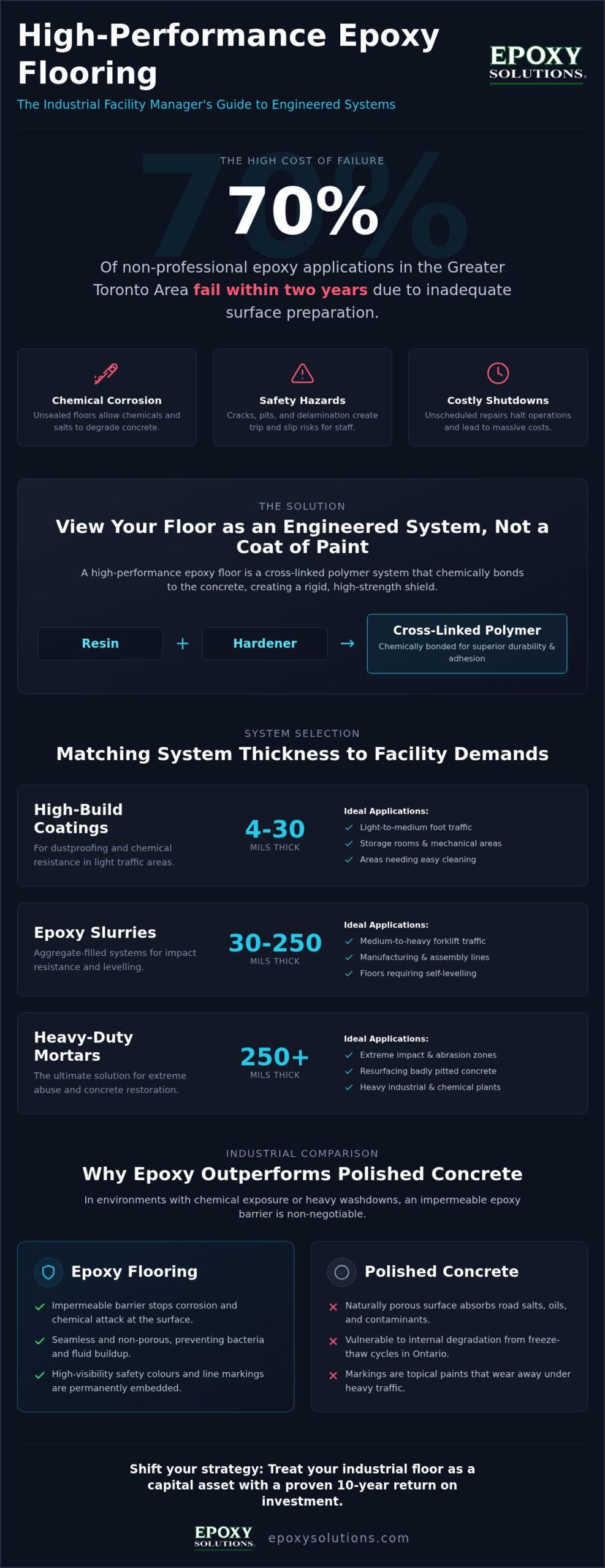
Industrial floors don’t fail by accident. They fail because they were treated as a bucket of paint instead of an engineered system. In the Greater Toronto Area, industry data shows that approximately 70% of non-professional epoxy flooring applications fail within two years due to inadequate surface preparation. For a facility manager in Mississauga or Toronto, that failure leads to more than just an eyesore; it results in chemical corrosion, safety hazards, and the massive cost of unscheduled shutdown time.
You deserve a surface that withstands heavy traffic and remains compliant with safety regulations for decades. This guide helps you master the technical specifications and selection criteria for high-performance epoxy flooring systems tailored for the Canadian industrial landscape. We will examine how to select chemical-resistant resins, ensure your facility meets the latest Ontario Building Code requirements, and implement a long-term, low-maintenance solution that ends the cycle of frequent repairs.
Key Takeaways
- Understand why high-performance surfaces are engineered as cross-linked polymer systems rather than simple coatings to withstand extreme mechanical stress.
- Learn the technical differences between coatings, slurries, and mortars to match your system thickness with specific facility requirements.
- Identify the critical role of mechanical surface preparation in preventing delamination and ensuring long-term adhesion in industrial settings.
- Discover how to engineer epoxy flooring for specialized needs like chemical resistance, anti-static properties, and UV protection.
- Shift your strategy toward long-term specifications that treat your floor as a capital asset with a proven 10-year ROI.
Understanding Epoxy Flooring Systems in Industrial Environments
Epoxy is an engineered solution. It’s a multi-component resinous system, not a thin layer of decorative finish. In the demanding industrial corridors of Toronto and Mississauga, facility managers often mistake retail-grade kits for high-performance installations. True epoxy flooring relies on a precise chemical reaction between a resin and a polyamine hardener. This reaction creates a rigid, cross-linked polymer structure that physically transforms the surface of your concrete slab into a high-strength shield. To understand the molecular basics of this process, you can explore What is Epoxy? and how its unique adhesion properties set the standard for heavy industry.
The Distinction Between Coatings and Resinous Systems
Stop calling it epoxy paint. In an industrial context, “paint” implies a solvent-based product that dries through evaporation. These products lack the build and durability required for forklift traffic or chemical spills. High-performance resinous systems bond chemically to the concrete substrate, becoming an integral part of the floor rather than a superficial film. This seamless nature is vital for facilities in Brampton or Vaughan that must maintain strict hygiene standards. Without grout lines or seams, there’s no place for bacteria or industrial fluids to hide, protecting both your product and your structural integrity.
Why GTA Facilities Prioritize Epoxy Over Polished Concrete
Polished concrete has its place, but it fails in environments with heavy washdowns or aggressive chemical exposure. Concrete is naturally porous. In Ontario, the winter brings road salt and brine into your facility on tires and boots. These contaminants can penetrate polished concrete, leading to internal degradation. Epoxy flooring provides an impermeable barrier that stops corrosion at the surface. Additionally, epoxy allows you to organize your workspace with high-visibility line markings and safety colours that are embedded into the system, not just painted on top. For a detailed breakdown of the financial trade-offs, consult our polished concrete vs epoxy flooring cost analysis to see which asset provides the best 10-year return for your specific operation.
The Chemistry of Performance: Coatings, Slurries, and Mortars
Performance is dictated by chemistry, not just coverage. The hierarchy of epoxy flooring is defined by mil thickness and aggregate load, where a “mil” represents one-thousandth of an inch. A successful installation begins with a dedicated primer that penetrates the concrete pores to create a permanent mechanical bond. Without this foundation, even the most expensive topcoat will eventually delaminate. The specific ratio of aggregate to resin determines the system’s final properties; higher aggregate loads increase compressive strength and impact resistance, transforming a brittle resin into a rugged industrial shield. These high-build systems are the baseline for facilities that manage heavy forklift traffic and constant mechanical stress.
Engineering these surfaces requires a deep understanding of Epoxy Resins in Industrial Applications to ensure the material can withstand the specific environmental hazards of your site. Whether you are managing a sterile pharmaceutical lab or a high-traffic distribution centre, the thickness of the system must match the anticipated abuse. If your current floor is showing signs of wear, it is likely because the specification was mismatched to the operational reality of the facility.
Thin-Film and High-Build Epoxy Coatings
Standard coatings typically range from 4 to 30 mils in thickness. These systems are ideal for light-to-medium traffic areas where dustproofing and ease of cleaning are the primary objectives. However, standard resins can amber when exposed to sunlight through loading dock doors or skylights. In these bright environments, we apply specialized topcoats to maintain colour stability. You can learn more about these specifications in our UV resistant epoxy flooring technical guide.
Epoxy Slurries and Mortar Systems
When the floor must endure heavy impact or requires self-levelling properties, we move to slurry systems, which range from 30 to 250 mils. These are created by adding fine silica sand to the resin, increasing the system’s density and durability. For the most extreme industrial abuse or to resurface badly pitted concrete, heavy-duty mortar systems are the only viable solution, often exceeding 250 mils in thickness. Damp sand mortars represent the highest tier of applicator skill, requiring hand-trowelling to achieve a level of density and durability that mechanical systems cannot replicate. To ensure your facility receives a specification that lasts, consult with our technical experts to evaluate your slab’s requirements.
Why Industrial Epoxy Flooring Fails: Preventing Delamination
Industrial flooring fails because people cut corners. It’s that simple. While material quality is a factor, approximately 70% of DIY epoxy flooring applications fail within two years because the installer treated the concrete like a canvas rather than a porous, living substrate. Delamination, or the physical peeling of the resin from the concrete, is the most frequent failure we encounter in Mississauga and Brampton plants. A floor that looks clean to the naked eye is rarely ready for a high-performance system. Contaminants like embedded oils, old sealers, and silicates hide within the concrete pores, ready to reject any new bond. Using retail-grade DIY kits in a professional industrial environment is a mistake that leads to costly repairs; these products lack the chemical density and adhesion strength to survive heavy mechanical stress.
The Critical Role of Mechanical Surface Preparation
Adhesion requires a profile. To achieve a permanent bond, we adhere to strict ASTM Flooring Preparation Standards which define the required Concrete Surface Profile (CSP). We use shot-blasting for high-build systems to strip away the weak upper layer of laitance, while precision diamond grinding is used for thinner systems to ensure a level, receptive surface. Without this mechanical tooth, the system is guaranteed to fail. We don’t rely on chemical etching because it’s inconsistent and leaves behind hazardous residues. We grind until the concrete has the texture of medium-grit sandpaper, allowing the resin to anchor itself deep into the slab.
Managing Moisture Vapour Emission (MVE)
Concrete breathes, and that’s a problem. Trapped moisture causes osmotic blistering, where vapour pressure builds up under the non-porous epoxy flooring and physically tears the bond apart. This is a common issue in older GTA facilities where the original vapour barrier has failed or was never installed. We never start a project without performing calcium chloride or in-situ probe testing to measure moisture levels accurately. If the emission rate is too high, we deploy specialized moisture-mitigating primers. These engineered products stabilize the slab and prevent moisture from compromising the integrity of the finished floor, ensuring your capital investment remains intact for decades.
Tailored Solutions: Chemical Resistance, ESD, and UV Protection
Standard flooring fails when it meets specialized industrial hazards. A generic floor coating cannot survive a sulfuric acid spill or prevent a static discharge from destroying sensitive electronic components. We engineer epoxy flooring to meet the exact environmental stresses of your facility. In Ontario, secondary containment is a regulatory requirement for chemical storage areas, not a suggestion. We provide high-performance resinous systems that act as an impermeable barrier, protecting the environment and your facility’s structural integrity from corrosive leaks. For electronics manufacturing and data centres, we implement anti-static flooring for critical environments to manage electrostatic discharge (ESD) safely through the floor to ground.
Chemical Resistant Coatings and Tank Linings
Chemical exposure requires specific resin chemistry. Whether your facility handles aggressive acids, alkalis, or organic solvents, the cross-linked polymer structure must be tailored to resist molecular penetration. Tank lining is the most demanding application in the industry, requiring a zero-failure approach to prevent structural corrosion of critical infrastructure. Epoxy Solutions™ demonstrates extreme capability in these environments, applying specialized linings that withstand constant immersion and thermal shock. We have been solving these complex corrosion problems for 45 years, providing a level of technical accuracy that generic contractors simply cannot match.
Precision Line Marking and Safety Flooring
Paint is a temporary fix for a permanent problem. In high-traffic warehouses across Toronto and Mississauga, standard floor paint peels and fades within months, creating safety risks and operational confusion. We integrate precision line marking directly into the resinous system using high-build epoxies that withstand heavy forklift scrubbing. This approach ensures safety aisles and loading zones remain visible for years. By incorporating non-slip textures into these safety zones, we help facilities maintain compliance with Ontario’s strict workplace safety regulations. For a deep dive into maintaining high-visibility layouts, read our durable epoxy floor striping guide. To secure a floor that meets your specific technical requirements, contact our engineering team today for a comprehensive facility assessment.
Implementing Long-Term Flooring Specifications in Ontario
A floor is not a consumable. It is a capital asset. Facility managers who treat epoxy flooring as a line-item expense often find themselves paying for the same floor twice within five years. To achieve a 10-year ROI, you must look beyond the initial quote and focus on a tailored specification that accounts for your facility’s specific mechanical and chemical loads. At Epoxy Solutions™, we have built a 45-year legacy in the Greater Toronto Area by setting the benchmark for industrial durability. Our process begins with a comprehensive site survey and facility evaluation. We analyze substrate integrity, moisture emission levels, and traffic patterns to ensure the chemistry of the system matches the reality of your operation.
Evaluating Lifecycle Costs and Maintenance
Cheap coatings are expensive. When a thin-film application fails, the true cost includes more than just the repair; it includes the massive operational downtime required to clear the floor and re-install the system. A single high-performance installation eliminates this cycle of failure. To maximize the service life of your resinous system, follow this maintenance protocol:
- Use only pH-neutral cleaners to prevent chemical etching of the topcoat.
- Utilize soft-bristle brushes or non-abrasive pads on floor scrubbers.
- Address mechanical gouges immediately to prevent fluids from migrating under the bond line.
- Rinse surfaces thoroughly after cleaning to remove suspended solids that act as abrasives.
Professional installation reduces long-term operational downtime by creating a surface that is easy to sanitize and resistant to the aggressive cleaning cycles required in modern industrial settings.
Choosing Local Expertise in Toronto and the GTA
Local knowledge is non-negotiable. Our crews understand the specific challenges of the Ontario climate, from high humidity during summer installations to the corrosive effects of winter road salts tracked into facilities. We ensure every project remains compliant with the Ontario Building Code and local safety regulations. Our service area covers the industrial heart of the province, including Toronto, Mississauga, Brampton, Milton, and Vaughan. We don’t just provide a service; we provide a standard-setting solution that has been refined since 1981. To secure a floor that withstands the most demanding environments, Consult with Epoxy Solutions™ for a tailored specification.
Securing Your Facility’s Future with High-Performance Specifications
Industrial flooring isn’t a cosmetic choice; it’s a structural requirement that dictates your facility’s operational efficiency. We have established that success depends on matching resin chemistry to environmental stress and ensuring mechanical preparation meets rigid standards. When you treat epoxy flooring as a long-term capital asset rather than a temporary fix, you eliminate the cycle of delamination and costly downtime.
Epoxy Solutions™ has specialized in high-performance resinous systems since 1981. For 45 years, we have served Toronto, Mississauga, and the broader GTA, stepping in where others have failed to deliver standard-setting results. We understand the specific demands of the Canadian industrial landscape and possess the technical accuracy to resolve your most complex surfacing challenges. Don’t leave your facility’s safety and compliance to chance.
Get a Professional Flooring Evaluation from Epoxy Solutions™ to ensure your next installation is engineered for a 10-year ROI and beyond. Your facility deserves a floor that performs as hard as your business does.
Frequently Asked Questions
How long does a professional epoxy flooring installation take?
A professional installation typically requires three to five days to complete properly. The first day is dedicated to mechanical surface preparation, such as diamond grinding or shot blasting, which is the most critical phase for ensuring a permanent bond. Subsequent days involve the application of primers, body coats, and topcoats. While the floor may be ready for light foot traffic within 24 hours, it requires a full seven days to achieve a total chemical cure.
Is epoxy flooring slippery when wet, and can texture be added?
Smooth epoxy flooring can be slippery when wet, but this is easily resolved through the integration of non-slip aggregates. During the installation process, we broadcast materials like silica sand, quartz, or aluminum oxide into the wet resin to create a textured surface. This ensures your facility remains compliant with Ontario safety standards and provides necessary traction for both pedestrian and forklift traffic in wet or oily environments.
Can epoxy be installed over existing tile or old coatings?
Installation over existing tile or old coatings is possible only if the underlying substrate is stable and the bond is sound. We perform adhesion tests to ensure the previous material isn’t failing. If the bond is secure, we use heavy-duty diamond grinding to remove the glaze from the tile or the surface of the old coating, creating the mechanical profile required for the new resinous system to anchor itself permanently.
What is the difference between an epoxy coating and a polyurethane topcoat?
Epoxy and polyurethane serve different roles within a high-performance system. Epoxy is the “muscle” of the floor, providing the thickness, compressive strength, and the primary bond to the concrete. Polyurethane is typically used as a thin topcoat to provide the “skin,” offering superior UV resistance to prevent yellowing and better scratch resistance against abrasive wear. We often specify a hybrid system to leverage the strengths of both materials.
How do I know if my concrete has too much moisture for epoxy?
Visual inspection is never sufficient to determine moisture levels. We utilize ASTM-standard testing methods, such as calcium chloride tests or in-situ relative humidity (RH) probes, to measure moisture vapour emission (MVE). If the test results exceed the material manufacturer’s threshold, we must install a specialized moisture-mitigating primer. This prevents osmotic blistering, which is a common cause of bond failure in facilities with high-moisture slabs or missing vapour barriers.
Does industrial epoxy flooring have a strong odour during installation?
The odour profile depends entirely on the system chemistry. While older, solvent-based systems have a pungent smell, modern 100% solids epoxies are low-VOC and virtually odourless. This is a critical consideration for food-processing plants or facilities that must remain operational in adjacent areas during the installation. We select the material specification based on your facility’s ventilation capabilities and sensitivity to environmental odours during the application process.
How much does industrial epoxy flooring cost per square foot in Canada?
The cost of epoxy flooring is determined by the specific engineering requirements of the slab and the intended environment. Primary cost drivers include the intensity of the mechanical surface preparation required, the total thickness of the system, and any specialized additives like anti-static or chemical-resistant resins. Larger facilities in the GTA often benefit from volume pricing, but the focus should always be on the total lifecycle cost rather than the initial square-foot rate.
What is the lifespan of a high-build epoxy system in a warehouse?
A high-build industrial system typically provides a service life of 10 to 20 years when installed and maintained correctly. The actual lifespan depends on the volume of forklift traffic, the types of chemicals used in the facility, and the consistency of your cleaning protocols. By choosing a high-performance specification and performing routine maintenance, you ensure the floor remains a durable capital asset that withstands the rigours of a demanding Canadian warehouse environment.