Standard floor coatings are not engineered for the heavy-duty abuse of a professional garage. Most automotive shop epoxy flooring installations fail within twenty-four months because the installer prioritized aesthetics over chemical bond strength. You’ve likely dealt with the frustration of hot tire pickup or watched road salt from a Mississauga winter eat through a supposedly premium finish. It’s a common industry failure that stems from treating the floor as a cosmetic upgrade rather than a critical piece of shop infrastructure.
We recognize that frequent downtime for floor repairs is a drain on your revenue and your professional reputation. You need a surface that handles constant impact and chemical exposure without flinching. This article explains why standard resins fail under automotive fluids and how to specify a high-performance system that survives oil, brake fluid, and the relentless slush of Ontario winters. We will detail the technical standards for diamond grinding, moisture barriers, and the specific resinous chemistries required to keep your shop floors functional for decades.
Key Takeaways
- Identify the technical causes of hot tire pickup and why standard coatings fail to survive the thermal demands of a service bay.
- Specify a high-performance automotive shop epoxy flooring system that utilizes 100% solids resin to resist oil, chemicals, and heavy impact.
- Recognize why mechanical surface preparation, specifically diamond grinding, is the only industry-standard method for ensuring a permanent concrete bond.
- Learn to distinguish between the UV-resistant requirements of a showroom and the rugged, chemical-resistant needs of a mechanical work area.
- Understand how to protect your infrastructure from the corrosive effects of Canadian road salts and winter slush using specialized resinous systems.
The Harsh Reality of Automotive Shop Floor Failures
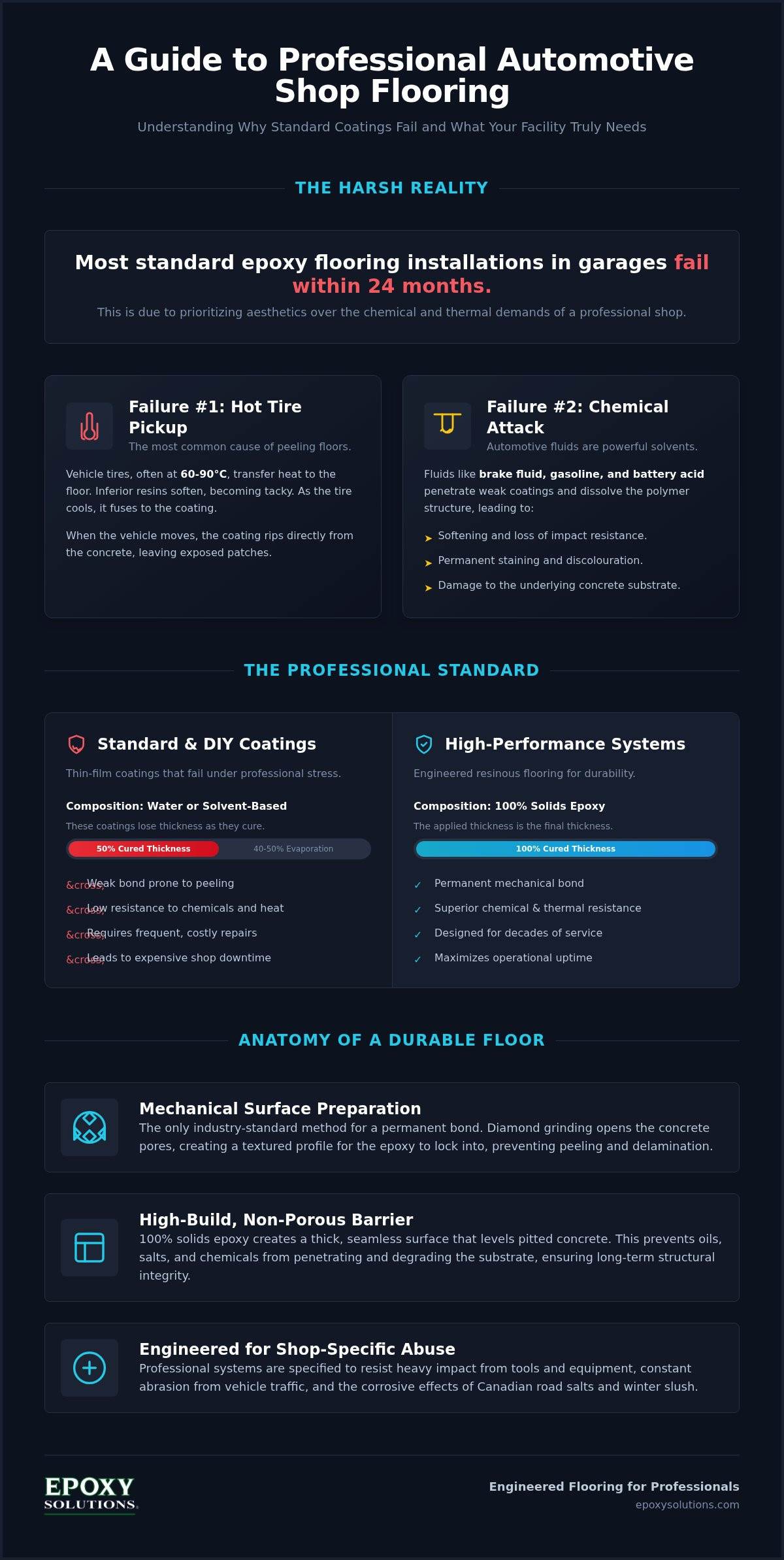
Cheap floors fail. It’s a blunt reality that many shop owners across the GTA discover only after their initial investment begins to peel away in sheets. Most retail-grade products and DIY kits are marketed as “industrial strength,” yet they lack the chemical density required to survive a professional environment. When you specify automotive shop epoxy flooring, you aren’t just buying a colour; you’re investing in a mechanical bond. Standard floor paints typically fail within six to twelve months because they cannot handle the relentless combination of mechanical weight and chemical exposure found in a busy service bay.
Why Hot Tire Pickup Destroys Retail Coatings
Physics doesn’t lie. When a vehicle drives into your shop, the tires are often reaching temperatures between 60 and 90 degrees Celsius. This heat transfers immediately into the floor coating. Inferior resins have a low threshold for thermal stress; they soften and become tacky under the pressure. As the tire cools, it effectively fuses to the resin. When the vehicle eventually pulls away, the bond between the tire and the coating is stronger than the bond between the coating and the concrete. The result is a “hot tire pickup” failure that leaves your floor looking like a patchwork of exposed, raw concrete. Professional systems prevent this through superior cross-linking in the epoxy resins, ensuring the material remains stable and rigid even under extreme heat.
Chemical Attack: The Silent Floor Killer
Automotive fluids are essentially high-powered solvents. Brake fluid, gasoline, and battery acid will make short work of a standard floor sealer. While many products are labelled as “oil-resistant,” this is often a marketing half-truth that only applies to brief, superficial spills. Without a high-build, chemical-resistant barrier, these fluids penetrate the coating and begin to dissolve the polymer structure from the inside out. This leads to:
- Softening: The floor becomes gummy and loses its impact resistance.
- Discolouration: Permanent amber or black staining that cannot be cleaned.
- Substrate Damage: Chemicals eventually reach the concrete, causing spalling and structural decay.
The true cost of a failing floor isn’t just the price of the materials. It’s the total loss of production. Repairing a delaminated floor requires clearing the entire shop, moving heavy equipment, and enduring days of dust-heavy grinding. In a high-volume facility in Toronto or Brampton, that downtime can cost thousands in lost revenue and bay fees every single day. Settling for a residential coating is a gamble that rarely pays off in a commercial setting.
High-Performance Epoxy Systems for Service Bays
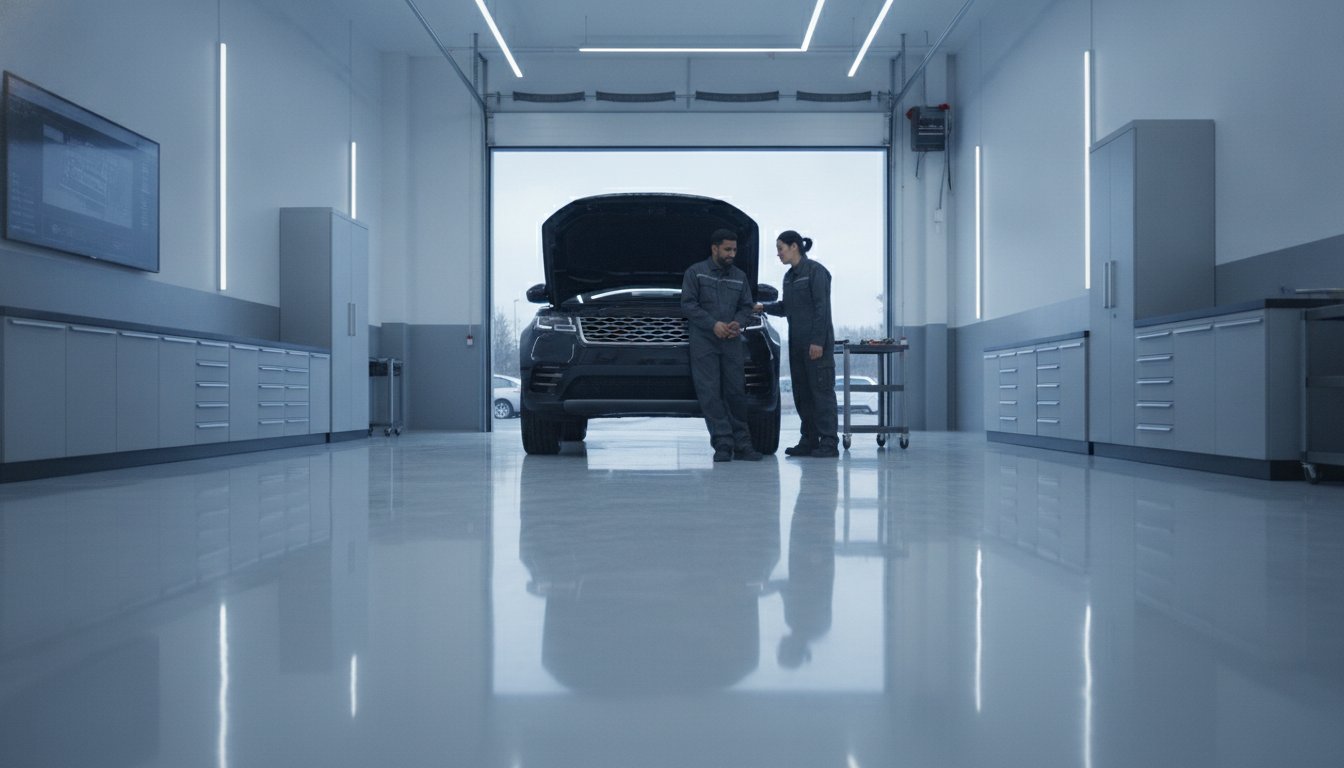
Service bays are high-stress environments. You cannot protect a concrete substrate with a thin-film coating designed for a residential basement. Professional automotive shop epoxy flooring requires a high-build resinous system capable of absorbing mechanical energy and resisting chemical penetration. We don’t just apply paint; we engineer a multi-layered barrier that becomes part of your facility’s structural integrity. This approach ensures your floor survives the weight of heavy-duty lifts and the constant abrasion of vehicle traffic without delaminating or cracking.
100% Solids Epoxy: The Industrial Benchmark
The term “100% solids” refers to the volume of the material that remains on the floor after the curing process is complete. Unlike water-based or solvent-based retail kits that lose 40% to 50% of their thickness to evaporation, a 100% solids system maintains its full applied depth. This thickness is vital for levelling out pitted concrete and creating a seamless, non-porous barrier. These systems are often specified in detailed industrial flooring specifications to ensure long-term performance under heavy vehicle traffic.
Beyond durability, these coatings help facilities maintain high safety standards. High-performance resins provide a predictable surface that is easy to maintain, aligning with the safety principles found in OSHA Regulation 1910.22, which mandates that walking-working surfaces be kept in a clean, safe, and dry condition. By eliminating cracks and porous gaps, you prevent the accumulation of hazardous oils and fluids that lead to slip-and-fall incidents.
Urethane Mortar for Thermal Shock and Impact
Standard epoxy is excellent for many areas, but certain zones require extreme capability. When your shop faces heavy impact from dropped rotors or the localized pressure of jack stands, a urethane mortar flooring installation is the superior choice. Urethane mortars are specifically engineered to handle thermal shock. In the GTA, a service bay floor can fluctuate from sub-zero temperatures to heated indoor air in seconds as garage doors open and close.
Standard coatings may crack under this rapid expansion and contraction. Urethane mortar moves with the concrete, providing a rugged, textured surface that survives both the environment and the equipment. It acts as a shock absorber for the substrate, preventing the concrete from spalling under heavy loads. If you are unsure which system fits your specific volume or chemical exposure, you can review our high-performance options to find a tailored match for your facility. Investing in the right material now prevents the massive expense of a full-floor failure three years down the road.
Showrooms vs. Mechanical Areas: Balancing Aesthetics and Utility
A single dealership facility often houses two entirely different worlds. Your front-of-house showroom is a branding tool designed to build customer confidence, while your service bays are high-intensity production zones. Specifying a uniform automotive shop epoxy flooring system across both areas is a common mistake that leads to either premature failure or unnecessary costs. A standard-setting approach treats each zone as a unique engineering challenge, selecting materials based on the specific environmental stressors they will face.
The Showroom: UV Resistance and Visual Impact
Showrooms are defined by large glass facades and high-intensity lighting. While these features highlight the vehicles, they also subject the floor to massive amounts of ultraviolet radiation. Standard epoxy resins will amber and lose their lustre when exposed to consistent sunlight, making a once-premium floor look aged and neglected. This is why professional specifications for dealership front-ends mandate UV resistant epoxy flooring.
These systems utilize light-stable topcoats that prevent yellowing while allowing for the integration of decorative flake or metallic systems that reflect your specific brand identity. These finishes maintain a high-gloss finish even under heavy foot traffic and display vehicle movement. Beyond the technical specs, a flawless showroom floor serves a psychological purpose; it signals to your clients that your facility operates at a level of precision they can trust. It’s about creating an environment where the floor supports the sale rather than distracting from it.
The Service Bay: Traction and Safety
Visuals take a backseat to safety and durability in the mechanical areas. Here, the floor must comply with ASTM C722-18, the industry standard for monolithic, resin-based flooring in chemical-resistant applications. The engineering challenge is balancing slip resistance with cleanability. Too much texture makes it impossible to mop up oil spills; too little turns the bay into a skating rink when wet. We resolve this by tailoring the aggregate profile to provide the exact grit required for your specific workflow.
Safety isn’t just about traction. It’s about organization. We use durable epoxy floor striping to create permanent safety aisles and designated work zones. Unlike standard paint that chips away under tire traffic, these markings are chemically bonded into the resinous system. This creates a seamless, non-porous surface that allows for rapid spill cleanup while maintaining high-visibility safety boundaries that won’t fade or peel over time. It’s a rugged, functional solution that keeps your technicians safe and your shop compliant.
Avoiding the Peel: Surface Preparation and Oil-Stop Primers
Preparation is not a suggestion; it is the foundation of the entire system. Approximately 90% of all resinous floor failures are the direct result of inadequate substrate preparation. In a professional garage, the concrete is rarely a clean slate. It is usually a sponge saturated with decades of hydraulic fluid, motor oil, and road salts. If you apply automotive shop epoxy flooring over these contaminants without proper mechanical intervention, the coating will delaminate within months. We don’t rely on luck; we rely on a standardized engineering process to ensure a permanent bond.
The Myth of “No-Prep” Flooring
Many retail products claim that a simple acid wash or “chemical etching” is enough to prepare a floor. This is a dangerous half-truth that leads to guaranteed failure in an industrial setting. Chemical etching is insufficient for professional shops because it only cleans the very surface without creating the necessary “profile” for the resin to grab onto. To achieve a lasting result, we must physically open the concrete pores. Mechanical profiling is the only way to ensure a 10-year bond. We utilize heavy-duty diamond grinding or shot blasting to remove the “laitance” (the weak top layer of concrete) and expose the aggregate, creating a surface texture similar to 60-grit sandpaper. This allows the primer to sink deep into the slab rather than just sitting on top of it.
Engineering for Oil-Saturated Concrete
Older facilities across the Toronto and Mississauga corridor often present a unique challenge: deep hydrocarbon saturation. When oil has soaked into a slab for forty years, a standard primer will simply float on the surface. We utilize specialized oil-stop primers designed to “wick” into the concrete and chemically displace the oils. These primers are engineered to bond to contaminated substrates where other materials fail.
Beyond oil, we must manage “vapour drive.” In many GTA shops, moisture from the high water table can push through the concrete slab, creating enough pressure to pop a standard coating off the floor. Our standard-setting approach includes rigorous moisture testing before the first drop of resin is mixed. If vapour levels are high, we specify a moisture-reductive primer that acts as a breathable but impermeable barrier. This is especially critical in Ontario, where the transition from frozen ground to spring thaw creates significant hydrostatic pressure under your shop floor.
Don’t risk your investment on a “no-prep” shortcut that will peel under the first set of hot tires. To ensure your facility meets industrial standards, you can consult with our engineering team regarding a site-specific substrate analysis. We identify the hidden killers of shop floors before the installation begins, ensuring your new surface is as rugged as the equipment you use every day.
Specifying Your Facility: The Epoxy Solutions™ Standard
Results define reliability. Choosing the right partner for your facility specification is the difference between a floor that lasts twenty years and one that fails in twenty months. At Epoxy Solutions™, we have specialized in high-performance resinous systems across the Toronto, Mississauga, and Brampton corridor since 1981. This historical perspective allows us to understand exactly how local environmental stressors affect industrial substrates. We don’t provide generic quotes; we provide tailored engineering designed to survive your specific volume and chemical exposure profile.
Local Expertise for the GTA Climate
Ontario winters are brutal. The heavy usage of road salts and the constant cycle of freezing and thawing create a corrosive environment that destroys standard concrete sealers. Our team designs automotive shop epoxy flooring specifically to withstand these conditions. In the industrial hubs of Mississauga and Brampton, we see facilities where salt-laden slush sits on the floor for months. We specify high-density, non-porous topcoats that prevent salt from penetrating the resin and reaching the concrete, preserving your infrastructure against seasonal decay. This site-specific engineering is something a generic kit or a non-local contractor simply cannot offer.
The ROI of “Doing it Right Once”
Cheap is expensive. When evaluating the polished concrete vs epoxy flooring cost, you must look beyond the initial invoice. A premium epoxy system offers a significantly lower lifecycle cost because it eliminates the need for frequent repairs and re-sealing. Beyond the balance sheet, a professional floor has a direct impact on your daily operations. High-gloss, light-reflective surfaces improve shop visibility, reducing the need for auxiliary lighting and increasing technician safety. A clean, organized environment also boosts technician morale and signals to your customers that their vehicles are in the hands of professionals.
We realize that closing your shop for flooring work isn’t always an option. Our crews are experienced in phased installations that allow you to keep your service bays operational while we work. This minimizes business interruption and ensures your revenue stream remains intact during the upgrade. If you are ready to move away from failing retail products and toward a standard-setting industrial solution, consult with an Epoxy Solutions™ expert for your facility spec today. We provide the technical accuracy required to ensure your floor remains an asset for decades.
Secure the Future of Your Facility Infrastructure
Automotive flooring is an engineering challenge that retail-grade kits simply cannot solve. You’ve learned that a permanent bond requires rigorous mechanical surface preparation and the use of high-build resinous systems tailored to your specific chemical exposure. Whether you are managing a high-traffic service bay in Mississauga or a premium showroom in downtown Toronto, your automotive shop epoxy flooring must be specified for long-term durability rather than short-term aesthetics. Settling for a residential-grade product is a gamble that inevitably leads to costly downtime and substrate damage.
Since 1981, Epoxy Solutions™ has operated as North American specialists in chemical-resistant traffic toppings and industrial resinous systems. We bring a seasoned industry veteran’s perspective to every project in the GTA, ensuring your floor withstands road salts, thermal shock, and heavy mechanical loads. Our expert installers understand the unique demands of the Ontario climate and provide the technical accuracy required for a standard-setting finish. Don’t wait for your current coating to fail; instead, invest in a surface that reflects the professional standards of your business.
Get a Professional Engineering Specification for Your Shop today and ensure your facility is built for decades of high-performance service.
Frequently Asked Questions
Is epoxy flooring too slippery for an automotive shop when wet?
Slip resistance is achieved through the strategic broadcast of aggregates into the wet resin. A high-gloss finish without texture is a safety hazard in a mechanical bay where oil and coolant spills are frequent. We tailor the grit level to provide maximum traction while still allowing for efficient cleaning. This balance ensures your facility remains compliant with workplace safety standards without compromising the ability to wipe up hazardous fluids quickly.
How long does it take to install epoxy flooring in a commercial garage?
A standard industrial installation typically requires three to five days for the application process. Traditional 100% solids epoxy systems then require an additional five to seven days to reach full chemical cure before they can support heavy vehicle traffic. While newer polyaspartic coatings can reduce this window to 24 hours, the specific timeline depends on your facility’s temperature and the number of build layers required for your shop’s traffic volume.
Can epoxy be applied over oil-stained concrete in an old shop?
Yes, but only if the substrate is mechanically profiled and treated with specialized primers. Standard coatings will fail over oil-saturated concrete because hydrocarbons prevent a chemical bond. We utilize heavy-duty diamond grinding to remove the top layer of contaminated concrete before applying an oil-stop primer. This primer is engineered to wick into the pores and displace remaining oils, creating a stable foundation for the high-performance resinous system.
What is the difference between a DIY garage kit and a professional automotive floor?
The primary difference lies in the resin quality and the application method. DIY kits are typically water-based and lose half their thickness to evaporation, leaving a thin film that peels under hot tires. Professional automotive shop epoxy flooring utilizes 100% solids resins that maintain their full applied depth. Additionally, professional installers use industrial-grade diamond grinders for surface preparation, whereas DIY kits rely on ineffective acid etching that fails to open the concrete pores.
How do Canadian winters and road salts affect epoxy flooring?
Road salts are highly corrosive and will cause pitting in unprotected concrete. In the GTA, winter slush carries these salts into your shop, where they can sit and eat through low-grade sealers. High-performance resinous systems are engineered to be non-porous and chemically resistant to sodium chloride. This prevents the salt from reaching the concrete substrate, protecting your facility’s structural integrity through the most demanding Ontario winters.
What maintenance is required to keep an automotive shop floor looking new?
Maintaining a professional floor requires a consistent cleaning schedule using non-acidic, pH-neutral cleaners. While the surface is engineered for chemical resistance, leaving caustic fluids like brake fluid or battery acid on the floor for extended periods can eventually dull the finish. We recommend using a soft-bristle floor scrubber or a microfibre mop to remove abrasive dirt and metal shavings. This simple routine prevents surface scratches and keeps the high-performance coating looking new for years.
Are there low-VOC epoxy options for shops that need to remain partially open?
Yes, modern bio-based and zero-VOC resinous systems are available for facilities that must remain operational during installation. These eco-friendly formulas don’t emit the harsh odours or volatile organic compounds associated with traditional solvent-based coatings. This allows us to perform phased installations in one part of your shop without the fumes affecting technicians or customers in adjacent bays. We prioritize these high-performance, low-odour materials to minimize business interruption and ensure a safe working environment.
How much does automotive shop epoxy flooring cost per square foot in the GTA?
Pricing for professional automotive shop epoxy flooring in the Toronto and Mississauga area is determined by the condition of the concrete and the chosen build thickness. Factors such as the level of oil saturation, the need for moisture barriers, and the complexity of safety line markings all influence the final investment. While DIY kits appear cheaper upfront, they lack the durability of an engineered system. We recommend a site-specific analysis to determine the most cost-effective specification for your facility’s long-term performance.