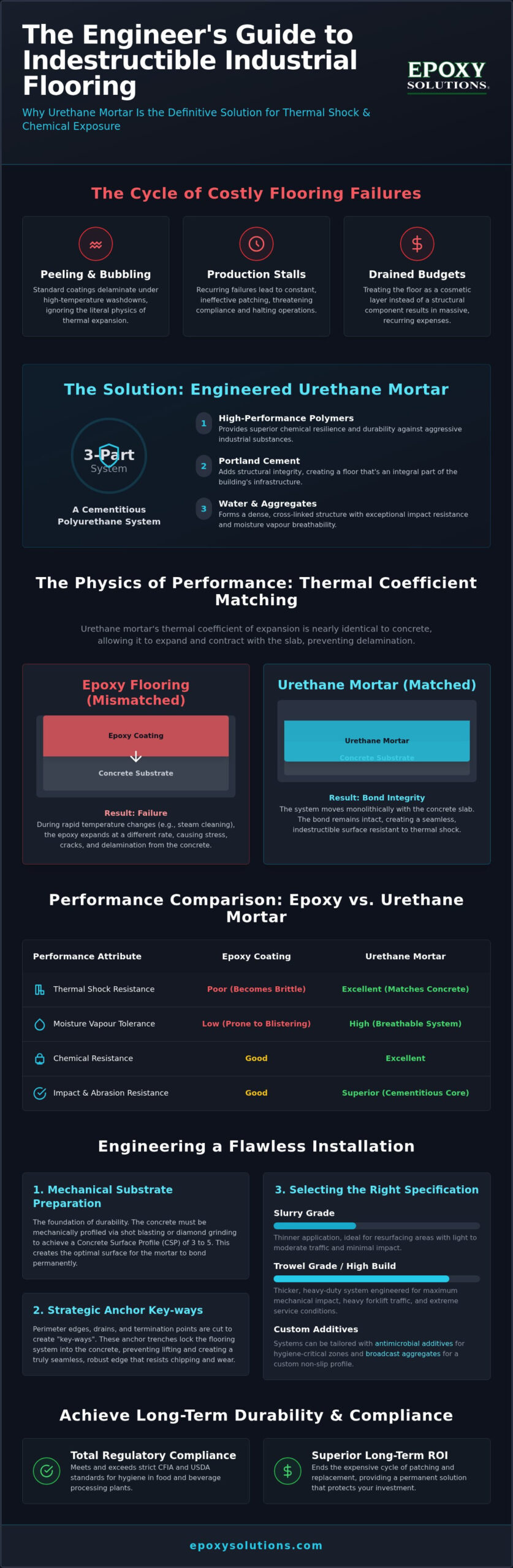
Most industrial floors fail not because the material is weak, but because the engineering behind the application ignored the literal physics of the facility. You’ve likely dealt with the frustration of a coating that looked pristine on Monday only to bubble and peel after the first high-temperature washdown on Friday. These recurring failures don’t just threaten your CFIA compliance; they stall production and drain your maintenance budget through constant, ineffective patching. It’s a common industry failure that results from treating a floor as a cosmetic layer rather than a structural component.
We understand that in a heavy-duty Canadian processing plant, a floor isn’t a design choice. It’s a critical piece of infrastructure. By mastering the technical nuances of urethane mortar flooring installation, you can finally end the cycle of delamination and secure a surface that remains indestructible against thermal shock and aggressive chemical exposure. It’s about moving beyond basic coatings toward a cementitious solution that actually expands and contracts at the same rate as your concrete substrate.
This guide provides a professional engineering perspective on the specific requirements for success. We’ll examine the critical importance of mechanical substrate preparation, the chemistry of thermal coefficient matching, and the precise installation steps required to ensure your facility achieves total hygiene compliance and a superior long-term ROI.
Key Takeaways
- Identify why three-part cementitious systems are the benchmark for surviving aggressive chemicals and extreme temperature fluctuations in industrial settings.
- Determine the optimal system thickness by matching slurry or trowel-grade specifications to your facility’s specific mechanical impact and heavy traffic requirements.
- Master the engineering requirements of a successful urethane mortar flooring installation, including the necessity of a CSP 3 to 5 profile and strategic anchor key-ways.
- Understand how matching the thermal coefficient of expansion between the floor and substrate prevents delamination during rigorous high-pressure steam cleaning cycles.
- Ensure long-term durability and regulatory compliance by applying professional standards that withstand the unique operational demands of Ontario’s industrial environments.
Understanding Urethane Mortar: The Industrial Heavyweight for Harsh Environments
Industrial floors are battlegrounds. In environments where heavy machinery, corrosive chemicals, and extreme temperatures are the norm, standard coatings simply won’t suffice. Urethane mortar is a three-part cementitious polyurethane system designed specifically for these high-stress conditions. Unlike traditional resins, it combines the structural integrity of Portland cement with the chemical resilience of high-performance polymers. This creates a floor that doesn’t just sit on top of the concrete but becomes an integral part of the building’s infrastructure.
A professional urethane mortar flooring installation is the definitive answer for facilities facing thermal shock. When you hit a cold floor with high-pressure steam, standard materials tend to crack, bubble, or delaminate. Urethane mortar possesses a thermal coefficient of expansion nearly identical to concrete. It moves with the slab, ensuring the bond remains intact despite rapid temperature shifts. This durability is essential for maintaining strict CFIA and USDA compliance in food and beverage processing plants where hygiene is non-negotiable.
The Chemistry of Durability
The secret lies in the hybrid matrix. By blending Portland cement, water, and polyurethane resin, the material forms a dense, cross-linked structure during the curing process. This bond realizes significantly better impact resistance than pure resin systems. Because it’s a cementitious hybrid, the material is also highly breathable. It manages moisture vapour transmission effectively, preventing the osmotic blistering often seen in non-breathable epoxy systems applied to slabs with high moisture content. For active GTA facilities, the low-odour and VOC-compliant nature of the material means you can often avoid costly shutdowns during application.
Epoxy vs. Urethane Mortar: When to Upgrade
Epoxy fails where heat dominates. It’s a blunt reality that many facility managers learn too late. While epoxy is excellent for dry storage or light manufacturing, it cannot handle the “hammer blow” of steam cleaning or the intense heat radiating from industrial fryers. Over time, constant thermal cycling makes epoxy brittle, leading to widespread failure and peeling.
If your concrete slab has high moisture levels or your process involves frequent washdowns, urethane mortar is the necessary upgrade. It provides a seamless, indestructible surface that epoxy simply cannot match in extreme conditions. For a deeper technical breakdown of how these materials compare under mechanical stress, consult our Industrial Flooring Specs: Engineering Guide for 2026. Choosing the right material at the start prevents the massive downtime and expense of a total floor replacement later.
Selecting the Right Specification: Slurry, Mortar, or High-Build Systems
Specification errors lead to catastrophic floor failure. Choosing the wrong thickness or grade of material is the most common reason industrial coatings delaminate under pressure. A urethane mortar flooring installation isn’t a singular product; it’s a range of engineered systems tailored to specific mechanical and environmental stressors. To ensure your facility survives, you must match the system’s compressive strength and thickness to your operational reality. Don’t let a contractor sell you a thin coating for a heavy-impact zone.
Beyond thickness, environmental factors dictate the final build. In food-safe environments, antimicrobial additives are integrated into the resin matrix to inhibit the growth of bacteria, fungi, and mould. Texture is equally critical. In wet-processing areas, we broadcast high-performance aggregates into the wet mortar to create a non-slip profile that meets safety standards without compromising cleanability. If you’re unsure which profile fits your facility, reviewing our industrial flooring engineering guide can help clarify the requirements for your specific sector.
Slurry Systems for Light to Medium Traffic
Self-levelling urethane slurries are typically applied at a thickness of 1/8-inch. These systems provide a smooth, high-density finish that excels in environments like bottling lines, laboratories, and light manufacturing centres. The primary advantage here is the speed of installation. Because the material is self-levelling, large areas can be covered quickly, allowing for a faster return to service. However, slurries have limits. They don’t offer the same depth of thermal shock protection as their thicker counterparts and should be avoided in areas with extreme temperature swings.
Trowel-Grade Mortar for Extreme Abuse
Heavy-duty environments require more mass. Trowel-grade mortar, applied at 1/4-inch to 3/8-inch thickness, is the industry benchmark for thermal shock protection. This thickness allows the floor to absorb the energy of rapid temperature changes without losing its bond to the concrete. By using a heavy aggregate loading, these systems achieve maximum compressive strength, making them indestructible under heavy forklift traffic and constant mechanical impact. Dairies, breweries, and heavy chemical plants realize the best ROI with this specification. It’s a premium solution for high-stakes environments where failure is not an option.
The Performance Advantage: Thermal Shock and Chemical Resistance Realities
Rigid floors fail by design. When a standard epoxy coating is subjected to a 90°C steam cleaning, it tries to expand at a rate significantly faster than the concrete beneath it. This mismatch creates massive shear stress at the bond line. Eventually, the bond snaps. A professional urethane mortar flooring installation solves this by using a material with a thermal coefficient of expansion that mimics the concrete slab. It doesn’t fight the physics; it works with them to maintain a permanent bond.
This resilience is vital in commercial kitchens where grease, heat, and aggressive cleaning cycles are constant. Standard resins become brittle and delaminate under the radiant heat of industrial ovens or the “hammer blow” of boiling water spills. Urethane mortar remains stable, providing a seamless surface that won’t compromise your facility’s hygiene or safety standards. It’s the only material capable of handling these conditions without requiring constant, expensive patching.
Engineering for Thermal Shock
Thermal shock is the rapid transition from one temperature extreme to another. In rigid systems, these spikes cause immediate micro-cracking and eventual “pop-offs.” Because urethane mortar forms a cementitious bond with the substrate, it possesses the structural integrity to withstand freeze/thaw cycles without losing adhesion. Imagine a cold storage facility in the GTA held at -5°C. When a sanitation crew performs a hot washdown at 60°C, a standard floor would buckle. Urethane mortar absorbs that energy, maintaining a liquid-tight seal that prevents moisture from reaching the slab and causing structural damage. For facilities operating freezer or refrigerated environments, understanding how urethane cement flooring for cold storage eliminates delamination under extreme freeze/thaw cycling is essential to specifying the right system from the start.
Chemical Resistance Standards
Food and beverage processing environments are chemically hostile. Organic acids like lactic acid from dairy products or acetic acid from pickling lines are notorious for dissolving standard resins. Urethane mortar is engineered to be impermeable to these corrosive agents, as well as the harsh caustic detergents used in Clean-In-Place (CIP) systems. It provides a level of protection that ensures your floor survives the very chemicals designed to sanitize it. For facilities requiring high-performance Chemical Resistant Floor Coatings, a proper urethane mortar flooring installation represents the premium standard for longevity and safety. The same principles of chemical bond strength and substrate preparation that govern industrial processing floors also apply to automotive shop epoxy flooring, where oil, brake fluid, and road salt create equally aggressive attack vectors against poorly specified coatings.
Step-by-Step Installation: How High-Performance Urethane Floors are Engineered
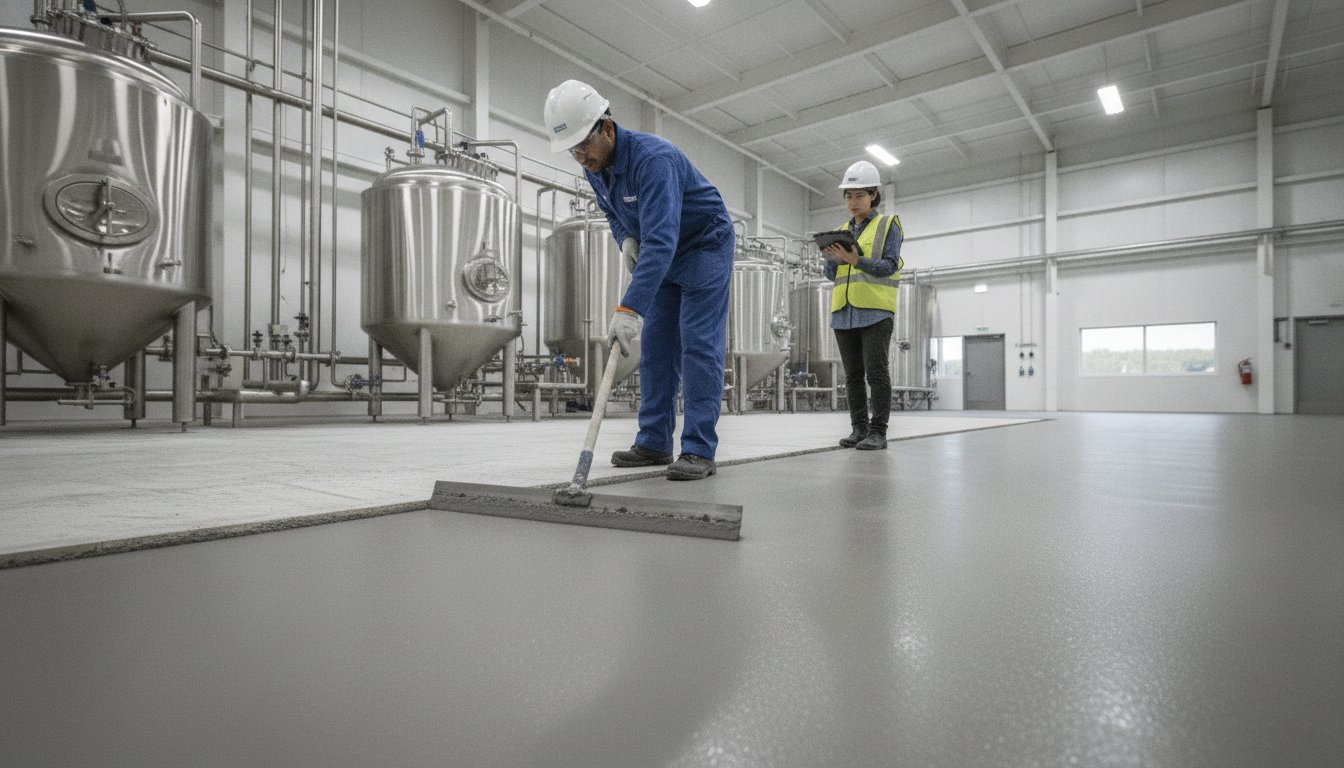
Precision is the difference between a floor that lasts decades and one that fails in months. A professional urethane mortar flooring installation requires more than just mixing bags; it demands rigorous engineering at every stage. In industrial settings, the physical bond between the mortar and the concrete substrate is the only thing standing between operational success and a costly shutdown. We don’t cut corners on the process because the environment won’t forgive technical errors. Every step is calculated to ensure the final surface can withstand the literal physics of a heavy-duty facility.
The Critical Nature of Surface Prep
Preparation is everything. If a contractor suggests “no-prep” options or simple acid etching, they’re guaranteeing a bond failure. For urethane mortar, mechanical shot-blasting is non-negotiable. This process removes the weak surface laitance and exposes the aggregate, achieving a Concrete Surface Profile (CSP) of 3 to 5. This profile provides the necessary “tooth” for the resin to anchor effectively. While urethane mortar is more tolerant of moisture than epoxy, we still perform moisture testing to ensure the slab’s vapour emission levels won’t compromise the final build. If the prep is wrong, the floor will fail. It’s a blunt reality that defines our standard-setting approach.
Anchor Grooves and Edge Detail
Mechanical keys are vital for long-term stability. We cut deep grooves, or anchor keys, around every drain, perimeter, and termination point. These grooves are typically twice as deep as the floor’s thickness. They act as a physical anchor that prevents the mortar from curling or lifting when subjected to thermal shock or heavy mechanical impact. Proper slope-to-drain requirements must also be realized during this stage to prevent pooling. Without these mechanical anchors, the natural expansion and contraction of the floor will eventually cause the edges to pull away from the concrete, creating hygiene traps and safety hazards.
The mixing protocol for three-part cementitious systems is equally demanding. We use high-shear mixers to combine the resin, hardener, and engineered aggregate into a homogeneous matrix. Once mixed, the material is distributed using screed boxes or hand trowels, then finished with a loop roller to release trapped air and settle the aggregate. Because these systems have a rapid set time, the installation team must move with calculated speed to maintain a wet edge. This technical accuracy ensures a seamless, indestructible finish that’s ready for traffic in as little as 12 to 24 hours. For a floor engineered to survive the most demanding Canadian industrial conditions, contact the experts at Epoxy Solutions™ to discuss your facility’s requirements.
Securing Your Investment: Professional Installation in the GTA
Cheap floors are expensive. In the high-stakes world of GTA manufacturing, a failed coating isn’t just an eyesore; it’s a structural liability that halts production and invites regulatory scrutiny. Selecting the right team for your urethane mortar flooring installation is a capital investment decision that dictates your facility’s operational efficiency for the next decade. You don’t need a contractor who simply follows a data sheet. You need an engineering partner who understands the specific stressors of an Ontario industrial environment and possesses the technical discipline to execute a flawless build.
Evaluating a contractor’s track record is the only way to mitigate risk. Many firms claim expertise but lack the specialized equipment and seasoned crews required for three-part cementitious systems. A premium installation might carry a higher upfront cost, but it eliminates the cycle of recurring failures that plague facilities using sub-standard materials. When you calculate the cost of downtime, lost product, and repeated repairs, a high-performance floor realizes a significantly better ROI over a ten-year lifecycle.
Local Expertise in Toronto and Mississauga
Facilities in the Greater Toronto Area face unique environmental challenges that out-of-province contractors often overlook. High seasonal humidity and the tracking in of winter salts can wreak havoc on concrete slabs if the preparation isn’t handled with precision. We understand the local compliance landscape, ensuring your facility meets all health and safety regulations required by provincial inspectors. Whether you’re operating in the food processing hubs of Brampton or the manufacturing centres in Milton, having a local partner means faster response times and a deeper understanding of the regional infrastructure. The same winter salt and freeze-thaw challenges that affect processing plants are equally destructive in vehicle service bays, making properly engineered automotive shop epoxy flooring in the GTA a critical specification decision for any garage or fleet maintenance facility in the region.
The Epoxy Solutions™ Guarantee
Since 1981, Epoxy Solutions™ has set the benchmark for resinous flooring across North America. We’ve built our reputation by stepping in where others have failed, providing the “Authoritative Expert” approach to every project. Our legacy is rooted in technical accuracy and a no-nonsense attitude toward quality. We don’t just apply a product; we engineer a solution tailored to your facility’s specific chemical and thermal requirements. This meticulous execution prevents the common industry failures, such as delamination and bubbling, that result from rushed preparation or poor mixing protocols.
Your facility deserves a floor that is as rugged and reliable as your operations. Don’t leave your infrastructure to chance with unproven contractors. For a floor that survives the most extreme conditions, request a professional site evaluation from the team that has been leading the industry for over four decades. We’ll provide a blunt, honest assessment of your needs and deliver a urethane mortar flooring installation designed for total durability.
Secure Your Facility’s Future with Engineered Durability
Engineering a floor that survives the relentless cycle of thermal shock and chemical exposure requires more than just high-quality materials. It demands a disciplined, technical approach to every phase of the project, from mechanical surface preparation to the precision of the final trowel. By choosing a urethane mortar flooring installation, you’re investing in a seamless, indestructible infrastructure that moves with your building and withstands the harshest sanitation protocols.
Since 1981, Epoxy Solutions™ has served as the authoritative partner for industrial facilities across North America. Our engineering-first approach to resinous flooring has established a proven history of success in the Toronto industrial sector, fixing the failures left behind by less experienced contractors. We prioritize long-term ROI and safety, ensuring your facility remains compliant and operational under the most extreme conditions.
Don’t let a sub-standard floor stall your production or compromise your hygiene standards. Take the first step toward a permanent solution today. Request a Technical Site Evaluation from Epoxy Solutions™ and secure a floor that’s built to last. We look forward to helping you set a new standard for durability in your facility.
Frequently Asked Questions
What is the difference between urethane mortar and cementitious urethane?
Urethane mortar and cementitious urethane are two names for the same high-performance technology. Both describe a three-part system consisting of polyurethane resin, a hardener, and a Portland cement-based aggregate. This chemistry allows the floor to breathe and manage moisture vapour better than traditional resins. It’s the standard-setting choice for environments requiring extreme thermal and chemical resistance, providing a dense, indestructible matrix that bonds permanently to the concrete substrate.
How long does a urethane mortar floor take to cure before I can use it?
Speed of return-to-service is a primary benefit of this system. Most professionally installed floors allow for light foot traffic within 8 to 12 hours after the final application. Full operational use, including heavy forklift traffic and chemical exposure, typically requires 24 hours. This rapid cure cycle is essential for GTA facilities that cannot afford prolonged shutdowns, though exact times depend on the ambient temperature and humidity during the installation.
Can urethane mortar be installed over damp concrete?
Yes, this material is specifically engineered to be moisture-tolerant. Unlike epoxy, which acts as a vapour barrier and can blister when applied to damp slabs, urethane mortar is breathable. It allows moisture vapour to pass through the matrix without compromising the bond. This makes it the definitive solution for “green” concrete or older slabs in food processing plants where total slab dryness is impossible to achieve.
Is urethane mortar more expensive than industrial epoxy?
The initial capital outlay for a urethane mortar flooring installation is higher than a standard epoxy coating. This reflects the increased material mass and the technical precision required for application. However, the long-term ROI is superior because it eliminates the recurring failures caused by thermal shock and aggressive cleaning. When you factor in the cost of production downtime and frequent repairs, urethane mortar is the more cost-effective engineering choice.
How do I clean and maintain a urethane mortar floor?
Maintenance is straightforward because the surface is non-porous and chemically inert. You can use high-pressure steam cleaning, hot water washdowns, and aggressive caustic detergents without damaging the floor’s integrity. For facilities in Toronto or Mississauga, we recommend regular mechanical scrubbing with a neutral or alkaline cleaner to remove grease and debris. Its indestructible nature means it doesn’t require the frequent resealing or waxing often associated with less durable flooring options.
Is urethane mortar suitable for outdoor traffic toppings?
Urethane mortar is not recommended for outdoor applications because it’s not UV stable. While the structural integrity remains intact, prolonged exposure to sunlight causes the material to yellow and chalk over time. For exterior ramps or parking decks, we install specialized traffic toppings that are engineered to withstand UV rays and Canadian freeze-thaw cycles. Urethane mortar should remain an indoor solution for processing areas, kitchens, and heavy manufacturing zones.
What is the typical lifespan of a professionally installed urethane mortar floor?
A correctly specified and installed floor typically lasts 10 to 15 years in high-abuse industrial environments. Some facilities report even longer lifespans when proper maintenance protocols are followed. Its longevity is rooted in its ability to move with the concrete, preventing the delamination that destroys thinner coatings. By investing in professional mechanical preparation and anchor grooves, you ensure the floor remains a permanent component of your facility’s infrastructure.
Does urethane mortar require a primer before installation?
Urethane mortar is generally a self-priming system that relies on mechanical tooth and anchor keys rather than a separate primer layer. The resin matrix is designed to penetrate the open pores of shot-blasted concrete to create a structural bond. In some specific cases involving highly porous or compromised slabs, a specialized moisture-tolerant primer might be used, but the engineering standard usually dictates a direct-to-substrate application for maximum adhesion.