A failed floor is a liability you cannot afford. Most commercial surfaces lose their lustre or begin dusting within months because they were treated as a janitorial task rather than a precise engineering project. If your warehouse or retail centre is currently battling peeling finishes or safety hazards, you already know that a low-bid installation often leads to high-cost disruptions. You deserve a surface that reflects your brand quality while meeting the rigorous demands of heavy traffic.
Mastering the technical specifications for commercial polished concrete Toronto facility managers require is the only way to ensure long-term performance. This 2026 buying guide provides the exact selection criteria needed to secure a floor that meets the 0.42 wet Dynamic Coefficient of Friction standard under ANSI A326.3. We will break down the 2024 Ontario Building Code amendments, the necessity of 25 MPa concrete strength, and why the industry is moving toward sustainable matte finishes. You will learn how to navigate the curing process and aggregate selection to achieve a professional, high-performance aesthetic that eliminates dusting and slashes maintenance costs for years to come.
Key Takeaways
- Define the mechanical grit sequence required to move from a flat, matte finish to a high-gloss, mirror-like surface that meets your specific aesthetic and safety needs.
- Learn how to specify the commercial polished concrete Toronto facilities require to effectively resist local challenges like heavy salt tracking and seasonal humidity shifts.
- Recognize that professional surface preparation, specifically addressing moisture vapour and substrate integrity, is the single most important factor in preventing premature floor failure.
- Evaluate whether polished concrete or high-performance epoxy is the superior choice for your specific operational environment, traffic levels, and safety requirements.
- Leverage a problem-first methodology to diagnose slab health before any grinding begins, ensuring a tailored solution that maximizes long-term ROI and durability.
The Toronto Standard: Defining Commercial Polished Concrete
Precision engineering defines the Toronto standard. For a facility to maintain a high-performance floor, the surface must undergo a rigorous mechanical process of grinding and honing. True Polished Concrete is not a topical sealer or a wax finish that eventually peels. It is a systematic refinement of the concrete slab itself, using industrial-grade diamonds to achieve a dense, durable surface. Many contractors offer burnished concrete as a cheaper alternative, but this is merely a high-speed buffing process that provides a temporary shine without the structural benefits of mechanical polishing. When you invest in commercial polished concrete Toronto projects, you are choosing the lowest life-cycle cost of any flooring system available today.
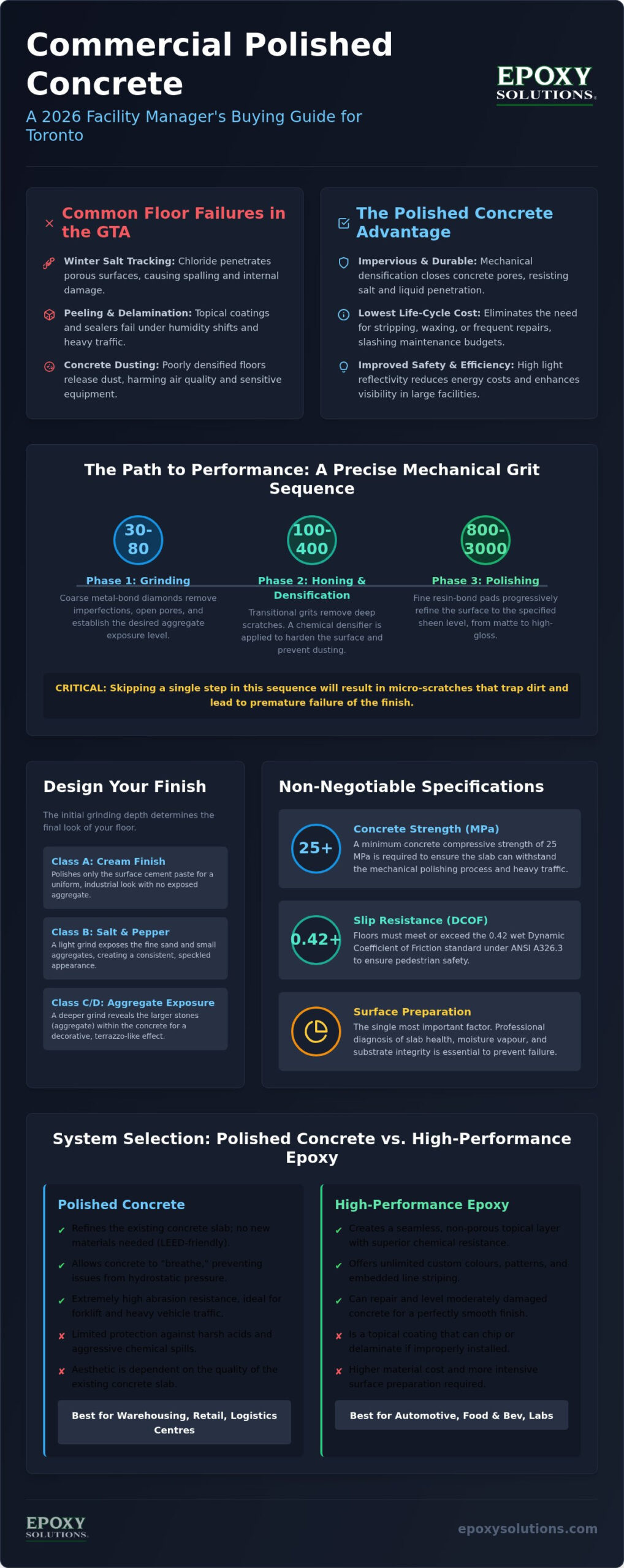
Toronto facilities face environmental pressures that destroy standard flooring. Winter salt tracking is the primary culprit, as calcium chloride and rock salt penetrate porous surfaces and cause internal pressure that leads to spalling. GTA warehouses also deal with significant humidity shifts that can cause topical coatings to delaminate. A mechanically polished floor eliminates these failure points by closing the concrete pores through chemical densification, making the surface nearly impervious to liquids and contaminants.
Why Commercial Facilities in the GTA are Switching
Operating costs drive the shift. In high-traffic hubs across the GTA, the expense of stripping and waxing VCT or repairing cracked grout in tile installations quickly exceeds the initial cost of concrete polishing. In massive logistics centres in Mississauga and Brampton, light reflectivity is a decisive factor. A polished surface can increase ambient light significantly, allowing facilities to reduce energy consumption and improve safety. For new Toronto developments, the green factor is equally vital; polished concrete often contributes to LEED credits by utilizing the existing slab and eliminating the need for new material manufacturing and transportation.
The Aesthetic vs. Performance Balance
A mirror-like shine is not a guarantee of quality. A high gloss finish can be achieved superficially, but without proper densification, that floor will begin dusting under the weight of forklift traffic. Densification is the chemical reaction that hardens the wear layer to prevent the release of concrete dust. This is critical for our core clients in retail, warehousing, and the automotive sector, where air quality and equipment longevity are non-negotiable. Performance is found in the grit sequence and the depth of the densifier, not just the final sheen level. We prioritize a floor that remains safe and functional long after the initial installation crew has left the site.
Technical Specifications: Understanding Grit and Sheen Levels
Precision engineering dictates the final performance of your floor. A high-quality commercial polished concrete Toronto installation depends entirely on a strict grit sequence. We begin with coarse 30-grit metal bond diamonds to remove surface imperfections and open the concrete pores. This progression continues through various stages up to 3000-grit resin pads. Skipping a single step in this sequence creates micro-scratches that trap dirt and dull the finish prematurely. It’s a technical process that demands patience and adherence to the ASCC Polished Concrete Standards to ensure a uniform result across thousands of square feet.
The Grit Sequence: Engineering the Surface
Shortcuts lead to failure. If a contractor jumps from a 100-grit metal to a 400-grit resin, the floor might look acceptable initially, but it won’t hold its lustre under heavy forklift traffic. Honing is the critical bridge between grinding and polishing that removes the deep scratches left by metal bonds. During this phase, we apply chemical densifiers. These silicates penetrate the concrete matrix to create a crystalline structure that hardens the wear layer. This step is non-negotiable for industrial facilities where dusting issues can compromise sensitive equipment or inventory.
Selection of aggregate exposure is your first design decision. You must choose a class that aligns with your facility’s aesthetic and structural needs:
- Class A (Cream): Only the surface paste is polished, providing a consistent, monolithic look with minimal stone exposure.
- Class B (Salt & Pepper): A light grind that reveals fine sands and small aggregates, hiding minor slab imperfections.
- Class C (Large Aggregate): A deep grind revealing the structural stone, offering a high-performance, terrazzo-like aesthetic.
Matching these classes to your sheen level is essential. Level 1 offers a flat, matte finish, while Level 4 provides a mirror-like high gloss with maximum light reflectivity. For high-traffic retail or showrooms, Level 3 or 4 is standard. For heavy-duty warehouses, a Level 2 satin finish often provides the best balance of durability and maintenance ease.
Slip Resistance and Safety Standards
Dry polished concrete is not dangerously slippery. This is a common industry myth that ignores the science of friction. In fact, a properly densified and polished floor often exceeds the safety requirements for Ontario commercial spaces. We measure success using the Dynamic Coefficient of Friction (DCOF). According to the ANSI A326.3 standard, a level interior surface should maintain a minimum wet DCOF of 0.42 to ensure pedestrian safety. If you need to dive deeper into the technical data regarding load capacities and chemical resistance, our industrial flooring specs engineering guide provides the comprehensive breakdown your engineering team requires. Before you finalize your tender, consider having our experts perform a site assessment to determine the optimal grit sequence for your specific slab condition.
Surface Preparation: The Only Way to Prevent Failure
Preparation is not a suggestion. It’s the foundation of every successful project. At Epoxy Solutions™, we operate on a single, non-negotiable principle: a floor is only as good as its preparation. Most commercial polished concrete Toronto failures occur because a contractor rushed the initial stages to save on labour. This neglect leads to “ghosting” or uneven finishes that reflect the poor substrate health underneath. To achieve high-performance results, we adhere to Unified Polished Concrete Specifications, ensuring every variable is controlled before the first resin pad touches the floor.
Moisture Testing and Substrate Analysis
Moisture vapour emission is the silent killer of floor integrity. Even if you aren’t applying a topical coating, excess moisture within the slab can lead to efflorescence or mineral deposits that ruin a polished aesthetic. We prioritize RH (Relative Humidity) testing to understand exactly what is happening inside the concrete. In older Toronto industrial buildings, we often encounter “soft” concrete or slabs contaminated by decades of oil and chemicals. These issues require specific remedial steps, including deep mechanical grinding to remove laitance. Laitance is the weak, milky layer of cement on the surface that must be stripped away to reach the structural integrity of the aggregate. We don’t guess; we measure.
Removing Existing Coatings and Adhesives
Removing existing coatings requires more than just a rental machine. Whether you’re dealing with stubborn VCT glue, old epoxy, or carpet mastic, mechanical diamond grinding is the only reliable method for removal. Chemical strippers are messy, often inferior, and can leave residues that interfere with the densification process. We focus on establishing the correct Concrete Surface Profile (CSP) before moving into the honing stages. This precision ensures that cracks, spalls, and joints are repaired with high-performance fillers that blend seamlessly into the final architectural finish. A handyman’s approach leaves visible patches and uneven “valleys” in the slab. Our approach creates a uniform, engineered surface that reflects brand quality and stands up to heavy-duty traffic.
Choosing the Right Commercial Floor: Polished Concrete vs. Epoxy
Selecting a flooring system is a strategic decision based on your facility’s operational environment. It’s not merely about aesthetics; it’s about survival. For retail showrooms, professional offices, and dry distribution centres, commercial polished concrete Toronto managers often find it to be the superior choice due to its breathability and resistance to thermal shock. However, if your facility handles chemical processing, heavy food and beverage production, or high-impact manufacturing, a high-performance epoxy coating is the only responsible specification. You can find a detailed budget breakdown for both systems in our Polished Concrete vs. Epoxy Flooring Cost guide.
Durability and Impact Resistance
We measure concrete hardness using the Mohs scale. Standard concrete typically sits at a 3 or 4, but the mechanical polishing process, combined with chemical densification, can elevate that surface to a 7. This makes it incredibly resistant to scratches from foot traffic and light machinery. While polished concrete is durable, it remains a porous material at its core. High-impact zones where heavy tools are dropped or areas prone to frequent chemical spills require the seamless, non-porous barrier that only epoxy provides. Our standard-setting approach involves analyzing the specific GTA sub-market demands, from the salt-heavy environments of downtown Toronto to the industrial loading docks in Vaughan, to ensure the selected system doesn’t fail under pressure.
Maintenance and Long-Term ROI
Cost of ownership is the only metric that matters. An authoritative expert fixer looks past the installation price to the 10-year maintenance cycle. Polished concrete requires minimal daily upkeep, usually limited to dust mopping and the use of pH-neutral cleaners to preserve the sheen. It eventually requires a re-polishing cycle, but this is a mechanical process that doesn’t involve the removal and re-application of a coating. Epoxy systems, while requiring a re-coating cycle every few years depending on traffic, offer superior protection against aggressive cleaning agents and heavy moisture. If you are unsure which system fits your specific slab condition, book a professional slab analysis to avoid a costly mis-specification.
The Epoxy Solutions™ Approach to Toronto Commercial Projects
Experience dictates results. Since 1981, Epoxy Solutions™ has set the benchmark for high-performance flooring across the Greater Toronto Area. We don’t offer “quick-fix” solutions that fail after a single winter season; our reputation is built on technical accuracy and long-term durability. For commercial polished concrete Toronto facility managers, this means partnering with a veteran team that understands the specific industrial demands of our region. We provide specialized service across key hubs including Mississauga, Brampton, Milton, and Vaughan, bringing four decades of expertise to every job site.
We lead with a “Problem-First” philosophy. Most contractors look at a floor and see a surface to be ground; we look at a slab and see a structural component that requires a full diagnosis. Before we quote a polish, we evaluate the substrate health to identify potential failure points like soft concrete or hidden contaminants. This standard-setting approach ensures the final specification is tailored to your specific traffic loads and environmental conditions. We prioritize performance over fluff, ensuring your investment is protected from the ground up.
Expert Execution in Demanding Environments
Downtime is a luxury you don’t have. We coordinate our execution around your facility’s operational schedule to ensure minimal disruption to your daily workflow. Our team utilizes professional-grade, heavy-duty planetary grinders that provide the consistent downward pressure required for a superior, uniform finish. A recent project in a large-scale Brampton distribution centre highlights our capability. We transformed 50,000 square feet of dusting, porous concrete into a high-performance, mirror-like surface while the facility remained partially operational. This level of logistical coordination is what separates an industry veteran from a general labourer.
Your Next Steps: The Consultation Process
Accuracy starts on-site. During an Epoxy Solutions™ site visit, we perform a comprehensive slab evaluation to determine the optimal mechanical grit sequence and densification requirements. You won’t receive a vague estimate based on guesswork. Instead, we provide a technical specification that outlines the exact mechanical steps and chemical treatments needed to secure your floor. If you’re ready to move past temporary fixes and invest in a surface that reflects your brand’s quality, it’s time to speak with a specialist. Request a High-Performance Flooring Consultation today to begin your facility’s transformation.
Securing Your Facility’s Long-Term Performance
A high-performance floor is the backbone of your facility. Choosing the right commercial polished concrete Toronto specification requires more than just an eye for aesthetics; it demands a deep understanding of grit sequences and substrate health. We have spent decades refining our process to ensure every slab we treat meets the highest safety and durability standards. Since 1981, Epoxy Solutions™ has specialized in high-performance industrial specifications, delivering results that withstand the unique environmental pressures of the GTA.
Don’t settle for a temporary shine that fails within months. Successful outcomes depend on rigorous surface preparation and a problem-first methodology that diagnoses issues before the first machine starts. Our authoritative expert approach ensures you get a floor that performs exactly as promised. It’s time to move past vague estimates and secure a technical plan tailored to your operation. Contact Epoxy Solutions™ for a Technical Flooring Assessment and take the first step toward a standard-setting floor that reflects your brand’s quality. Your facility deserves a surface built to last.
Frequently Asked Questions
How much does commercial polished concrete cost per square foot in Toronto?
Cost varies significantly based on the slab’s current condition and your desired aggregate exposure. Factors like the removal of old adhesives, the number of grit stages, and the total square footage dictate the final investment. Retrofitting an existing slab often requires more intensive surface preparation than a new pour. We focus on providing a technical assessment to ensure your budget aligns with long-term performance rather than just the initial installation price.
Is polished concrete too slippery for a commercial retail space?
Properly installed polished concrete is not dangerously slippery when dry. It meets or exceeds the ANSI A326.3 standard of a 0.42 wet Dynamic Coefficient of Friction (DCOF) for level interior surfaces. Chemical densifiers harden the surface, and the mechanical honing process provides a consistent, safe texture. For high-traffic retail environments, we ensure the floor maintains its slip resistance through precise grit sequencing and regular maintenance with pH-neutral cleaners.
How long does the concrete polishing process take for a typical warehouse?
A typical warehouse project usually takes seven to ten business days, depending on the required grit sequence and total area. Surface preparation is the most time-consuming phase, as we must remove old coatings and repair cracks before polishing begins. We coordinate our execution to work around your operational schedule, minimizing downtime for your facility. Large-scale equipment like our heavy-duty planetary grinders allows us to maintain a rapid pace without compromising on technical accuracy.
Can any concrete floor in a Toronto facility be polished?
Most concrete floors can be polished, but the slab must meet specific structural requirements. For a successful commercial polished concrete Toronto installation, the concrete should have a minimum strength of 25 MPa. Slabs with excessive moisture vapour emission or deep chemical contamination may require remedial treatments or a different flooring system like epoxy. We perform a thorough slab analysis to determine if your floor is a candidate for mechanical polishing or if it needs structural repair.
What is the difference between polished concrete and sealed concrete?
Polished concrete is a mechanical process that refines the slab itself, while sealed concrete relies on a topical film. Sealed concrete is a temporary solution that eventually peels, flakes, or yellows under UV exposure. True mechanical polishing uses diamond abrasives to close the concrete pores, creating a permanent, dense surface. This results in a much lower life-cycle cost because you won’t need to strip and re-apply a sealer every few years.
How do I maintain the shine on my commercial polished concrete floor?
Maintaining the lustre requires a simple but disciplined cleaning routine. Daily dust mopping is essential to remove abrasive grit that can dull the surface over time. You should use an automatic scrubber with a pH-neutral cleaner to lift contaminants without damaging the densified wear layer. Avoid harsh chemicals or acidic cleaners, as they can etch the surface and destroy the mechanical polish. Periodic high-speed burnishing with a diamond-impregnated pad can also help restore the floor’s original sheen.
Does polished concrete provide any LEED credits for my building project?
Polished concrete is an exceptionally sustainable choice that can contribute to several LEED credits. It utilizes the existing concrete slab, which reduces the need for new material manufacturing and transportation. The high light reflectivity of polished surfaces can also lower energy consumption by reducing the need for artificial lighting in large warehouses. Additionally, the process uses low-VOC chemicals and densifiers, supporting indoor environmental quality standards for new Toronto developments and commercial retrofits.
What happens if my concrete slab has cracks or major imperfections?
Cracks and imperfections are common in older Toronto industrial buildings, but they can be professionally repaired. We use high-performance semi-rigid polyurea fillers to patch cracks and spalls before the polishing process starts. These materials are ground flush with the slab to ensure a seamless, architectural finish. While some imperfections may remain visible as character, the structural integrity of the floor is restored, ensuring a flat and safe surface for vehicle and pedestrian traffic.