Floor failure is inevitable when you treat a coating like paint. Most facility managers in the GTA have dealt with the frustrating cycle of peeling surfaces and constant operational downtime. You realize that a compromised floor is more than an eyesore; it’s a safety hazard that creates concrete dusting and slows down your entire production line. You need a surface that survives the brutal mechanical loads of a high-volume warehouse without requiring repairs every few years.
This article explains how to specify and install high-performance abrasion resistant epoxy flooring designed to withstand extreme industrial wear for over a decade. We’ll analyze the specific resin chemistries required for heavy forklift traffic, explore compliance with Ontario Building Code safety standards, and detail the diamond-grinding preparation necessary for a permanent bond. From Mississauga to Vaughan, we build floors that set the industry standard for durability and hygiene.
Key Takeaways
- Identify how micro-abrasions from mechanical loads and winter grit lead to concrete dusting and equipment wear.
- Learn why resin chemistry and high-solids formulations are the baseline for specifying durable abrasion resistant epoxy flooring.
- Evaluate the performance differences between epoxy coatings and urethane mortars for facilities facing thermal shock or extreme wear.
- Recognize why mechanical surface preparation and moisture testing are the only ways to ensure a permanent bond to the concrete slab.
- Understand how a tailored flooring system helps your facility maintain compliance with safety and hygiene standards.
The High Cost of Surface Failure: Why Abrasion Resistance Matters
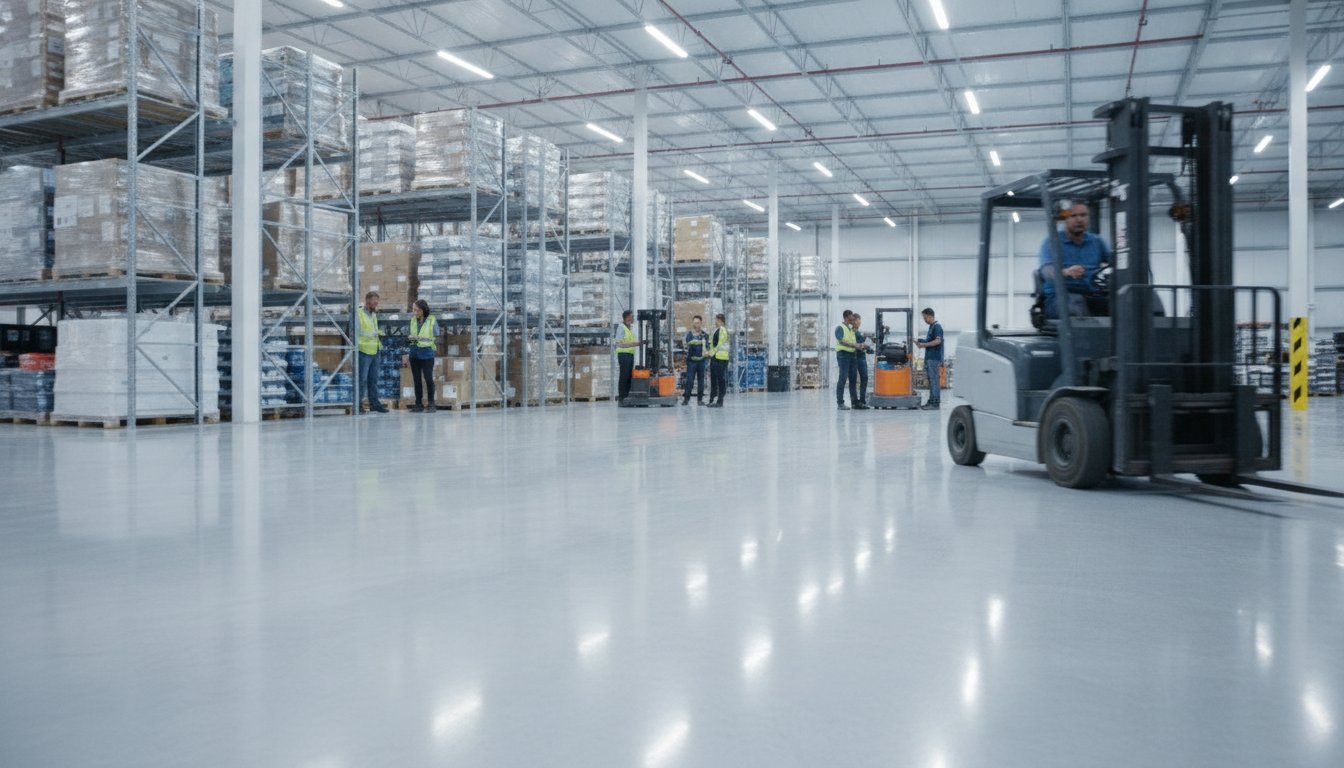
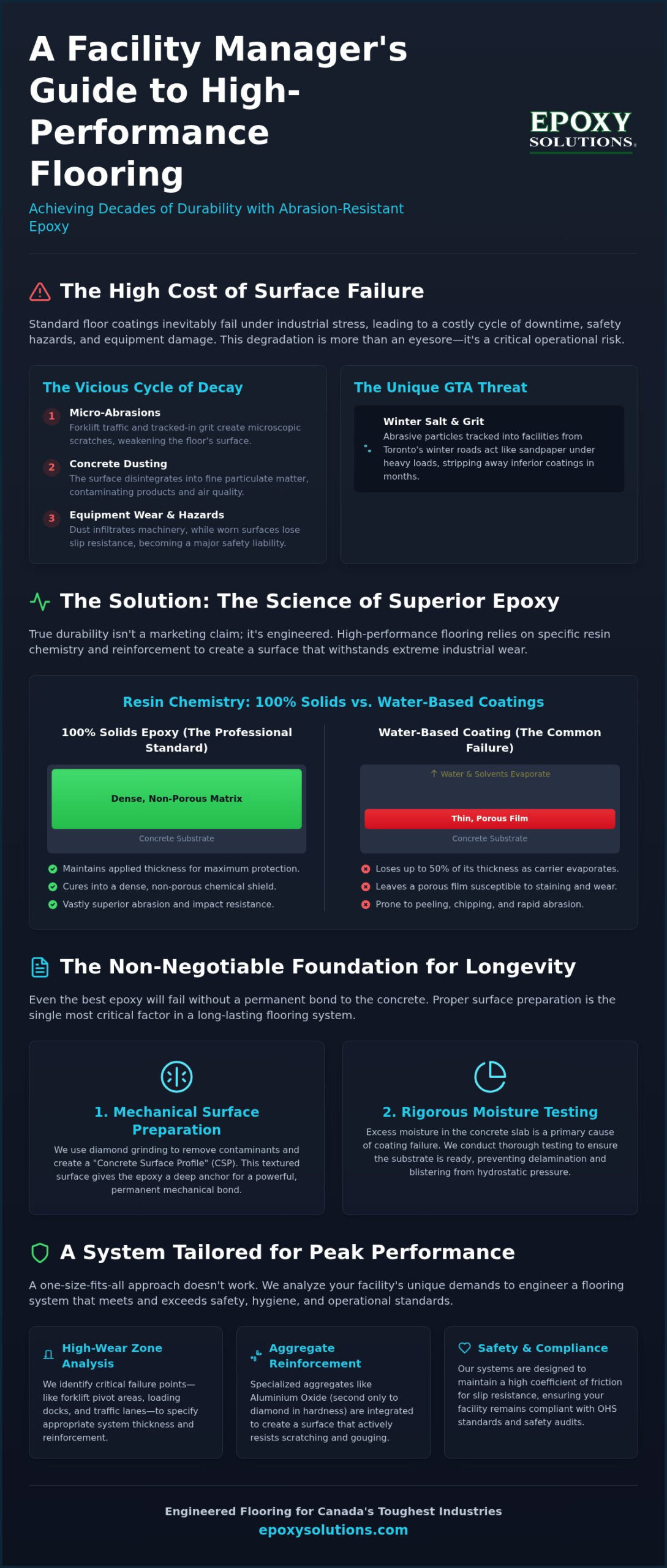
Operational friction destroys floors. When a surface lacks the necessary mechanical strength, it doesn’t just look bad; it begins to disintegrate. This process starts with micro-abrasions that eventually lead to concrete dusting. This fine particulate matter is a silent killer for industrial facilities. It infiltrates sensitive machinery, increases equipment wear, and creates a respiratory hazard for your workforce. High-performance abrasion resistant epoxy flooring is the only definitive barrier against this cycle of decay.
GTA facilities face a unique environmental threat that many installers ignore. In cities like Toronto and Mississauga, winter road salt and heavy grit are tracked into loading docks and production zones daily. These abrasive particles act like sandpaper under the weight of forklift tires and heavy pallets. Without a system engineered for these conditions, a standard coating will be stripped away within months. True durability requires understanding the chemical structure of epoxy resins and how they bond to the substrate to resist this specific type of mechanical scouring.
Safety and compliance are also at stake. As a floor wears down, it loses its slip resistance. A surface that once met the 0.6 coefficient of friction required by OHS standards can quickly become a skating rink when the texture is polished away by traffic. Worn floors fail safety audits and increase your liability. While some managers choose cheap, thin-film re-coating every two years, the financial reality is clear. Investing in a premium, high-build system is the only way to avoid the constant operational downtime of frequent repairs.
Identifying High-Wear Zones in Your Facility
Mechanical abrasion is rarely uniform across a floor. Forklift traffic lanes and pivot points are the primary failure zones because they endure the highest torque and weight. Loading docks and transition strips are where impact meets friction, requiring extra reinforcement. In chemical processing areas, corrosives can soften the resin, making it significantly more susceptible to scratching and gouging. We identify these zones during our assessment to ensure the system is thick enough to survive the load.
The Aesthetic Toll: Why Scratched Floors Impact Brand Image
A professional appearance is a direct reflection of your company’s standards. In commercial or retail environments, a scratched and dull floor suggests a lack of attention to detail. Using abrasion-resistant topcoats allows you to preserve a high-gloss look that resists the “traffic patterns” that plague inferior systems. Beyond the client’s perspective, a well-maintained facility has a profound psychological impact on employee morale. People work better in an environment that is clean, safe, and clearly built to a higher standard.
Quantifying Durability: The Science of Abrasion Resistant Epoxy
Abrasion resistance is the specific ability of a surface to resist mechanical scraping and wear. It is a measurable engineering property, not a vague promise of durability. For GTA facility managers, understanding this metric is the difference between a floor that lasts two years and one that lasts twenty. High-performance abrasion resistant epoxy flooring relies on the density of its molecular structure to repel the grinding forces of industrial traffic.
Resin chemistry dictates the baseline of this performance. High-solids epoxies are vastly superior to water-based or solvent-based alternatives. When a water-based coating cures, the carrier evaporates, leaving behind a thin and often porous film. In contrast, 100% solids systems maintain their applied thickness and create a non-porous, dense matrix. This density is what prevents micro-fractures from forming under the weight of heavy machinery. Maintaining these surfaces in good repair is a critical component of meeting OSHA safety standards for walking and working surfaces. If you are unsure which resin chemistry fits your traffic pattern, you can consult with our technical team to review your facility’s specific mechanical loads.
We often integrate specialized aggregates like aluminium oxide or quartz to further enhance surface hardness. Aluminium oxide is one of the hardest minerals available, second only to diamond on the Mohs scale. By suspending these particles within the resin, we create a floor that effectively grinds down the grit tracked in from outside rather than being scratched by it. The Taber Abrasion test is the industry standard for measuring mass loss under friction.
Understanding the Taber Abrasion Test (ASTM D4060)
The ASTM D4060 test provides a concrete way to read a spec sheet. It involves placing a sample under CS-17 abrasive wheels and subjecting it to 1,000 cycles of mechanical friction under a 1,000-gram load. Engineers measure the mass of the sample before and after the test. A lower “mg loss” number indicates a tougher, more resilient floor. While a consumer-grade kit might show a loss of 100mg or more, premium industrial systems typically lose fewer than 30mg, proving their ability to survive high-traffic environments.
Mohs Hardness and Impact Resistance
Scratching and denting are two different physical failures. Abrasion is the surface being scraped away, while impact is the substrate or coating being compressed or cracked by a falling object. We engineer floors to handle both forces simultaneously by balancing surface hardness with tensile strength. A floor that is too hard becomes brittle and will shatter under impact; a floor that is too flexible will gouge easily. We realize that the ideal system must be rigid enough to resist abrasion but resilient enough to absorb energy without cracking.
Epoxy vs. Alternatives: Selecting the Right System for Your Load
Industrial facility requirements vary significantly by sector and geographic location. A distribution centre in Mississauga faces different mechanical stresses than a chemical processing plant in Vaughan. Epoxy coatings remain the industry benchmark for high-build, chemical-resistant durability. They provide a seamless, non-porous barrier that protects the concrete from oils and harsh corrosives. This makes them the primary choice for most abrasion resistant epoxy flooring installations where long-term substrate protection is the priority.
Urethane mortars are the definitive solution for environments where thermal shock and extreme heavy-duty wear are the standard. While epoxy is exceptionally rigid, urethane possesses a thermal expansion coefficient that closely mimics concrete. This characteristic prevents the floor from buckling or delaminating when exposed to rapid temperature swings. Before committing to a system, facility managers should weigh these technical benefits against the Polished Concrete vs. Epoxy Flooring Cost to ensure the chosen solution matches both the budget and the operational load.
Urethane vs. Epoxy: Friction and Heat
Food processing plants in Brampton frequently require urethane mortars because they survive daily steam cleaning and hot water washdowns. Epoxy would likely fail under that level of thermal stress. Conversely, epoxy provides superior scratch resistance in dry manufacturing environments where mechanical friction from pallets is the primary concern. We often utilize a hybrid approach to maximize longevity:
- Epoxy primers for maximum mechanical bond to the concrete substrate.
- High-build epoxy mid-coats for impact resistance and levelling.
- Urethane topcoats for enhanced UV stability and chemical resistance.
This tailored methodology ensures the system doesn’t just meet the industry standard but sets it for the entire facility.
Polished Concrete: The High-Traffic Alternative
Polished concrete is a densified surface rather than a coating. It’s often chosen for high-traffic retail spaces where aesthetics and low initial cost are priorities. However, we must address the dusting risk. In sensitive pharmaceutical or electronics environments, even a densified concrete surface can produce micro-particulates that compromise air quality. Heavy industrial warehouses in the GTA also deal with constant salt and grit tracked in during winter months. This abrasive debris acts as a grinding agent under forklift tires. While polished concrete handles abrasive wear well in retail, heavy industrial sites often require the added protection of abrasion resistant epoxy flooring to prevent the concrete from eventually pitting, spalling, or suffering from salt-induced rebar corrosion. Maintenance for polished concrete involves regular burnishing, whereas epoxy systems typically require only basic scrubbing to maintain their high-performance finish.
The Expert Fixer’s Guide: Why Surface Prep is Non-Negotiable
Prep is everything. You can buy the most expensive resin in North America, but if the substrate isn’t ready, your investment will peel within months. We’ve seen countless GTA facilities waste capital on installers who skip mechanical profiling in favour of speed. True abrasion resistant epoxy flooring doesn’t just sit on top of concrete; it becomes part of it through a tenacious mechanical bond. If the surface isn’t opened up correctly, the resin has nothing to “bite” into, leading to catastrophic delamination under the first heavy load.
Acid etching is obsolete for industrial specifications. It’s an amateur technique that fails to remove deep contaminants or create a consistent profile across a large slab. We rely exclusively on mechanical methods to achieve the correct Concrete Surface Profile (CSP) required for your specific system. For a deeper dive into these technical requirements, refer to our Industrial Flooring Specs: Engineering Guide for 2026. Without the right profile, even high-performance resins cannot resist the lateral shear forces of a turning forklift or the vibration of heavy machinery.
Diamond Grinding and Shot Blasting
We use heavy-duty diamond grinders and shot blasters to strip away laitance, which is the weak, brittle layer of cement paste on the surface. This process exposes the aggregate and opens the pores of the concrete to receive the primer. Our equipment is fully dust-contained to protect your facility’s air quality and sensitive inventory. We realize that operational continuity is vital, so we ensure our preparation phase is as clean as it is thorough, removing old contaminants to ensure a permanent chemical bond.
Moisture Mitigation and Priming
Moisture vapour transmission is the silent killer of industrial floors. If water vapour is trapped under a non-porous epoxy, it creates osmotic pressure that leads to blistering. These blisters eventually pop and peel, creating a safety hazard and a point of failure. We conduct rigorous testing before a single drop of resin is mixed. For old, oil-saturated slabs in Mississauga or Toronto, we specify specialized oil-tolerant primers that penetrate the concrete despite decades of contamination. Ensuring the substrate is as tough as the abrasion-resistant topcoat is the only way to guarantee a decade of performance.
If your current floor is showing signs of delamination or bubbling, it’s time for a professional evaluation. Contact Epoxy Solutions™ today to schedule a comprehensive site assessment and substrate moisture test.
Epoxy Solutions™: The Standard for Abrasion Resistant Flooring in Canada
Results matter most. Since 1981, Epoxy Solutions™ has provided high-performance resinous systems that withstand the most demanding environments in North America. We don’t offer generic, one-size-fits-all coatings because we realize that every facility has unique failure points. Whether it’s a high-speed distribution centre in Mississauga or a heavy manufacturing plant in Toronto, we provide abrasion resistant epoxy flooring that is engineered to last. We’ve seen every possible industry failure; we possess the specific expertise to resolve them permanently.
We are the authoritative expert fixers who step in when others have failed. Our reputation is built on a legacy of reliability and a refusal to compromise on technical accuracy. We position ourselves as a premium provider because we focus on long-term performance and safety rather than the lowest price point. This solution-oriented mindset ensures that your facility remains compliant with all hygiene and safety standards while minimizing maintenance requirements for the next decade.
Our Bespoke Specification Process
We identify the root cause. Our bespoke specification process begins with an on-site facility audit to map out specific mechanical and chemical wear patterns. We don’t just look at the surface; we evaluate the equipment loads, traffic frequency, and environmental stressors that your floor must endure. This allows us to design custom-engineered high-build systems that provide maximum durability. Our project management team coordinates every phase to minimize operational downtime, ensuring your business remains productive throughout the installation. For a deeper look at our technical approach, you can explore our High-Performance Epoxy: Guide for Industrial Facilities.
Setting the Benchmark for Industrial Longevity
Quality is non-negotiable. We refuse to install sub-standard systems that we know will fail under industrial pressure. This “no-nonsense” attitude toward craftsmanship has allowed us to set the benchmark for high-performance abrasion resistant epoxy flooring for over four decades. We take pride in meticulous execution, from the initial diamond grind to the final application of the abrasion-resistant topcoat. We aren’t just following industry standards; we are setting them. Our rugged, experienced professionals are equally comfortable in a boardroom or on a demanding job site, providing a sense of security for every client we serve.
Request a professional facility audit and quote from Epoxy Solutions™ to ensure your next flooring project meets the highest standards of performance and safety.
Securing Longevity for Your Industrial Facility
Industrial durability is the result of precise engineering, not luck. You realize that a floor is only as resilient as the science behind its resin chemistry and the quality of its mechanical bond. By prioritizing high-solids formulations and rigorous diamond grinding, you eliminate the cycle of dusting and delamination that plagues sub-standard installations. Selecting the correct abrasion resistant epoxy flooring ensures your facility handles heavy forklift traffic and winter grit without compromising safety or hygiene standards.
Epoxy Solutions™ has been setting the industry standard across North America since 1981. We specialize in high-build industrial systems tailored for the unique demands of Toronto, Mississauga, and Brampton. Our expert fixers don’t just apply coatings; we build long-term assets that protect your substrate for a decade or more. It’s time to stop patching failures and start investing in a surface designed for extreme capability. Get a Tailored Industrial Flooring Quote from Epoxy Solutions™ and secure the future of your facility today.
Frequently Asked Questions
What is the best epoxy for high-traffic forklift areas?
100% solids high-build epoxy systems are the industry standard for these environments. They provide the necessary thickness and density to resist the lateral shear and heavy compression of forklift tires. In GTA warehouses, we specify systems with specialized aggregates like aluminium oxide to handle constant mechanical grinding. These high-performance coatings prevent the concrete from pitting or spalling under the thousands of pounds of pressure exerted by industrial equipment daily.
How is abrasion resistance measured in industrial flooring?
Abrasion resistance is primarily measured using the Taber Abrasion test, following the ASTM D4060 standard. This process involves rotating abrasive wheels over a sample for 1,000 cycles and measuring the resulting mass loss in milligrams. A lower number indicates a tougher floor. For industrial facilities in Mississauga or Brampton, we target systems with a loss of less than 30mg to ensure the surface survives the mechanical scouring of heavy production environments.
Does abrasion-resistant epoxy prevent scratches from metal pallets?
While no floor is entirely scratch-proof, abrasion resistant epoxy flooring significantly minimizes the depth and visibility of gouges from metal pallets. By integrating hard aggregates into the resin matrix, we create a surface that is harder than the metal being dragged across it. This prevents the unsightly white scratches common in standard coatings. We realize that heavy manufacturing in Vaughan requires this extra level of surface hardness to maintain professional facility standards.
How long does an abrasion-resistant epoxy floor last in a warehouse?
A professionally installed system can last between 15 and 25 years with proper maintenance. Longevity depends on the volume of traffic and the specific mechanical loads in your facility. In busy GTA distribution centres, we’ve seen floors perform for over a decade without significant wear because they were specified for the correct load pattern. Regular cleaning to remove abrasive grit tracked in from outside is the most effective way to preserve the topcoat.
Can I apply an abrasion-resistant topcoat over my existing epoxy floor?
Yes, but only if the existing coating is structurally sound and properly prepared. We don’t just pour a new layer over an old one; the existing surface must be mechanically sanded or diamond ground to ensure a chemical bond. If the original floor is peeling or bubbling, a simple topcoat won’t fix the underlying failure. We evaluate the bond strength of your current floor in Milton before recommending a refresh or a full replacement.
What industries benefit most from abrasion-resistant flooring?
Logistics, heavy manufacturing, and food processing are the primary sectors that require these systems. Any facility using forklifts, pallet jacks, or heavy automated machinery needs a surface that resists constant mechanical friction. In Brampton’s food manufacturing hub, these floors are essential because they resist the wear from heavy cleaning equipment and thermal shock. We also install these systems in aerospace and automotive plants throughout the GTA where precision and cleanliness are non-negotiable.
How does temperature affect the abrasion resistance of epoxy?
Extreme temperatures can alter the physical properties of the resin. High heat may soften certain epoxies, making them more susceptible to gouging, while extreme cold can make them brittle. For facilities in Toronto that deal with thermal cycling, we often specify urethane mortars or hybrid systems. These materials maintain their abrasion resistance across a wider temperature range, ensuring the floor doesn’t crack or peel when exposed to rapid temperature shifts during winter operations.
Is abrasion-resistant flooring more difficult to clean?
It’s actually easier to maintain than standard concrete or low-grade coatings. Because the surface is non-porous and resists micro-scratching, dirt and contaminants cannot become trapped in the floor’s profile. You won’t deal with the constant concrete dusting that occurs when a surface begins to fail. Regular scrubbing with a neutral cleaner is usually all that’s required to keep a facility in Mississauga or Milton looking professional while maintaining its safety and slip-resistance ratings.