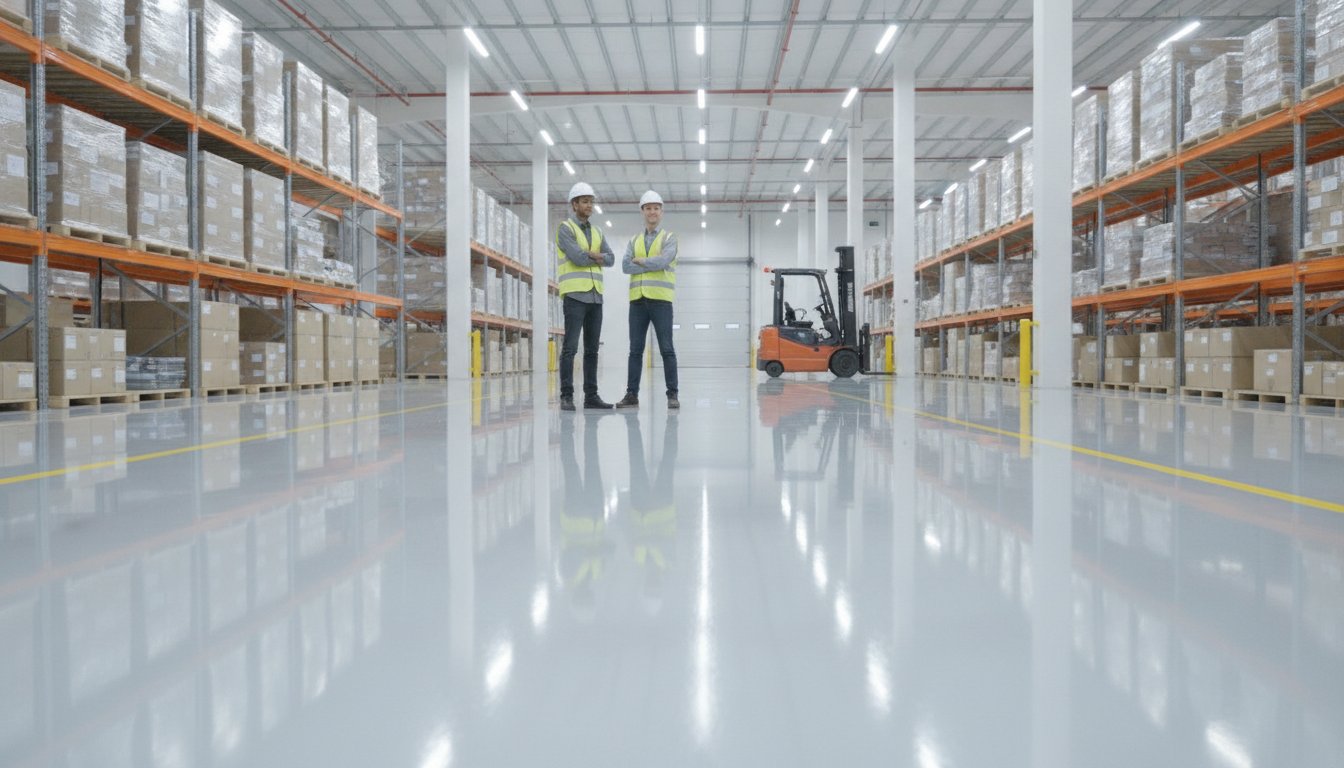
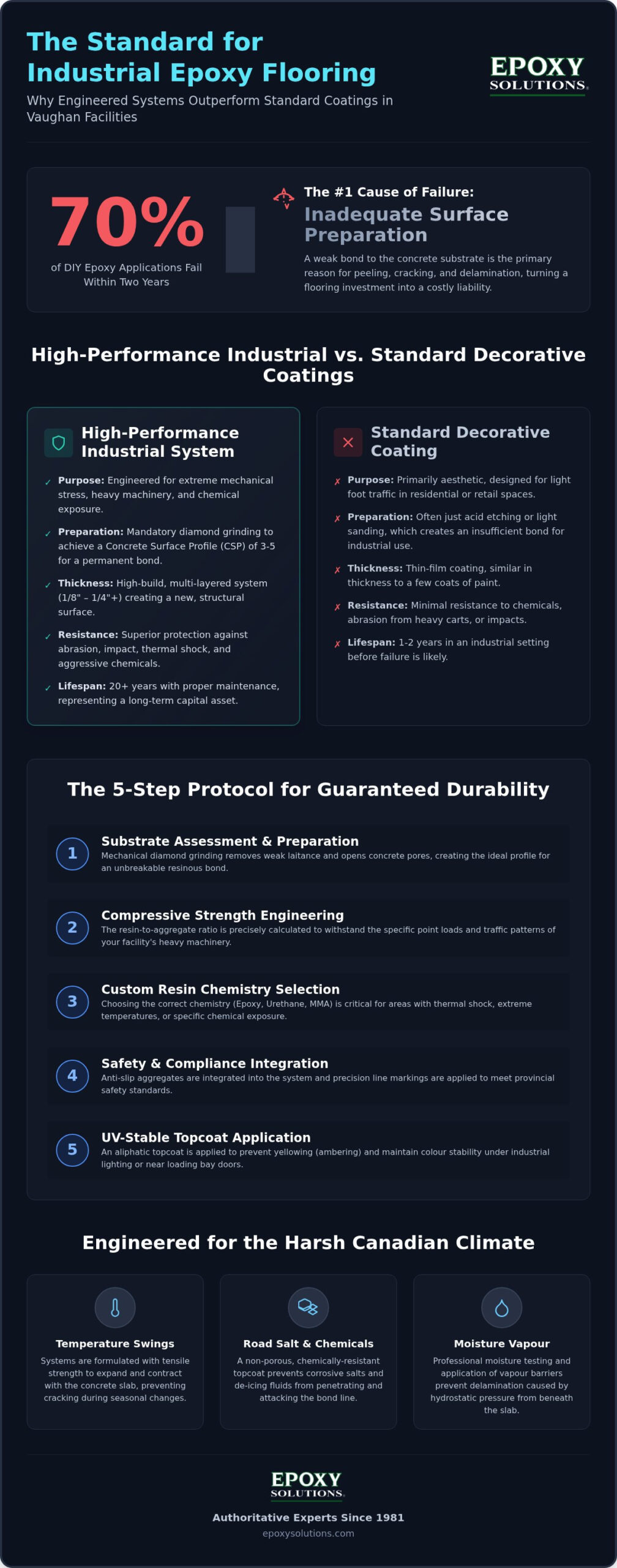
Approximately 70% of DIY epoxy flooring applications fail within two years because of inadequate surface preparation. In a high-traffic industrial facility, a floor failure is not just an eyesore; it is a costly liability that halts production and compromises safety standards. You already know that your facility requires more than a thin, residential-grade coating to withstand heavy machinery loads and constant chemical exposure. Selecting the right epoxy flooring installers Vaughan depends on moving past cheap shortcuts and prioritizing engineered performance that lasts for decades. This article explains why high-performance industrial epoxy flooring is the non-negotiable standard for Vaughan facilities and how to select an installer that guarantees long-term durability. We will examine the technical specifications required for heavy loads, the necessity of chemical resistance, and the meticulous installation steps that ensure a seamless, maintenance-free finish. By the end, you will have a clear framework for choosing a partner who understands the rigorous demands of an industrial environment.
Key Takeaways
- Understand why industrial environments require multi-layered resinous systems tailored for specific mechanical stress rather than standard retail-grade coatings.
- Learn the technical necessity of substrate preparation through diamond grinding to ensure a permanent bond and prevent premature floor peeling.
- Identify the essential criteria for vetting epoxy flooring installers Vaughan, specifically regarding their equipment capacity and history with large-scale industrial specifications.
- Discover how to implement a realistic maintenance schedule that protects your flooring investment from aggressive cleaning chemicals and heavy forklift traffic.
- Realize the long-term ROI of partnering with an authoritative expert established in 1981 to ensure full compliance with safety and durability standards.
The Reality of Industrial Epoxy Flooring in Vaughan Facilities
Industrial flooring is not paint. It is a multi-layered resinous system engineered for high-impact environments. While basic products use Epoxy resins as a binder, the final performance depends entirely on the formulation and installation technique. Facility managers in industrial hubs like Concord and Woodbridge often learn this the hard way after a budget coating fails within months. A floor is a structural asset, not just a surface colour. It must withstand the mechanical stress of heavy machinery and the chemical realities of modern manufacturing. When vetting epoxy flooring installers Vaughan, you must look for those who prioritize substrate testing and engineering over quick, cosmetic applications.
Why Standard Coatings Peel in Canadian Facilities
Ontario’s climate presents unique challenges that off-the-shelf products cannot handle. Temperature fluctuations cause concrete to expand and contract significantly. Without the proper tensile strength and bond, cheap coatings simply snap or delaminate from the surface. Winter compounds the issue. Road salt and corrosive chemicals tracked in by vehicles settle into micro-fissures and attack the bond line. Additionally, moisture vapour transmission acts as an invisible force, pushing against the coating from beneath the slab. Professional epoxy flooring installers Vaughan must account for these environmental stressors before the first drop of resin hits the floor, or the system will inevitably fail.
High-Performance vs. Decorative Epoxy
There is a massive gap between a decorative flake floor and a high-build industrial system. Decorative systems prioritize aesthetics for retail or residential use. Industrial resins prioritize density, durability, and resistance. In a Vaughan manufacturing plant, the floor must resist aggressive cleaning agents and constant abrasion from steel-wheeled carts. An engineered specification identifies the exact compressive strength required to prevent crushing under heavy forklift traffic. We don’t just apply a coating; we install a performance layer tailored to the specific mechanical loads of your facility. This distinction is the difference between a floor that lasts five years and one that lasts twenty.
- Industrial epoxy is a structural component designed for mechanical stress.
- Temperature swings and road salt in Vaughan accelerate the failure of low-grade coatings.
- High-build resins are necessary for manufacturing environments requiring chemical resistance.
- Engineered specifications ensure the floor can handle specific forklift and machinery loads.
Engineering the Perfect Specification: Beyond the Surface
Industrial flooring fails when specifications are guessed. Reliable epoxy flooring installers Vaughan look past the surface aesthetics to the mechanical requirements of the slab. Engineering a floor involves a five-step protocol that ensures the system survives the rigours of a working facility. It starts with substrate assessment. We use diamond grinding or shot blasting to remove laitance and open the concrete pores. Next, we determine the compressive strength requirements. A floor supporting heavy forklift traffic requires a higher resin-to-aggregate ratio to prevent crushing under point loads.
Selecting the right resin chemistry is the third critical step. While standard epoxy works for many applications, environments prone to thermal shock, such as blast freezers or steam-cleaned wash bays, require Urethane or MMA systems. The fourth step incorporates safety elements. We integrate anti-slip aggregates and precision line marking to meet provincial safety standards. For facilities in the food and beverage sector, following the FDA food code on flooring ensures that surfaces remain non-porous and easy to sanitize. Finally, we apply a UV-resistant topcoat. This aliphatic layer prevents ambering and maintains colour stability under industrial lighting or near loading docks.
Surface Preparation: The Authoritative Expert Approach
Preparation is where most contractors fail. At Epoxy Solutions™, we prioritize mechanical preparation over acid etching because chemicals cannot create a predictable bond. We focus on achieving the correct Concrete Surface Profile (CSP). A CSP 3 is typically sufficient for thin-film coatings, but heavy-duty traffic toppings require a CSP 5 to ensure the resin anchors deeply into the concrete. When done correctly, the bond strength of the epoxy exceeds the tensile strength of the concrete itself. If the concrete pulls apart before the coating peels, the installation was successful.
Specialized Systems for Critical Environments
Certain Vaughan facilities require more than just impact resistance. Electronics manufacturers and data centres need anti-static flooring for critical environments to prevent electrostatic discharge from damaging sensitive components. Similarly, chemical processing plants require specialized tank lining and secondary containment coatings that can withstand aggressive acids and solvents. These are not general-purpose products. They are engineered solutions designed to protect both the environment and your infrastructure. If you’re managing a facility with unique environmental demands, it’s time to consult with a specialist who understands these technical nuances.
Comparing Epoxy Flooring Installers in Vaughan
Finding a contractor is easy. Finding professional epoxy flooring installers Vaughan who understand industrial load-bearing requirements is difficult. You must evaluate candidates based on tangible assets and historical performance. A startup founded last year lacks the data set of a firm operating since 1981. Experience matters when you’re dealing with slab moisture or contaminated concrete that has seen decades of oil saturation. We’ve seen every failure mode possible, and that history allows us to prevent those issues before they start.
Equipment capacity is a non-negotiable metric. If an installer arrives with a handheld grinder for a 10,000-square-foot facility, they cannot achieve the necessary CSP. High-production diamond grinders are significant capital investments that separate the expert from the general handyman. You should also verify WSIB compliance and safety certifications. Vaughan industrial sites are strictly regulated; an uninsured crew is a liability your corporation shouldn’t carry. Look for a portfolio that includes large-scale commercial resinous flooring installations across the GTA to prove they can manage the logistics of a major project.
Red Flags in Commercial Flooring Quotes
Beware of “one-day” systems. These products prioritize the installer’s schedule over the floor’s integrity. Industrial resins require specific cure times to achieve full cross-linking and chemical resistance. A quote that is significantly lower than the market average usually indicates skipped preparation steps or thinned-out resins. Don’t accept a “one-size-fits-all” approach. Ask the installer about their specific experience with urethane mortars. If they can’t explain why a mortar system is superior for thermal shock environments, they aren’t qualified for a high-performance facility.
The Value of a Standard-Setting Partner
A premium provider acts as a consultant. We help facility managers realize long-term ROI by matching the floor chemistry to the specific activity of the zone. This involves adhering to recognized floor safety standards to ensure your staff is protected from slip-and-fall hazards. It also means following comprehensive industrial flooring specifications that account for every variable from chemical exposure to cure time. Finally, ensure your partner can execute durable epoxy floor striping. Precision line marking is essential for traffic flow and safety compliance in busy Vaughan warehouses.
Vaughan Facility Survival: Maintenance and Longevity
Concrete assets require stewardship. An industrial floor is a high-performance tool, not a passive surface. Even the most robust systems installed by professional epoxy flooring installers Vaughan will degrade without a structured maintenance protocol. In the heavy-traffic zones of Woodbridge or Concord, mechanical abrasion from forklift tires and chemical spills from production lines create constant wear. Protecting your investment means identifying early signs of distress, such as localized dulling or micro-scratches, before they penetrate the resin and reach the structural concrete. A proactive approach ensures the floor remains a safety asset rather than becoming a trip hazard or a source of concrete dust contamination.
Cleaning Protocols for Resinous Floors
Proper cleaning is the first line of defence. Use only pH-neutral cleaners specifically formulated for epoxy or polished concrete systems. Harsh acidic or alkaline detergents can etch the surface, leading to permanent staining or a loss of slip resistance. Never apply wax or high-gloss retail finishes. These products create dangerous slip hazards and interfere with the floor’s engineered coefficient of friction. Training your staff on rapid spill response is equally vital. While our chemical-resistant coatings provide a window of protection, allowing aggressive solvents to dwell on the surface for extended periods can eventually compromise the topcoat. Simple, consistent cleaning prevents grit from acting like sandpaper under heavy wheels.
When to Re-coat vs. Full Replacement
Timing is everything. After 5 to 10 years of heavy industrial use, most topcoats will show signs of thinning in high-traffic aisles. At this stage, a maintenance re-coat is a high-ROI decision. By mechanically abrading the existing topcoat and applying a fresh aliphatic layer, you essentially reset the clock on the floor’s service life for a fraction of the cost of a full replacement. This prevents the primary resin system from being exposed to direct mechanical wear. Consulting with an expert allows you to organize these maintenance windows during scheduled shutdowns to ensure zero impact on your production timeline. If you wait until the resin has peeled to the bare concrete, the window for a simple re-coat has closed.
If your facility floor is showing signs of wear or losing its slip-resistant texture, contact the experts at Epoxy Solutions™ to schedule a technical assessment and protect your infrastructure.
Epoxy Solutions™: Vaughan’s Authoritative Flooring Expert
Legacy defines reliability. Since 1981, Epoxy Solutions™ has set the benchmark for resinous flooring across North America. We aren’t just another group of epoxy flooring installers Vaughan; we are industrial engineers who specialize in high-performance environments. While startups focus on the lowest price point, we focus on the lowest total cost of ownership through superior specifications and meticulous execution. Our “Problem-First” approach means we are the partners facility managers call when a previous installation has delaminated, cracked, or failed to meet safety standards. We identify the root cause of the failure, be it poor substrate preparation or incorrect resin chemistry, and provide a definitive, long-term fix.
Our Local Vaughan Projects and Expertise
Our footprint in the York Region is extensive. From the manufacturing hubs in Concord to logistics centres in Woodbridge, we have engineered flooring solutions for the most demanding conditions. This includes specialized tank lining for chemical processing and thermal shock-resistant floors for cold storage facilities. We understand the specific logistical and environmental pressures facing Vaughan businesses. Facility managers trust our high-performance epoxy guide to navigate the complexities of industrial specifications. Whether your project involves anti-static requirements or heavy traffic toppings, our team has the historical data and technical capacity to deliver a result that exceeds provincial safety codes.
Start Your Industrial Flooring Project
Quality begins with an accurate assessment. We don’t provide ballpark estimates over the phone because a professional floor requires a site-specific engineered specification. The process starts with a comprehensive facility visit where we evaluate your concrete’s condition, moisture levels, and mechanical demands. This data allows us to tailor a resinous system that aligns with your operational goals and budget. Preparing your facility for a seamless installation involves coordinating with our project managers to minimize downtime. We work around your production schedule to ensure the transition is efficient and the result is standard-setting. Contact Epoxy Solutions™ today to organize a professional facility assessment in Vaughan and secure a floor engineered for performance.
Securing the Future of Your Industrial Infrastructure
Industrial facilities in Vaughan cannot afford the catastrophic downtime associated with floor failure. Success in these high-demand environments depends on moving beyond aesthetic coatings and investing in engineered resinous systems designed to handle heavy machinery and constant chemical stress. By prioritizing mechanical substrate preparation and accurate resin selection, you ensure a seamless, durable surface that meets strict safety standards and operational requirements. Selecting the right epoxy flooring installers Vaughan is the definitive step toward achieving a maintenance-free facility with a long-term service life.
As industry veterans since 1981, Epoxy Solutions™ provides comprehensive GTA service coverage, specializing in high-load industrial specifications for the York Region. We understand that a floor is a structural asset that must perform under extreme conditions. Don’t settle for residential-grade shortcuts that peel under pressure. Request a Professional Facility Assessment from Epoxy Solutions™ to set a new benchmark for durability in your workspace. Your floor is a critical component of your infrastructure; treat it with the technical expertise it deserves for a result that lasts decades.
Frequently Asked Questions
How long does a commercial epoxy floor installation take in Vaughan?
A typical industrial installation requires three to five days depending on the total square footage and substrate condition. This timeline accounts for mechanical surface preparation, primer application, build coats, and the final topcoat cure. We prioritize full cross-linking to ensure maximum chemical resistance. While some contractors promise one-day systems, these often skip critical curing phases, leading to premature failure. We coordinate with your production schedule to minimize operational downtime.
What is the difference between residential garage epoxy and industrial flooring?
Residential coatings are primarily aesthetic flakes designed for light foot traffic and passenger vehicles. Industrial flooring systems are engineered resinous layers built to withstand heavy forklift traffic, point loads, and aggressive chemicals. As experienced epoxy flooring installers Vaughan, we use high-solids resins that provide significantly higher compressive strength. Industrial specifications also prioritize safety compliance and slip resistance, whereas residential kits lack the density required for long-term industrial survival.
Can epoxy flooring be installed over old or damaged concrete?
Yes, provided the concrete is mechanically restored to a sound state first. We use high-production diamond grinders to remove contaminated laitance and open the pores of the slab. Damaged areas, cracks, and spalls are repaired with specialized epoxy mortars that possess higher tensile strength than the concrete itself. This ensures a permanent bond. If the substrate is structurally compromised, we provide a technical assessment to determine the best remediation path.
Is epoxy flooring suitable for Vaughan food processing facilities?
Our resinous systems are ideal for food processing because they create a non-porous, seamless surface that inhibits bacterial growth. These floors meet strict hygiene standards and are easily sanitized with industrial cleaners. We specify urethane mortars for wash-down zones to handle thermal shock from hot water cleaning. This ensures your facility remains compliant with safety regulations while providing a durable surface that resists organic acids and constant moisture exposure.
How do I choose between polished concrete and epoxy for my Vaughan warehouse?
Polished concrete is an excellent low-maintenance choice for dry warehouses with moderate traffic. However, if your facility handles chemicals, oils, or heavy mechanical impact, an epoxy system is necessary to protect the slab. Epoxy provides a liquid-tight barrier and customizable slip resistance that polished concrete cannot match. We evaluate your specific operational hazards to recommend the specification that offers the best return on investment for your York Region facility.
What is the typical lifespan of an industrial epoxy floor in a high-traffic area?
An engineered industrial floor typically lasts between 10 and 20 years when maintained correctly. The primer and base coats remain intact while the sacrificial topcoat is refreshed every five to seven years. This maintenance cycle prevents mechanical abrasion from reaching the structural layers. Factors such as forklift tire types and cleaning protocols influence this duration. Our systems are designed for longevity, prioritizing performance over the temporary aesthetics of cheaper alternatives.
Do you provide safety line marking and aisle striping in Vaughan?
We provide precision line marking and aisle striping as part of our comprehensive safety flooring installations. These markings are integrated into the resinous system using high-visibility, durable coatings that resist wear from heavy traffic. Clear thoroughfares and safety zones are essential for provincial compliance and warehouse efficiency. Our team ensures that all markings are accurate and permanent, eliminating the need for frequent repainting associated with standard floor paints.
Are your epoxy systems resistant to road salt and winter chemicals?
Our industrial-grade systems are specifically formulated to resist road salt, magnesium chloride, and other winter de-icing chemicals. These substances can devastate bare concrete or low-quality coatings by causing scaling and delamination. By installing a high-performance barrier, we prevent corrosive elements from penetrating the slab. This is a critical requirement for Vaughan facilities with loading docks or vehicle bays that interact with the harsh Ontario winter environment every day.