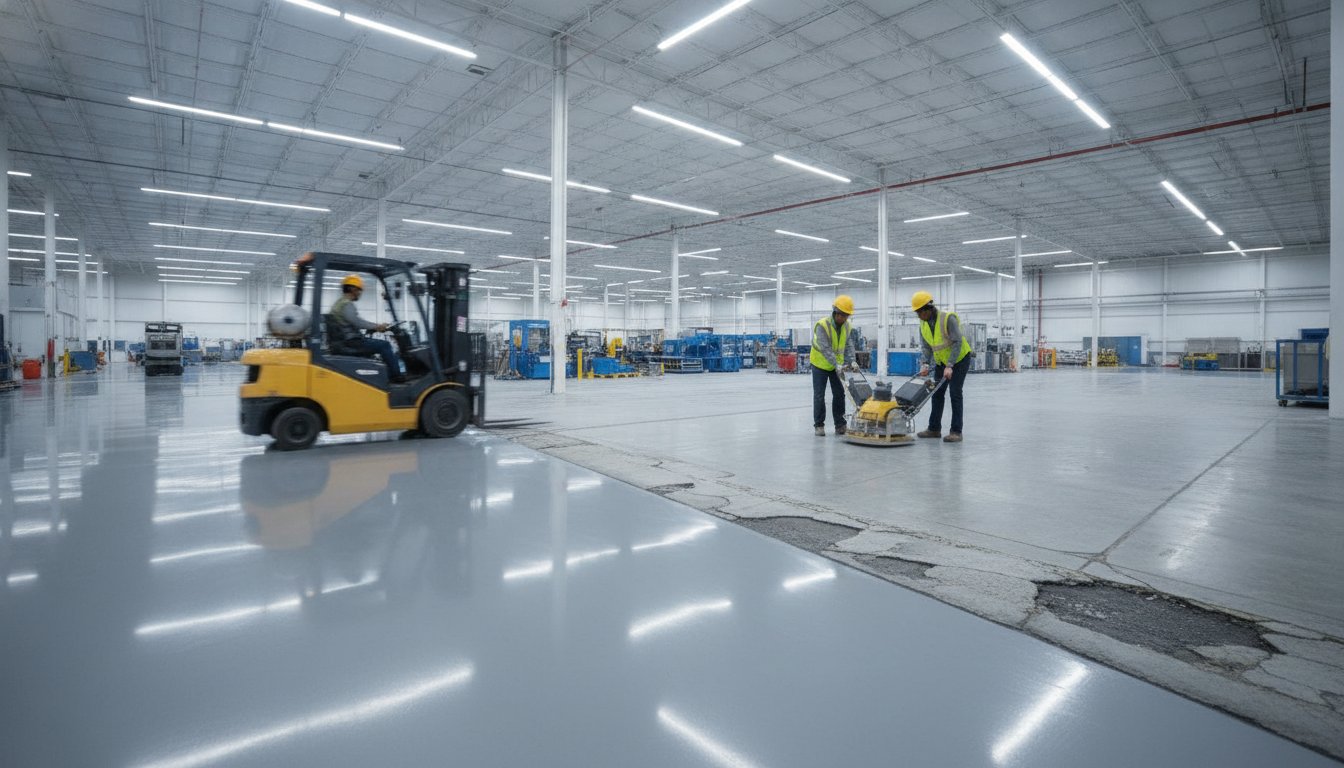
A failing industrial floor is more than an eyesore; it’s a direct threat to your bottom line. You’ve likely dealt with the frustration of previous coatings peeling under forklift traffic or spalling concrete that creates constant safety hazards for your team. It’s a common cycle in many Mississauga and Toronto facilities where low-bid solutions fail to meet the actual demands of heavy manufacturing. We understand that you can’t afford to halt operations for weeks, yet you cannot ignore a surface that no longer meets OHSA safety standards. High-performance industrial concrete resurfacing is a structural performance upgrade, not a cosmetic patch.
This guide details the technical requirements for resurfacing to help you avoid the massive expense and disruption of a full slab replacement. You’ll learn how to analyze the specific resinous systems required for chemical resistance and heavy impact. We’ll examine the engineering behind durable surfaces that minimize facility downtime and reduce long-term maintenance labour. From precise surface preparation to selecting UV-resistant or anti-static options, this overview ensures your next flooring project is your last one for years to come.
Key Takeaways
- Stop the cycle of temporary fixes by learning how to accurately evaluate slab integrity before committing to a repair strategy.
- Master the selection of high-build epoxy systems designed for industrial concrete resurfacing to ensure your floor withstands heavy impact and chemical exposure.
- Realize why surface preparation accounts for the majority of floor longevity and how to specify the correct profile for your facility’s traffic.
- Minimize operational disruptions by identifying high-performance systems that offer rapid return-to-service times without compromising on durability.
- Learn the “Problem-First” methodology used by industry veterans to deliver floors that meet OHSA standards and eliminate frequent maintenance costs.
Understanding Industrial Concrete Resurfacing: Restore Performance Without Demolition
Concrete failure is an operational liability. In heavy-duty environments, the surface eventually yields to the constant abuse of heavy machinery and chemical exposure. Industrial concrete resurfacing isn’t a cosmetic patch; it’s a structural restoration that bonds a new, high-performance wear layer to your existing slab. This process allows facilities in Mississauga and Toronto to bypass the extreme costs and logistical nightmares of total demolition. By utilizing the existing foundation, you maintain operational continuity while upgrading the surface to withstand modern industrial loads and strict safety requirements.
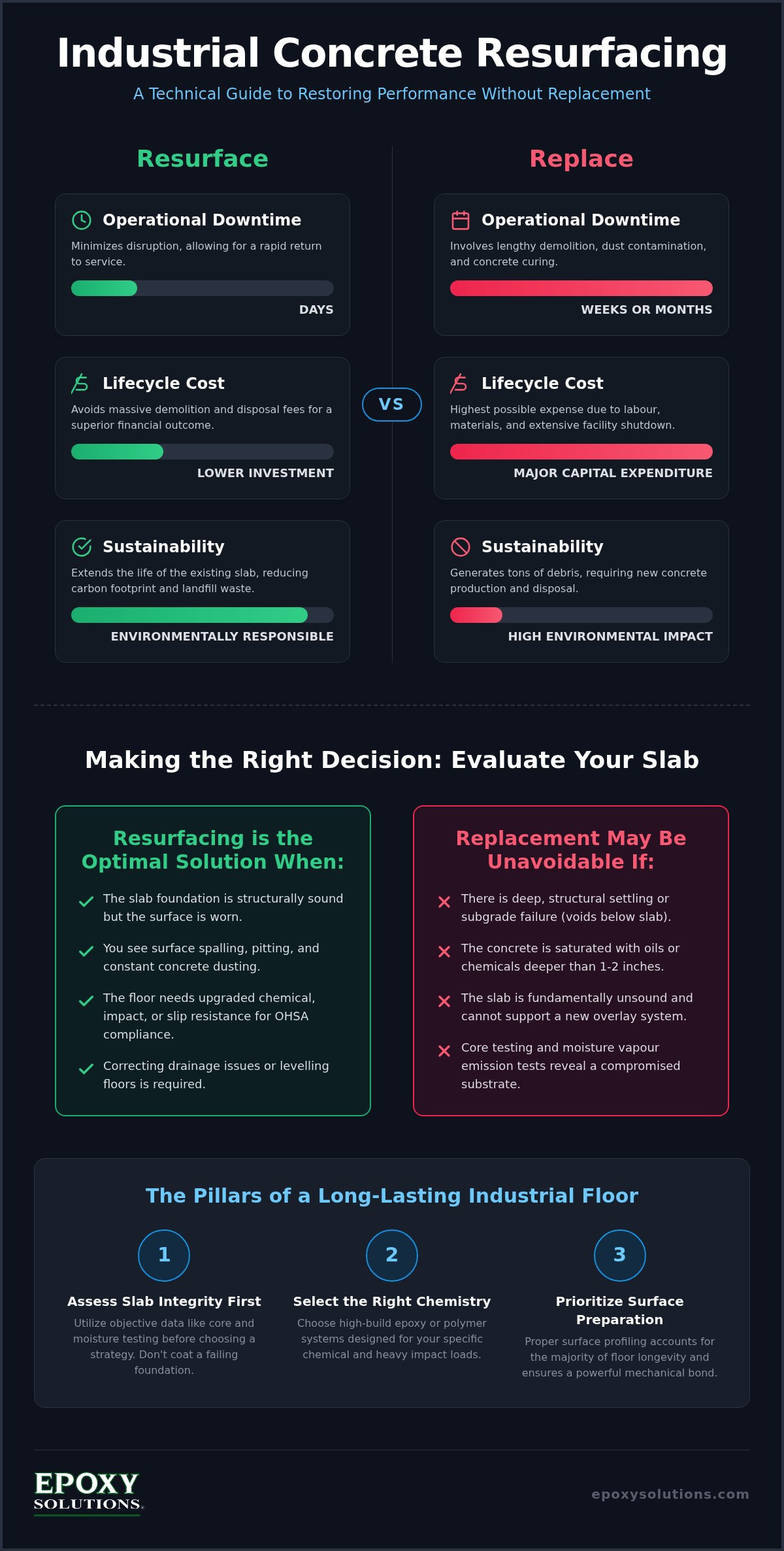
The choice to resurface is often driven by the need for speed and reliability. Tearing out a slab involves weeks of downtime, dust contamination, and massive disposal fees. Resurfacing provides a faster return to service while offering a surface that is often more durable than the original concrete. It’s also the most sustainable option for Ontario facilities. Extending the life of an existing slab reduces the carbon footprint associated with new concrete production and prevents tons of debris from entering local landfills.
The Mechanics of Resurfacing Overlays
Bonding is the foundation of success. Polymer-modified mortars use advanced resin chemistry to create a mechanical and chemical bond that is often stronger than the host concrete. These systems rely on high compressive strength to support heavy forklift traffic and stationary machinery without cracking or delaminating. Industrial resurfacing is a high-strength engineered overlay designed specifically to increase the load-bearing capacity and chemical resistance of an existing industrial floor. This technique mirrors many principles of Concrete pavement restoration (CPR) used in large-scale infrastructure, focusing on slab stabilization and long-term durability in punishing environments.
When Resurfacing is the Definitive Answer
Surface spalling and constant dusting are clear indicators that your floor’s integrity is compromised. These issues create safety hazards and can damage sensitive equipment or contaminate products. In food processing or pharmaceutical plants, resurfacing corrects drainage issues and floor levelling that otherwise lead to bacteria-harbouring puddles. Safety is the final piece of the structural puzzle. Beyond the physical surface, we integrate slip resistance and precision line marking services to ensure your facility remains compliant with OHSA standards while organizing traffic flow for maximum efficiency.
Resurface or Replace? Evaluating Slab Integrity and Lifecycle Costs
Assess the foundation before committing to a finish. Many facility managers in the GTA mistake surface-level damage for structural failure, leading them to consider expensive slab replacements that are often unnecessary. Conversely, applying a high-end coating to a compromised substrate is a guaranteed path to failure. Successful industrial concrete resurfacing requires an objective, data-driven assessment of the existing slab. We utilize core testing and moisture vapour emission tests to determine if the concrete can support a new high-performance system. If the base is sound, resurfacing is almost always the superior financial and operational choice.
Downtime is the primary metric for any renovation. A full slab replacement in a Mississauga manufacturing plant can take weeks, involving heavy demolition, dust mitigation, and a lengthy curing period before any traffic is permitted. Resurfacing reduces this window to days. The decision rests on the “Standard-Setting” methodology: we evaluate the slab-on-ground integrity to ensure the repair matches the expected lifespan of the facility. If you are unsure of your current floor’s condition, a professional expert facility assessment can prevent a costly miscalculation.
Red Flags: When Resurfacing is Not Enough
Some floors are beyond repair. If a facility is experiencing deep structural settling or subgrade failure where voids have formed beneath the concrete, an overlay will not solve the problem. Severe chemical contamination is another deal-breaker. If oils or acids have saturated the slab deeper than two inches, achieving a reliable bond becomes impossible. Standard-setting contractors refuse to resurface these compromised slabs because the system will inevitably delaminate. We prioritize long-term performance over a quick sale; if the slab is fundamentally broken, we will tell you bluntly.
Financial Analysis for GTA Facility Managers
Lifecycle costs tell the true story of value. While a thin-film coating might look attractive on a budget sheet today, it will likely peel under heavy forklift traffic within twenty-four months. High-performance industrial flooring specifications are engineered to provide a ten-year or greater service life. This reduces the total cost of ownership by eliminating frequent repairs and reducing maintenance labour. The process starts with the most critical phase: following Best Practices for Preparing Concrete Surfaces to ensure the new layer becomes a permanent part of the structure. When you factor in the hidden costs of replacement, such as permits and lost production, the ROI of a precision-engineered resurfacing project is undeniable.
Industrial Resurfacing Systems: Selecting the Right Chemistry for Your Load
System selection is precision engineering. You cannot apply a generic coating and expect it to survive a 24/7 production schedule. Industrial concrete resurfacing requires a chemistry that matches your specific environmental stressors, whether that’s heavy impact, abrasive traffic, or aggressive chemicals. In high-velocity Brampton warehouses, for instance, floors face constant friction from pallet jacks and forklifts. A high-build epoxy system provides the necessary thickness to absorb these loads without fracturing. For environments involving extreme temperatures or frequent steam cleaning, urethane cement is the industry standard. It expands and contracts at a rate similar to concrete, preventing the delamination that destroys standard coatings during thermal shock.
We see failures when facility managers choose systems based on price rather than performance. A thin-film coating is for a residential garage; it has no place in a manufacturing plant. We focus on high-performance specifications that include specialized traffic toppings for ramps and high-wear zones. These systems are designed to bridge small cracks and provide a uniform, durable surface that restores the slab’s utility. By matching the system chemistry to your specific load, you eliminate the need for frequent repairs and ensure the floor remains a functional asset rather than a maintenance headache.
Epoxy and Resinous Systems for Manufacturing
Resinous systems offer the most versatility for specialized environments. We tailor epoxy coatings to resist specific acids, alkalis, or solvents based on your facility’s chemical profile. In electronics manufacturing or cleanrooms, engineering anti-static (ESD) solutions is mandatory to protect sensitive components from static discharge. We also address external environmental factors. Large loading docks in Milton or Mississauga often suffer from ambering and brittleness due to sunlight exposure; we utilize UV-resistant topcoats to maintain the floor’s integrity and aesthetic over the long term.
Polished Concrete as a Resurfacing Alternative
Not every industrial floor needs a resinous overlay. When the priority is long-term cost efficiency and sanitation, industrial polished concrete services provide a compelling alternative for sound slabs. This process densifies the existing concrete, creating a seamless surface that won’t dust or harbour bacteria. It’s an excellent choice for large-scale distribution centres where maintenance labour must be kept to a minimum. While resinous floors offer superior chemical resistance, polished concrete excels in high-traffic areas that require a hard, wear-resistant finish without the risk of peeling or delamination. Selecting between these systems depends entirely on your operational requirements and the specific chemistry of your daily activities.
The Precision Process: Why Surface Preparation Determines Success in Ontario
Ninety percent of industrial floor failures are preventable. They stem directly from inadequate surface preparation. Industrial concrete resurfacing is only as reliable as the mechanical bond between the new system and the host slab. If you fail to remove laitance, oils, or previous coating residues, your investment will delaminate under the first heavy load. We don’t accept “good enough” in this phase. We follow a rigorous technical process to ensure the substrate is ready for a permanent bond.
Achieving the Correct Concrete Surface Profile (CSP)
Surface roughness is measured by the Concrete Surface Profile (CSP) scale. Matching the CSP to the thickness of your chosen system is a technical necessity. Diamond grinding is effective for removing minor contaminants and smoothing surfaces for thin-film applications. However, for heavy-duty resurfacing, shot blasting is often required to create a more aggressive anchor pattern. Removing the weak, powdery top layer of concrete is the only way to expose the aggregate and ensure the resin penetrates the pores. For high-build epoxy systems, a minimum profile of CSP 3 to CSP 5 is required to ensure the resin penetrates and locks into the substrate.
Moisture Mitigation and Environmental Control
Ontario’s climate introduces variables that many contractors ignore. High humidity in Toronto and Mississauga summers can trap moisture within a slab, while dry, freezing winters affect the chemical curing process. Moisture vapour emission testing (MVET) is a mandatory step in our precision process. Excess moisture is the primary enemy of anti-static flooring, as it leads to osmotic blistering and compromises the conductive properties of the system. We utilize specialized vapour barriers and moisture-tolerant primers to neutralize the wicking effect from the soil beneath the slab. Managing ambient temperatures during the curing phase is equally critical. We ensure the facility environment is controlled so the resin achieves its full engineered strength regardless of external Canadian weather conditions.
Ensure your next project follows a standard-setting prep process. Reach out for a technical facility assessment to verify your slab’s readiness.
Engineering Long-Term Durability with Epoxy Solutions™
Results define our reputation. Epoxy Solutions™ has specialized in high-performance resinous flooring and polished concrete since 1981, setting the industry benchmark for durability in the Greater Toronto Area. We operate as the authoritative expert fixer in a market often saturated with low-bid compromises that fail under pressure. Industrial concrete resurfacing is a technical discipline that requires a partner who understands that a floor is a structural component of your production line. Our “Problem-First” methodology begins by identifying exactly why your previous surface failed before we ever suggest a new specification. This no-nonsense approach ensures that the solution we provide is permanent, reliable, and tailored to the extreme demands of your specific environment.
Extreme Capability in Demanding Environments
Generic contractor “deals” are a liability in a high-stakes facility. We have a proven history of success in chemical processing, aerospace, and heavy manufacturing sectors where floor failure is not an option. Our specifications are engineered to outperform standard coatings by focusing on superior bond strength and impact resistance. We maintain a meticulous approach to safety and OHSA compliance, ensuring your facility remains organized and hazard-free. When we take on a project, we bring the weight of four decades of experience to the job site. This allows us to resolve complex logistical or environmental challenges that would deter less experienced providers.
- Proven expertise in chemical-resistant and anti-static systems.
- Standard-setting installation techniques that exceed industry norms.
- Rugged, high-performance surfaces designed for 24/7 operational cycles.
- Direct, professional communication that prioritizes technical accuracy.
Partnering for Performance
Logistics in the Greater Toronto Area demand precision and local knowledge. Whether your facility is located in Toronto, Mississauga, or Vaughan, we coordinate every phase of the project to minimize your operational impact. We provide accurate project timelines and stick to them because we realize that every hour of lost production represents lost revenue. Our commitment to high-performance results means we never cut corners on surface preparation or material quality. You receive a floor that is built to last, reducing your total cost of ownership and eliminating the cycle of frequent repairs. We are the reliable partner you call when you need the job done right the first time.
Contact Epoxy Solutions™ for a technical facility assessment today to secure a floor that meets the highest standards of industrial performance.
Secure the Future of Your Industrial Flooring Assets
A failing floor is a liability that compromises safety and productivity. We’ve established that high-performance industrial concrete resurfacing is the most cost-effective way to restore structural integrity without the disruption of a full slab replacement. Success depends on two non-negotiable factors: precise mechanical surface preparation and selecting a resin chemistry tailored to your specific facility loads. Whether you’re managing a high-traffic warehouse in Brampton or a chemical processing plant in Mississauga, the goal is long-term durability over the lowest initial bid.
Epoxy Solutions™ has been the industry veteran since 1981. We specialize in high-performance resinous flooring that sets the benchmark for quality across the GTA. Our team understands the local environmental challenges and logistical requirements of facilities in Toronto, Mississauga, Brampton, and Vaughan. Don’t settle for temporary patches that will inevitably peel. It’s time to invest in a surface engineered for extreme capability.
Request a Technical Consultation for Your GTA Facility today to eliminate downtime and ensure your operations remain compliant with the highest safety standards. Your facility deserves a floor that performs as hard as your business does.
Frequently Asked Questions
How long does industrial concrete resurfacing typically take to cure?
Industrial concrete resurfacing systems generally reach light foot traffic capacity within 24 hours. Full mechanical and chemical cure for heavy forklift use typically requires 48 to 72 hours. These timelines depend on ambient temperatures in your Toronto or Mississauga facility and the specific resin chemistry used. We prioritize rapid-return systems to minimize your operational downtime while ensuring the material achieves its full engineered hardness before you resume production.
Can resurfacing handle heavy forklift traffic and pallet jack loads?
Resurfacing systems are specifically engineered to withstand the concentrated point loads of forklifts and pallet jacks. We utilize high-build epoxy and aggregate-filled overlays that provide the necessary compressive strength to prevent crushing or cracking. In Brampton distribution centres, where traffic is constant, we specify high-performance traffic toppings that offer extreme abrasion resistance. This ensures the floor remains a durable asset rather than a recurring maintenance liability.
What is the difference between a concrete coating and a resurfacing overlay?
A coating is a thin-film application, usually measured in mils, intended primarily for dustproofing or light aesthetics. Resurfacing involves a much thicker overlay, often ranging from 1/16 to 1/4 inch or more. These overlays are designed to restore the structural integrity of a worn slab by filling deep pits and spalling. While a coating might peel under heavy use, a resurfacing system becomes a permanent, integral part of the substrate.
Is resurfacing effective for floors with significant chemical damage?
Resurfacing is highly effective for chemically damaged floors provided the compromised concrete is mechanically removed during surface preparation. We then install chemical-resistant flooring systems tailored to your facility’s specific acid or solvent exposure. This stops ongoing degradation and protects the underlying slab from future leaks. In heavy manufacturing environments, this specialized chemistry is the only way to ensure long-term performance and avoid the extreme cost of full slab replacement.
How often does an industrial resurfaced floor need to be maintained?
High-performance resinous floors require very little maintenance beyond routine sweeping and mopping with a pH-neutral cleaner. Because the surface is seamless and non-porous, it does not trap oils or bacteria like bare concrete. This reduces your long-term labour costs and ensures your facility stays compliant with sanitation standards. We recommend periodic technical inspections of high-traffic zones to ensure the slip-resistant texture remains effective for your team’s ongoing safety.
Can you resurface concrete in cold storage or freezer environments?
Concrete resurfacing in freezer or cold storage environments requires specialized resins that can cure at sub-zero temperatures. We utilize urethane cements and low-temp epoxies that maintain their bond strength even in extreme thermal conditions. These systems are designed to resist thermal shock during wash-downs, preventing the delamination common with generic products. Our team has the extreme capability to install these systems without requiring you to bring the entire room to room temperature.
What safety standards do your resurfacing systems meet in Ontario?
Our flooring systems are designed to exceed OHSA safety standards in Ontario, particularly regarding slip resistance and high-visibility line marking. We integrate specific textures into the topcoat to ensure a safe grip for workers even in wet or oily conditions. Additionally, our materials are often low-VOC and meet strict sanitation requirements for food and pharmaceutical facilities. This commitment to safety helps you avoid workplace injuries and maintain full regulatory compliance.
Why is moisture testing critical before resurfacing industrial concrete?
Moisture testing is critical for industrial concrete resurfacing because trapped vapour is the primary cause of floor delamination. High hydrostatic pressure can force a coating to blister and peel, regardless of how well the surface was prepared. By identifying moisture levels beforehand, we can specify vapour barriers or moisture-tolerant primers to neutralize the problem. This technical accuracy is what separates a standard-setting installation from a failed low-bid project.