
Paint, thermoplastic and cold-applied plastic are not interchangeable: the right choice depends on the site, not just the material name. In Milton, painted pedestrian crossovers on lower-volume roads rely on pavement markings and signs, not flashing signals. On private property, traffic, pavement condition, expected wear, layout and the disruption the work area can tolerate all matter when planning pedestrian walkway marking.
Comparing materials before committing is worthwhile because the choice affects application, maintenance and cost. Pricing depends on the project and is provided after a quote request. Key factors include the marking area and complexity, surface preparation, material and site access. This guide compares paint, thermoplastic and cold-applied plastic, explains what affects pedestrian walkway marking costs in Milton, and shows how preparation and accurate layout support a clear, consistent crossing. The goal is a legible result suited to the site, not a one-material-fits-all answer.
Key Takeaways
- Compare paint, thermoplastic and cold-applied plastic by considering the site’s traffic, surface condition and expected wear.
- See how marking area, layout complexity, preparation, material choice and site access affect a project’s pricing.
- Learn the Ontario requirements for tactile walking surface indicators at depressed crossing curbs, including placement, depth and tonal contrast.
- Get a clearer sense of the details to establish before arranging new or refreshed markings, so the work suits the site and its users.
Paint, thermoplastic or cold plastic?
For a private site in Milton, choose a marking material based on pavement condition, traffic and the crossing’s purpose. The application method and layout matter just as much as the material.
Walkway marking materials
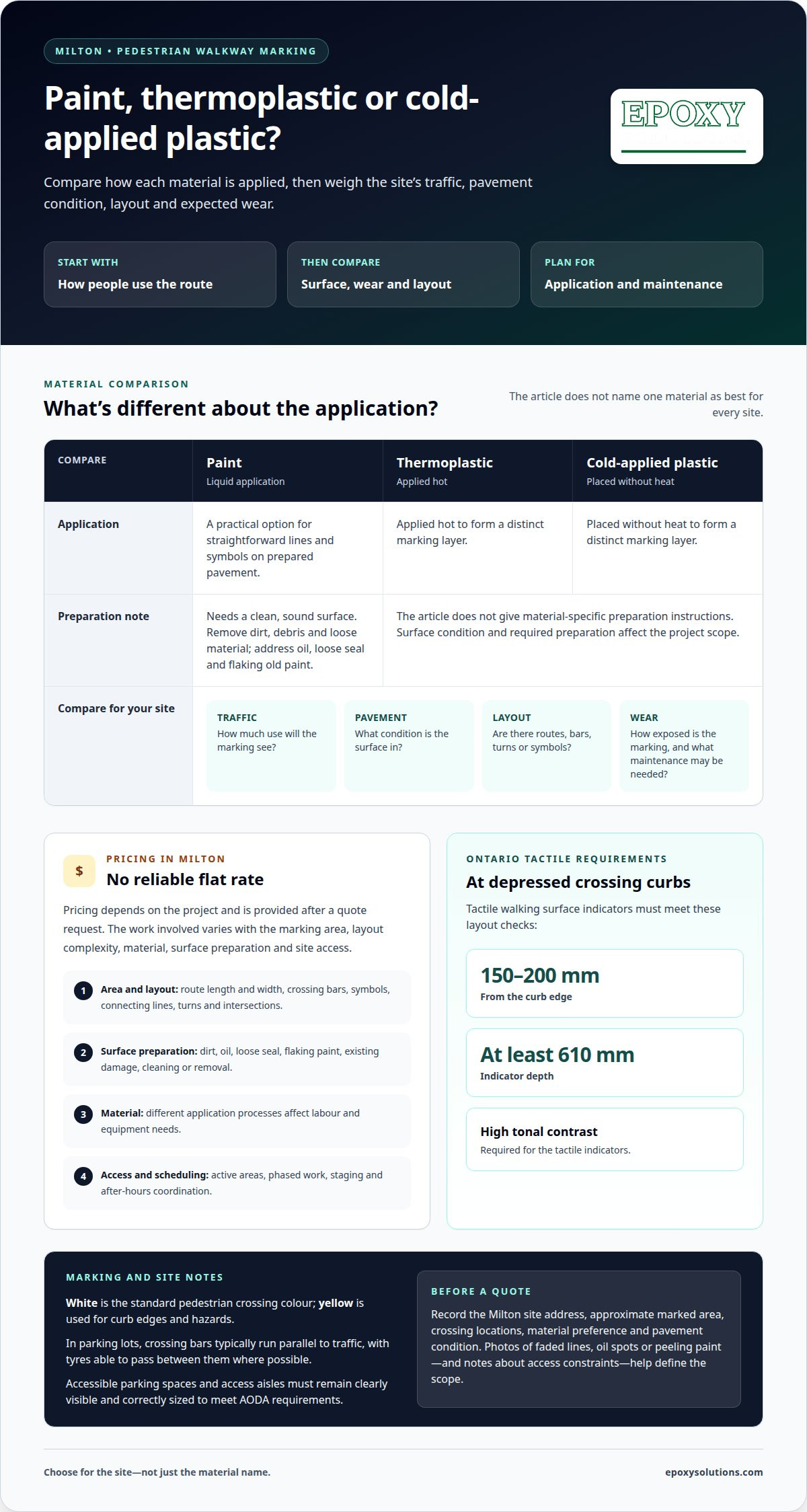
Paint is applied as a liquid, making it practical for straightforward lines and symbols on prepared pavement. Thermoplastic is applied hot, while cold-applied plastic is placed without heat; both form a distinct marking layer. Compare them by wear exposure, surface condition, layout detail and maintenance needs. The right choice starts with how people will use the marked route.
Marking types and municipal standards
A walkway marking guides people along a route; a crosswalk marks where they cross vehicle traffic. A sidewalk is the pedestrian path itself, not simply a painted crossing. In car parks, crossing bars are typically white and parallel to traffic, with vehicle tyres able to pass between them where possible. White is the standard crossing colour; yellow is used for kerb edges and hazards.
Ontario requirements include specific tactile features at crossings. According to Government of Ontario, tactile walking surface indicators at depressed curbs need high tonal contrast, sit 150-200 mm from the curb edge and be at least 610 mm deep. Accessible parking spaces and access aisles in Milton must also remain clearly visible and correctly sized to meet AODA requirements.
Paint needs a clean, sound surface. Remove dirt, debris and loose material so it can bond, and address oil, loose seal and flaking old paint before applying new lines. Professional line painting also uses measured layouts, chalk lines or layout tools to keep bars and route markings accurate. Traffic paint must dry before vehicles or pedestrians return, so plan the closure around the product and site conditions.
Milton’s painted pedestrian crossovers are used on lower-volume roads and rely on pavement markings and signs rather than flashing signals. On private developments, owners are responsible for keeping crossings safe and visible. Inspect markings in daylight and at dusk, then repaint those that look worn or dull.
Pricing factors
There is no reliable flat rate for a pedestrian crossing in Milton. Pricing depends on the project and is provided after a quote request. The main factors are marking area, layout complexity, material, surface preparation and access. A single straight route and a multi-crossing car park require different quantities and planning.
Start with the layout. A quote needs to account for the length and width of marked routes, crossing bars, symbols and connecting lines. A compact entrance with one crossing uses less marking material than a large car park with several pedestrian routes. Extra turns, intersections and symbols add measuring and application work.
Material affects the scope. Traffic paint, thermoplastic and cold-applied plastic have different application processes, which shape labour and equipment needs. Compare options against the site’s traffic and pavement condition, as well as the initial work. Choosing only the smallest upfront scope can overlook how often exposed markings may need refreshing.
Surface condition also matters. Oil, loose seal, dirt and flaking paint can interfere with a new application, adding preparation before marking begins. Milton’s freeze-thaw cycles, snow clearing, road salt and ultraviolet exposure gradually wear parking-lot paint. Existing damage and the cleaning or removal needed therefore affect the work involved.
Access affects scheduling and staging. A busy car park may need phased work, keeping some bays open while another area is marked. Early-morning or after-hours scheduling can change site coordination, while cones and clear work zones help separate vehicles from the application area. The site plan should identify entrances, pedestrian routes and areas available during the work.
For a useful estimate, document the site address in Milton, approximate marked area, crossing locations, material preference and pavement condition. Include photos showing faded lines, oil spots or peeling paint, plus access constraints such as active loading areas. These details help define the scope before work is scheduled. Use a marking project scope to organize those details and support a tailored quote.
What are Milton’s standards for pedestrian walkway marking dimensions, colours and symbols?
Clear markings separate pedestrian routes from vehicle space in Milton car parks and private developments. Start by identifying each crossing, walkway entrance, curb ramp and accessible route on a site plan. White is the standard colour for pedestrian crossings; yellow is used for kerb edges and hazards. Use each colour consistently across the property.
At depressed curbs on pedestrian crossings, tactile indicators have specific placement and contrast requirements. According to Government of Ontario, tactile walking surface indicators must have high tonal contrast, sit 150-200 mm from the curb edge, and be at least 610 mm deep. Treat those dimensions as a layout check, not a visual approximation, when planning the curb transition.
Symbols should clarify movement, not compete with crossing bars. Keep the route consistent from a building entrance to a marked crossing, and align directional arrows with that route. In a car park, white crossing bars typically run parallel to traffic, with vehicle tyres able to pass between them where possible. Avoid placing unrelated symbols inside the pedestrian path.
Accessible parking spaces and access aisles in Milton must remain clearly visible and correctly sized to meet AODA requirements. During layout, compare each space and aisle with the site plan, then check that adjacent pedestrian routes connect without being blocked by parked vehicles. A faded aisle or obscured symbol weakens visual guidance, even if nearby crossing bars remain visible.
Before applying markings, measure the route, mark reference points and check alignment from pedestrian and driver approaches. At a curb ramp, confirm the tactile surface’s contrast, distance from the edge and depth. At a car-park crossing, check bar direction and visibility from the vehicle lane. These checks help keep dimensions and symbols consistent across entrances, access aisles and crossings.
Inspect existing markings in daylight and at dusk. Record worn bars, unclear symbols and access aisles that have become difficult to distinguish. This gives property managers a practical list for prioritizing repainting and restoring clear, consistent pedestrian guidance.
How can residents request new or refreshed pedestrian walkway markings in Milton?
First, locate the crossing in Milton and determine whether it is on a public road or private property. That distinction identifies who is responsible for the request: the relevant road authority or property owner. For example, report a faded crossing at a plaza entrance to the site’s owner or manager. Raise concerns about a public-street crossing with the authority responsible for that road.
Make the request specific. Give the street address or site name, describe the crossing’s position and explain what needs attention. Note whether paint is faded, a route is difficult to follow or markings are missing near an entrance. Photos taken in daylight and at dusk can show how clearly the lines appear in different conditions. Include nearby landmarks to make the location easy to identify.
For a private development, send the details to the property owner or manager. Ask them to review the route, crossing points and adjoining pedestrian areas together. A crossing near a vehicle entrance, loading area or accessible parking aisle may need a coordinated layout. Describe the issue and location rather than prescribing a material before the pavement is assessed.
For a public-road location, submit the address and photos to the responsible road authority through its established service-request process. Describe the concern plainly, such as a worn crossing or unclear pedestrian route. Keep a copy of the submission and any reference number for follow-up. Do not repaint public-road markings yourself; coordinate changes through the authority responsible for the location.
Property managers planning refresh work can define the scope around affected areas, surface condition and vehicle access. Pedestrian crossing work in Milton typically takes a few hours, while lot size, layout complexity and preparation affect the schedule. Phasing can keep part of a car park available during the work.
For private-site marking, arrange a marking project discussion with the site layout, photos and access constraints ready.
Epoxy Solutions™: Epoxy Coatings & Installation
Epoxy Solutions™ installs epoxy coatings for commercial and industrial flooring projects. For property managers planning pedestrian routes, a durable floor surface can form part of a broader facility improvement, especially when the flooring itself needs attention alongside site markings.
Consider each area’s flooring requirements. UV-resistant flooring may suit spaces exposed to ultraviolet light, while chemical-resistant flooring addresses environments where chemical exposure is a concern. Anti-static flooring is another option for facilities with static-control needs. The right system depends on the surface and the conditions it must handle.
Keep the work scopes distinct: the authority responsible for a public road handles its crossings, while private-site markings and flooring serve different functions. Contact Epoxy Solutions™ to discuss a commercial flooring project and the conditions your facility needs to address.
Set the next project up for success
Treat pedestrian walkway marking in Milton as part of the site’s broader circulation plan. Consider how people move from entrances to destinations, where vehicles cross those routes and which areas need clearer separation. This turns a faded line or missing crossing into a defined scope of work rather than an isolated patch.
For a private property, bring together the site plan, photos and priorities before planning the work. Identify the routes that matter most to visitors, staff or deliveries, and note any operational constraints that affect access. A clear brief makes it easier to discuss the intended result and practical requirements.
When the marking scope is ready to discuss, start a site-specific conversation with Epoxy Solutions™. A well-planned route can make the property easier to understand and navigate. Take the next step with a clear picture of what your site needs.
Frequently Asked Questions
Which marking styles guide pedestrians around Milton sites?
Milton sites use painted lines and crossing bars, while thermoplastic and cold-applied plastic are options for private-property markings. A marked walkway guides people through a site; a crosswalk identifies a route across vehicle traffic. On lower-volume public-road crossovers, pavement markings and signs are used without flashing signals. The layout should distinguish pedestrian paths from drive aisles and vehicle entrances.
What is the process and timeline for installing pedestrian walkway markings in Milton?
Pedestrian crossing work typically takes a few hours, with site size, preparation and layout affecting the schedule. The process includes defining the route, preparing the pavement, applying the selected material and allowing it to dry or set. In a busy car park, plan phased access so vehicles can use unaffected areas while the work zone remains closed until ready. A clear site plan helps coordinate each step.
Who pays for pedestrian walkway marking in Milton, and what affects the cost?
The cost of pedestrian walkway marking in Milton depends on the marking area, design complexity, material, pavement preparation and site access. Pricing is provided after a quote request. For private developments, the property owner is responsible for keeping on-site crossings safe and visible, including arranging and budgeting for maintenance. Public-road markings are handled by the responsible road authority, not repainted privately.