
High-build epoxy is a practical starting point for many concrete cannabis cultivation, drying and curing rooms. Urethane cement is also worth considering where floors face frequent wetting, heavier chemical exposure or temperature changes. For flooring for cannabis production facilities in Vaughan, choose a system according to each room’s conditions, not just the material name. Assess concrete moisture against the proposed flooring system’s requirements, since moisture vapour can cause blisters or bubbles in a floor covering.
Both options can provide a durable, cleanable floor when matched to the space and installed as a complete system by professionals like Epoxy Solutions™. The decision also involves slip resistance, colour, cleaning demands and floor-to-wall details. This guide compares epoxy and urethane cement, explains how moisture and room use affect the choice, and shows why flooring details matter in cannabis production facilities.
Key Takeaways
- Match epoxy or urethane cement to each room’s moisture, chemical exposure and temperature conditions; assess the concrete before selecting a system.
- Balance light-coloured finishes and cleanability with traction suited to wet walkways and work areas.
- Plan seamless floor-to-wall transitions, cove details and equipment interfaces as part of the flooring system, not as afterthoughts.
- Define the facility’s cleaning, traffic and operational demands to shape a flooring specification that supports practical maintenance.
Concrete-floor porosity and moisture vapour transmission
Bare concrete is porous. In cannabis cultivation rooms, it can absorb water, fertilizers and environmental moisture, leaving the surface vulnerable to contamination. Moisture vapour moving through the slab can also cause blisters or bubbles beneath a flooring system. These failures can undermine the floor even if the resin surface looks intact at installation.
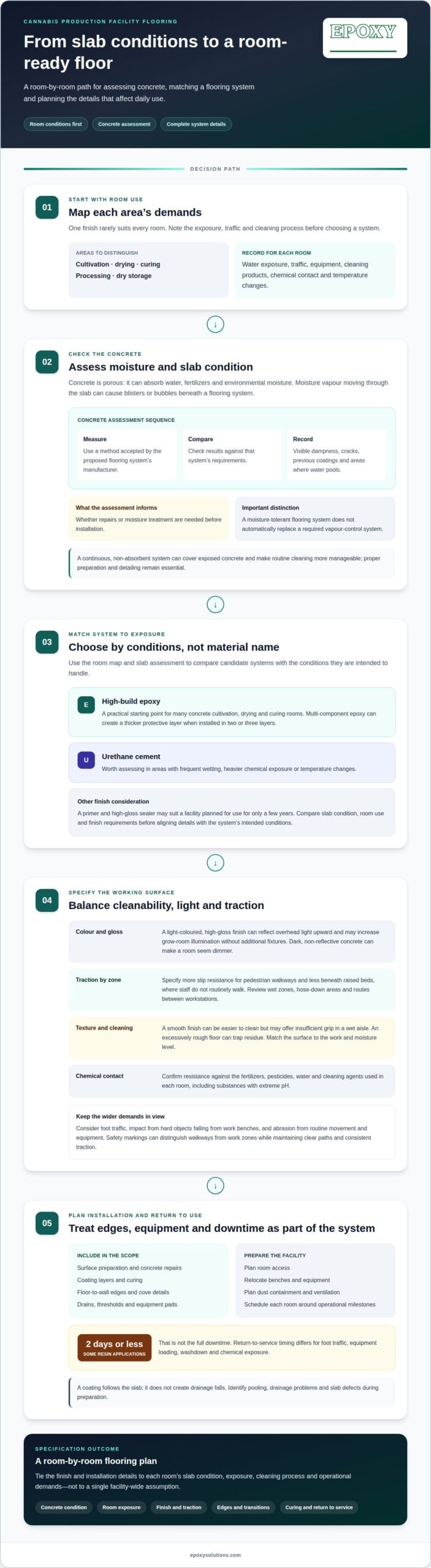
Assess the concrete before selecting a coating. Measure moisture using a method accepted by the proposed flooring system’s manufacturer, then compare the results with its requirements. Record visible dampness, cracks, previous coatings and areas where water pools. This assessment helps determine whether the slab needs repairs or moisture treatment before installation. A moisture-tolerant flooring system does not automatically replace a required vapour-control system.
Porosity also affects sanitation. Untreated concrete can absorb liquids, making spills harder to remove. In moist grow rooms, porous concrete can provide a place for plant pathogens, including powdery mildew, botrytis and Aspergillus, to persist. A continuous, non-absorbent flooring system covers exposed concrete and makes routine cleaning more manageable, but proper preparation and detailing remain essential.
Installation timing depends on preparation, repairs, application and curing. Some resin flooring applications can be installed in two days or less, but that isn’t the full downtime. Before work, the facility team should plan room access, bench and equipment relocation, dust containment and ventilation. Return-to-service timing differs for foot traffic, equipment loading, washdown and chemical exposure. In a 24/7 operation, schedule each room around those milestones.
Renovations call for a close look at the existing slab. In a repurposed industrial facility, uneven areas or coating failures may require concrete repairs, moisture mitigation or a new urethane mortar cement base layer before the finish system. Water pooling can damage unprotected concrete, so identify drainage problems and slab defects during preparation. A coating follows the slab; it does not create drainage falls.
Light-coloured and slip-resistant flooring
For hygienic cleaning, choose a smooth, durable, non-absorbent floor with sealed edges around drains. Seamless surfaces reduce crevices where dirt and contaminants can collect, helping staff clean thoroughly. Flooring supports sanitation but does not replace a facility’s pest-control practices.
Colour affects visibility and lighting. A light-coloured, high-gloss finish can reflect overhead light upward and may increase grow-room illumination without additional fixtures. Dark, non-reflective concrete, by contrast, can make the room seem dimmer. The finish still needs to withstand abrasion, cleaning and contact with fertilizers, pesticides and water.
Match traction to the work and the amount of moisture. A smooth finish can be easier to clean but may offer insufficient grip in a wet aisle. An excessively rough floor can trap residue. Specify more slip resistance for pedestrian walkways and less beneath raised beds, where staff do not routinely walk. Review wet zones, hose-down areas and routes between workstations before choosing the finish.
Traffic and impact matter too. A grow room may have constant foot traffic, and hard objects can fall from work benches. The coating should suit those demands as well as abrasion from routine movement and equipment. Consider urethane cement for areas with frequent wetting, heavier chemical exposure or temperature changes. Match the system to actual room conditions rather than applying one finish everywhere.
Fertilizers, water and substances with extreme pH can contact cultivation floors. Confirm chemical resistance against the products and cleaning agents used in each room. In a wet walkway, pair a cleanable finish with suitable texture; in a dry work area, prioritize a surface that releases residue during cleaning. Safety markings can distinguish walkways from work zones while maintaining clear paths and consistent traction. Flooring systems with antimicrobial features are intended to help limit the growth and spread of microbes, mildew and fungi in moist spaces, but cleaning remains essential.
Flooring and wall systems for cannabis production facilities
One finish rarely suits every room. Match the flooring system and wall details to each area’s exposure, traffic and cleaning process.
Flooring Systems by Facility Area
High-build epoxy is a practical starting point for many concrete cultivation, drying and curing rooms. Processing areas with frequent wetting or heavier chemical exposure may need a different system, while dry storage has other demands. Map each room’s traffic, cleaning products, equipment and water exposure before choosing the finish. A room-by-room schedule helps avoid overbuilding low-demand areas or under-specifying wet, high-use zones.
Urethane Cement and Epoxy Systems
Urethane cement is worth assessing where wetting, chemical exposure or temperature changes are frequent. Multi-component epoxy can create a thicker protective layer when installed in two or three layers. A primer and high-gloss sealer may suit a facility planned for use for only a few years. Compare slab condition, room use and finish requirements, then align installation details with the flooring system’s intended conditions.
Cannabis Flooring Contractors in Vaughan and the GTA
Epoxy Solutions™ installs resinous flooring systems for commercial and industrial facilities, including projects in Vaughan and the GTA. Define the full installation scope, including surface preparation, repairs, coating layers, curing and transitions. A written system specification should explain how the finish suits each room’s use. Account for floor-to-wall edges, drains, thresholds and equipment pads, not just the open floor area.
Wall details matter. Integral cove bases create a cleanable curve at the floor-to-wall junction instead of a ninety-degree corner. Specify the cove height, wall termination and transitions at thresholds and equipment pads. Sealed drain edges and carefully detailed trenches help maintain a continuous, cleanable surface. The coating follows the slab, so it will not create drainage falls; consider existing slopes and drainage details in the design.
Cannabis facility flooring requirements
Flooring for cannabis production facilities in Vaughan should be specified around each room’s operations, not chosen by appearance alone. Cultivation floors must support cleaning, traffic and the weight of products and machinery. Start with the substrate and work performed in each space, then document the finish and performance requirements.
For Ontario facilities, fire and electrical requirements depend on the facility’s design and applicable project requirements; a floor finish alone does not establish compliance. Set slip resistance according to use, with suitable traction for wet walkways and surfaces that will not trap residue during cleaning.
Build the specification room by room. A cannabis grow area may encounter water, fertilizers and cleaning chemicals, while a processing space may see equipment, storage containers and heavier traffic. The floor system must also suit the slab and moisture-control measures. A moisture-tolerant surface does not automatically replace a required vapour-control system.
Seamless resin flooring can reduce grout lines and crevices where contaminants may collect. Include sealed drain edges and coved floor-to-wall transitions in the design. Confirm that the finish suits the facility’s cleaning process, including steam cleaning or hot power washing if those methods are used.
Do not treat an epoxy floor as a complete compliance plan. A floor alone does not establish Health Canada compliance for a cannabis facility. Public-health guidance may call for smooth, durable, non-absorbent flooring that is easy to clean and kept in good repair. Both the coating and substrate preparation matter.
For flooring for cannabis production facilities in Vaughan, put room use, cleaning products, drainage, slip resistance, wall transitions and substrate condition into a written scope. Include thresholds and equipment-pad edges, not just open floor areas. Plan a facility flooring system around those practical demands before installation begins.
Epoxy Solutions™: Epoxy Coatings & Installation
Epoxy Solutions™ provides epoxy coatings and installation for facilities planning a resinous floor around room-specific operating demands. Turn to this service when cultivation or processing areas need a durable coating suited to their concrete substrate, cleaning routines and exposure to moisture or chemicals.
The flooring plan can account for finish, slip resistance, colour and floor-to-wall details as part of the overall system. UV Resistance Flooring, Anti-Static Flooring and Chemical Resistance Flooring address additional project considerations where they fit the facility’s needs. Start the specification with the conditions in each room and the performance expected from the finished surface.
Share the facility’s room uses, substrate condition, cleaning methods and exposure concerns to move the flooring decision forward. Contact Epoxy Solutions™ or visit epoxysolutions.com to discuss your facility flooring project.
Set the Next Step in Motion
Turn the flooring decision into a room-by-room project brief. Identify how each space operates, the cleaning process it must support and the performance priorities that matter most. This provides a practical starting point and helps align the flooring plan with the facility’s day-to-day needs.
For flooring for cannabis production facilities in Vaughan, Epoxy Solutions™ offers Epoxy Coatings & Installation, UV Resistance Flooring and Anti-Static Flooring. Consider these options alongside your facility’s operational requirements when developing a flooring scope.
Bring your facility’s priorities into the next conversation. Contact Epoxy Solutions™ about your facility to discuss a flooring approach for your operation. A clear plan is the first step toward a floor built around the work it needs to support.
Frequently Asked Questions
Epoxy or urethane cement?
Choose according to each room’s operating conditions, not a facility-wide preference. Epoxy is a practical option for concrete rooms with routine cleaning and moderate exposure. Urethane cement is worth assessing in areas with frequent wetting, temperature changes or heavier chemical exposure. For example, compare a dry curing room with a washdown zone, then specify a system for each area’s demands.
What flooring systems are suitable for cannabis production facilities?
High-build epoxy and urethane cement are common resinous flooring options to assess for cultivation and processing spaces. The right specification depends on the slab, room use, cleaning process and exposure to water or chemicals. Polished concrete may also suit some areas. Assess each room separately: a storage space and a frequently washed production area do not necessarily need the same finish.
What are the flooring requirements for licensed cannabis facilities in Canada?
No flooring material, by itself, establishes licensing compliance in Canada. A suitable floor should support sanitation and be smooth, durable, non-absorbent, easy to clean and maintained in good repair. A facility’s compliance obligations extend beyond its floor. Include flooring decisions in the broader facility plan, alongside cleaning procedures, drainage details and the intended use of each room.
Which flooring materials resist cannabis nutrients, acids, solvents, and disinfectants?
Do not assume any flooring material resists every nutrient, acid, solvent or disinfectant. Resinous systems can be selected for chemical resistance, but compatibility depends on the specific substances, their concentration, exposure conditions and cleaning routine. List the products used in each room and compare them with the flooring system’s chemical-resistance information. This matters especially where a process uses solvents rather than routine cleaning agents.
What flooring is suitable for grow rooms, processing areas, and cannabis extraction rooms?
Grow rooms often need a system suited to moisture and plant-care products; processing spaces may face more equipment and cart traffic. For an extraction room, prioritize compatibility with the chemicals and process conditions used there, and coordinate flooring decisions with the facility’s wider safety design. Vaughan operators planning several room types can specify finishes by area instead of applying one system throughout.
How do epoxy, urethane, and polished concrete flooring compare for cannabis production?
Epoxy and urethane are resinous flooring options, while polished concrete retains the concrete slab as the finished surface. Epoxy may suit many dry production rooms; assess urethane cement for demanding wet or temperature-variable conditions. Polished concrete may suit areas where operating and cleaning demands allow. Compare how each option handles the room’s exposure, maintenance needs and requirements for a protective, non-absorbent surface.