The toughest floor isn’t always the right floor. A system that doesn’t suit your facility’s traffic, concrete condition, or exposure can still wear, crack, collect dust, or become difficult to clean. Choosing heavy traffic flooring solutions Milton facilities can rely on starts with matching the floor to the work, not simply selecting the heaviest-duty option.
When an existing floor fails, repairs or replacement can disrupt operations. The right choice depends on more than forklift and foot traffic: substrate condition, chemical exposure, cleaning routines, and installation planning all affect performance and downtime. A durable floor is designed around those demands.
This guide compares commercial flooring approaches by traffic, substrate, and site conditions so you can identify a fit-for-purpose system for your Milton facility. You’ll also learn which preparation and installation factors influence durability, and how traffic toppings and line marking can support an effective floor plan. Epoxy Solutions™ installs commercial and industrial flooring in Milton and across the GTA, including Toronto, Mississauga, Brampton, and Vaughan.
Key Takeaways
- Define heavy traffic by vehicle type, turning, braking, load movement, and how often each area is used.
- Compare epoxy coatings, traffic toppings, and polished concrete against your facility’s use, concrete condition, and maintenance priorities.
- Assess each area separately to match heavy traffic flooring solutions to the demands of your Milton facility.
- Plan substrate preparation, access, traffic routes, staging, and work sequencing to support a more controlled installation.
- Coordinate flooring selection with traffic toppings and line marking as part of the overall facility plan.
Heavy Traffic Flooring Solutions in Milton: Start With the Demands on Your Floor
The wrong floor can wear out early. When cracks, surface wear, dust, or difficult cleaning begin to affect daily work, repairs or replacement may disrupt operations. Selecting heavy traffic flooring solutions Milton facilities can rely on starts with a clear assessment of how each area is used, not a broad label such as “industrial grade.”
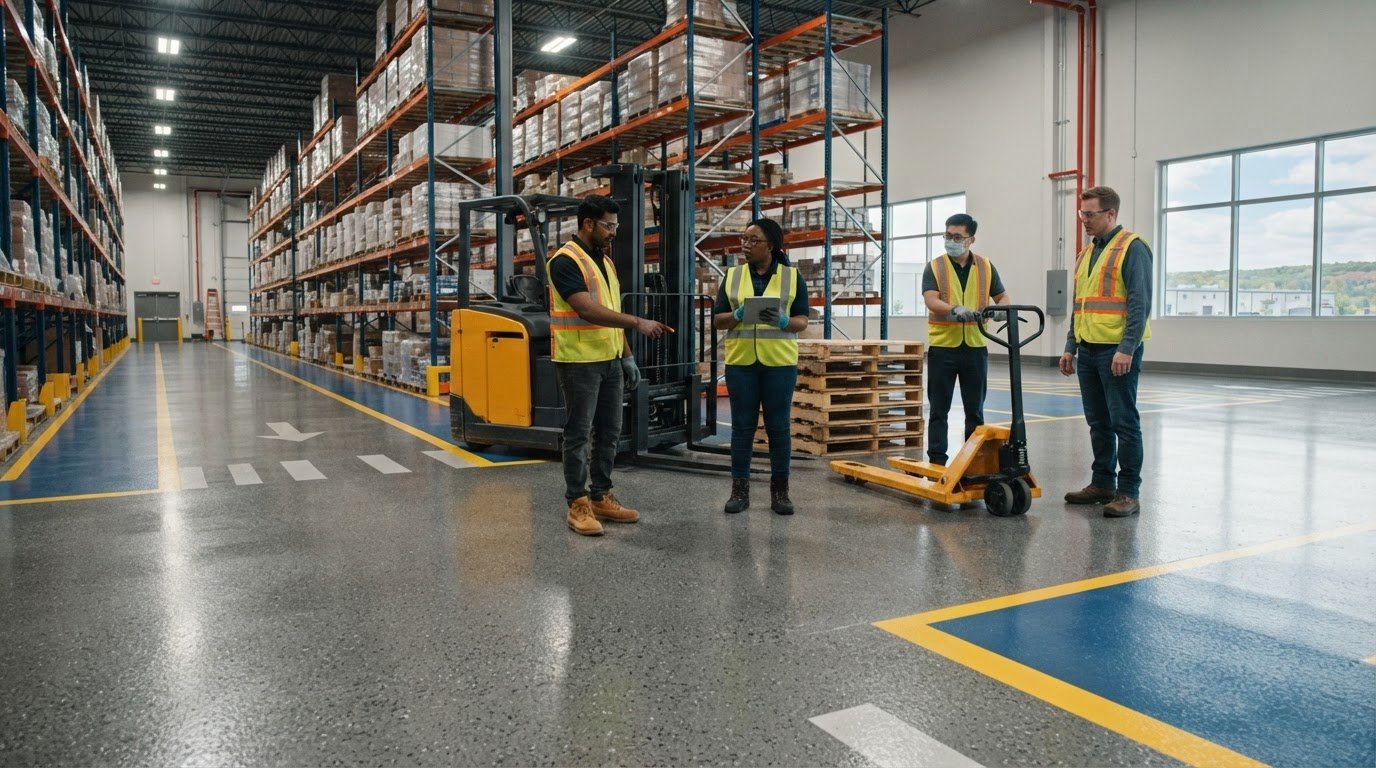
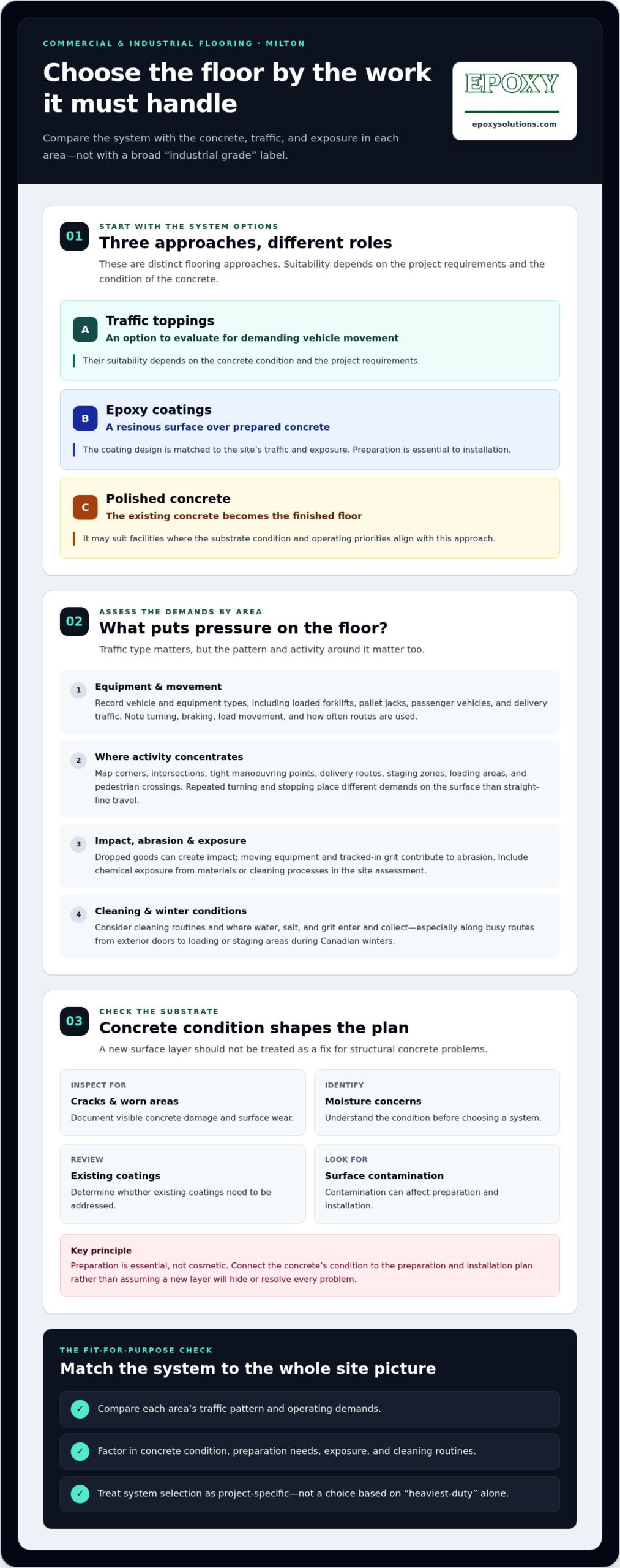
Heavy-traffic flooring is a system selected for the facility’s actual use conditions, not a label applied to a floor. Occasional passenger-vehicle use creates different demands from loaded forklifts, pallet jacks, or repeated delivery traffic. Vehicle weight matters, but so do turning, braking, load movement, and how often equipment follows the same route. A floor that handles straight-line travel faces different demands at corners and tight manoeuvring points where wheels repeatedly pivot or stop.
Which traffic patterns put the greatest demand on an industrial floor?
Start by identifying where pressure concentrates. Loaded forklifts and turning wheels repeatedly stress the surface at corners, intersections, and tight manoeuvring points. Map delivery routes, staging zones, loading areas, and pedestrian crossings. Each may have a different mix of equipment movement and foot traffic.
Separate the demands instead of treating them as one problem. Dropped goods create impact; moving equipment and tracked-in grit contribute to abrasion; pallet jacks and other equipment create rolling loads. Chemical exposure from materials or cleaning processes is another consideration. Not every area faces the same combination. For perspective, Vinyl Composition Tile (VCT) is one commercial flooring category associated with high-traffic settings, but that association alone doesn’t establish whether it suits a particular facility.
What should a Milton facility assess before comparing flooring systems?
Build a practical site record before comparing options. Note equipment types, operating hours, traffic routes, and where vehicles turn, stop, or load. Document the floor’s current condition too, including visible concrete cracks, worn areas, existing coatings, moisture concerns, and surface contamination that could affect preparation or installation.
Pay close attention to entrances. During Canadian winters, footwear and vehicle traffic can bring water, salt, and grit indoors. These materials add to cleaning demands and surface wear, particularly along busy routes from exterior doors to loading or staging areas. Record where they collect and how the space is used. Those details help match heavy traffic flooring solutions Milton facilities need to actual site conditions instead of assumptions about the whole building.
How Heavy-Traffic Flooring Systems Perform in Milton Facilities
Resinous flooring is a protective system installed over prepared concrete. It can include epoxy coatings and traffic toppings, but these are distinct approaches, not interchangeable names for one solution. The right system depends on the concrete, the traffic and exposure identified during assessment, and how accurately the project is designed and installed.
A durable flooring system still depends on sound concrete and proper preparation. A coating shouldn’t be treated as a fix for structural concrete problems. Cracks, moisture concerns, old coatings, or contamination may affect adhesion and change the work required before installation. Assessing these conditions helps define the project scope and identify a suitable system.
How concrete condition and preparation influence floor performance
Preparation is essential, not cosmetic. Existing coatings may need to be addressed, and surface contamination can interfere with installation. Cracks and moisture concerns also need to be understood before choosing a floor system. A project assessment should connect the concrete’s condition to the preparation and installation plan, rather than assume a new surface layer will hide or resolve every problem.
How traffic toppings, epoxy coatings, and polished concrete differ
Traffic toppings are an option to evaluate for areas with demanding vehicle movement. Their suitability depends on the concrete condition and project requirements. Epoxy coatings create a resinous surface over prepared concrete, with the design matched to site traffic and exposure. Polished concrete uses the existing concrete surface as the finished floor and may suit facilities whose substrate and operating priorities align with that approach.
System selection is project-specific. The GSA Facilities Standards (P100) offers a US public-building reference for facility design criteria, but it isn’t a substitute for requirements applicable to a Milton project. Comparing heavy traffic flooring solutions Milton facilities may use means weighing concrete condition alongside the demands each area actually faces.
Epoxy Solutions™ installs commercial and industrial flooring in Milton, selecting systems to suit each facility and its concrete. Learn about the commercial flooring installation approach by considering the conditions the floor must handle.
Compare Heavy-Traffic Flooring Solutions for Milton: Match the System to the Use
No single floor suits every facility. Epoxy coatings, traffic toppings, and polished concrete can address different operating demands. The right fit depends on the concrete, traffic patterns, exposure, and maintenance priorities. Use the comparison below as a starting point, then assess each area against its own conditions.
| Flooring approach | Potential applications | Substrate considerations | Traffic and maintenance priorities |
|---|---|---|---|
| Epoxy coatings | Commercial or industrial areas where a resinous surface is part of the project requirements. | Concrete condition, existing coatings, contamination, and preparation needs inform suitability. | Consider the type and frequency of traffic, site exposure, and the facility’s cleaning routine. |
| Traffic toppings | Areas to evaluate for concentrated vehicle or equipment movement, such as busy routes or work zones. | Assess the concrete and project conditions before selecting a system. | Focus on turning, braking, rolling loads, and the demands concentrated in that area. |
| Polished concrete | Facilities where the existing concrete can serve as the finished floor. | The condition and suitability of the concrete are central to this approach. | Compare the surface approach with the facility’s traffic and ongoing maintenance priorities. |
Choose the floor for the work it must support and the concrete it will rely on. This is more useful than ranking systems from “best” to “worst.” One facility may have different needs in a loading zone, production area, and pedestrian route, so don’t assume one approach must suit every space.
When should a Milton facility consider epoxy coatings or traffic toppings?
Consider epoxy coatings in relation to the project requirements and the condition of the prepared concrete. Where vehicle or equipment movement is concentrated, evaluate traffic toppings as a potential option. Compare the actual use and site exposure rather than relying on a general claim about a system’s strength or lifespan. Preparation and system design remain specific to the project.
Where can polished concrete fit in a heavy-use facility?
Polished concrete differs from an applied resinous system because the concrete itself becomes the finished floor. It may suit a facility when the slab’s condition and operating priorities support that choice. Before deciding, compare cleaning expectations, traffic demands, and the work needed to prepare the existing surface. For additional context, see the related polished concrete versus epoxy flooring cost guide.
For reference, the Resilient Tile Flooring Specifications address installation requirements for resilient tile, a different flooring category. To compare heavy traffic flooring solutions Milton facilities can use, explore commercial and industrial flooring options from Epoxy Solutions™.
Plan Heavy-Traffic Flooring Installation Around Milton Facility Operations
A sound installation plan accounts for the facility as well as the floor. Access restrictions, active traffic routes, staging space, and the order of work all affect how a project proceeds. The schedule and scope depend on site conditions and the selected flooring system, so downtime and reopening expectations need to be set for the specific project.
What belongs in a project-specific flooring plan?
Build the plan around how the facility operates and what the floor must handle. Record concrete condition, site exposure, traffic zones, and the requirements of the selected system. Then identify access constraints, staging areas, and operational activities that could overlap with the work. This gives the installation plan a clear connection to facility use without assuming a standard schedule.
A practical sequence keeps key decisions in order:
- Assess: Review the floor, facility layout, access, and operating conditions.
- Define use requirements: Map traffic zones and establish the demands each area must accommodate.
- Prepare: Plan the required substrate preparation and organize work areas and staging.
- Install: Sequence the work around access needs and agreed operational constraints.
- Review: Check the completed work against the project scope before the area returns to its intended use.
Depending on the layout, work may need to be sequenced by zone to coordinate access and movement. The appropriate approach, timing, and scope depend on the facility and chosen system.
How should traffic routes and safety markings be coordinated?
Map vehicle paths, pedestrian routes, crossings, loading zones, and designated work areas before finalizing installation plans. This reveals where routes intersect and where temporary access arrangements may be needed during the project. Once the floor plan is established, line marking can define routes and zones, while safety flooring can support movement in areas where it suits the selected system. These elements work best as part of one coordinated facility-flooring plan.
For related marking considerations, consult a durable epoxy floor striping guide alongside the site layout. Planning routes and markings together helps avoid treating them as an afterthought.
For a Milton facility, balance the concrete, traffic patterns, system requirements, and operational constraints. Explore a Milton commercial flooring project with Epoxy Solutions™ as part of your flooring plan.
Epoxy Solutions™ Heavy-Traffic Flooring in Milton: Move From Assessment to Installation
Heavy-traffic flooring should be selected around how your facility operates and what its concrete can support. Epoxy Solutions™ installs commercial and industrial flooring in Milton. Start with an assessment of traffic, substrate condition, and exposure, then shape the system and installation plan to the site.
What Epoxy Solutions™ can bring to a Milton flooring project
Epoxy coatings, traffic toppings, and polished concrete address flooring needs through different approaches. Selection depends on facility use, concrete condition, and operating requirements, rather than a one-size-fits-all specification. A review of the site helps connect each area’s demands to a suitable flooring system and installation scope.
Other elements can support the wider facility plan. Traffic toppings can be considered for demanding vehicle movement, while safety flooring may suit designated areas based on their use. Line marking can define routes and zones, coordinating the floor with how people and equipment move through the space. For broader system context, consult a high-performance epoxy guide as you compare project requirements and flooring approaches.
What to prepare before discussing a flooring project
Clear site information helps focus the assessment. Bring together details that show how the floor is used and what condition it’s in:
- Facility layout: Identify work areas, entrances, loading zones, and access constraints.
- Traffic information: Note equipment types, routes, turning points, crossings, and how frequently each area is used.
- Concrete condition: Record visible cracks, moisture concerns, previous coatings, contamination, and areas of premature wear.
- Operational requirements: Outline activities that need to continue and any sequencing considerations for the work.
This information supports a practical discussion about heavy traffic flooring solutions Milton facilities can match to their site conditions. It also helps bring flooring, safety features, and line marking into one coordinated plan, with scope and scheduling tied to the selected system and facility operations.
Ready to review your traffic patterns, substrate, and operating requirements? Discuss a heavy-traffic flooring project in Milton with Epoxy Solutions™.
Plan a Floor That Fits Your Facility
A durable commercial floor starts with the real demands of the site. Match the system to vehicle and pedestrian traffic, concrete condition, and facility exposure rather than choosing by a general durability label. Then plan preparation, access, work sequencing, and any line marking around how the space operates.
Epoxy Solutions™ installs commercial and industrial flooring in Milton, Toronto, Mississauga, Brampton, and Vaughan. Its work includes epoxy coatings, traffic toppings, and polished concrete, with systems selected to suit project conditions. A clear assessment is the practical first step toward choosing heavy traffic flooring solutions Milton facilities can use with confidence.
Share your traffic patterns, substrate concerns, and operational requirements to begin planning a fit-for-purpose floor. Discuss a heavy-traffic flooring project in Milton with Epoxy Solutions™.
Frequently Asked Questions
Which flooring is best for heavy forklift traffic in a Milton warehouse?
The best choice depends on forklift routes, turning and braking points, load movement, concrete condition, and facility exposure. Traffic toppings may be worth evaluating in areas with concentrated vehicle movement, while epoxy coatings or polished concrete may suit other areas depending on project requirements. Assess loading zones, staging areas, and intersections individually. A site-specific review helps match the system to how the warehouse operates instead of relying on a universal “best” floor.
Can epoxy flooring handle repeated vehicle and equipment traffic?
Epoxy flooring can be considered for repeated vehicle and equipment traffic when the system is designed for the facility’s conditions and installed over properly prepared concrete. Traffic intensity, turning, braking, rolling loads, chemical exposure, and substrate condition all matter. The word “epoxy” alone doesn’t define a floor’s suitability. For heavy traffic flooring solutions Milton facilities need, evaluate how each area is used and the project-specific system requirements before selecting a coating.
What is the difference between epoxy coatings and traffic toppings?
Epoxy coatings and traffic toppings are distinct flooring approaches, not interchangeable terms. Epoxy coatings form a resinous surface over prepared concrete, with the system selected according to site requirements. Traffic toppings are an option to assess for demanding traffic areas, including zones with concentrated vehicle or equipment movement. The appropriate choice depends on concrete condition, traffic patterns, exposure, and operating priorities. System design and installation requirements should be determined for the specific project.
How does concrete condition affect heavy-traffic flooring installation?
Concrete condition influences preparation, system suitability, and project scope. Cracks, moisture concerns, contamination, surface wear, and existing coatings can affect how the substrate must be addressed before installing a new floor. Assessment is essential; a coating shouldn’t be assumed to correct structural concrete problems. Documenting visible issues and previous coatings helps inform a project-specific plan and supports a more accurate comparison of flooring options.
How can a facility reduce disruption during industrial floor installation?
Plan installation around the facility’s access needs and active operations. Map vehicle routes, pedestrian crossings, loading areas, staging space, and the zones where work will take place. Sequencing work by area may help coordinate installation with facility use, depending on the site and selected system. Discuss operational constraints early and keep schedule expectations specific to the project. Avoid assuming a standard downtime or reopening period, since timing depends on the work required and flooring system.
Is polished concrete suitable for a busy commercial or industrial facility?
Polished concrete may suit a busy facility if the existing concrete and operating priorities support using the slab as the finished surface. Compare this approach with applied resinous flooring by considering substrate condition, traffic, exposure, cleaning routines, and the work needed to prepare the concrete. It isn’t automatically suitable for every heavy-use area. A site assessment helps determine whether polished concrete or another flooring approach better fits the facility’s requirements.
What factors affect the scope of a heavy-traffic flooring project in Milton?
Project scope depends on the facility layout, traffic and equipment patterns, concrete condition, existing coatings, contamination, moisture concerns, and exposure. Access, staging, work sequencing, and the need to coordinate traffic routes or line marking can also shape the plan. Epoxy Solutions™ installs commercial and industrial flooring in Milton, Toronto, Mississauga, Brampton, and Vaughan. Sharing site details helps guide an assessment tailored to the project.