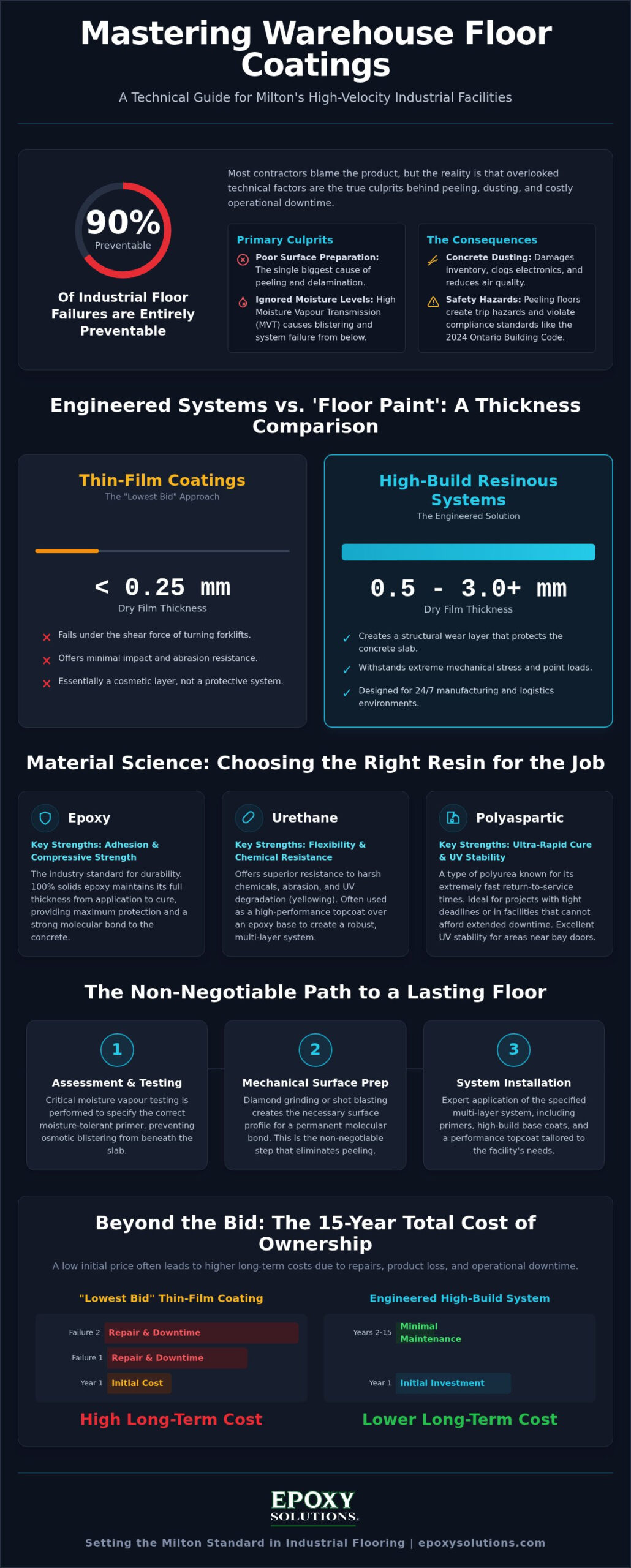
Ninety percent of industrial floor failures are entirely preventable. Most contractors blame the product, but the reality is that poor surface preparation and ignored moisture levels are the true culprits behind peeling surfaces and costly downtime. In a high-velocity logistics hub like Milton, your floor isn’t just a surface; it’s a critical piece of infrastructure that must withstand constant forklift traffic and strict safety regulations.
We understand the frustration of seeing a brand-new coating fail within months. It creates safety hazards, damages inventory through concrete dusting, and forces operations to a standstill. This 2026 guide is designed to help you master the technical requirements for warehouse floor coatings Milton facilities need to remain compliant with the 2024 Ontario Building Code. You’ll learn how to specify high-performance systems, including UV-resistant and chemical-resistant coatings, that prioritize long-term ROI over the lowest initial bid. We will cover everything from moisture vapour testing to the strategic use of polyaspartic topcoats for rapid return-to-service.
Key Takeaways
- Identify why standard concrete dusting compromises inventory and how engineered resinous systems solve this structural vulnerability.
- Compare high-build specifications to select the most resilient warehouse floor coatings Milton industrial sites need for heavy-duty forklift traffic.
- Learn why mil thickness and material science, rather than just initial price, determine the 15-year total cost of ownership for your facility.
- Discover the non-negotiable mechanical preparation standards that eliminate the risk of peeling and premature system failure.
- Ensure your facility meets the latest 2024 Ontario Building Code standards for impermeable flooring and industrial safety.
Why Standard Concrete Fails in Milton Warehouse Environments
Bare concrete is a liability. It’s a porous, friable material that naturally disintegrates under the friction of daily industrial operations. Professional warehouse floor coatings Milton facilities rely on are not simply “floor paint”; they are engineered resinous systems designed to transform a substrate into an industrial asset. These systems, frequently formulated with epoxy resins, create a molecular bond with the concrete to eliminate “dusting.” In Milton’s high-volume logistics centres, concrete dust is more than a nuisance. It is a contaminant that settles on high-value inventory, clogs sensitive electronics, and compromises the air quality for your entire workforce.
Cheap coatings are a trap. We often see facilities that prioritized the lowest bid only to suffer from widespread delamination and peeling within six months. In the Halton Region, extreme seasonal temperature fluctuations cause concrete slabs to expand and contract significantly. If your coating lacks the specific tensile strength and bond tenacity to move with the building, it will fail. The hidden costs of these failures include not just the price of a second installation, but the massive operational downtime required to grind away the failed material and start over from scratch.
The Mechanical Stress of Milton Logistics Hubs
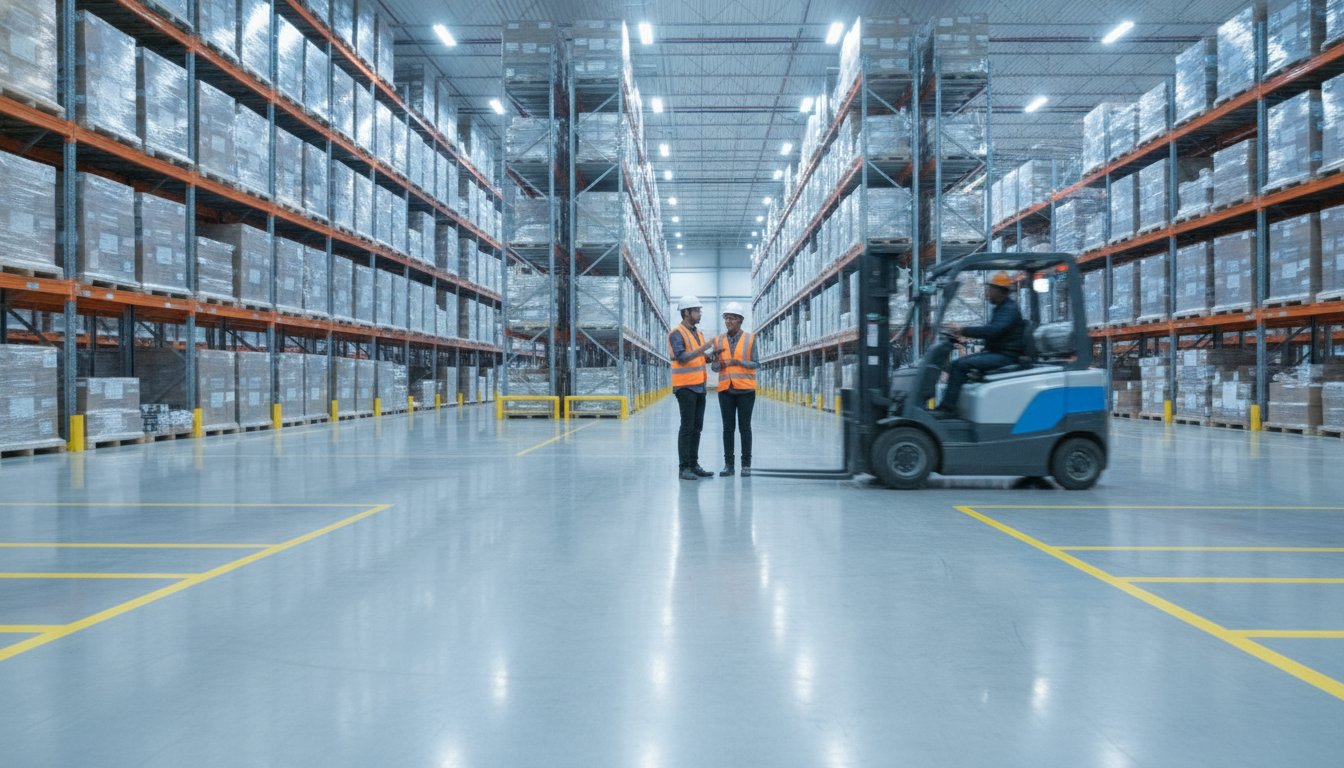
Milton’s industrial corridors house some of the busiest distribution centres in North America, making the choice of warehouse floor coatings Milton managers select a critical operational decision. These environments subject floors to immense mechanical stress that standard concrete cannot survive. High-reach forklifts and massive racking systems create concentrated point loads that lead to floor spalling and structural cracking. Shipping bays require exceptional impact resistance to handle the constant abuse of pallet dragging and heavy drops. We also account for the persistent vibration from industrial machinery, which can fatigue a low-quality coating until the bond eventually snaps.
Environmental Factors in Southern Ontario Facilities
Moisture is the primary cause of coating failure in older Milton slabs. Many facilities were constructed without modern vapour barriers, leading to high moisture vapour transmission (MVT). This upward pressure causes osmotic blistering in standard epoxies that haven’t been properly specified. We solve this by utilizing moisture-tolerant primers that anchor the system deep within the concrete pores. Additionally, warehouses with cold storage or those requiring aggressive wash-down protocols must utilize systems with high thermal shock resistance. For facilities with large bay doors, we integrate UV-resistant topcoats to prevent the yellowing and brittleness that natural light exposure causes over time.
Comparing Industrial Coating Systems: High-Build vs. Thin-Film
Industrial flooring is an engineered asset. Many Milton facility managers make the mistake of treating warehouse floor coatings Milton as a cosmetic finish rather than a structural requirement. A “coat of paint” or a thin-film sealer typically measures less than 0.25 millimetres in thickness; it will inevitably fail under the shear force of a turning forklift. High-build epoxy systems are high-performance resinous coatings typically specified at a thickness ranging from 0.5 mm to over 3.0 mm to provide a structural wear layer. These systems are non-negotiable for 24/7 manufacturing environments where downtime for floor repairs is not an option.
The material science behind your floor determines its survival. While epoxy provides the best adhesion and compressive strength, urethane offers superior flexibility and chemical resistance. Methyl Methacrylate (MMA) is often chosen for its ultra-fast cure times in cold environments, though it requires specialized ventilation. Choosing the wrong resin for your specific point loads or chemical exposure leads to delamination. If you’re unsure which system fits your operational load, our team can help you select a tailored flooring specification that prevents premature failure.
Epoxy Coating Specifications for Heavy Industry
100% solids epoxy is the industry standard for durability. Unlike solvent-based alternatives that lose volume as they dry, 100% solids systems maintain their full thickness from application to cure. For facilities requiring a perfectly flat surface for high-reach forklifts, self-levelling epoxies are essential. These systems create a seamless, glass-like finish that eliminates joint rattle and equipment wear. In high-traffic zones, we utilize multi-layer broadcast systems, incorporating aggregates to enhance slip resistance and impact durability. Following the National Safety Council guidelines on floor safety ensures these textured surfaces meet strict coefficient of friction standards to protect your staff.
Specialized Resinous Alternatives
Urethane mortars are the definitive answer for extreme environments. They excel in facilities facing thermal shock or aggressive chemical wash-downs that would cause standard epoxy to go brittle. For Milton projects with tight maintenance windows, polyaspartic coatings allow for a rapid return-to-service, often curing in as little as 24 hours. However, not every square foot of a warehouse needs a heavy-duty resin. In low-traffic storage areas, comparing polished concrete vs epoxy flooring cost can reveal significant savings while still maintaining a dust-free environment. The key is matching the material’s specific performance profile to the localized stress of each zone.
Selecting the Right Coating for Your Milton Facility Use Case
Generic specifications lead to specific failures. A one-size-fits-all approach to warehouse floor coatings Milton facilities often attempt is a primary driver of premature delamination. You must zone your facility based on localized mechanical and chemical loads. Loading docks, for instance, require extreme impact resistance and aggressive texture to handle wet tires and heavy pallet drops. Conversely, production lines might prioritize ease of cleaning and chemical resistance over raw impact strength. We engineer each zone to meet its specific operational demand, ensuring you aren’t over-specifying low-traffic areas or under-specifying critical thoroughfares.
Compliance is a legal necessity for Milton’s expanding food-grade and pharmaceutical sectors. The 2024 Ontario Building Code (O.Reg. 163/24) mandates that floors in areas designated for the storage of dangerous goods must be constructed from impermeable materials. Our high-performance resinous systems create a seamless, non-porous barrier that prevents chemical absorption and bacterial growth. Beyond the slab itself, facility organization is a core component of industrial safety. Integrating durable epoxy floor striping directly into the coating system creates permanent, high-visibility aisle markers that won’t peel or lift like floor tape under heavy traffic.
Anti-Static and Chemical Resistant Requirements
Precision manufacturing requires precision flooring. If your Milton operation involves sensitive electronics or volatile chemicals, you need anti-static flooring for critical environments to safely dissipate electrostatic charges. For hazardous material storage, we specify systems designed to withstand aggressive acids, alkalis, and industrial solvents. These installations often include secondary containment linings, providing a critical safety net that protects the environment and ensures your facility remains in total regulatory compliance.
Safety and Slip Resistance Standards
Slips and falls represent a significant preventable cost in industrial settings. We customize the coefficient of friction (COF) for every zone within your facility, ensuring that wet loading bays have significantly more grit than dry assembly areas. High-visibility safety yellow markings are incorporated into the coating to clearly define pedestrian walkways and forklift lanes. Additionally, we utilize high-gloss, light-reflective finishes that can reduce energy costs by maximizing the effectiveness of your existing overhead lighting, which simultaneously improves visibility and worker safety.
The Installation Reality: Why Surface Prep is Non-Negotiable
Preparation is the most critical phase of any installation. It’s also where most contractors cut corners to save time. The blunt truth is that 90% of industrial floor failures stem from poor surface preparation or ignored moisture issues. Without a mechanical bond, the warehouse floor coatings Milton facility managers invest in will inevitably fail under the shear stress of a turning forklift. We don’t rely on chemical adhesion alone; we engineer a physical bond between the resin and the substrate.
Mechanical preparation methods like shot-blasting and diamond grinding are the only acceptable ways to prepare an industrial slab. Acid etching is a residential tactic that has no place in a heavy-duty warehouse. Shot-blasting uses high-velocity steel shot to strip away laitance and expose the aggregate. Diamond grinding creates a flatter, smoother profile that is ideal for high-build systems where precision and flatness are paramount. Testing ensures the warehouse floor coatings Milton industrial sites require actually achieve the intended bond tenacity.
We never apply resin until the slab is thoroughly tested. Moisture vapour transmission (MVT) testing is mandatory in Southern Ontario’s climate to prevent osmotic blistering. We also identify deep-seated contaminants like oils or previous sealers that act as bond-breakers. In active Milton warehouses, we utilize industrial vacuum systems to manage dust and debris. This keeps your inventory clean and ensures the work area remains safe for your staff during the installation process.
Achieving the Correct Concrete Surface Profile (CSP)
CSP is a standardized scale from 1 to 9 that dictates the required roughness of the concrete. Matching the preparation method to your specific industrial flooring specifications is the difference between a floor that lasts five years and one that lasts fifteen. A high-build system requires a more aggressive profile than a thin-film sealer. Before the primer hits the floor, we repair all cracks and spalled joints to create a truly seamless finish that can withstand heavy point loads.
Professional Application and Curing Phases
Climate control is a non-negotiable requirement during the application phase. We monitor temperature and humidity levels to ensure the resin cures according to the manufacturer’s precise chemical timeline. The process follows a strict sequence: a moisture-tolerant primer, a high-build base coat, and a high-wear topcoat. You must also respect “Return to Service” timelines. While a floor might be ready for foot traffic in 24 hours, heavy forklift traffic typically requires 48 to 72 hours to prevent permanent indentation or marking of the fresh surface.
If you’re tired of floors that peel and want an installation that lasts, book a technical site assessment with our team today.
Epoxy Solutions™: Setting the Milton Standard Since 1981
Results matter most. Since 1981, Epoxy Solutions™ has specialized in high-performance specifications for industrial facilities that cannot afford to fail. We understand that Milton facility managers face immense pressure to maintain safety and throughput in a high-velocity logistics environment. While many contractors compete on the lowest initial price, we compete on the lowest 15-year total cost of ownership. Our legacy of installing high-performance epoxy across North America provides us with a depth of experience that local startups simply cannot match. We don’t just sell a floor; we provide a standard-setting engineered system tailored to the specific mechanical loads and chemical exposures of your operation.
Local expertise is our foundation. We possess the mobilization capacity to handle large-scale industrial projects across the GTA while maintaining a meticulous focus on the specific needs of Milton warehouse owners. We don’t believe in generic “office-speak” or fluff. Our team provides a grounded, matter-of-fact delivery that prioritizes technical accuracy over salesmanship. When you choose us, you’re partnering with a seasoned industry veteran that has seen every possible substrate challenge and possesses the specific expertise to resolve it.
Proven Results in Challenging Environments
We are the authoritative expert fixers. Often, we are called into local sites to remediate warehouse floor coatings Milton businesses had installed by inexperienced crews who ignored moisture levels or surface profile requirements. Whether it’s widespread delamination in a manufacturing plant or dusting concrete in a high-traffic logistics centre, we step in when others have failed. Our commitment to technical accuracy ensures that every joint repair and resin application is executed to the highest industry standards, preventing the recurring downtime that plagues facilities with sub-standard flooring.
Start Your Milton Facility Consultation
Securing your facility’s future begins with an accurate assessment. We don’t guess; we test. Every project starts with a professional site assessment, including comprehensive moisture vapour transmission testing and a review of your operational point loads. This data allows us to develop a bespoke flooring specification that meets your unique needs and ensures total compliance with the 2024 Ontario Building Code. Don’t settle for a cheap coating that will peel under the first forklift load. Contact Epoxy Solutions™ today to schedule your technical site assessment and secure a floor that performs as hard as your business does.
Future-Proof Your Industrial Flooring Investment
An industrial floor is only as reliable as the technical specification behind it. We’ve detailed why standard concrete dusting is a liability and why high-build resinous systems are the only viable solution for high-velocity logistics. Success requires more than just premium materials; it demands meticulous mechanical preparation and a deep understanding of the 2024 Ontario Building Code. Settling for a cheap, thin-film coating is a guaranteed path to delamination and repeated operational downtime.
Your facility deserves an engineered surface that stands up to heavy point loads and aggressive chemical exposure. With over 40 years of industrial experience, Epoxy Solutions™ specializes in the high-load environments that define Milton’s logistics centres. Our local GTA presence ensures rapid response times and mobilization for projects of any scale. It’s time to move past temporary fixes and invest in a standard-setting floor that supports your long-term growth.
Request a Professional Site Assessment for Your Milton Facility to ensure your warehouse floor coatings Milton project meets every benchmark for safety and durability. We’re ready to help you secure your facility’s operational future.
Frequently Asked Questions
How long does it take to install warehouse floor coatings in Milton?
Most standard industrial installations require three to five days to complete. This timeline includes mechanical surface preparation, primer application, base coats, and the final high-wear topcoat. While fast-curing polyaspartic systems can allow for a rapid return-to-service in approximately 24 to 48 hours, high-build epoxy systems for heavy logistics require a full 72-hour cure period before they can support heavy forklift traffic without risk of permanent marking or indentation.
Can epoxy floor coatings withstand heavy forklift traffic and pallet jacks?
High-performance resinous systems are specifically engineered to withstand the shear force and point loads of heavy forklifts. Success depends entirely on the mil thickness and the compressive strength of the resin. A thin-film sealer will fail under these loads; however, a high-build 100% solids epoxy system creates a structural wear layer that resists the constant abrasion of pallet jacks and high-reach equipment in busy distribution centres.
What is the difference between commercial epoxy and industrial-grade coatings?
Commercial coatings often prioritize aesthetics and cost, typically utilizing water-based or solvent-based resins with low solids content. Industrial-grade coatings focus on technical performance and durability. These systems use 100% solids epoxy and specialized aggregates to handle extreme mechanical stress, chemical exposure, and heavy impacts. In a Milton logistics environment, industrial specifications are required to ensure the floor doesn’t delaminate under the pressure of 24/7 warehouse operations.
How do I maintain my warehouse floor coating to ensure it lasts 10+ years?
Longevity is achieved through consistent mechanical sweeping and mopping with pH-neutral cleaners. It’s critical to avoid aggressive solvent-based cleaners that can dull or soften the topcoat over time. You should also address spills immediately to prevent chemical staining and inspect high-traffic thoroughfares for physical damage. Periodic re-coating of the sacrificial topcoat every five to seven years can extend the life of the primary base system well beyond a decade.
Are warehouse floor coatings in Milton compliant with CFIA or health standards?
Professional warehouse floor coatings Milton facilities utilize are fully compliant with CFIA and health standards because they are non-porous and seamless. These systems eliminate grout lines and cracks where bacteria and contaminants can accumulate. By creating an impermeable barrier, our resinous floors meet the 2024 Ontario Building Code requirements for chemical resistance and hygiene, making them ideal for pharmaceutical storage and food-grade manufacturing environments in the Halton Region.
Can you apply new epoxy over an existing, peeling floor coating?
Applying new resin over a failing surface is a guaranteed recipe for a second failure. We don’t recommend over-coating peeling material because the new system is only as strong as the bond of the layer beneath it. The failed coating must be mechanically removed through shot-blasting or diamond grinding to expose a fresh concrete surface profile. This ensures the new industrial coating can achieve the molecular bond required for long-term performance.
What is the typical cost per square foot for industrial warehouse flooring in the GTA?
Pricing for industrial systems in the GTA varies significantly based on the condition of the concrete and the required performance specifications. High-build systems generally require a larger investment than simple thin-film sealers due to the volume of resin and the intensity of mechanical preparation required. Factors such as moisture vapour transmission levels, the need for chemical resistance, and specific anti-static requirements will all influence the total project cost for a professional installation.
Do warehouse floor coatings help with concrete dusting and inventory cleanliness?
Resinous coatings solve the problem of concrete dusting by sealing the porous substrate and creating a hard, non-friable surface. Standard concrete naturally disintegrates under friction, releasing fine particles that settle on inventory and sensitive electronics. By installing a high-performance warehouse floor coatings Milton system, you eliminate this source of contamination. This results in a cleaner facility, reduced maintenance costs, and better protection for high-value goods stored within your warehouse.