
The cheapest quote you receive for your facility floor is almost certainly the most expensive one you’ll ever pay for. In the industrial sector, a low-ball estimate usually signals a failure to properly organize substrate preparation, leading to peeling surfaces and costly operational downtime. Understanding the true polished concrete cost in Brampton requires looking beyond the initial sticker price to the technical rigour required for heavy machinery and constant foot traffic. We’ve seen countless facilities forced to strip and redo floors because the initial installation lacked the necessary industrial-grade standards.
It’s frustrating to budget for large-scale facilities when local pricing feels like a moving target. This guide provides the definitive 2026 breakdown of costs, specifically designed for managers overseeing 20,000 square feet or more. We’ll move past the vague industry averages to examine the real-world ROI of premium finishes versus resinous coatings. You’ll gain a clear framework for understanding why quotes vary so widely between contractors and how to identify a partner capable of meeting high-performance specifications without the fluff.
Key Takeaways
- Determine the primary variables influencing polished concrete cost Brampton, from the initial substrate condition to the specific number of diamond grinding passes required for industrial durability.
- Differentiate between a simple topical seal and true mechanical polishing to ensure your facility floor withstands heavy machinery and high-traffic conditions.
- Identify hidden cost drivers such as joint stabilization and moisture vapour emission rates (MVER) that are essential for preventing peeling and long-term structural failures.
- Compare the 10-year maintenance ROI of polished concrete against high-performance resinous coatings to select the most cost-effective solution for your specific environment.
- Utilize a professional framework to evaluate industrial flooring specifications in contractor quotes, prioritizing long-term safety and performance over the lowest initial bid.
The Reality of Polished Concrete Costs in Brampton
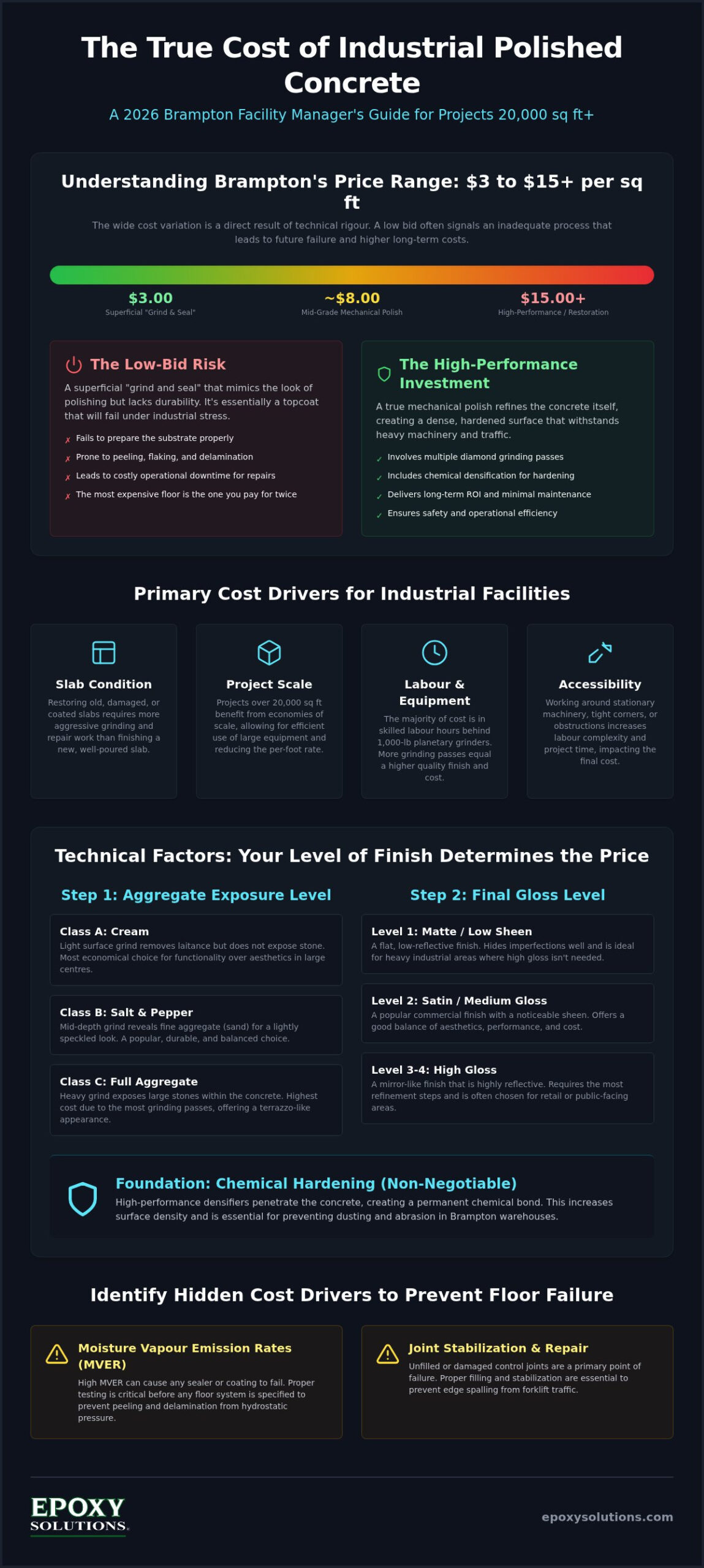
Price ranges deceive. In the Brampton industrial market, quotes for commercial flooring vary wildly, often landing anywhere between $3 and $15 per square foot. This discrepancy isn’t random. It’s the direct result of the technical gap between a superficial grind and seal and a true, high-performance mechanical finish. While a basic seal might look acceptable on day one, it won’t survive the shear forces of heavy forklift traffic or pallet jack dragging. To understand the actual polished concrete cost Brampton facility managers face, you have to look at the technical rigour of the process. Truly understanding what polished concrete is involves recognizing the mechanical refinement of the slab itself rather than just applying a plastic-like topcoat that will eventually flake and fail.
Brampton’s unique logistics also play a role. As a central hub for North American shipping, the local demand for high-grade industrial flooring is intense. This creates a competitive market for skilled labour and specialized diamond tooling. For large-scale operations, the economy of scale is your greatest ally. Smaller projects often carry a premium price per foot because mobilization and setup costs remain constant regardless of the area size. We focus on the industrial sector because that’s where the value of a high-performance floor is truly realized.
Base Rates vs. Total Project Investment
Labour drives costs. In a professional industrial quote, the majority of your investment goes toward the hours spent behind a 1,000-pound planetary grinder. Materials like densifiers and sealers are secondary to the craftsmanship of the diamond passes. We’ve found that 20,000 square feet represents the sweet spot for pricing. At this scale, crews can maximize the efficiency of large-scale equipment, reducing the per-foot rate significantly compared to smaller retail footprints. Accessibility also matters. If our teams have to navigate tight corners or work around stationary machinery, the labour hours climb, and the price reflects that complexity.
New Concrete vs. Existing Slab Restoration
Old slabs cost more. Restoring a 30-year-old warehouse floor requires aggressive grinding to remove decades of oils, adhesives, or failing coatings. Don’t assume new concrete is a blank canvas that saves you money. Fresh pours often require significant initial grinding to achieve the flatness required for a high-gloss finish. If the initial pour was poorly finished, we have to spend more time levelling the substrate before the actual polishing begins. Budgeting for polished concrete cost Brampton must include a thorough assessment of the existing slab’s integrity to avoid surprises during the grinding phase.
Technical Factors: Defining Your Level of Finish
Precision defines price. In the industrial sector, “polished” is not a single setting on a machine. It is a spectrum of mechanical refinements. The polished concrete cost Brampton facility owners pay is directly tied to two technical variables: the depth of the aggregate exposure and the final gloss level. Each step up in these categories requires additional diamond-grinding passes, specialized tooling, and increased labour hours. If you’re unsure which specification fits your operational needs, reviewing our industrial flooring specifications can help clarify the technical requirements for your site.
Beyond the mechanical grinding, chemical hardening is a non-negotiable component of a professional installation. We use high-performance densifiers to penetrate the concrete pores, creating a permanent chemical bond that increases surface density. This process is essential for resisting the “dusting” common in untreated Brampton warehouses. While aesthetic additions like solvent-based dyes or decorative stains can add $1 to $3 per square foot to your budget, the core value of the floor remains its structural hardening and mechanical finish.
Aggregate Exposure Levels
The depth of the initial grind determines how much of the internal stone is visible. We categorize these into three distinct classes:
- Class A (Cream): This is the most economical choice. We perform a light grind to remove the surface “laitance” without exposing the underlying stone. It’s ideal for massive distribution centres where functionality outranks aesthetics.
- Class B (Salt and Pepper): A mid-depth grind that reveals fine aggregate and sand. This level offers a sophisticated, speckled look often preferred in Brampton retail environments or light manufacturing zones.
- Class C (Large Aggregate): The deepest grind possible. We remove the top 2-3mm of the slab to expose large stones. This requires significant labour and creates a premium, terrazzo-like appearance for high-end showrooms.
Gloss and Light Reflectivity (GU)
Gloss levels are measured by light reflectivity, known as Gloss Units (GU). Achieving a higher gloss isn’t about applying a shiny wax; it’s about using progressively finer resin-bond diamonds to “close” the surface of the concrete.
- Level 1 (Matte): Finished with 100-grit diamonds. This level provides a flat look with zero light reflection. It’s rugged, hides imperfections well, and is perfect for heavy manufacturing.
- Level 2 (Satin): Finished with 400-grit diamonds. You’ll see a dull matte appearance with a slight overhead light reflection. It’s the standard for professional workspaces.
- Level 3 & 4 (High Gloss): These levels require 800 to 3,000-grit diamonds. The result is a mirror-like finish that dramatically increases ambient light reflectivity, which can lower energy costs by reducing the need for overhead lighting in large facilities.
Hidden Cost Drivers: What Most Contractors Miss
Surface aesthetics are deceptive. While a quote might look clean on paper, the underlying condition of the slab dictates the final polished concrete cost Brampton facility managers actually pay. Contractors often overlook the structural integrity of joints and the moisture profile of the slab. Ignoring these factors doesn’t just lower the initial bid; it guarantees a floor failure within two years. We’ve seen hundreds of projects where the “cheapest” contractor skipped the essential prep work, leaving the client with a dusting, delaminating mess that cost double to fix later.
High-traffic facilities require joint stabilization. Without it, heavy forklift wheels will spall the concrete edges, leading to crumbling joints that no amount of polishing can fix. Similarly, Moisture Vapour Emission Rates (MVER) must be tested. If moisture levels are too high, the polishing process is compromised. This requires specialized treatments that less experienced contractors fail to mention until the project is already underway. Brampton’s industrial zones also feature “soft” concrete slabs in certain older developments. These porous surfaces absorb densifiers quickly, often requiring double the material volume to achieve a hardened, industrial-grade finish.
Labour drives the budget. While large planetary grinders handle the majority of the floor, corners and perimeters require manual hand-grinding. This “edge work” is a major cost driver. If your facility has a complex layout with numerous pillars, doorways, or stationary equipment, the manual labour hours will climb. A transparent quote must account for these technical realities from the start.
Substrate Repair and Patching
Fix the foundation first. We utilize colour-matched polyurea to perform “invisible” repairs on spalled joints and deep cracks. These aren’t just cosmetic fixes. They provide the structural support needed to prevent further slab movement under heavy loads. If a contractor suggests polishing over existing defects without a dedicated repair plan, they’re ignoring the physics of the floor. Budgeting for polished concrete cost Brampton must include a contingency for these repairs to ensure long-term durability.
Logistical Constraints in Brampton Facilities
Production cannot stop. Operating in an active facility often necessitates night or weekend shifts to minimize operational downtime. These labour premiums are a reality of industrial work. Additionally, heavy-duty grinding equipment requires 480V 3-phase power. If your facility isn’t equipped, we must mobilize industrial generators, which adds to the logistical cost. Proper dust containment is also mandatory. We use high-performance HEPA filtration systems to protect your sensitive inventory and equipment from concrete particulates, ensuring a clean and safe environment throughout the installation.
Comparing ROI: Polished Concrete vs. Resinous Coatings
Initial installation is only the first chapter of your facility’s financial story. To truly calculate the polished concrete cost Brampton managers must evaluate over a decade, you have to look at the Total Cost of Ownership (TCO). While resinous coatings offer superior protection against aggressive chemicals, polished concrete often wins the long-term ROI battle in standard warehousing and retail environments. The decision often hinges on the specific environmental stressors of your site. If your facility handles high-concentration acids or heavy oils, you should analyze the polished concrete vs epoxy flooring cost to determine which system prevents premature substrate failure.
High-gloss finishes aren’t just for show. In massive Brampton distribution centres, the light reflectivity of a Level 3 or 4 polish can reduce the number of required light fixtures or lower the wattage needed to maintain safe foot-candle levels on the floor. This energy efficiency, combined with the reuse of the existing slab, makes polished concrete a standard-setting choice for LEED-certified industrial projects. It eliminates the need for new material manufacturing and reduces the carbon footprint associated with floor replacements.
Maintenance Requirements and Lifecycle
Ditch the wax. The primary financial advantage of polished concrete is the “no-wax” lifecycle. Unlike VCT or basic concrete seals, a mechanically polished floor doesn’t require stripping and re-coating every few years. Daily maintenance is limited to a simple sweep and an auto-scrub with clean water and a pH-neutral cleaner. While you might invest in periodic high-speed burnishing to maintain the gloss in high-traffic aisles, the polished concrete cost Brampton facilities incur for upkeep is a fraction of the labour required for resinous or tiled systems. This predictable maintenance schedule allows for more accurate long-term budgeting.
Environmental and Safety Considerations
Safety is non-negotiable. Despite their mirror-like appearance, high-gloss polished floors meet or exceed Canadian safety standards for slip resistance when kept clean and dry. During the installation, the process is virtually VOC-free, meaning your facility doesn’t have to worry about toxic fumes affecting air quality or requiring specialized ventilation. In our Canadian climate, the thermal mass of the concrete slab also helps regulate indoor temperatures, absorbing heat during the day and releasing it slowly at night. If you’re looking to optimize your facility’s performance while maintaining strict safety benchmarks, our team can provide a tailored technical assessment for your next project.
Selecting a Brampton Contractor: The Epoxy Solutions™ Standard
Experience dictates results. When evaluating the polished concrete cost Brampton contractors provide, you aren’t just buying a service; you’re investing in a legacy of technical accuracy. Epoxy Solutions™ has operated across North America since 1981, specializing in high-performance environments that demand long-term durability. We don’t offer generic retail finishes. We engineer floors designed to withstand extreme loads and constant industrial wear. Our team has performed under pressure in diverse environments, from high-traffic distribution centres to specialized manufacturing plants, proving universal competence in surface preparation.
Every project begins with a blunt, problem-first assessment. We identify existing slab failures, moisture risks, and structural weaknesses before any equipment enters the site. This approach ensures that the final quote reflects the actual requirements for a standard-setting floor rather than a superficial estimate that will inevitably lead to change orders. Understanding industrial flooring specifications is critical for any facility manager. A quote that lacks technical depth regarding grit sequences or densification rates is a red flag for future delamination and surface failure.
Questions to Ask Your Concrete Polisher
Technical transparency is mandatory. A professional contractor should provide concrete data points during the bidding phase to ensure they understand the specific needs of your facility. We recommend demanding clarity on these three points before signing any contract:
- Request the specific Mohs hardness test results for your current slab to determine the necessary diamond bond for effective grinding.
- Verify the dust collection protocols used to protect sensitive inventory and equipment from concrete particulates during the polishing process.
- Demand a specific gloss meter reading guarantee to ensure the finished product meets your required light reflectivity and safety standards.
The Epoxy Solutions™ Advantage
Fixing failed floors is our specialty. We’ve built our reputation by stepping in when other contractors have cut corners on surface preparation or material quality. Our focus remains on the long-term performance and safety of your facility. We don’t compete on the lowest bid because we prioritize the technical rigour required to prevent operational downtime and premature floor replacement. We take pride in craftsmanship that stands up to the most demanding conditions.
Our communication is direct and grounded in over 45 years of global expertise. We provide tailored solutions that align with your specific environmental stressors, whether you’re managing a 20,000-square-foot distribution centre or a high-traffic manufacturing plant. You receive authoritative guidance from a partner who has seen every possible challenge and possesses the specialized equipment to resolve it. We set the benchmark for the industry, ensuring your investment in polished concrete cost Brampton delivers a floor that performs for decades.
Secure Your Facility’s Industrial Future
The lowest bid is usually a liability. Calculating the true polished concrete cost Brampton facility managers face requires shifting from viewing flooring as a line-item expense to treating it as a long-term operational asset. We’ve established that technical variables like aggregate exposure and gloss levels dictate the initial investment; however, it’s the standard-setting surface preparation that ensures your floor survives industrial wear. Ignoring joint stabilization or moisture testing only guarantees costly downtime and repair bills later.
Since 1981, Epoxy Solutions™ has specialized in high-performance industrial specifications across North America. We are authoritative experts in concrete restoration, frequently stepping in when previous installations have failed to meet the rigours of heavy manufacturing. Don’t settle for a superficial finish that will peel or dust within months. Your facility deserves a floor that performs as hard as your team does every day.
Get a Professional Quote for Your Brampton Facility
Frequently Asked Questions
How much does polished concrete cost per square foot in Brampton for 2026?
Rates vary based on the technical specification and the total square footage of your facility. Larger industrial spaces in the GTA benefit from economies of scale, where the per-foot rate decreases as the project size increases. Factors such as the number of diamond passes and the condition of the substrate are the primary drivers. Commercial polished concrete cost Brampton estimates are tailored to the heavy-duty requirements of logistics hubs rather than residential standards.
Is polished concrete cheaper than epoxy flooring for industrial use?
Polished concrete often has a lower lifecycle cost but may have a similar initial investment to certain resinous systems. Epoxy flooring provides superior chemical resistance for specialized environments, whereas polished concrete excels in high-traffic distribution zones. The “cheapest” option often fails to account for long-term maintenance. We evaluate your facility’s specific environmental stressors to determine which system offers the best ROI over a 10-year period for your specific operation.
Does the age of my warehouse concrete slab affect the polishing cost?
Yes, older slabs usually require more aggressive grinding and extensive substrate repair. A 30-year-old warehouse floor in Brampton often harbours decades of oil penetration or failing previous coatings that must be removed. These issues necessitate additional labour hours for restoration. Even new slabs require mechanical refinement to achieve a level finish, but the lack of existing damage typically streamlines the preparation phase compared to aging industrial substrates.
How long does the concrete polishing process take for a 10,000 sq. ft. facility?
A typical 10,000-square-foot project requires approximately five to seven business days to complete. This timeline depends on the desired gloss level and the amount of manual edge work involved. We organize our crews to minimize operational downtime, often working in phases to keep your facility functional. Complex layouts with stationary machinery or extensive joint repair requirements can extend this duration, so efficient mobilization is key to meeting tight schedules.
Are there hidden costs in concrete polishing that I should budget for?
Budget for joint stabilization, moisture testing, and perimeter hand-grinding. Many facility managers overlook the cost of repairing spalled joints or addressing high moisture vapour emission rates (MVER). These technical steps are mandatory for a durable floor. Additionally, if your facility lacks 480V 3-phase power, you must account for industrial generator rentals. Transparent quotes should always include these logistical and structural realities upfront to avoid surprises during the installation.
Can you polish concrete that has been previously coated with epoxy?
Yes, but the existing epoxy must be mechanically removed before the polishing process begins. This involve aggressive diamond grinding to strip the old resin and reach the virgin concrete substrate. It’s a standard restoration procedure for our teams. The removal process adds labour hours and tooling wear, which will be reflected in the total polished concrete cost Brampton facility owners receive during the technical bidding phase.
What is the most cost-effective gloss level for a Brampton distribution centre?
A Level 2 (Satin) finish provides the best balance of durability and light reflectivity for distribution centres. This level requires fewer resin-bond diamond passes than a high-gloss mirror finish, which reduces labour costs. It effectively hides minor slab imperfections while still improving ambient light levels. For heavy-duty logistics hubs, a satin finish offers a professional appearance without the premium price tag associated with Level 4 high-gloss refinement.
Does polished concrete require a lot of maintenance in a high-traffic environment?
Polished concrete is one of the lowest-maintenance industrial flooring options available. It eliminates the need for stripping, waxing, or re-coating. Daily maintenance simply involves using an auto-scrubber with clean water and a pH-neutral cleaner. While high-traffic aisles may require periodic high-speed burnishing to restore their original sheen, the overall labour requirement is significantly lower than that of tile or basic sealed concrete systems, saving you money annually.