

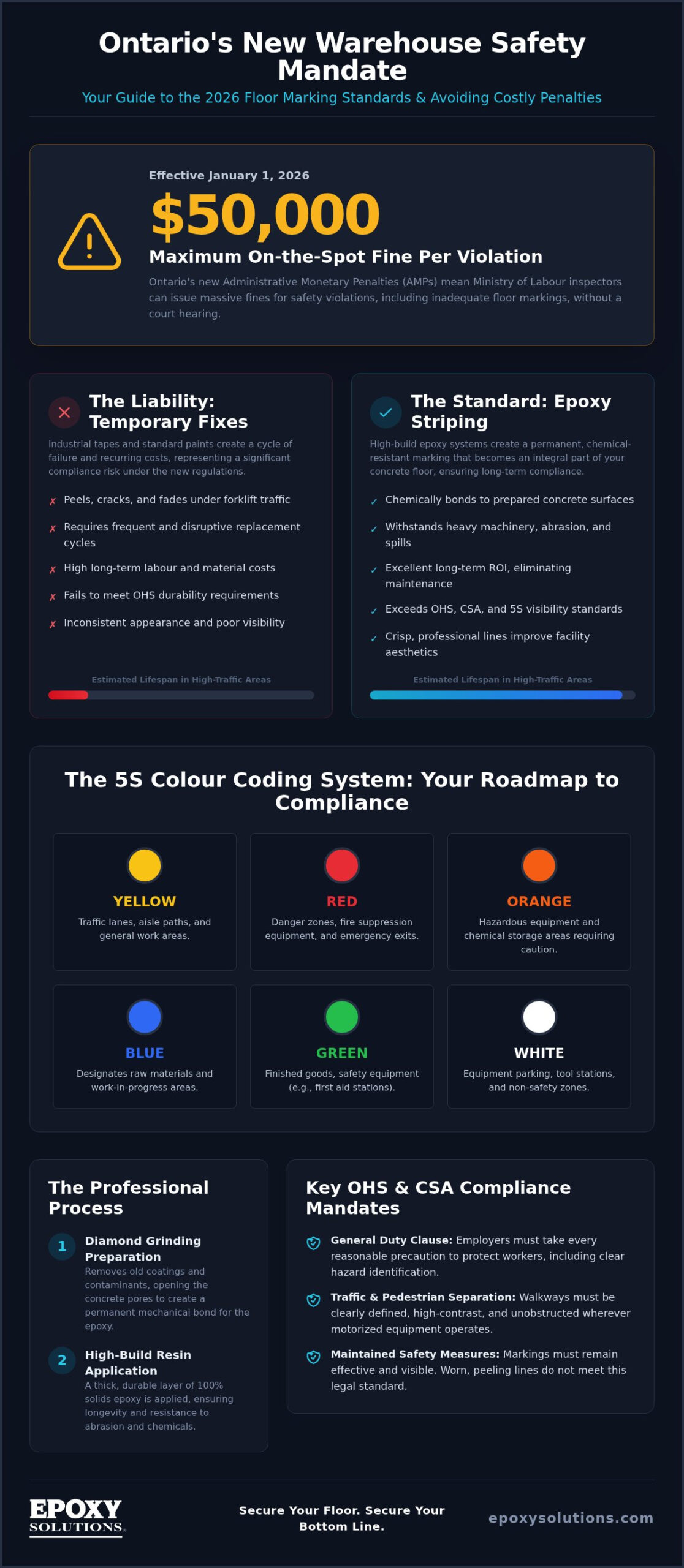
As of January 1, 2026, a single safety oversight in your Ontario facility can trigger an on-the-spot fine of up to $50,000 without a single court hearing. These new Administrative Monetary Penalties mean that “good enough” floor markings are now a massive financial liability. You’ve likely experienced the frustration of heavy-duty tape peeling under forklift traffic or inconsistent colour coding that leads to dangerous near-misses. It is an exhausting cycle of temporary fixes that fail to meet the rigorous expectations of OHS inspectors and the demands of high-volume operations.
Facility managers need reliability, not excuses. This guide provides the technical roadmap to master the warehouse floor striping standards Canada mandates for 2026. You will discover why permanent epoxy striping is the definitive benchmark for facility compliance and operational flow. We will examine the latest CSA S345 and A344 updates, 5S colour protocols for GTA distribution hubs, and the engineering required to eliminate maintenance cycles. It is time to replace temporary fixes with high-performance standards that secure your floor and your bottom line.
Key Takeaways
- Prepare for Ontario’s new Administrative Monetary Penalties by identifying the specific safety gaps that lead to immediate on-the-spot fines of up to $50,000.
- Understand how the warehouse floor striping standards Canada enforces in 2026 impact your facility’s legal standing and overall operational safety.
- Standardize your facility layout using the 5S colour system to create clear, high-contrast separation between pedestrians and heavy machinery.
- Evaluate the long-term ROI of permanent epoxy systems compared to the frequent failure and recurring replacement costs of industrial floor tapes.
- Learn why professional diamond grinding and high-build resin application are essential for achieving the precision required by modern OHS inspectors.
Canadian Warehouse Safety: Navigating OHS and CSA Striping Standards
Safety is not an option. In the Canadian industrial sector, the legal framework governing facility safety is a complex layering of federal and provincial mandates that leave no room for ambiguity. For federally regulated workplaces, the Canada Labour Code, Part II, dictates the standard. However, the vast majority of facilities in the GTA operate under provincial Occupational Health and Safety (OHS) Acts. Central to all these regulations is the “General Duty Clause.” This clause mandates that employers must take every reasonable precaution to protect workers from foreseeable hazards. In a high-traffic warehouse, failing to clearly define vehicle paths and pedestrian walkways is a direct violation of this duty. To meet these obligations, many facilities adopt the 5S Colour Coding System, which provides a logical structure for organization and hazard identification.
The cost of negligence has skyrocketed. As of January 1, 2026, Ontario’s Ministry of Labour inspectors can issue Administrative Monetary Penalties (AMPs) directly to employers on-site. These fines range from $500 to $50,000 per violation and don’t require a court hearing. In the Greater Toronto Area, where facility density is high, an inspection is an inevitability. Non-compliance leads to more than just immediate fines; it creates massive legal liability in the event of an accident and can result in forced operational shutdowns. Adhering to warehouse floor striping standards Canada requires more than just marking lines; it requires a commitment to durability that ensures those lines remain visible under the duress of 24/7 operations.
OHS Requirements for Pedestrian and Traffic Separation
Separation saves lives. Canadian OHS standards require clear, unobstructed pedestrian walkways whenever motorized equipment, such as forklifts or reach trucks, is in use. These “safe zones” must be high-contrast and easily identifiable from a distance. If a facility owner relies on fading paint or peeling adhesive tape, they’re effectively ignoring their legal obligation to provide a safe environment. Legal precedents in Canada have consistently held facility owners liable when poor or non-existent line marking contributed to workplace injuries. CSA Z1210-17 further supports this by defining the role of safety markings in reducing response times and preventing confusion during emergencies.
Ontario-Specific Regulations for Industrial Establishments
Ontario’s Regulation 851 for Industrial Establishments provides specific directives for facilities in Mississauga, Toronto, and across the province. While permanent physical barriers are the preferred method for high-risk areas, visual striping is the industry standard for traffic management in dynamic environments where layouts may shift. However, the regulation demands that these markings remain effective and visible. Using low-grade materials that wear away within months doesn’t satisfy the requirement for “maintained” safety measures. OHS compliance is the baseline for GTA industrial safety.
The 5S Colour Coding System: Standardizing Your Facility Layout
Visual clarity is the backbone of facility safety. In a fast-paced environment, employees rely on instantaneous cues to navigate safely without pausing to second-guess their surroundings. Adhering to the warehouse floor striping standards Canada enforces ensures that these cues remain universal across your entire operation. When Navigating OHS and CSA Striping Standards, facility managers often find that colour consistency is the most effective way to eliminate confusion and reduce response times during emergencies. A haphazard approach to colour coding isn’t just unprofessional; it’s a liability.
- Yellow: The industry standard for traffic lanes, aisle paths, and general work areas.
- Red: Reserved strictly for danger zones, fire suppression equipment, and emergency exits.
- Orange: Used to identify hazardous equipment and chemical storage areas that require caution.
- Blue and Green: These colours organize the flow of raw materials and finished goods to prevent cross-contamination.
- White: Designating equipment parking, tool stations, and non-safety related zones.
Implementing the 5S Methodology in Canadian Warehouses
Efficiency follows order. The 5S methodology; Sort, Set in Order, Shine, Standardize, and Sustain; relies heavily on floor markings to maintain operational discipline. By integrating your layout with precision line marking services, you create a permanent framework that reduces worker fatigue and prevents costly logistical errors. 5S consistency is the “language” of warehouse efficiency. This approach ensures that every square foot of your GTA facility serves a specific, documented purpose, making it easier for new staff to adapt to your safety protocols.
Visibility Standards: Contrast and Width Requirements
Lines must be seen to be followed. For forklift lane visibility, industry best practices dictate a minimum line width of 4 to 6 inches to ensure operators can identify boundaries from a distance. Managing colour contrast is equally critical. Applying yellow resin to a light polished concrete floor requires a different technical approach than marking a dark epoxy coating. High-performance epoxy ensures these markings don’t fade into the background over time, even under heavy scrubbing. If your current markings are too narrow or lack contrast, you’re inviting a safety violation. Professional layout planning is the only way to guarantee your floor meets these technical requirements.
Durability Engineering: Why Epoxy Striping Outlasts Tapes and Paints
Tapes are a temporary illusion of safety. In high-traffic Canadian facilities, adhesive-backed vinyl is destined for failure the moment a forklift makes its first pivot. While many facility managers opt for tape due to its low initial cost, they quickly discover the blunt reality of adhesive shear. This occurs when the lateral force of a turning tire exceeds the bond strength of the tape’s glue, physically scrubbing the marking off the floor. Maintaining warehouse floor striping standards Canada requires a substrate bond that survives more than a single season of heavy industrial use.
Peeling tape is more than an eyesore; it is a direct safety violation. Once an edge lifts, it creates a trip hazard and begins to trap pallet debris and dust, obscuring the visual cue. This leads to maintenance fatigue, where staff are trapped in a perpetual cycle of patching and replacing failed sections. Aligning with CCOHS warehouse safety standards requires markings that stay visible and intact under industrial duress, not ones that require weekly repairs.
The Failure Mechanics of Floor Tape
Adhesive failure is inevitable in a working warehouse. Forklift tires generate immense heat and friction, especially during tight manoeuvres in narrow aisles. This heat softens standard adhesives, causing them to slide or “creep” across the concrete. In unheated Canadian warehouses, the problem is compounded by thermal cycling. As the concrete slab expands and contracts with the seasons, rigid tapes lose their grip and flake away. A truly compliant floor demands a marking system that shares the same thermal expansion coefficient as the substrate.
Resinous Line Marking: A Permanent Substrate Bond
Epoxy striping isn’t a sticker; it’s a structural component. We achieve this through meticulous mechanical preparation. Diamond grinding is non-negotiable, as it removes the weak surface laitance and opens the concrete pores to allow the resin to penetrate deep into the slab. This creates a mechanical lock that no forklift can scrub away. For facilities requiring minimal downtime, Methyl Methacrylate (MMA) provides a rapid-cure alternative that reaches full chemical resistance in under an hour. These systems are detailed further in our industrial flooring specifications.
Chemical resistance is the final piece of the durability puzzle. Industrial floors are regularly exposed to hydraulic fluids, battery acid, and aggressive alkaline cleaners. While traditional traffic paint dissolves under these substances, high-performance epoxy remains unaffected. When you calculate the Total Cost of Ownership (TCO) over a five-year period, the professional installation of resinous markings is the only logical choice for GTA facilities that prioritize performance over temporary fixes.
Designing for Compliance: Strategic Aisle Marking and Traffic Management
Efficiency relies on spatial intelligence. In the high-velocity environments of Mississauga logistics hubs, floor layout is the difference between seamless throughput and a catastrophic collision. Adhering to the warehouse floor striping standards Canada mandates requires more than just drawing boundaries; it requires a strategic engineering approach to traffic flow. Calculating aisle widths is a critical first step. While maximizing storage density is a business priority, OHS safety clearances dictate that aisles must provide sufficient room for the largest equipment to manoeuvre without endangering personnel or racking structures.
The “Pivot Point” rule is a standard-setting technique for industrial durability. In areas where forklifts consistently turn, such as at the ends of racking rows, the rotational friction is exponentially higher than in straightaways. We reinforce these high-wear turning radii with high-build resin to prevent premature degradation. Integrating floor signs and symbols, such as stop bars and speed limits, provides essential non-verbal safety communication that transcends language barriers in a diverse workforce.
Optimizing Forklift Traffic Flow
Chaos is a liability. Clearly defined one-way or two-way lane specifications reduce the risk of head-on incidents and cornering accidents. Stop bars and designated “Slow” zones manage vehicle speed through immediate visual cues, forcing operators to acknowledge intersections. We also emphasize the importance of “dead zones” near racking uprights. These exclusion areas prevent equipment from clipping structural supports, a common cause of rack failure. If your facility layout feels congested, it is time to consult with a precision line marking expert to restore order.
Pedestrian Safety and Egress Routes
Separation must be absolute. Pedestrian safe zones, marked with high-visibility hatching patterns, denote “No-Go” machinery zones where foot traffic is protected. Emergency exit paths must remain visible even under low-light conditions, ensuring a clear route to safety during power failures. OHS guidelines suggest a minimum pedestrian-to-machine separation distance of one metre whenever physical barriers are not present. Using bold, contrasting colours for crossings ensures that both operators and pedestrians realize exactly where their paths intersect, minimizing the chance of a near-miss.
Precision Execution: The Epoxy Solutions™ Approach to Industrial Line Marking
Accuracy is not accidental. Many facilities attempt DIY striping or rely on general contractors who use standard traffic paint, only to see those markings vanish under forklift traffic within months. Meeting the warehouse floor striping standards Canada requires for 2026 demands specialized equipment and chemical engineering that goes beyond the capabilities of a standard maintenance crew. At Epoxy Solutions™, we are the “Authoritative Expert Fixer.” We are frequently called to remediate sites where “cheap” striping has failed, leading to safety near-misses and failed OHS inspections. Our methodology replaces these temporary failures with a permanent, engineered solution.
Preparation is the foundation of longevity. We don’t simply apply resin over existing concrete; we use industrial diamond grinding to remove surface laitance and open the concrete pores. This mechanical bond ensures the line marking becomes a structural part of the floor rather than a topical layer. We realize that a distribution centre in the GTA never truly sleeps. To minimize operational downtime, we utilize strategic phasing and rapid-cure resinous systems, allowing your facility to maintain productivity while we secure your compliance.
Our Technical Specification for Line Marking
Quality is found in the chemistry. We utilize high-solid epoxy formulations that provide maximum opacity and wear resistance, ensuring your safety lanes remain vivid even in high-pivot areas. In facilities with significant natural light or high-intensity LED systems, we apply UV-stable topcoats to prevent the yellowing that often plagues lower-grade materials. Our installation teams use precision masking techniques to achieve razor-sharp lane definitions, providing the visual clarity required for both human workers and automated guided vehicles (AGVs).
Serving Toronto, Mississauga, and the GTA Since 1981
Experience matters in a regulated landscape. Since 1981, we’ve provided specialized line marking and safety flooring across Ontario’s most demanding industrial hubs. We possess deep local expertise in provincial safety regulations, having worked extensively in high-load distribution and manufacturing centres where precision is mandatory. We don’t just follow industry standards; we set them. Ensure your facility meets 2026 standards with Epoxy Solutions™ precision marking.
Future-Proof Your GTA Operations
Compliance is not a stationary target. With Ontario’s new Administrative Monetary Penalties now in effect, the margin for error in facility safety has vanished. You’ve seen why temporary tapes fail under industrial pressure and how a standardized 5S layout serves as the foundation for both safety and efficiency. Adhering to the warehouse floor striping standards Canada requires in 2026 demands a shift from reactive maintenance to permanent, engineered solutions. High-performance resinous systems don’t just mark your floor; they protect your personnel and your bottom line from the high cost of non-compliance.
Epoxy Solutions™ has been the industry benchmark for facility compliance since 1981. We specialize in high-performance resinous systems designed to withstand the most demanding GTA distribution and manufacturing environments. Our team brings decades of expert knowledge to every project, ensuring your facility meets every provincial and federal mandate with razor-sharp precision. Don’t wait for an inspector to identify your vulnerabilities. Contact Epoxy Solutions™ for a Precision Line Marking Audit and secure a safer, more efficient future for your operation today.
Frequently Asked Questions
What are the legal requirements for warehouse floor striping in Canada?
Legal requirements are rooted in the General Duty Clause of provincial OHS Acts and the Canada Labour Code. Employers must take every reasonable precaution to protect workers, which necessitates clearly defined traffic routes and pedestrian safe zones. In Ontario, failure to maintain visible markings can lead to immediate Administrative Monetary Penalties. These on-the-spot fines range from $500 to $50,000 per violation under the updated 2026 enforcement protocols.
Which colour coding system should I use for my Canadian warehouse?
The 5S colour coding system is the definitive industry best practice for Canadian facilities. While specific colours aren’t always mandated by law, OHS inspectors use 5S as the benchmark for organizational safety and due diligence. Yellow typically designates traffic lanes and work cells, while red is reserved strictly for fire equipment and danger zones. Using this standardized system ensures that workers in Toronto or Mississauga can navigate safely without hesitation.
How wide should forklift lanes be in a compliant facility?
Forklift lanes must be wide enough to accommodate your largest equipment plus a minimum safety clearance for pedestrians and racking. To meet warehouse floor striping standards Canada mandates for visibility, the lines themselves should be between 4 and 6 inches wide. In Mississauga logistics hubs, we recommend allowing at least 12 inches of clearance on either side of the vehicle to prevent structural collisions and ensure pedestrian safety in shared spaces.
Why does my floor striping tape keep peeling off?
Adhesive tape fails because it cannot withstand the lateral shear forces generated by pivoting forklift tires. When a heavy vehicle turns, the friction physically scrubs the tape from the concrete substrate. This problem is often worsened by poor surface preparation or seasonal thermal cycling in unheated warehouses. Peeling tape creates a significant trip hazard and often leads to non-compliance citations during routine OHS inspections in GTA facilities.
Is epoxy line marking better than painted lines for heavy traffic?
Epoxy line marking is far superior to standard traffic paint for high-traffic industrial environments. Unlike paint, which sits on the surface and chips away, resinous systems are mechanically bonded to the concrete through professional diamond grinding. This creates a high-performance finish that resists hydraulic fluids, battery acid, and constant abrasion. For high-volume distribution centres, the long-term ROI of epoxy outweighs the recurring costs and downtime of repainting failed lines.
How long does professional epoxy floor striping take to install?
Installation timelines depend on the total linear footage and the specific resin system selected for your facility. A typical project in a Brampton warehouse can often be completed in phases to prevent total operational shutdowns. By utilizing rapid-cure Methyl Methacrylate (MMA) or high-solid epoxies, we can often return areas to service in one to four hours. Our goal is to secure your compliance without causing unnecessary paralysis to your daily productivity.
Do OHS inspectors check for specific floor marking colours?
Inspectors prioritize consistency, high contrast, and the clear communication of hazards over specific shades. However, using the 5S system is the most reliable way to demonstrate you’ve met warehouse floor striping standards Canada requires for due diligence. If your markings are faded, inconsistent, or use confusing colour schemes, an inspector may conclude that you’ve failed your duty to provide a safe and organized workplace for your employees.
Can I install epoxy striping over existing polished concrete?
Epoxy striping can be installed over polished concrete, but it requires specialized mechanical preparation to ensure a permanent bond. We use precision diamond grinding to remove the polished seal and create a profile that the resin can penetrate deeply. Skipping this step results in immediate delamination under forklift traffic. Epoxy Solutions™ has specialized in these high-performance applications since 1981, ensuring that even difficult substrates meet rigorous safety standards.