
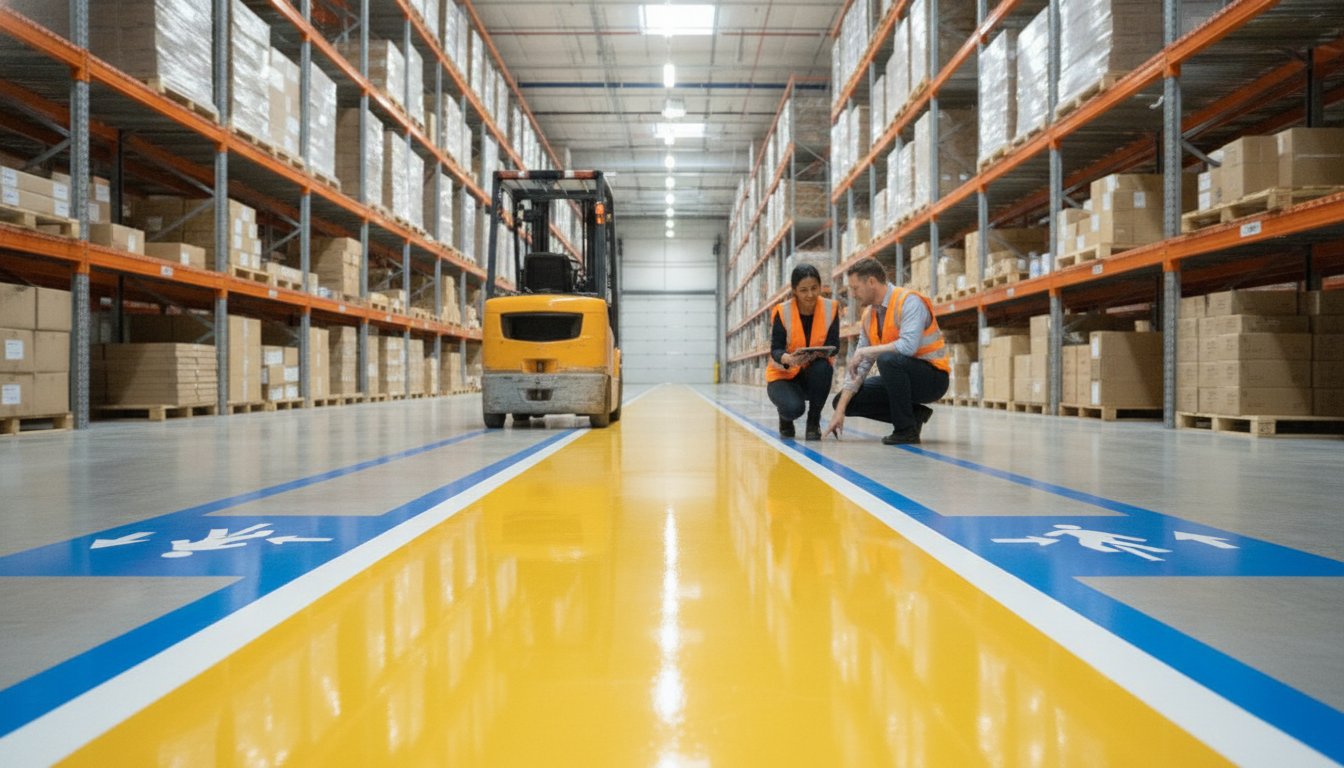
Peeling tape is a failure. It isn’t just a maintenance headache; it’s a liability that signals a lack of operational control to every Ministry of Labour inspector who walks through your doors. You’ve likely struggled with the conflicting information between US-centric OSHA rules and the specific, often-misunderstood Canadian landscape. It’s frustrating to invest in safety only to watch it strip away under heavy forklift traffic within months. This guide cuts through the confusion to define the actual warehouse floor marking standards Canada requires for 2026, ensuring your facility remains compliant and your workers stay safe.
We will examine the latest CSA A344:24 updates, the impact of the new Ontario Administrative Monetary Penalties effective January 1, 2026, and how to transition from temporary fixes to permanent, high-performance systems. You’ll gain a clear roadmap to reduce workplace accidents and eliminate the need for annual re-striping once and for all. By moving beyond the cycle of constant maintenance, you can focus on operational efficiency while meeting the highest safety benchmarks in the industry.
Key Takeaways
- Understand why relying on US OSHA guidelines is a liability and how to align your facility with the specific warehouse floor marking standards Canada mandates for 2026.
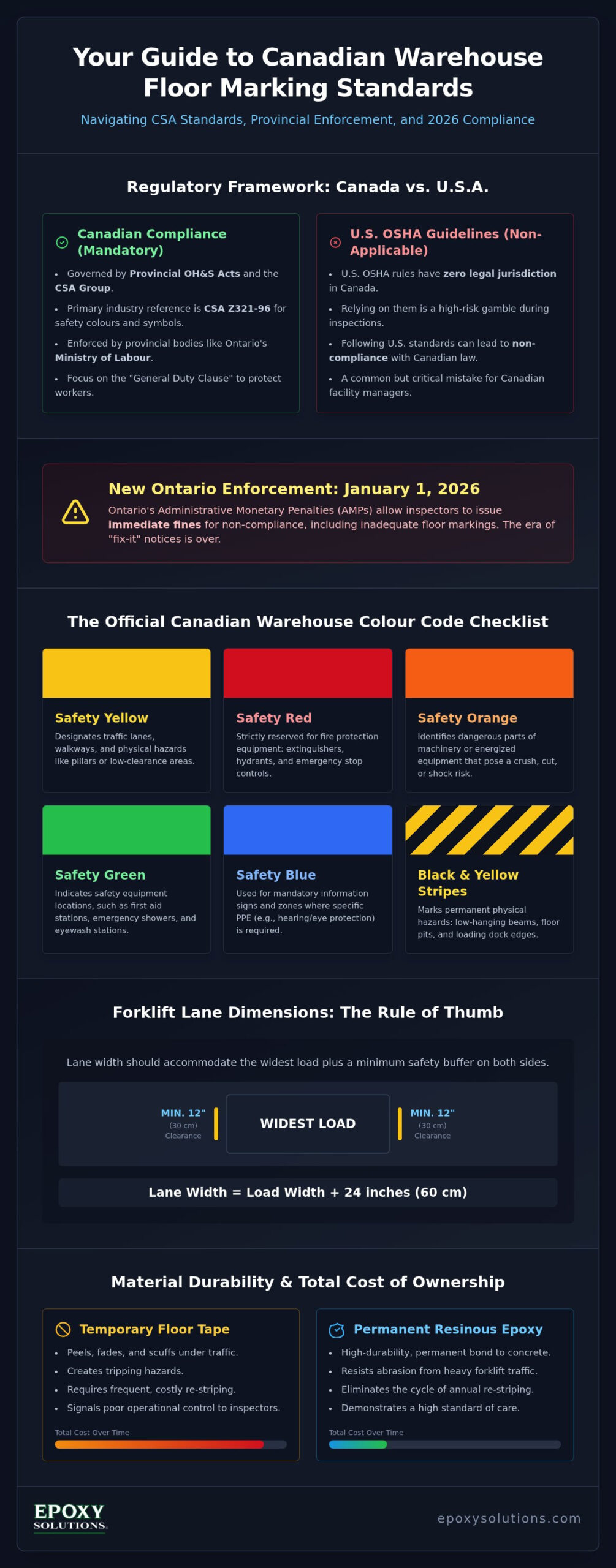
- Identify the mandatory colour codes required for Canadian compliance, including the strict use of Safety Yellow for traffic lanes and physical hazards.
- Master essential layout dimensions for GTA facilities, such as the “Rule of Thumb” for forklift lanes that requires load width plus 12 inches of clearance on each side.
- Evaluate the total cost of ownership between temporary floor tape and permanent resinous epoxy to eliminate the cycle of annual re-striping.
- Learn how professional installation techniques allow for the implementation of high-performance safety systems without causing operational downtime.
Canadian Regulatory Framework: CSA Z321 vs. OSHA
Stop following American rules. Many Canadian facility managers default to US OSHA guidelines simply because they’re more prevalent in online searches, but OSHA has zero legal jurisdiction in Canada. Relying on US standards during a Ministry of Labour inspection is a high-risk gamble that leads to non-compliance. In this country, the regulatory landscape is governed by provincial Occupational Health and Safety (OH&S) Acts and the benchmarks set by the CSA Group. Understanding the distinction is the first step toward building a facility that passes every audit.
The Authority of CSA Z321-96
CSA Z321-96 (Signs and Symbols for the Occupational Environment) is the cornerstone of Canadian visual safety. Although the CSA Group officially withdrew this standard in recent years, it remains the primary industry reference for safety colours and symbols because no direct replacement has been issued. It provides the technical framework for colour coding that ensures a forklift operator in Mississauga recognizes the same hazard markers as one in Calgary. Consistency across provincial borders is not just a preference; it’s a safety requirement that prevents split-second hesitation in high-traffic zones.
While some facilities still use Floor marking tapes to meet these requirements, the standard itself focuses on the visibility and permanence of the signal rather than the material. However, if your markings are peeling or faded, you are no longer in compliance with the intent of the standard. CSA Z321-96 serves as the definitive cornerstone of Canadian visual safety by standardizing colours and symbols across industrial environments.
Provincial Enforcement in Ontario
In Ontario, the Ministry of Labour enforces warehouse safety through the Occupational Health and Safety Act (OHSA). They don’t provide a specific map for your floor; instead, they enforce the “General Duty Clause.” This requires employers to take every precaution reasonable in the circumstances to protect a worker. In a fast-paced GTA warehouse, failing to clearly define pedestrian walkways and forklift lanes is a direct violation of this duty. Inspectors in Toronto and Mississauga increasingly look for permanent, high-visibility solutions that don’t create new hazards, such as tripping on loose tape.
The stakes for non-compliance shifted significantly on January 1, 2026. Ontario’s new Administrative Monetary Penalties (AMPs) now allow inspectors to issue immediate fines for safety violations, including inadequate traffic management and poor warehouse floor marking standards Canada compliance. You can no longer wait for a “fix-it” notice. If your markings are deemed insufficient during a routine inspection, the financial penalty is immediate. Maintaining a high standard of care through professional resinous markings is the only way to demonstrate that you’ve taken every reasonable precaution to prevent workplace accidents.
The Canadian Warehouse Colour Code Checklist
Visual communication is a survival tool. In a busy GTA facility, your floor markings are the only thing preventing a three-tonne forklift from occupying the same space as a pedestrian. Adhering to warehouse floor marking standards Canada requires a disciplined approach to colour, moving beyond the “any yellow paint will do” mentality that leads to confusion and accidents. A standardized palette ensures that every worker, regardless of their native language or experience level, understands the environment instantly and reacts correctly to potential hazards.
Mandatory Safety Colours
Safety Yellow is the non-negotiable standard for traffic lanes and physical hazards. It must be high-visibility and durable enough to withstand constant abrasion from heavy equipment. Red is strictly reserved for fire protection equipment, including extinguishers, hoses, and emergency stop controls, ensuring these life-saving tools are never obstructed. Orange identifies the dangerous parts of machinery or energized equipment that could crush, cut, or electrocute. If these colours are faded, peeling, or incorrectly applied, your visual warning system is broken, and your liability increases. Precision in these applications is what separates a compliant facility from a dangerous one.
Organizational and Functional Colours
Green indicates safety equipment such as first aid kits, emergency showers, and eyewash stations. Blue is used for mandatory information zones, identifying areas where PPE like hearing or eye protection is a legal necessity. For permanent physical hazards such as low-hanging beams, floor pits, or loading dock edges, black and yellow diagonal stripes are the industry benchmark. These markings must remain crisp and permanent to be effective in low-light or high-stress situations. Using high-performance materials ensures these functional cues don’t disappear after a few months of pallet dragging and heavy traffic.
Black and white markings are frequently used to define “Out of Bounds” areas or zones for work in progress. Using these high-contrast borders prevents inventory clutter from creeping into safety lanes and maintains the integrity of your traffic flow. For facilities looking to set a higher benchmark and eliminate the constant cycle of maintenance, implementing a permanent line marking system ensures these colours remain vibrant and compliant for years. A professional resinous application provides the technical accuracy and durability that standard floor paint simply cannot match in a demanding industrial environment.
Layout and Dimension Standards for GTA Facilities
Precision saves lives. In high-density facilities across Mississauga and Brampton, the margin for error is measured in inches, not feet. Designing a floor layout is an exercise in spatial physics that must balance the speed of your logistics with the safety of your personnel. Adhering to warehouse floor marking standards Canada requires moving beyond guesswork and implementing a dimensionally accurate system that accounts for equipment dimensions, load widths, and human movement. A poorly measured aisle isn’t just a bottleneck; it’s a collision waiting to happen.
Traffic lanes must accommodate your largest equipment and widest loads. The industry “Rule of Thumb” for forklift lanes is the width of the widest load plus 12 inches of clearance on each side. For a standard 48-inch pallet, this results in a minimum aisle width of 72 inches for one-way traffic. Pedestrian walkways require a minimum 36-inch width to ensure safe egress and compliance with fire codes. In staging areas and loading docks, “Keep Clear” zones must be permanently marked around fire exits and electrical panels to ensure unobstructed access during emergencies.
Calculating Safe Traffic Lanes
Determining the correct aisle width for high-reach trucks and order pickers requires a methodical approach. Follow these steps to establish your facility’s baseline:
- Identify the widest load: Measure the maximum width of your most common inventory, including any pallet overhang.
- Add the buffer zone: Calculate 12 inches of clearance for each side of the vehicle to account for operator sway and minor steering adjustments.
- Verify turning radius: Ensure intersections provide enough clearance for the specific turning radius of your forklift fleet.
In GTA facilities where space is at a premium, these measurements ensure you maximize storage without compromising the safety of your operators or the integrity of your racking systems.
Marking Critical Hazard Zones
Intersections are the most dangerous areas in any warehouse. Use high-visibility “Stop” and “Caution” markings at every 4-way crossing to force operators to slow down and check for cross-traffic. Charging stations require a clearly defined perimeter to keep personnel away from battery-operated equipment and potential chemical spills. For facilities utilizing automated machinery or AGVs, exclusion zones must be marked with high-contrast borders to keep pedestrians at a safe distance from moving parts. These visual barriers are essential for maintaining a standard-setting facility that prioritizes long-term safety over temporary convenience.
Material Selection: The Durability Gap
Cheap materials are expensive. When you calculate the total cost of ownership over a five-year period, the price of “budget” floor tape or standard traffic paint skyrockets due to constant re-application and operational downtime. In a high-traffic Canadian warehouse, these temporary fixes are destined to fail. Achieving warehouse floor marking standards Canada requires a material that can survive the brutal reality of industrial life, where heavy forklift traffic, pallet dragging, and extreme temperature fluctuations are the daily norm. A line that peels is a line that doesn’t exist in the eyes of a safety auditor.
The Failure of Temporary Solutions
Floor tape is not engineered for the shearing forces of a three-tonne forklift pivoting on a dime. This “scrubbing” action quickly tears the adhesive away from the substrate, leading to unsightly peeling and obscured safety visuals. In Canada, the situation is worsened by seasonal cold cycles that cause standard adhesives to become brittle and lose their bond. Beyond the aesthetics, loose tape is a significant safety hazard, creating trip risks and catching on moving equipment. For those requiring technical specifications on systems that actually hold up, our guide to durable epoxy floor striping details the resinous chemistry needed for industrial environments.
Engineering for Longevity
Permanent lines require more than just a surface bond; they require mechanical integration. Our standard-setting process begins with diamond grinding, a non-negotiable step that removes surface laitance and opens the concrete pores for maximum adhesion. We then apply high-build resinous systems that sit “in” the floor rather than just “on” it. This ensures the marking remains flush and resistant to the impact of heavy loads. For facilities with high natural light or large loading dock doors, we integrate UV-resistant topcoats to prevent the yellowing or fading that often renders safety lines useless over time.
Industrial cleaning shouldn’t erase your safety system. Our resinous markings are engineered for high chemical resistance, ensuring they survive aggressive scrubbing and accidental chemical spills without losing their vibrancy. Beyond line markings, facilities operating in wet or high-traffic zones should also consider anti-slip industrial flooring to achieve a wet static coefficient of friction of 0.60 or higher and prevent the workplace falls that account for over 16% of all industrial fatalities. If you’re tired of the annual cycle of re-striping and want a solution that passes every audit for years to come, it’s time to invest in a permanent resinous line marking system installed by experts who understand the demands of the GTA market.
Professional Implementation and Maintenance
DIY is a liability. Attempting to manage safety striping with in-house maintenance teams or general painters almost always results in a compliance failure. Precision marking requires specialized equipment and a deep understanding of warehouse floor marking standards Canada that most general contractors simply don’t possess. When lines are crooked, wobbly, or applied over improperly prepared concrete, they don’t just look unprofessional; they signal a lack of operational discipline to employees and inspectors alike. A standard-setting facility demands a level of technical accuracy that only a seasoned industry veteran can provide.
Logistics don’t pause for safety upgrades. We understand that GTA facilities operate on razor-thin margins and demanding schedules. Epoxy Solutions™ manages the entire installation process to ensure zero operational downtime, often working during off-peak hours or in phases to keep your supply chain moving. By treating safety flooring as a critical infrastructure project rather than a weekend chore, you establish a culture of discipline. High-performance markings improve employee morale by providing a clear, predictable environment that reduces the stress of near-misses and traffic congestion.
The Installation Process
Our methodology begins with a comprehensive site assessment to identify high-risk conflict points where pedestrians and forklifts converge. We don’t just follow existing lines; we optimize the layout for modern throughput requirements. During the execution phase, we utilize laser-guided layout tools to ensure perfectly straight lines that meet strict dimensional tolerances. Finally, our professional curing process uses industrial-grade resins that reach full hardness in record time, allowing your heavy equipment to return to the floor without damaging the new safety system. Facility managers in the Halton Region looking to complement their safety markings with a durable base surface should also review our commercial polished concrete Milton buying guide for the technical specifications needed to meet 2026 regulatory requirements.
Audit Readiness in the GTA
With the introduction of Ontario’s Administrative Monetary Penalties on January 1, 2026, being “mostly compliant” is no longer an option for facilities in Toronto or Mississauga. You must be audit-ready every single day. This requires maintaining a formal floor marking log that tracks annual inspections and documents repairs. If a section of your resinous coating is gouged by a dropped load, it requires a precision repair rather than a full re-striping. Our team provides the “Expert Fixer” support needed to maintain your facility’s integrity year-round, ensuring you never fear a surprise Ministry of Labour visit. Contact Epoxy Solutions™ for a precision line marking assessment to secure your facility’s future.
Securing Your Facility’s Future Compliance
Safety isn’t a suggestion; it’s a legal requirement that demands technical precision. You’ve seen why relying on US guidelines or temporary floor tape is a strategy destined for failure during a Ministry of Labour inspection. Compliance in 2026 requires a shift toward permanent, high-performance systems that align with the specific warehouse floor marking standards Canada enforces. By moving from reactive maintenance to a standard-setting resinous solution, you eliminate the constant cycle of peeling tape and ensure your facility remains audit-ready every day of the year.
Serving the GTA since 1981, Epoxy Solutions™ acts as the definitive specialist in high-performance resinous flooring. We provide the durability needed to withstand heavy industrial environments while setting the benchmark for safety and craftsmanship. Don’t leave your facility’s compliance to chance or low-grade materials that won’t survive the next season of heavy traffic. It’s time to implement a system that passes every audit and protects your workforce for the long term. Take the first step toward a safer, more disciplined industrial environment today.
Request a Precision Line Marking Quote from Epoxy Solutions™
Frequently Asked Questions
Are warehouse floor marking colours legally mandated in Canada?
There is no federally mandated universal colour code for warehouse floor markings in Canada; however, provincial regulations require employers to take every reasonable precaution for worker safety. Following CSA Z321-96 provides the recognized industry benchmark for safety colours. Using Safety Yellow for traffic lanes is the standard-setting approach that ensures your facility remains compliant during Ministry of Labour inspections.
What is the minimum aisle width for forklifts according to Canadian standards?
Canadian standards require that aisles be wide enough to allow for the safe passage of equipment and pedestrians. The industry “Rule of Thumb” for forklift lanes is the width of the widest load plus 12 inches of clearance on each side. In GTA facilities, this ensures that operators have sufficient buffer zones to prevent collisions with racking or personnel in high-density storage areas.
How often should I refresh my warehouse floor markings?
Maintenance frequency depends entirely on the material choice and traffic volume. Temporary solutions like floor tape often require replacement every six to twelve months because they peel and shear under heavy loads. High-performance resinous systems are engineered for longevity and typically remain compliant for five years or longer. Professional epoxy installations eliminate the cost and disruption of annual re-striping.
Is floor tape or epoxy better for heavy-traffic warehouses in Toronto?
Resinous epoxy is the definitive choice for heavy-traffic environments in Toronto and the GTA. Floor tape fails because it can’t withstand the mechanical scrubbing of forklift tires or the temperature fluctuations found in Canadian warehouses. Epoxy coatings provide a permanent bond to the concrete substrate, creating a high-performance safety system that doesn’t catch on pallets or create trip hazards.
Does the Ontario Ministry of Labour require specific pedestrian walkway markings?
The Ontario Ministry of Labour requires that employers provide clear, unobstructed paths for pedestrian travel and emergency egress. Walkways should be a minimum of 36 inches wide to meet standard safety protocols and fire code requirements. Clearly defined pedestrian zones are essential for maintaining warehouse floor marking standards Canada and preventing hazardous intersections between workers and heavy machinery.
Can I use OSHA colour codes in my Canadian facility?
You can use OSHA colour codes as a secondary reference, but they have no legal authority in Canada. Many facilities adopt these U.S. standards for consistency across North American operations. However, your primary focus must remain on meeting provincial OH&S requirements and CSA benchmarks to ensure your facility passes local audits and provides clear visual communication for Canadian workers.
What happens if my warehouse fails a safety marking audit?
Failing a safety marking audit in Ontario can lead to immediate Administrative Monetary Penalties (AMPs) as of January 1, 2026. Ministry of Labour inspectors can issue fines directly for non-compliance with traffic management and floor safety regulations. Beyond the financial cost, a failure signals a lack of operational control and can lead to increased scrutiny or work-stop orders until the hazards are resolved.
How long does professional epoxy line marking installation take?
Professional installation is designed to minimize operational disruption and can often be completed in phases or during off-peak hours. While the exact timeline depends on the facility size and floor condition, high-performance resinous systems are engineered for rapid curing. This allows your facility to return to full capacity in record time, ensuring that your safety upgrades don’t cause unnecessary downtime in your supply chain.