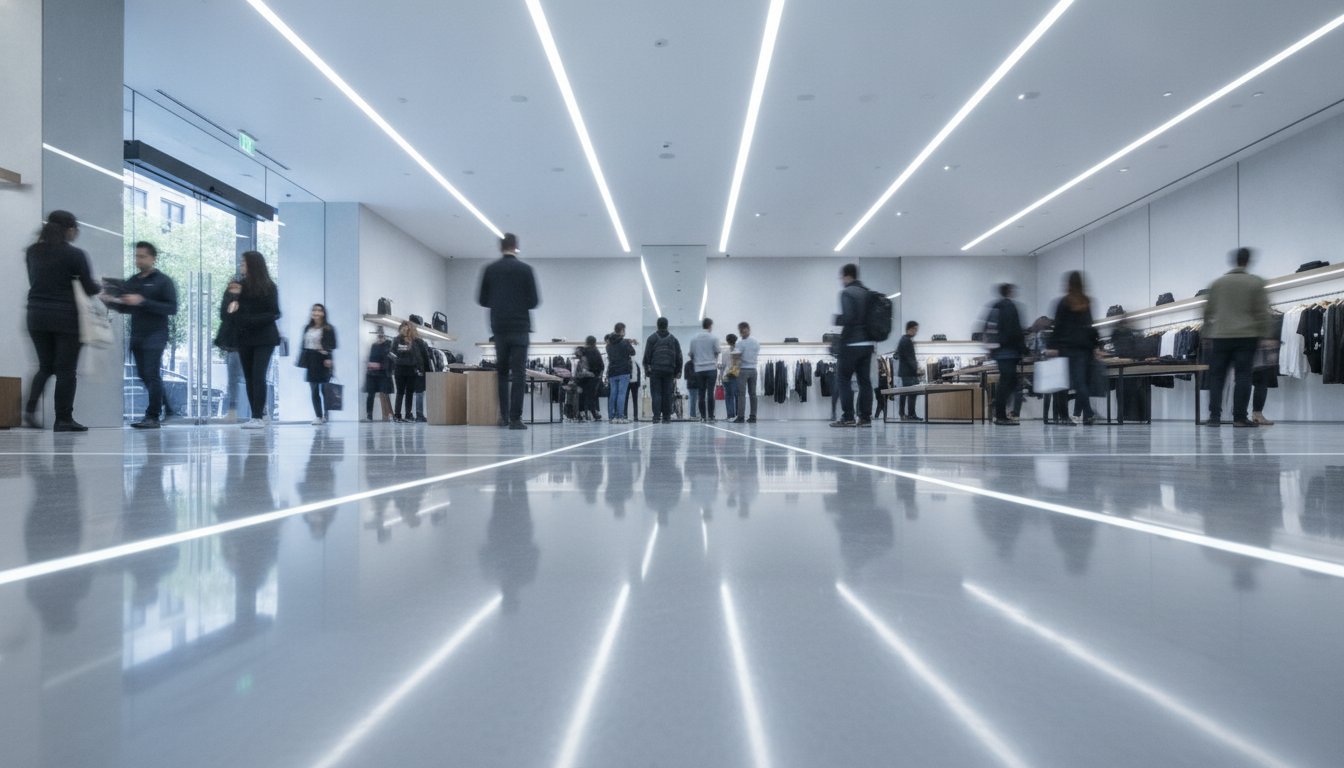
Retail flooring is a survival game. In the Canadian market, your floor isn’t just a design element; it’s a structural component that must withstand a relentless cycle of road salt, melting slush, and thousands of abrasive footsteps every single day. Most commercial surfaces aren’t built for this reality. They peel, crack, and become a liability within months, forcing you into expensive repairs and unnecessary downtime that your bottom line can’t afford.
We understand the frustration of managing high-maintenance tile or low-grade coatings that fail under pressure. You need a solution that balances brand-aligned colours with industrial-grade durability. This 2026 engineering guide details how to specify, install, and maintain high-performance resinous flooring for retail stores to ensure a seamless finish that lasts over a decade. We’ll examine the technical standards for slip resistance, the impact of current VOC regulations, and why meticulous surface preparation is the only way to eliminate the risk of delamination in high-traffic environments. It’s time to move past temporary fixes and invest in a floor that sets the standard for performance.
Key Takeaways
- Understand why a seamless, multi-layer system is essential for retail environments facing constant foot traffic and high-point loads.
- Evaluate the engineering differences between high-build epoxy and urethane mortar to ensure your resinous flooring for retail stores meets rigorous durability standards.
- Learn how to balance brand-aligned colours with UV-resistant finishes and high-traction textures to maintain store safety and visual integrity.
- Discover the technical strategies used to protect surfaces from the osmotic pressure and delamination caused by Canadian road salt and winter slush.
- Recognize why professional mechanical preparation, including diamond grinding, is the only way to achieve a ten-year bond and minimize operational downtime.
Understanding Resinous Flooring for Retail Stores
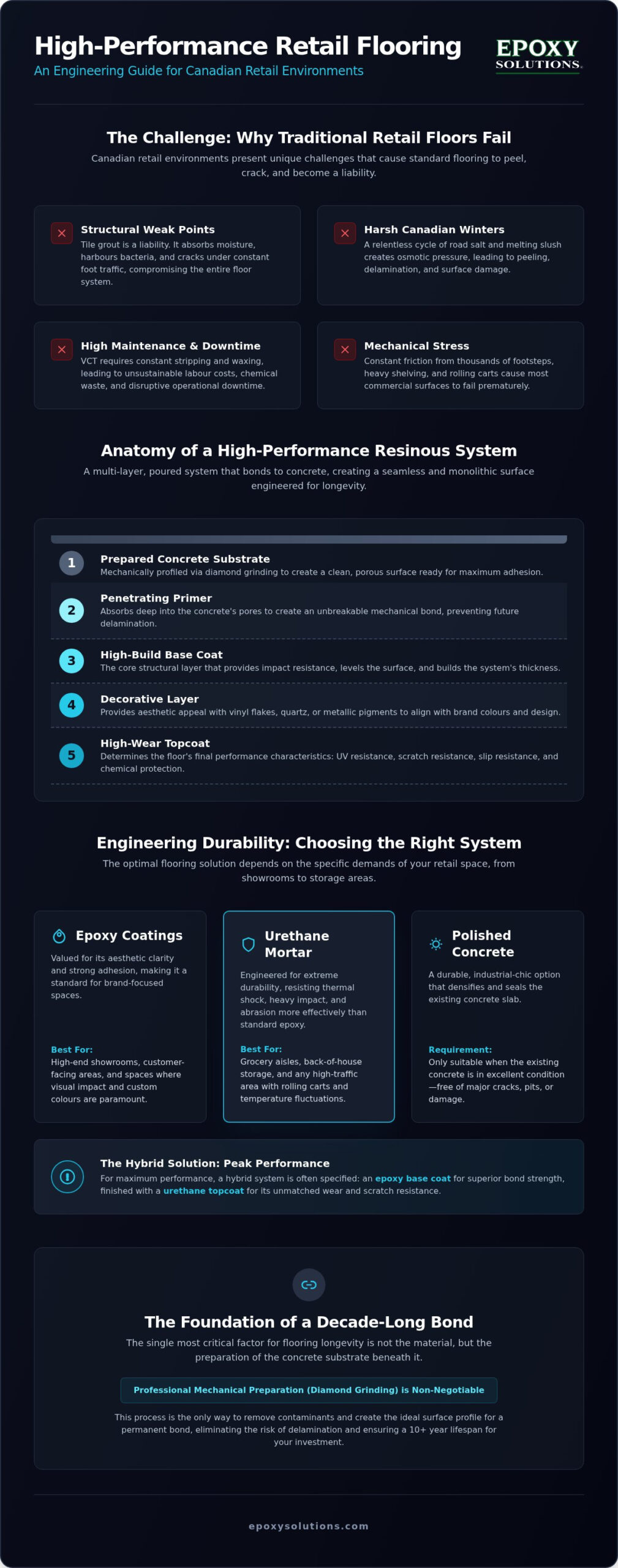
Retail environments are high-stress zones. Floors in these spaces face constant friction, heavy point loads from shelving, and the relentless vibration of rolling carts. Resinous flooring for retail stores is a multi-layer, poured system designed to handle these specific mechanical demands. It isn’t a thin coat of paint; it’s an engineered surface that bonds directly to the concrete substrate to create a monolithic finish.
Traditional materials like tile or Luxury Vinyl Tile (LVT) often fail because of their joints. Grout is a structural liability in a commercial setting. It absorbs moisture, harbours bacteria, and eventually cracks under the pressure of constant foot traffic. Once the grout fails, the entire floor system is compromised. A resinous system eliminates these weak points entirely. It creates a “branded floor” that functions as a functional marketing asset, allowing for custom colours that align with corporate identity while providing a surface that is actually easy to maintain.
The Anatomy of a High-Performance Retail Floor
A premium retail floor relies on a precise build. It starts with a primer that penetrates the concrete pores to ensure a permanent bond. This is followed by a high-build base coat and a decorative layer, such as vinyl flakes or quartz. The final high-wear topcoat determines the floor’s longevity. Seamless polymer flooring is now the standard for food-retail environments because it removes the crevices where dirt and debris hide. In GTA storefronts with massive floor-to-ceiling windows, we specify uv resistant epoxy flooring to prevent the ambering or yellowing that occurs when standard resins are exposed to direct sunlight.
Why Commercial Facilities are Moving Away from Polish and Wax
Facility managers are abandoning VCT (Vinyl Composition Tile) and temporary coatings. The hidden labour costs of stripping and waxing VCT in 2026 make it an unsustainable expense for modern businesses. While the initial investment for a resinous system is higher, the life-cycle cost is significantly lower. You aren’t paying for annual maintenance cycles or facing the downtime of a full replacement every five years. This permanent approach also offers environmental benefits by reducing the chemical waste associated with traditional floor waxes and strippers. Adhering to strict industrial flooring specifications ensures the system is engineered for the specific traffic patterns of your facility.
Engineering Durability: Comparing Resinous Systems and Polished Concrete
Most retail failures start with a mismatch between the environment and the floor’s chemical makeup. Selecting the right resinous flooring for retail stores requires an objective look at your concrete slab. If your substrate is pitted, cracked, or uneven, a thin coating will not hide the flaws. We utilize high-build resinous systems to resurface damaged concrete, providing an extreme capability to level and repair surfaces that other materials simply cannot match. Adhering to strict industrial flooring specifications is the only way to ensure the chemistry of the system matches the mechanical loads of your facility.
Epoxy vs. Urethane: Which Coating Wins?
Epoxy is the standard for aesthetic clarity. It offers superior adhesion to the concrete, making it ideal for high-end showrooms where visual impact and brand-aligned colours are paramount. However, epoxy can be brittle under specific conditions. In grocery aisles or back-of-house storage where thermal shock and heavy impact are frequent, urethane mortar is often the better choice. It handles temperature fluctuations and resists scratches from rolling carts more effectively than standard epoxy. Many modern retailers now opt for hybrid systems. We often install an epoxy base for maximum bond strength and finish with a urethane topcoat for its superior wear resistance.
The Case for Polished Concrete in Modern Retail
Some facilities don’t need a multi-layer coating. When the concrete slab is in excellent condition, high gloss polished concrete provides a durable, industrial-chic aesthetic that has become a staple in boutique and big-box environments alike. The primary benefit is the lack of a topical film; there’s nothing to peel or flake off over time. However, it requires a different maintenance mindset. You’ll need to use specific densifiers and perform occasional burnishing to maintain the lustre and density of the surface.
Safety remains the non-negotiable factor in every installation. Regardless of whether you choose a resinous coating or a polished finish, the surface must meet the ANSI A326.3 standard for dynamic coefficient of friction. This ensures your floor is safe for customers even when tracked-in slush makes the entrance slippery. If you’re struggling to determine which system fits your traffic profile, it’s best to consult with a technical expert who understands the GTA’s unique environmental pressures and can recommend a tailored solution.
Design and Safety: Customizing Colours, Textures, and Slip Resistance
Retail aesthetics should never compromise customer safety. While a floor’s visual appeal serves as a critical marketing tool, its slip resistance is a non-negotiable legal mandate. High-performance resinous flooring for retail stores provides the unique ability to engineer specific friction levels without sacrificing the “showroom” finish that modern brands demand. We treat the floor as a functional asset that must perform under the worst Canadian weather conditions while maintaining its design integrity for a decade or more.
Sun-drenched mall entrances and storefronts with large glass facades are notorious for degrading standard epoxy resins. Without the correct chemistry, these areas will yellow or “amber” within months of installation. We specify UV resistant epoxy flooring to ensure colour stability in high-exposure zones. Beyond simple colour choice, we utilize custom flake and quartz blends to create a variegated surface that effectively hides salt tracking and dirt between cleaning cycles. For larger facilities, we can incorporate brand logos and durable epoxy floor striping directly into the system, ensuring directional cues and safety zones never peel or fade like topical paint.
Balancing Slip Resistance with Ease of Cleaning
Facility managers often face the “Retail Friction Paradox”: a floor must be textured enough to prevent slip-and-fall accidents from wet boots, yet smooth enough to be mopped efficiently. We resolve this by utilizing tailored additives such as aluminium oxide or glass beads. These aggregates are suspended within the topcoat to provide consistent traction that meets Ontario safety standards for public foot traffic. Unlike grit that is simply “thrown” onto the wet resin, our mechanical suspension method ensures the texture remains even across the entire sales floor, preventing the accelerated wear patterns common in high-traffic corridors.
Branding from the Ground Up
The psychological impact of a clean, seamless floor on customer trust is well-documented. A floor that looks sanitary and professional reinforces the quality of the products being sold. For luxury boutiques, we often deploy metallic epoxies that provide a high-end, multidimensional depth similar to natural stone but with the durability of an industrial coating. This system allows for seamless transitions between different retail zones, such as moving from a high-gloss sales floor to a slip-resistant backroom, without the need for unsightly transition strips that create trip hazards and collect debris.
The Canadian Retail Factor: Salt, Slush, and Surface Longevity
Canadian winters are the primary cause of floor failure in Toronto and Mississauga. It’s a blunt reality that many facility managers realize only after their investment begins to flake. When road salt and de-icing chemicals are tracked inside, they don’t just sit on the surface. They create a corrosive brine that seeks out any microscopic pore in the concrete. This leads to osmotic pressure, a physical force that pushes the coating away from the substrate, resulting in unsightly bubbles and eventual delamination. Even in non-industrial settings, specifying chemical resistant floor coatings is a technical necessity to protect your investment from winter chemistry.
Big-box store entrances face a much higher threat level than interior mall shops. A shop inside a climate-controlled mall benefits from several hundred metres of “buffer” flooring that strips moisture from boots. In contrast, a standalone retail entrance is the front line. The resinous flooring for retail stores in these high-exposure zones must be engineered to handle constant saturation and the abrasive friction of salt crystals ground underfoot by thousands of customers daily. Without a non-porous barrier, this liquid ingress will eventually reach the rebar, causing structural expansion and concrete spalling.
Combating Winter Ingress
Effective moisture management starts with the floor’s physical design. We often engineer specialized resinous “drop zones” or entrance pits that contain liquid ingress before it reaches the main sales floor. Because the surface is non-porous, salt-water cannot penetrate the concrete slab to cause structural damage. Maintenance teams must also follow specific cleaning protocols. Neutralizing salt residue quickly is vital; however, using the wrong harsh chemicals can cloud the resin topcoat. A steady regimen of pH-neutral cleaners ensures the floor remains both clear and functional throughout the winter months.
Thermal Cycling in GTA Retail Facilities
Temperature swings near entrance vestibules create significant physical stress. As cold air rushes in, the concrete and the coating expand and contract at different rates. If a coating is too rigid, this thermal cycling causes it to crack and pull away from the slab. We utilize flexible urethane topcoats in these areas because they possess the elongation properties needed to move with the building. This prevents “thermal shock” peeling, a common issue during late-night winter maintenance when floors are scrubbed with cold water while the building’s heating system is active. If your current floor is showing signs of winter damage, contact our engineering team to discuss a more resilient specification for your facility.
Professional Installation: Minimizing Retail Downtime in the GTA
Preparation is the foundation of performance. A floor that lasts 10 years isn’t the result of a superior brand of resin alone; it’s the result of 90% preparation and 10% application. We see failed retail floors across the GTA because contractors prioritized speed over mechanical profiling. We don’t cut corners. Every installation of resinous flooring for retail stores begins with diamond grinding or shot blasting to remove laitance and open the concrete’s pores for a permanent chemical bond. Without this mechanical profile, the coating is merely sitting on top of the slab, waiting to peel under the first heavy point load.
Mall environments present unique logistical hurdles. Odour sensitivity and strict air quality regulations mean traditional industrial resins are often unsuitable for shops sharing a ventilation system. We solve this by deploying low-VOC, low-odour systems that allow for installation in occupied buildings without triggering tenant complaints or safety concerns. For major retail centres in Toronto and Mississauga, we utilize fast-cure polyaspartic systems and overnight schedules to ensure the project is completed during off-hours, moving from preparation to final topcoat before your doors open the next morning.
The Epoxy Solutions™ Standard-Setting Process
Moisture is the most common cause of delamination. We never start a project without verifying the slab vapour rate through rigorous moisture testing. If the concrete is emitting too much vapour, we apply a moisture mitigation primer to prevent future peeling or bubbling. This process includes meticulous crack injection and joint treatment to ensure the final surface remains monolithic and doesn’t telegraph substrate movement over time. Quality control checkpoints at every stage of the multi-day installation process guarantee that the thickness and texture meet the original engineering specification.
Planning Your Retail Floor Renovation
Coordinating with other trades in Brampton or Vaughn requires precision. We manage the flooring phase so it doesn’t become a bottleneck for your grand opening or renovation timeline. It’s critical to understand “Return to Service” times; while some systems take days to cure, our high-performance specifications often allow for full foot traffic in as little as 24 hours. We provide clear timelines so you can schedule merchandising and staff training with total confidence. If you need a floor that survives the friction of the modern market, contact Epoxy Solutions™ for a tailored retail flooring specification today.
Secure Your Retail Environment for the Next Decade
Retail flooring is more than a surface; it’s a structural asset that dictates your facility’s maintenance costs and customer safety for years. Selecting high-performance resinous flooring for retail stores allows you to eliminate the failures common with traditional materials. We’ve detailed why meticulous mechanical preparation and chemistry-driven moisture management are the only ways to survive the corrosive effects of Canadian road salt and heavy foot traffic. Safety and aesthetics don’t have to be mutually exclusive when you engineer for both.
Epoxy Solutions™ has been the authoritative expert in the GTA since 1981. With over 40 years of industry-leading experience, we specialize in low-odour and fast-cure systems tailored for active commercial spaces. Whether your project is in Toronto, Mississauga, Brampton, Milton, or Vaughn, we deliver the reliability and craftsmanship that set the benchmark for the industry. Don’t let a failing floor compromise your brand’s reputation or safety record. Take the first step toward a seamless, durable, and brand-aligned environment today.
Get a Professional Retail Flooring Estimate for Your GTA Facility
Frequently Asked Questions
How long does resinous flooring last in a high-traffic retail store?
A professionally installed resinous floor typically lasts 10 to 15 years under heavy retail traffic. Longevity depends entirely on the quality of the initial mechanical preparation. We use diamond grinding to ensure a permanent bond to the concrete substrate. Without this step, resinous flooring for retail stores will fail within months. Regular maintenance with non-abrasive cleaners also extends the life-cycle of the surface in high-traffic GTA storefronts.
Can resinous flooring be installed over existing tile in a retail space?
We do not recommend installing resinous flooring for retail stores over existing tile. While some contractors offer this as a shortcut, tile and grout lines are unstable and often lead to delamination or “ghosting” where the tile pattern shows through the resin. For a standard-setting result, we remove the existing tile and grind the underlying concrete to create the necessary mechanical profile for a long-term bond.
Is epoxy flooring too slippery for customers when it rains or snows?
High-performance resinous floors are not inherently slippery if they are specified with the correct slip-resistance additives. We utilize materials like aluminium oxide or glass beads to increase the dynamic coefficient of friction. This ensures your sales floor remains safe for customers even when they track in snow and slush during a Mississauga winter. Every installation is tailored to meet specific safety standards for public foot traffic.
How long must my store be closed for a new floor installation?
Downtime varies by the system chosen, but many retail projects are completed within 24 to 48 hours. We specialize in fast-cure polyaspartic coatings that allow for foot traffic just hours after the final topcoat is applied. In major GTA shopping centres, we often perform installations overnight to ensure your business remains operational during standard retail hours. Effective logistical planning is central to our project management approach.
What is the best way to clean a seamless resin floor in a retail environment?
The best cleaning method involves a consistent regimen to prevent abrasive wear. Because the surface is non-porous and seamless, dirt and road salt cannot hide in grout lines. We recommend the following tools:
- Microfibre mops for daily dust removal
- pH-neutral commercial detergents
- Soft-bristle scrubbers for stubborn spots
Avoid using highly acidic or alkaline chemicals, as these can dull the finish over time.
Does the installation process produce a strong odour that will bother neighbours?
We utilize low-VOC and low-odour systems specifically engineered for indoor environments like malls and office buildings. These advanced resins do not produce the heavy chemical fumes associated with traditional industrial epoxies. This allows us to complete installations in Mississauga or Milton retail centres without disrupting neighbouring tenants or triggering air quality concerns. We prioritize the safety and comfort of everyone in the facility during the process.
What is the cost difference between polished concrete and epoxy for retail?
Polished concrete and resinous coatings offer different technical benefits depending on your specific needs. While polished concrete often has a lower initial installation cost, it provides less chemical resistance against road salt and cleaning agents. Resinous systems offer a wider range of custom colours and superior protection against liquid ingress. We recommend evaluating the long-term life-cycle cost and mechanical stressors of your facility before making a final selection.
Are resinous floors resistant to high-heel marks and heavy display racks?
Resinous floors are engineered to withstand high-point loads from heavy display racks and the concentrated pressure of high-heel traffic. The systems we install possess high compressive strength, meaning they don’t indent or crack under the weight of static shelving. We also apply scratch-resistant urethane topcoats that protect the decorative layer from the constant friction of foot traffic and rolling carts in busy GTA retail environments.