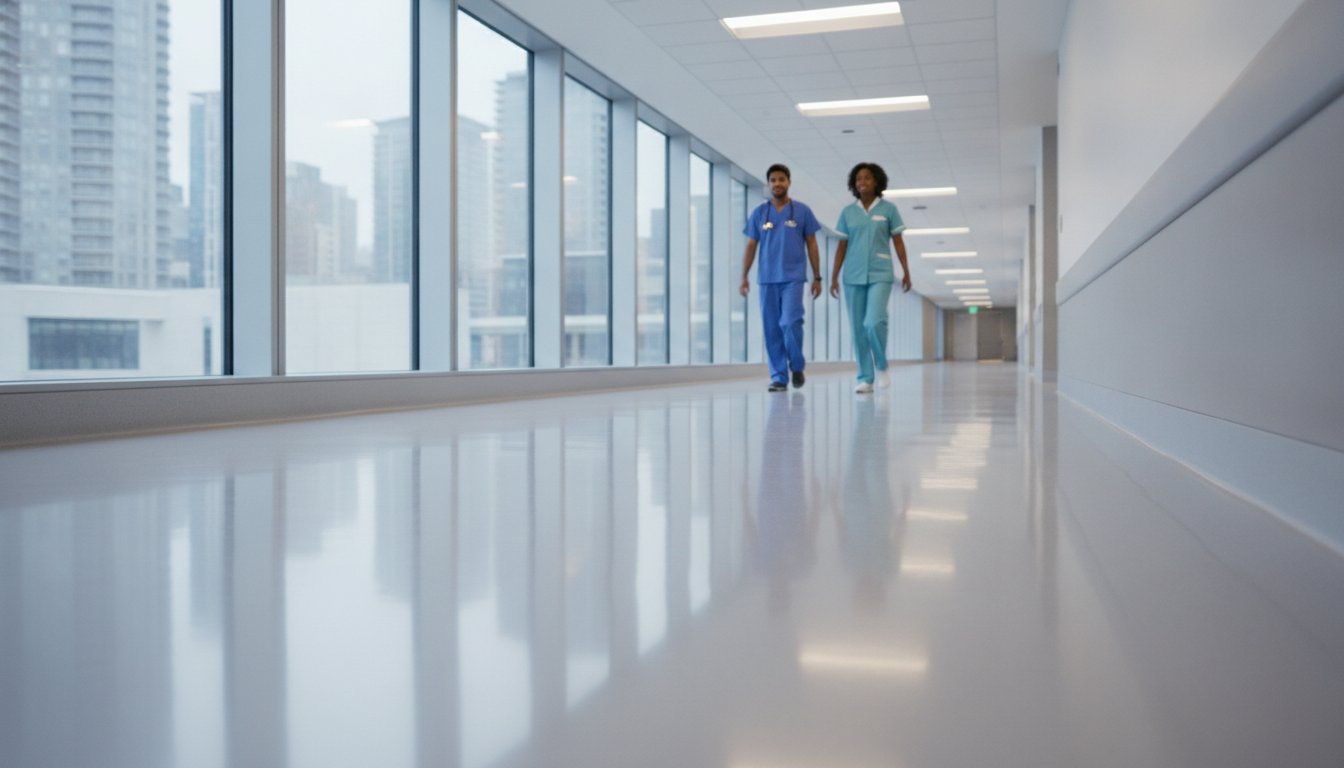
Seams are failures. Every joint in a hospital floor is a potential breeding ground for bacteria and a guaranteed point of structural delamination. Finding truly durable flooring for healthcare facilities requires moving beyond traditional materials that peel in high-traffic corridors and create unacceptable contamination risks. You likely realize that maintaining a sterile environment requires more than just strict cleaning protocols; it requires an engineered surface that doesn’t provide a place for pathogens to hide.
This guide will demonstrate why resinous flooring systems have become the definitive standard for Canadian medical environments, offering a monolithic barrier that stands up to 20 or more years of rigorous clinical use. We will examine how these seamless systems meet the 2026 FGI Codes and Canadian infection control standards while eliminating the lifecycle costs associated with failing grout lines. From chemical resistance in laboratories to anti-static requirements in imaging suites, we provide the technical roadmap for flooring that prioritizes patient safety and long-term reliability.
Key Takeaways
- Understand why monolithic, seamless surfaces are mandatory to eliminate pathogen breeding grounds in sterile clinical environments.
- Compare resinous systems against resilient sheets to realize why impact resistance is critical for high-traffic corridors and heavy gurney movement.
- Learn how to specify durable flooring for healthcare facilities that integrates anti-static properties for imaging suites and UV resistance for public-facing areas.
- Identify the essential surface preparation and moisture mitigation protocols required to prevent delamination and installation failures in the Ontario climate.
- Discover how to achieve a 20-year lifecycle while ensuring full compliance with the latest 2026 FGI guidelines for Canadian healthcare infrastructure.
The Crisis of Seams: Why Healthcare Flooring Fails
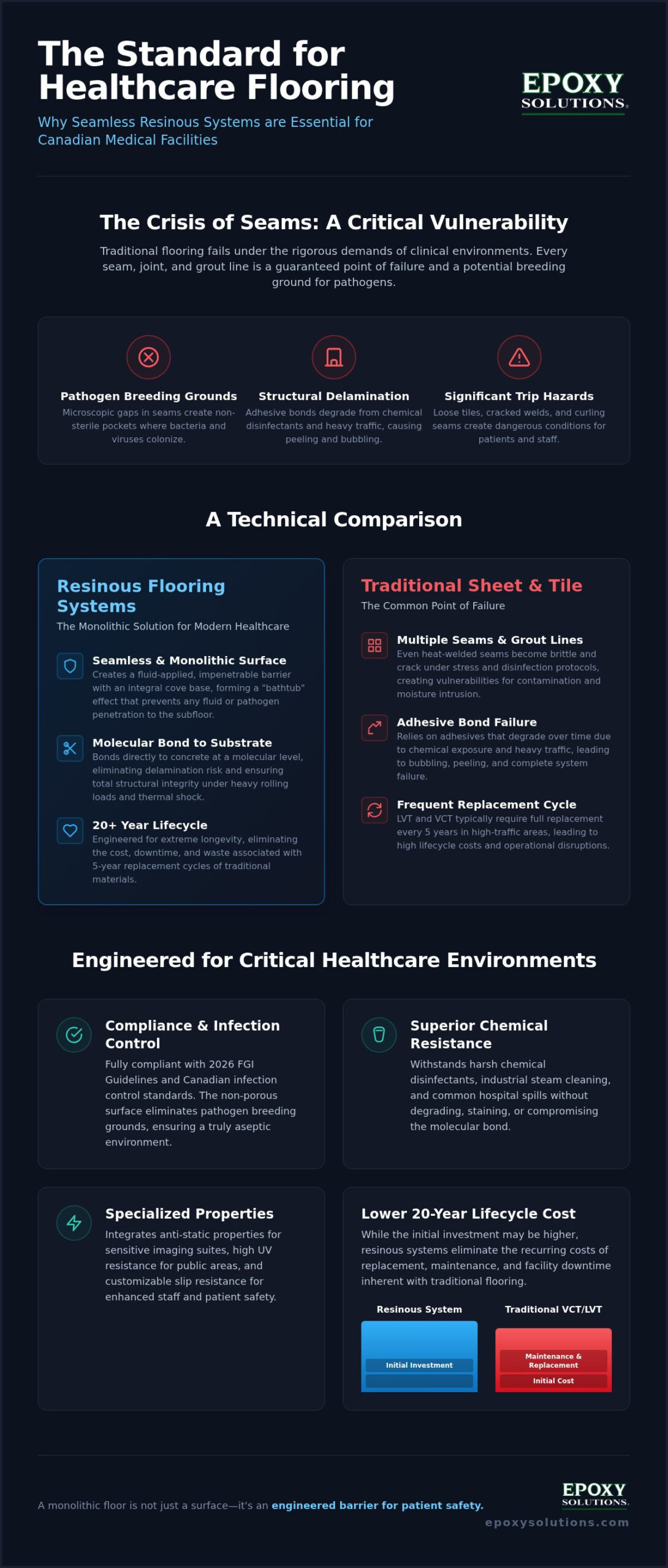
Seams are structural vulnerabilities. In a clinical setting, a floor is an engineered barrier, not just a surface. Durable flooring for healthcare facilities must meet a strict “Monolithic Standard” to ensure total infection control. Traditional flooring materials like tile or Luxury Vinyl Tile (LVT) rely on mechanical or adhesive bonds that inevitably separate under stress. Resinous flooring is a fluid-applied, seamless system that bonds molecularly to concrete. This molecular bond eliminates the microscopic gaps where pathogens thrive and ensures the floor remains an impenetrable shield.
Hospitals never sleep. The daily reality involves relentless stressors that destroy inferior surfaces. Heavy rolling loads from gurneys and diagnostic equipment exert hundreds of pounds of pressure per square inch. Constant foot traffic in 24-hour facilities grinds dirt into porous surfaces. Meanwhile, the harsh chemical disinfectants required to meet safety standards eventually degrade the adhesives holding traditional seams together. Without a molecular bond, the floor will eventually delaminate, bubble, or crack.
The Hidden Cost of “Cheap” Flooring
Choosing LVT or Vinyl Composition Tile (VCT) often seems like a budget-friendly decision during construction. It’s a mistake. These systems require frequent stripping and waxing cycles to maintain hygiene levels. Every maintenance window causes facility downtime. Every delaminated seam or loose tile represents a significant trip hazard for staff and patients alike. When calculating lifecycle costs over 20 years, resinous systems outperform traditional resilient flooring by eliminating the need for replacement every five years. Specifying durable flooring for healthcare facilities requires looking past the initial invoice to the long-term operational reality.
Infection Control and the Seam Problem
Pathogens colonize in the smallest gaps. Traditional floor seams, even heat-welded ones, remain structural weaknesses. Under rigorous Canadian disinfection protocols, welds can crack or pull away from the substrate, creating non-sterile pockets that are impossible to reach. A truly monolithic surface is non-porous and extends up the wall via an integral cove base. This creates a “bathtub” effect that prevents bacteria and fluids from ever reaching the subfloor. For high-acuity areas, resin systems are the only way to ensure a truly aseptic environment that meets the highest standards of patient care.
Resinous Flooring vs. Resilient Sheet: A Technical Comparison
Vinyl is the default. It’s also the most frequent failure point in high-acuity environments. While resilient sheet flooring is often marketed as the most versatile option, it lacks the structural integrity required for trauma centres and diagnostic suites. Truly durable flooring for healthcare facilities must withstand more than just foot traffic; it must survive point loading from heavy imaging equipment and the constant vibration of gurneys. Resinous systems are engineered to distribute these loads across the entire substrate, whereas vinyl often suffers from permanent indentation or tearing under the same pressure. Safety is paramount, yet slip resistance cannot come at the expense of cleanability. We engineer surfaces that provide high coefficients of friction while remaining smooth enough for rapid sterilization.
Hygiene standards dictate that surfaces must be easy to sanitize. Many of the latest healthcare flooring products attempt to mimic the seamless nature of epoxy with heat-welded seams. These welds eventually become brittle and fail under stress. In contrast, a fluid-applied resinous system creates a single, continuous surface that is inherently non-porous. This eliminates the need for the stripping and waxing cycles that characterize vinyl maintenance, reducing long-term operational costs and facility downtime. Vinyl requires a continuous cycle of cleaning, buffing, and sealing just to maintain its appearance. Resinous flooring eliminates these labour-intensive steps, allowing staff to focus on patient care rather than floor maintenance.
Performance Under Pressure
Indentation resistance is a critical metric. A high-build epoxy system provides a shore hardness that resilient sheets simply cannot match. When a heavy oxygen tank or medical device is dropped, vinyl often punctures, exposing the subfloor to moisture and contaminants. Resinous systems absorb these impacts without structural compromise. They also handle the thermal shock of industrial steam cleaning, which causes vinyl adhesives to fail and bubble. While some critics claim epoxy is “cold” or “loud,” modern formulations allow for acoustic underlays and specialized aggregates that provide comfort without sacrificing durability.
Chemical Resistance in Clinical Zones
Clinical environments are chemically aggressive. Spills of biological fluids, blood, and medical reagents can permanently stain or degrade vinyl surfaces. Our Chemical resistant floor coatings are engineered to withstand prolonged exposure to these substances without softening or discolouring. When specifying durable flooring for healthcare facilities, this chemical stability is vital for laboratories and sterile processing departments where hygiene is non-negotiable. UV resistance is also essential in sun-drenched lobbies and patient atriums to prevent the yellowing and brittleness that often plagues traditional plastics. If you are designing a high-performance space, a tailored resinous installation will protect your infrastructure investment for decades.
Specialized Systems for Critical Healthcare Environments
A hospital is a complex machine with diverse operational zones. Durable flooring for healthcare facilities must be engineered to meet the specific technical requirements of each department, from sterile surgical suites to high-traffic public lobbies. A generic coating will fail because it doesn’t account for the specialized stressors present in modern medicine. We provide tailored systems that address static electricity, ultraviolet degradation, and the physical architecture of infection control.
Integral coving is a non-negotiable standard for aseptic environments. By extending the flooring material up the wall in a smooth, continuous curve, we eliminate the 90-degree angles where bacteria and moisture inevitably accumulate. This monolithic transition ensures that cleaning protocols remain 100% effective. Additionally, we integrate safety line marking directly into the resinous system to define equipment zones and emergency egress routes, creating a permanent visual guide that won’t peel or fade like adhesive tape.
Static Control in High-Tech Diagnostics
Sensitive diagnostic equipment requires precise environmental control. Electrostatic discharge (ESD) can interfere with MRI and CT imaging, leading to data corruption or hardware failure. Our anti-static flooring uses conductive elements to safely dissipate static electricity through the floor to a grounded point. This isn’t a temporary surface treatment; it’s a fundamental property of the system that maintains its conductivity for the life of the floor. For a deeper look at high-performance specifications, see our High-Performance Epoxy: Guide for Industrial Facilities.
UV Stability and Biophilic Design
Modern healthcare design prioritizes natural light to improve patient recovery times. However, standard epoxies often yellow and become brittle when exposed to sunlight, ruining the aesthetic and compromising the structural integrity of the surface. We utilize specialized resins to ensure long-term colour stability in sun-drenched atriums and corridors. These systems support biophilic design principles without sacrificing the resilience required for heavy foot traffic. For more information on protecting your facility, consult our UV Resistant Epoxy: Engineering Guide for GTA Facilities. Maintaining a bright, clean appearance is essential for both patient confidence and staff morale in public-facing areas.
The GTA Reality: Avoiding Installation Failures in Healthcare
Installation is where engineering meets the environment. Most durable flooring for healthcare facilities fails not because of the material, but because of a total lack of respect for the substrate. In the Greater Toronto Area, we deal with extreme seasonal humidity and varying concrete conditions that can lead to catastrophic delamination if ignored. If an installer claims a floor is “straightforward” without conducting rigorous moisture testing, the project is already at risk. We don’t just apply coatings; we engineer a bond that survives the specific environmental stressors of Ontario facilities. Specifying durable flooring for healthcare facilities in the GTA requires a partner who understands our unique climate and the chemistry required to master it.
Surface Preparation: The Authoritative Expert View
Mechanical bonding requires more than a clean surface. We strictly adhere to Concrete Surface Profile (CSP) standards to ensure the resin has a physical “tooth” to grab onto. Diamond grinding is our non-negotiable standard. It’s the only way to remove laitance and contaminants while opening the pores of the concrete. In GTA facilities, we also perform comprehensive pH and moisture vapour transmission testing. Without these data points, you’re guessing; and guessing leads to peeling. For a technical deep dive into these requirements, consult our Industrial Flooring Specs: Engineering Guide for 2026.
The Problem-First Approach to Delamination
Delamination starts with a bubble. These warning signs often appear in high-traffic corridors where moisture from the slab meets an improperly bonded surface. We’ve spent decades remediating failed third-party installations where corners were cut during prep. Our 1981 legacy is built on fixing these industry failures. With over 45 years of experience, we understand the specific chemistry required to bond resinous systems to the diverse concrete slabs found across Southern Ontario. We don’t just follow standards; we set them by ensuring every installation starts with a verified, mechanically prepared substrate.
To ensure your facility avoids these common pitfalls, follow this 5-step checklist for a successful installation:
- Moisture Vapour Testing: Conduct calcium chloride or relative humidity (RH) probe testing to quantify moisture levels before application.
- Mechanical Preparation: Use diamond grinding to achieve the specific CSP required for the medical-grade resin system.
- pH Level Verification: Ensure the concrete slab is chemically neutral to prevent osmotic blistering and bond failure.
- Environmental Control: Maintain specific temperature and humidity levels during the application and curing phases to ensure chemical stability.
- Certified Execution: Use experienced crews who understand the specific cure times and mixing ratios of high-performance resins.
Don’t let poor preparation compromise your patient safety standards. Contact Epoxy Solutions™ to discuss your facility’s specific engineering requirements today.
Specifying for Longevity: Why Epoxy Solutions™ is the Benchmark
Success in healthcare infrastructure isn’t accidental. It’s the result of precise engineering and a refusal to accept industry-standard failures. When selecting durable flooring for healthcare facilities, the specification must reflect the actual stressors of the environment. A high-traffic corridor requires different mechanical properties than a sterile processing department. We move beyond generic catalogues to provide tailored resinous systems that ensure long-term performance and total compliance with Ontario’s strict health standards. One-size-fits-all is a recipe for premature delamination and compromised hygiene.
Zone-Specific Flooring Strategies
Different zones demand different chemistries. Operating rooms require high chemical resistance and antimicrobial properties to withstand constant sterilization and exposure to medical reagents. Conversely, cafeteria spaces need systems that prioritize stain resistance and slip safety without compromising the aesthetic of a public space. We also integrate Durable Epoxy Floor Striping: 2026 Industrial Guide protocols to improve traffic flow and equipment zoning. This zone-specific approach ensures that every square foot of the facility is optimized for its intended use, reducing lifecycle maintenance costs and preventing floor failure.
Partnering with a GTA Specialist
Experience is the only hedge against installation failure. Serving Toronto, Mississauga, Brampton, Milton, and Vaughn, we bring a 45-year legacy of reliability to every project. Our no-nonsense approach prioritizes technical accuracy over the lowest initial bid, because we know the true cost of a floor that peels or bubbles in two years. We understand the 2026 FGI Codes and CSA guidelines that govern Ontario healthcare facilities. This expertise allows us to step in where others have failed, setting the benchmark for what a medical-grade installation should look like. Our crews are trained to work in demanding conditions, ensuring that your facility remains a safe, standard-setting environment.
Reliability creates peace of mind. Moving from a state of facility concern to total confidence requires a partner who understands the high stakes of patient safety and the rigorous demands of Canadian infection control. We provide the technical site evaluations and accurate specifications needed to ensure your infrastructure lasts 20 years or more, regardless of the heavy gurney traffic or chemical exposure it faces. By adhering to the latest 2026 FGI Codes and local Ontario building requirements, we ensure your facility remains compliant and operational. Contact Epoxy Solutions™ today to secure an engineered surface that meets the highest standards of the Canadian healthcare industry.
Securing Your Facility’s Long-Term Infrastructure
Seams are structural liabilities. Every joint in a floor is a potential breach in your infection control strategy. Moving to a monolithic, resinous system isn’t just about aesthetics; it’s about engineering a surface that eliminates pathogen breeding grounds and withstands the relentless pressure of a 24-hour clinical environment. You now understand that durable flooring for healthcare facilities requires a molecular bond to the substrate and a rigorous approach to GTA-specific moisture challenges. Choosing the right material is only half the battle; the other half is ensuring the installation meets the highest mechanical standards.
Since 1981, we’ve specialized in high-performance resinous systems that set the industry benchmark for reliability. We serve Toronto, Mississauga, Brampton, and the surrounding regions with a no-nonsense commitment to technical accuracy. Your facility deserves a floor that lasts 20 years or more without the disruption of frequent maintenance shutdowns or delamination failures. Take the first step toward a safer, more resilient environment. Request a Technical Site Evaluation for Your Healthcare Facility today. We look forward to helping you realize a standard of hygiene and durability that protects both your patients and your infrastructure investment.
Frequently Asked Questions
What is the best flooring for high-traffic hospital corridors?
Resinous flooring systems are the superior choice for high-traffic hospital corridors due to their monolithic nature and extreme durability. Unlike traditional tiles that crack under heavy rolling loads, these systems bond molecularly to the concrete substrate. This prevents the delamination common in Toronto facilities where gurneys and diagnostic equipment move constantly. They provide a seamless barrier that eliminates structural weaknesses, ensuring the floor remains intact despite relentless 24-hour foot traffic and mechanical stress.
How long does an epoxy floor last in a healthcare facility?
A professionally installed system can last 20 years or longer in a clinical environment. Long-term performance depends entirely on the quality of the initial mechanical preparation and the specific resin chemistry used. Since 1981, we’ve seen that durable flooring for healthcare facilities only reaches this lifespan when installers prioritize diamond grinding over simple acid etching. This meticulous approach ensures the bond is permanent, preventing the premature peeling often seen in lower-quality commercial applications.
Is resinous flooring compliant with Canadian healthcare hygiene standards?
Resinous systems are fully compliant with the latest 2026 FGI Codes and Canadian infection control standards. These regulations mandate non-porous, easy-to-sanitize surfaces in semi-restricted and restricted areas. Because our systems are fluid-applied, they create a truly seamless environment that leaves no room for pathogens to colonize. This level of hygiene is impossible to achieve with heat-welded vinyl, which eventually becomes brittle and separates from the wall base over time.
Can resinous flooring be installed over existing concrete in older clinics?
Resinous systems can absolutely be installed over older concrete slabs in clinics across Mississauga and Brampton. The process involves testing the existing slab for moisture vapour transmission and pH levels to ensure a successful bond. We often remediate older facilities by removing failing VCT or LVT and applying a high-performance epoxy. This modernization process stabilizes the substrate and provides a monolithic surface that meets modern Canadian healthcare standards without requiring a full slab replacement.
How do you clean and maintain medical-grade resinous floors?
Maintenance is significantly simpler than traditional flooring because resinous systems don’t require stripping or waxing. Regular cleaning involves using medical-grade disinfectants or industrial steam cleaning to maintain an aseptic environment. The non-porous surface prevents chemicals and biological fluids from penetrating the floor, which protects the concrete underneath. This lack of intensive maintenance reduces facility downtime and lowers the total lifecycle cost for hospitals and private clinics in the GTA.
What is the difference between standard epoxy and healthcare-grade resin?
Healthcare-grade resins are engineered with specific chemical resistance to handle biological fluids and harsh medical reagents. Standard epoxy lacks the specialized additives required to prevent staining from blood or degradation from high-strength disinfectants. Additionally, medical-grade systems often include UV-stable components to prevent yellowing in patient atriums. We tailor these specifications to the specific zone, ensuring the chemistry matches the environmental stressors present in a modern Canadian medical facility.
How does the installation of resinous flooring affect facility downtime?
Installation timelines vary based on the system’s complexity, but fast-cure resins can minimize operational disruptions. We often coordinate phased installations for facilities in Vaughn and Milton to keep critical departments functional. While the initial application requires a temporary shutdown, the 20-year lifespan of resinous systems eliminates the frequent closures needed for repairing or replacing failing vinyl. Investing in a durable installation now prevents the recurring downtime caused by inferior materials.
Does healthcare flooring require anti-static (ESD) properties?
Anti-static (ESD) properties are essential in diagnostic imaging suites and server rooms to protect sensitive electronic components. Standard durable flooring for healthcare facilities doesn’t provide the conductivity needed to dissipate electrostatic discharge. In areas with MRI or CT scanners, we install specialized conductive systems that safely ground static electricity. This prevents data corruption and equipment interference, ensuring that critical diagnostic tools remain accurate and operational for the safety of Ontario patients.