Standard coatings fail. Most workshop floor coatings are nothing more than a cosmetic mask destined to peel under pressure. Industry standards aren’t suggestions; they’re the difference between a functional service centre and a costly liability. You likely recognize the frustration of watching a fresh floor bubble and lift after its first encounter with hot oil or corrosive winter brine. It’s a recurring failure across the GTA, where road salt and heavy impact turn unprotected concrete into a pitted, dangerous mess.
This guide explains why specialized epoxy flooring for automotive workshops is a critical engineered safety system rather than a simple aesthetic choice. You’ll discover why professional automotive workshops require high-performance resinous flooring to survive the harsh chemical and physical demands of a Canadian service bay. We will examine the technical requirements for a seamless, oil-resistant floor that lasts 10 plus years, improves your shop’s professional appearance, and ensures full compliance with the 2024 Ontario Building Code.
Key Takeaways
- Identify why porous concrete acts as a sponge for automotive fluids and how hydrocarbon saturation causes standard floor coatings to lift and fail.
- Learn why high-performance epoxy flooring for automotive workshops must be engineered to withstand extreme point-load stress from jack stands and heavy equipment.
- Discover the critical performance gap between high-build industrial systems and thin-film retail kits that inevitably peel under the demands of a Canadian winter.
- Evaluate how to balance high-traction safety surfaces with the chemical resistance needed to survive constant exposure to corrosive road salt and brine.
- Understand how strategic visual organization and precision line marking can improve workflow efficiency while ensuring compliance with provincial safety regulations.
Why Standard Concrete Fails in Automotive Workshops
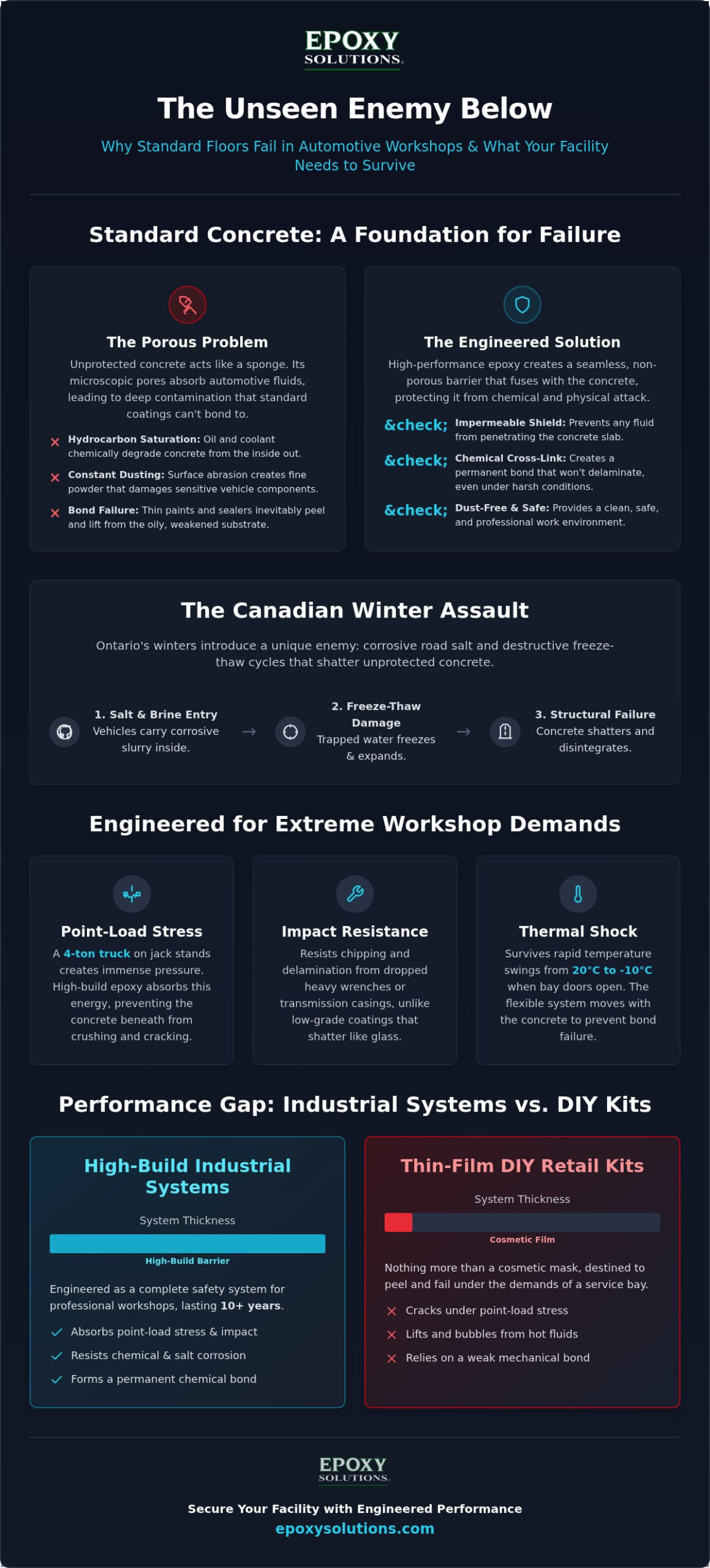
Concrete is a sponge. While it appears solid, its microscopic structure is a network of interconnected pores and capillaries that act as a vacuum for automotive fluids. In a busy service bay, every spill of motor oil, transmission fluid, or coolant is absorbed deep into the slab. This is hydrocarbon saturation; a process that destroys concrete from the inside out. Once oil penetrates these pores, it doesn’t just sit there. It chemically degrades the cement paste that holds the aggregate together, leading to a structural softening that no surface-level cleaning can fix.
Standard paints and thin sealers are useless in this environment. They rely on a mechanical bond that is physically impossible to achieve on an oily substrate. When you apply a low-grade coating, it simply sits on top of the contamination. Eventually, the bond breaks, leading to the “Peel Problem” where the floor lifts in large, unsightly sheets. Professional epoxy flooring for automotive workshops relies on specific Epoxy resin properties to create a chemical cross-link with the concrete. Without proper decontamination and industrial-grade materials, the floor is destined for failure.
Surface degradation also leads to constant dusting. As heavy vehicles and equipment move across unprotected concrete, the top layer of the slab wears down into a fine, abrasive powder. This concrete dust is more than just a cleaning nuisance. It’s a mechanical hazard that can infiltrate sensitive vehicle components, damage engine parts during rebuilds, and compromise the health of your technicians. A workshop floor that is constantly “shedding” is a sign of a failing asset.
The Hidden Threat of Oil Saturation
Oil travels deep. In many GTA shops, we see slabs where hydrocarbons have migrated several inches below the surface. This creates a phenomenon known as outgassing. As temperatures in the workshop fluctuate, air and moisture trapped beneath the oil expand, forcing their way upward. If a coating is applied over this, it will bubble and blister within weeks. Many shop owners realize too late that a simple pressure wash or a quick degreasing isn’t enough. Professional workshops require mechanical diamond grinding and specialized oil-stop primers to ensure the new system actually stays down.
Canadian Winter Realities: Brine and Road Salt
Toronto and Mississauga workshops face a unique enemy: road salt. During an Ontario winter, vehicles carry a slurry of brine and salt directly into your service bays. This salt accelerates concrete pitting and can lead to rebar corrosion, compromising the structural integrity of the entire floor. When salt-laden water enters the concrete’s pores and freezes, it expands with immense force. This freeze-thaw cycle shatters the surface of the concrete, creating a rough, dusty environment that is impossible to keep clean. Without a high-performance barrier, your floor will literally disintegrate under the weight of seasonal demands.
Engineering for Extreme Durability and Point Loads
Tires are easy. They have a large footprint that distributes weight relatively evenly across a surface. The real test for any floor is the jack stand. When a four-ton truck rests on small metal feet, it creates immense pressure concentrated on a tiny area. This is point-load stress. If your floor isn’t specifically engineered for this, the concrete beneath the coating will crush, causing the surface to spiderweb and crack. High-performance epoxy flooring for automotive workshops must provide a high-build barrier that absorbs this energy and distributes it across the slab.
Impact resistance is another non-negotiable requirement. Mechanics drop heavy items. Whether it’s a heavy wrench or a transmission casing, the floor must survive the strike without chipping or delaminating. Low-grade coatings often shatter like glass because they lack the necessary resinous density and flexibility. We specify systems with high compressive strength to handle these mechanical shocks. In the context of 2026 workshop standards, compressive strength is the measure of a floor’s ability to withstand heavy vertical pressure without deformation or structural failure.
Thermal shock is a silent killer in Ontario service bays. Imagine a bay door opening in the middle of a January cold snap. The floor temperature can drop from 20 degrees to minus 10 in seconds, while a hot engine drips 90-degree fluids nearby. This rapid temperature swing causes materials to expand and contract at different rates. If the coating doesn’t have the flexibility to move with the concrete, it will eventually lose its bond. Our systems are designed to bridge these thermal gaps, ensuring the floor remains intact regardless of the weather outside.
Jack Stands and Lift Points
High-build epoxy systems are essential in areas where heavy lifting occurs. A thin-film coating simply isn’t thick enough to bridge the gap between a metal stand and the concrete. By building a thicker resinous matrix, we ensure the weight is distributed evenly across the floor. This prevents the “punch-through” effect that ruins so many DIY or low-end commercial jobs. Professional installation also ensures workplace safety with epoxy is maintained during the application of these high-performance materials.
Chemical Resistance Beyond Motor Oil
Oil is just the beginning of the chemical assault. Brake fluid is highly corrosive and acts like a paint stripper on standard coatings. Battery acid and aggressive degreasers will etch into unprotected concrete within hours, causing permanent damage. Our systems create a non-porous, seamless finish that keeps these fluids on the surface where they can be safely contained. If you’re tired of seeing your floor eaten away by chemicals, it’s time to invest in industrial-grade traffic toppings that are built to last.
High-Build Systems vs. Thin-Film DIY Failures
Cheap kits are a trap. Most “box store” epoxy products are designed for occasional foot traffic in a residential garage, not the relentless grind of a professional service bay. These thin-film coatings usually measure between 2 to 3 mils in thickness. For comparison, a professional installation of epoxy flooring for automotive workshops ranges from 30 to over 125 mils. When a 3-mil coating meets hot tires or a dropped wrench, it lacks the structural mass to stay bonded. It’s why roughly 70% of DIY applications fail within two years, often peeling within the first six months. Investing in a premium system might cost more upfront, but it eliminates the cycle of grinding and re-coating every two seasons, providing a significantly lower total cost of ownership over a decade.
The Myth of “Acid Etching” for Prep
Liquid prep is insufficient. Most DIY kits suggest acid etching to “open” the concrete, but this chemical process rarely reaches deep enough to remove industrial contaminants like oil and grease. If the surface isn’t mechanically profiled, the epoxy cannot “root” into the slab. At Epoxy Solutions™, we prioritize diamond grinding or shot blasting as the non-negotiable first step for every project in the GTA. This mechanical preparation creates a textured surface that ensures an unbreakable bond, even in high-demand Mississauga and Toronto shops. Adherence to OSHA safety standards for workshop floors requires a surface that remains intact; a peeling floor is a trip hazard and a liability.
Industrial High-Performance Epoxy Coatings
A professional floor is an engineered assembly. It isn’t a single coat of paint; it’s a multi-layered system consisting of moisture-tolerant primers, high-build base coats, and chemically resistant topcoats. We tailor these layers based on the specific zones of your facility. A wash bay requires different traction and UV resistance than a heavy-duty service bay where jack stands are used. By using high-performance epoxy, you ensure each area of your shop is optimized for its specific workload. This zoned approach prevents premature wear in high-traffic areas and ensures your investment survives the brutal Canadian winter cycle of salt and slush.
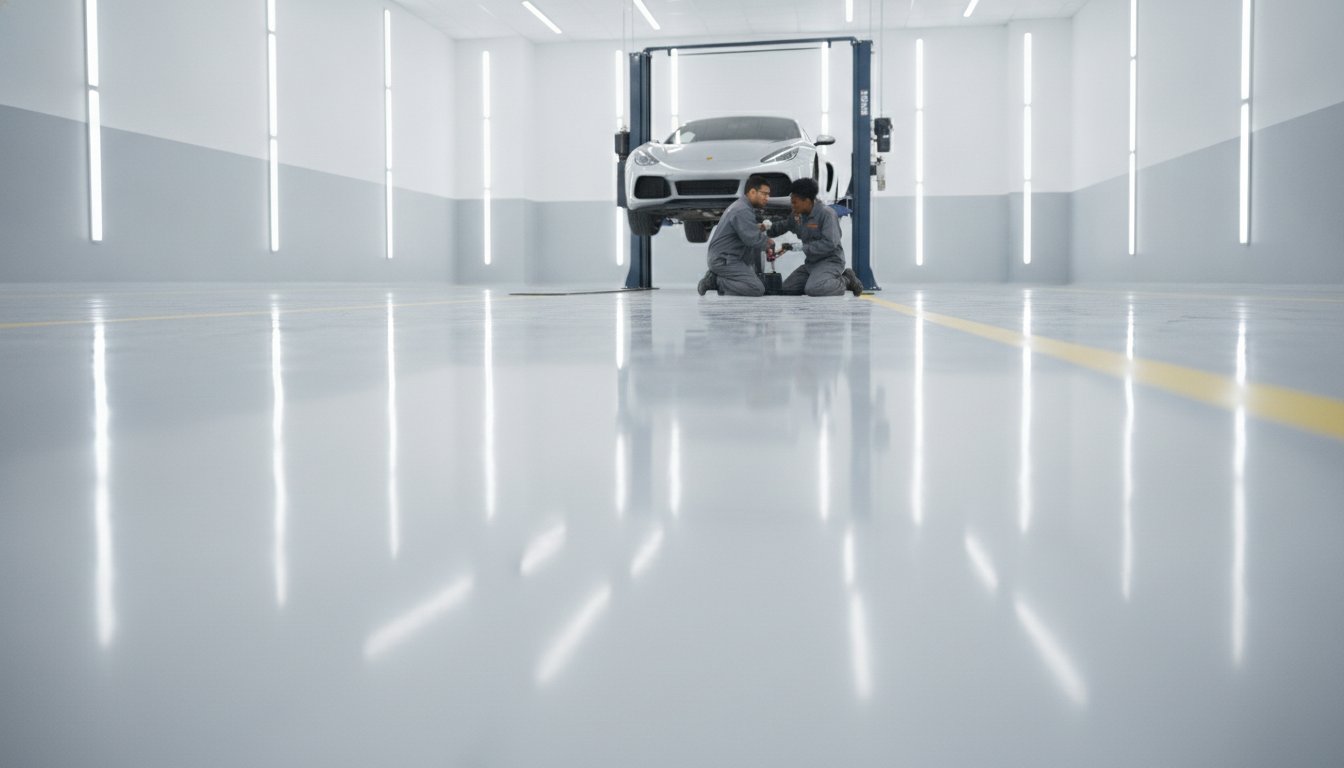
Safety is an engineered outcome. A cluttered, dark, and oily workshop floor isn’t just an eyesore; it’s a liability that threatens both employee health and customer trust. Professional epoxy flooring for automotive workshops provides the foundation for a lean, efficient workflow by transforming the ground into a functional tool. By choosing light-coloured, high-gloss finishes, you significantly increase the ambient light levels within the service bay. This reflectivity improves visibility for technicians working on undercarriages and reduces the energy costs associated with high-intensity overhead lighting.
Visual organization is the next step in shop optimization. A seamless floor allows for the clear demarcation of specific work zones, separating hazardous mechanical areas from customer waiting paths. This isn’t just about aesthetics. It’s about creating a predictable environment where everyone knows exactly where they should be standing. When every tool and vehicle has a designated spot, the risk of accidents drops and productivity rises.
Precision Line Marking for Service Bays
Permanent borders are essential. Unlike paint that chips or tape that peels under the weight of a floor scrubber, durable epoxy floor striping is chemically fused to the base system. We use these markings to define service bay perimeters, “no-go” zones around heavy machinery, and dedicated walking paths. This level of precision is critical for maintaining compliance with Ontario workplace safety standards. It ensures that safety protocols are literally built into the floor, providing a permanent visual guide that never fades under heavy traffic.
Anti-Slip Textures for Wet Bays
Traction is a balance. In a wash bay or a tire change area, the floor is constantly exposed to water, slush, and lubricants. You need aggressive slip resistance to prevent falls, but you cannot sacrifice mop-ability. If the texture is too rough, it traps grease and dirt, becoming impossible to sanitize. We solve this by tailoring the aggregate size to the specific zone. By integrating quartz or aluminum oxide into the topcoat, we provide a surface that grips even when wet while remaining smooth enough for daily cleaning.
A professional workshop deserves a floor that works as hard as the technicians standing on it. If your current floor is a slippery, disorganized mess, it’s time to upgrade to a system that prioritizes both safety and performance. Contact us today for a tailored safety flooring assessment for your GTA facility.
The Standard for Automotive Flooring in the GTA
Experience matters. In the high-stakes environment of a commercial service bay, you cannot afford to hire a generalist contractor. Epoxy Solutions™ has spent over four decades refining the application of epoxy flooring for automotive workshops across North America. We don’t just sell coatings; we engineer specific solutions for facilities where previous systems have failed under the weight of Canadian winters. Our methodical approach ensures that every installation meets the highest industry standards, providing a durable, high-performance surface that stands up to the most demanding point loads and chemical exposures.
Shutting down a workshop is expensive. We understand that every hour your lifts are empty is an hour of lost revenue. Our installation teams prioritize efficiency without compromising on technical accuracy. By utilizing advanced curing technologies and a disciplined project management framework, we minimize operational downtime for GTA businesses. We provide a clear, realistic timeline and stick to it, allowing you to return to full capacity with a floor that is built to last for the next decade.
A Legacy of Performance in Ontario
Since 1981, we have set the benchmark for resinous flooring. Our 45 years of experience in the North American industrial sector allows us to anticipate the specific environmental stresses of the GTA, from humidity shifts in the summer to the corrosive brine of the winter. We act as the authoritative expert fixer for shops that have been burned by low-quality DIY kits or inexperienced installers. Our commitment to rigorous industrial flooring specifications ensures that your facility receives a tailored system designed for extreme capability.
Local Expertise in Toronto and Brampton
Regional challenges require local expertise. Whether you are managing a facility in Toronto, Mississauga, or Brampton, your floor faces unique pressures from road salt and high-volume traffic. We provide direct, solution-oriented service to facility managers who demand reliability over fluff. We know the local building codes and the specific demands of Ontario’s automotive sector. Don’t settle for a temporary fix when you can install a permanent asset. Book a technical consultation with our team today to secure the future of your workshop floor.
Secure Your Facility with Engineered Performance
Concrete failure in an automotive shop is more than an eyesore; it’s a structural liability. A floor that peels under hot tires or cracks under the concentrated pressure of jack stands compromises your entire operation. You need a system engineered for the specific chemical and physical stresses of the GTA. High-build epoxy flooring for automotive workshops provides the necessary thickness and resilience to withstand corrosive road salt and heavy mechanical impacts for over a decade.
Epoxy Solutions™ has been the standard for North American industrial environments since 1981. We specialize in chemical-resistant systems and heavy-duty traffic toppings that consistently outperform standard coatings. Our team serves Toronto, Mississauga, Brampton, and the surrounding GTA, helping facility managers replace failed surfaces with permanent, high-performance assets. Stop managing a deteriorating slab and start investing in a floor that supports your technicians and protects your equipment.
Contact Epoxy Solutions™ for a High-Performance Workshop Floor Consultation and take the first step toward a safer, more professional service bay. Your facility deserves a foundation that won’t back down.
Frequently Asked Questions
Is epoxy flooring too slippery for a mechanic shop when wet?
No, professional epoxy flooring for automotive workshops is not inherently slippery. We customize the surface texture by integrating aggregates like quartz or aluminum oxide into the final topcoat. This provides essential traction for technicians working in wet or oily conditions. The key is balancing slip resistance with ease of cleaning; a texture that is too aggressive will trap grease, while a floor that is too smooth becomes a safety hazard.
How long does an industrial automotive epoxy floor actually last?
A professionally installed high-build system typically lasts 10 to 15 years in a high-traffic service environment. This longevity depends on the mil-thickness and the quality of the initial surface preparation. Unlike thin-film coatings that peel within months, our industrial-grade resinous systems are engineered to withstand the extreme point-load stress of jack stands and heavy machinery common in Toronto and Mississauga workshops.
Can you install epoxy over an old, oil-soaked concrete floor?
Yes, but professional mechanical preparation is mandatory. Standard pressure washing or chemical degreasing cannot remove deep-seated hydrocarbons. We use diamond grinding or shot blasting to remove the contaminated surface layer and open the concrete pores. Following this, we apply specialized oil-stop primers to block outgassing and ensure a permanent chemical bond. Without these steps, any new coating will eventually bubble and lift from the slab.
What is the difference between a garage floor kit and professional epoxy?
The primary differences are thickness and resin density. Retail garage kits are usually water-based and cure to a thickness of only 2 to 3 mils. Professional systems are 100% solids and result in a build of 30 to 125 plus mils. A professional installation provides the structural mass needed to resist hot-tire pickup and mechanical impact, whereas DIY kits lack the bond strength to survive industrial use.
How much downtime should I expect for a workshop floor installation?
Most professional installations require a window of 3 to 5 days. This timeline accounts for mechanical surface preparation, primer application, base coat layering, and final topcoat curing. While we realize that downtime equals lost revenue for Brampton and Milton shops, rushing the curing process compromises the floor’s long-term durability. We coordinate closely with facility managers to organize the project in phases whenever possible.
Does road salt from Canadian winters damage epoxy flooring?
Industrial-grade epoxy is specifically designed to resist the corrosive effects of road salt and winter brine. In the GTA, vehicles carry a constant slurry of salt into service bays, which causes unprotected concrete to pit and degrade through freeze-thaw cycles. Our chemical-resistant flooring creates a non-porous barrier that prevents salt from reaching the slab, protecting the concrete and internal rebar from structural corrosion.
Is polished concrete a better option for automotive workshops than epoxy?
Polished concrete is rarely the best choice for active service bays. While durable, it remains naturally porous and can be stained or etched by motor oil, brake fluid, and battery acid. Epoxy flooring for automotive workshops provides a seamless, impermeable barrier that prevents fluid saturation. It also allows for customized slip resistance and safety line marking, which are difficult to achieve and maintain with a polished concrete finish.
What maintenance is required to keep an automotive epoxy floor in top condition?
Maintenance is straightforward but requires consistency. You should sweep daily to remove abrasive grit and mop weekly using a pH-neutral cleaner. Avoid using stiff-bristled wire brushes or highly acidic cleaning agents that can dull the finish. While our systems are highly chemical-resistant, you should still wipe up aggressive fluids like brake fluid or battery acid promptly to maintain the floor’s high-gloss reflectivity and professional appearance.