Vinyl composition tile is a recurring operational tax. While VCT often appears as the low-cost leader on an initial quote, the reality of constant stripping, waxing, and seam failures makes it a liability for any high-traffic facility. You’ve likely realized that the labour costs and downtime required to maintain these dated surfaces are no longer sustainable. It’s a failed strategy that compromises your budget, safety, and operational hygiene.
Migrating from VCT to a resinous floor system is the definitive solution for stakeholders who prioritize long-term ROI over temporary fixes. This 2026 guide provides the technical roadmap for executing a professional migration that eliminates bacteria-trapping seams and withstands punishing forklift traffic. We’ll examine the lifecycle cost advantages, explore updated safety standards like the ANSI A326.3 benchmark, and detail the specialized preparation required to ensure your new high-performance coating sets the industry standard for durability and performance.
Key Takeaways
- Eliminate the costly cycle of stripping and waxing by identifying why traditional vinyl tile fails to meet modern industrial demands.
- Discover how migrating from VCT to a resinous floor system provides a seamless, hygienic surface that resists chemical damage and heavy forklift traffic.
- Learn the essential technical steps for a professional migration, including mechanical mastic removal and critical moisture testing of the concrete substrate.
- Justify your facility upgrade with a 10-year lifecycle cost analysis that proves the superior ROI of high-performance epoxy over high-maintenance tile.
- Leverage over 40 years of industrial expertise to ensure your floor installation meets the latest 2026 safety and durability benchmarks.
The VCT Maintenance Trap: Why Traditional Tile Fails Industrial Demands
Vinyl Composition Tile (VCT) was once the standard for commercial interiors across Ontario. It offered a low entry price and a predictable, albeit dated, aesthetic. However, industrial environments have evolved. What worked for a 1980s retail space cannot withstand the rigours of a modern 24/7 manufacturing facility. The modular nature of VCT is its primary technical flaw. Unlike seamless flooring systems, VCT relies on thousands of individual tiles held down by moisture-sensitive adhesives. This creates a fragmented surface that is prone to failure at every joint.
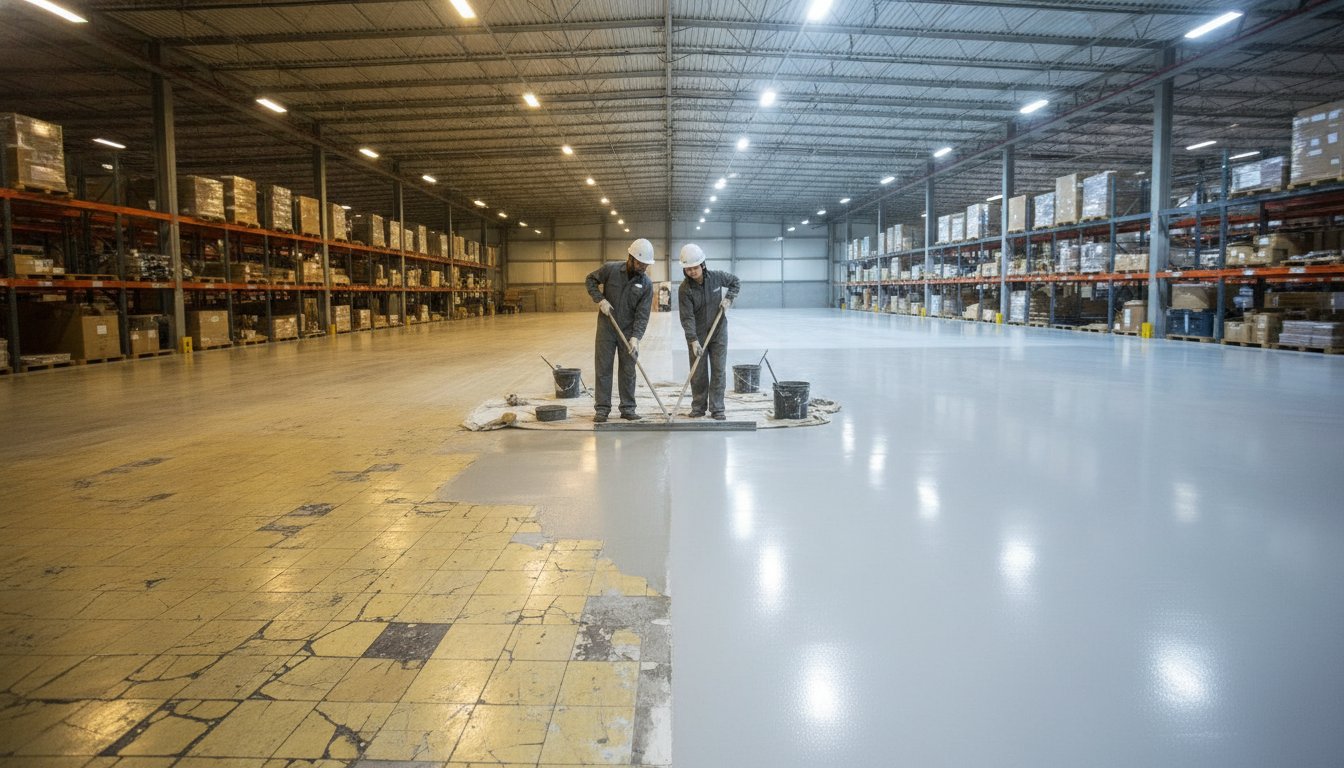
Heavy equipment is the primary enemy of vinyl. Forklifts and pallet jacks exert immense point loads that VCT simply wasn’t engineered to handle. Over time, these loads pulverize the brittle tile core, leading to cracking and delamination. Once the structural integrity of a single tile is compromised, the surrounding area quickly follows. This is why facility managers are increasingly migrating from VCT to a resinous floor system that bonds directly to the concrete substrate, creating a monolithic shield that absorbs impact rather than shattering under it.
The Hidden Cost of VCT Upkeep in the GTA
Maintenance is a budget killer. The “wax and strip” cycle is a relentless labour drain that requires specialized equipment and recurring chemical purchases. In the GTA, the cost of professional labour continues to rise, making this manual process a significant financial burden. Beyond the direct costs, the environmental impact of harsh stripping chemicals is a growing concern for Ontario facilities aiming for greener operational standards. High VOC emissions from these solvents often require ventilation shutdowns. Every time a floor is stripped, your facility faces operational downtime, which is a hidden cost that often exceeds the price of the maintenance itself.
Sanitation and Safety: The Invisible Risks
Pathogens thrive in seams. Every joint between VCT tiles is a potential colony for bacteria and moisture, making them entirely unsuitable for food-grade or pharmaceutical environments. As the adhesive ages, tiles begin to “curl” at the edges. These micro-elevations create significant trip hazards for staff and cause vibration damage to sensitive rolling equipment. VCT is also inherently porous. When spills occur, liquids penetrate the surface and the seams, leading to permanent staining and persistent odours that no amount of surface waxing can resolve. Modern safety demands a seamless, non-porous solution that meets the ANSI A326.3 benchmark for slip resistance, a standard VCT struggles to maintain once its topical wax begins to wear.
Resinous Flooring Systems: The Seamless Alternative to Vinyl Tile
Resinous flooring is a high-performance category encompassing epoxy, urethane, and MMA (Methyl Methacrylate) systems. Unlike VCT, which is a collection of individual tiles prone to shifting, a resinous system is a fluid-applied liquid that cures into a monolithic, seamless surface. This lack of joints is a fundamental shift in facility hygiene. When you eliminate the seams, you eliminate the primary breeding ground for pathogens and moisture. For many facility managers, migrating from VCT to a resinous floor system is the first step toward achieving a truly sterile and durable environment.
Durability is where the distinction becomes undeniable. VCT relies on a topical adhesive to stay in place, making it susceptible to lifting when moisture migrates through the slab. In contrast, resinous systems achieve a mechanical bond with the concrete substrate. For a successful installation, the slab must meet specific Floor Flatness Standards to ensure the resin distributes evenly and bonds correctly. This structural integration is why resinous flooring is considered a capital improvement rather than a mere cosmetic update. It doesn’t just sit on the floor; it becomes the floor.
Epoxy Coatings vs. Urethane Mortars
Choosing the right material depends on your specific operational environment. High-build epoxy coatings provide excellent wear resistance and a high-gloss finish suitable for standard commercial traffic and light manufacturing. However, if your facility deals with thermal shock, heavy impact, or constant washdowns, urethane mortars are the industry benchmark. These systems possess a thermal expansion coefficient similar to concrete, preventing delamination during rapid temperature changes. You can review detailed technical benchmarks in our industrial flooring specifications to determine which chemistry fits your floor’s demand profile.
Aesthetic and Safety Customization
Safety is integrated into a professional resinous installation. We apply precision line marking directly into the system, ensuring hazard zones never peel like tape. For facilities with high UV exposure, we utilize UV-resistant topcoats to prevent ambering. We also provide anti-static (ESD) options for electronics manufacturing where sensitive components require protection from static discharge. If you’re ready to move beyond tile, our team can help you navigate industrial flooring specifications to find the right fit for your facility.
The Migration Blueprint: From Tile Removal to Surface Preparation
Execution requires precision. A successful transition begins with the complete eradication of the existing floor. Migrating from VCT to a resinous floor system is not a cosmetic overlay; it is a structural integration. The process starts with the mechanical removal of every vinyl tile and, crucially, the underlying mastic adhesive. Leaving even trace amounts of old glue compromises the bond of the new resin, leading to localized delamination that can eventually shut down a production line.
Once the slab is bare, we perform a rigorous assessment of the concrete’s structural integrity. This stage includes moisture vapour emission rate (MVER) testing. High moisture levels in Ontario’s concrete slabs can cause osmotic blistering if not addressed with specialized moisture-mitigation primers. After validation, we utilize diamond grinding or shot blasting to achieve the specific Concrete Surface Profile (CSP) required for the selected resin. Finally, all cracks and expansion joints are filled with high-strength resinous fillers to create the perfectly monolithic surface required for modern industrial hygiene.
Why ‘Coating Over Tile’ is a Professional Non-Starter
Shortcuts lead to failure. Some contractors suggest applying epoxy directly over well-adhered VCT to save on labour. This is a technical disaster. Your new floor is only as strong as the decades-old glue holding the vinyl to the slab. This “weakest link” approach ignores the risk of outgassing, where trapped air or moisture beneath the tile expands and ruptures the new coating. Epoxy Solutions™ maintains a blunt stance: we do not coat over tile. We build floors to last decades, not months, and that requires a direct bond to a properly prepared concrete substrate.
The Role of Diamond Grinding in Ontario Facilities
Mechanical profiling is non-negotiable. Diamond grinding opens the pores of the concrete, allowing the resin to penetrate and form a mechanical lock. There is a vast difference between a floor that looks clean and one that is properly profiled. To keep GTA facilities operational, we employ advanced dust-contained grinding technology. This high-efficiency filtered system captures particulates at the source, allowing neighbouring zones to remain active during the migration. This meticulous approach ensures a standard-setting finish without compromising your facility’s air quality or production schedule.
Lifecycle Cost Analysis: Justifying the Migration to Resinous Coatings
VCT is a financial liability disguised as a budget-friendly option. While the initial procurement cost of vinyl tile appears lower on a balance sheet, the long-term operational expenses are staggering. Facility managers often overlook the compounding costs of labour, specialized chemicals, and equipment depreciation required to keep VCT functional. Migrating from VCT to a resinous floor system shifts your flooring from a recurring maintenance tax to a durable capital asset. This transition isn’t just about aesthetics; it’s a strategic move to stabilize your facility’s long-term budget.
The impact extends to your mobile assets. Fragmented VCT surfaces with failing seams create constant vibration and impact for forklifts and pallet jacks. This accelerated wear on tires and suspension systems leads to increased fleet maintenance costs and premature equipment replacement. A seamless resinous surface provides a consistent, level plane that protects your machinery and improves operator comfort. For commercial property owners, this upgrade also secures ‘Class A’ appeal, significantly increasing property value and attracting high-quality industrial tenants who prioritize operational excellence.
The 10-Year Financial Breakdown
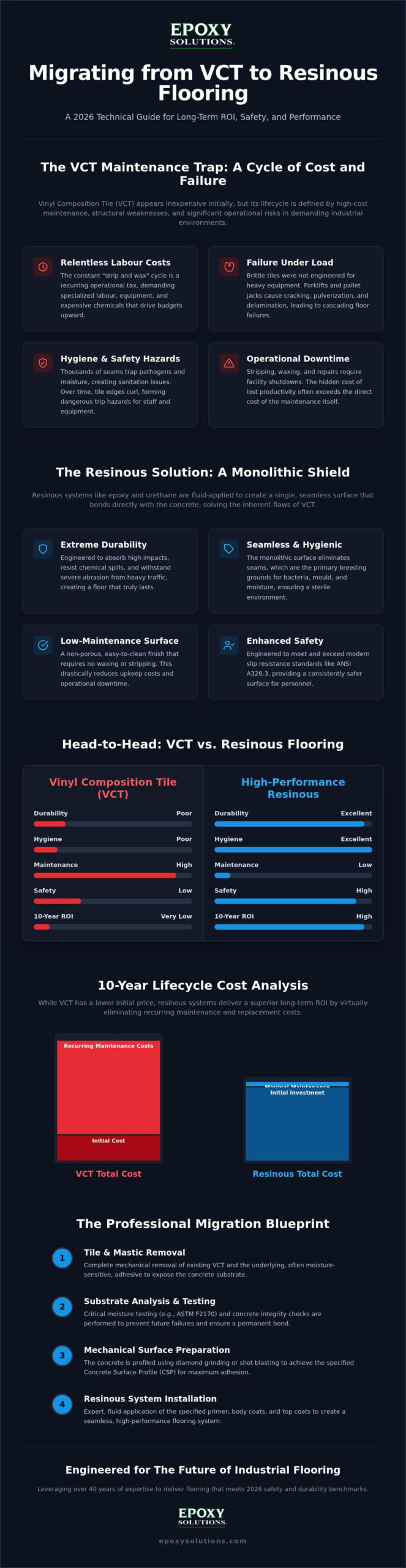
Data-driven decisions require a clear view of total cost of ownership (TCO). A 10-year cost analysis for a typical 10,000 square foot space reveals a total expenditure of $185,000 for VCT when accounting for the relentless “wax and strip” cycle. In contrast, a high-performance epoxy system totals approximately $82,000 over the same period. This represents a 56% savings, with the breakeven point typically occurring within 2 to 3 years. You can find more detailed ROI comparisons in our polished concrete vs epoxy flooring cost guide to help justify your next facility upgrade.
Operational Efficiency and Downtime
Maintenance shutdowns are productivity killers. VCT requires bi-annual stripping and waxing, which forces entire zones to go dark for days. A professional resinous installation can last 15 years or more with minimal intervention, effectively eliminating these recurring disruptions. There is also a significant safety ROI; engineered textures reduce slip-and-fall incidents, potentially lowering insurance premiums. Furthermore, high-reflectivity coatings can reduce facility lighting requirements, leading to measurable energy savings. If you want to stop the maintenance drain, you can contact our team for a technical consultation on your facility’s specific needs.
Executing Your Upgrade with Epoxy Solutions™
Experience defines reliability. At Epoxy Solutions™, we bring more than 40 years of North American industrial expertise to every project we undertake. We don’t settle for “good enough” when migrating from VCT to a resinous floor system. Our team follows a no-nonsense approach that prioritizes meticulous mechanical surface preparation over the quick, low-quality fixes that often lead to premature failure. We serve the entire Greater Toronto Area, providing specialized, standard-setting installations in Toronto, Mississauga, Brampton, and the surrounding regions. The final result is a high-performance surface engineered to outlast the building itself. We take pride in being the authoritative expert fixers who step in when others have failed to deliver on quality or longevity.
Our legacy in the flooring industry is built on technical accuracy and a deep-seated pride in craftsmanship. We understand that an industrial floor is a critical piece of infrastructure, not just a surface to walk on. By choosing a partner with a 40-year history, you’re investing in a floor that has been tested in the most demanding environments across the globe. We don’t just follow the standards; we set the benchmark for what a premium industrial floor should be.
Tailored Specifications for GTA Industries
Toronto’s industrial landscape is exceptionally diverse. We realize that a food processing plant in Mississauga has vastly different requirements than a heavy electronics manufacturing facility in Brampton. Our experts customize every system, selecting specific chemistries like chemical-resistant epoxies or anti-static options to match your unique demand profile. We prioritize the use of premium low-VOC, high-solids materials for our installations. This commitment ensures better indoor air quality for your staff and reduces the environmental footprint of the upgrade. Our history in Ontario allows us to navigate the specific logistical and environmental challenges of the local market with ease.
Starting Your Migration Journey
Precision starts with a thorough on-site consultation. We don’t guess; we verify. We examine your substrate to identify hidden challenges like moisture vapour emissions or contaminated concrete before a single tile is removed. Our team manages the entire transition process, including strict scheduling and logistics, to minimize operational impact on your facility. You can expect a transparent timeline and a dedicated project manager who ensures every technical specification is met with absolute accuracy. We move you from a state of concern about failing tile to total confidence in a durable, seamless floor. Contact Epoxy Solutions™ today to schedule your facility assessment.
Secure Your Facility’s Operational Future
VCT is a legacy material that no longer meets the rigorous hygiene or durability requirements of modern industrial environments. The constant labour and chemical costs associated with vinyl are an unnecessary tax on your facility’s bottom line. By migrating from VCT to a resinous floor system, you replace a fragmented, high-maintenance surface with a seamless, high-performance shield that withstands heavy forklift traffic and simplifies daily sanitation protocols.
Epoxy Solutions™ brings an industry-leading 40-year track record to every project. We don’t just follow the standards; we define them. Our team utilizes specialized diamond grinding equipment to ensure an accurate mechanical bond that stands the test of time. Serving Toronto and the entire GTA, we specialize in resolving failed surfaces and setting the benchmark for industrial durability. The transition to a resinous system is a strategic investment in safety, operational efficiency, and long-term property value. We’re ready to help you execute a professional migration that protects your assets for decades. Take the first step toward a standard-setting, maintenance-free floor today.
Request a Professional Floor Assessment from Epoxy Solutions™
Frequently Asked Questions
Can I install epoxy directly over my existing VCT tile?
No. You cannot install epoxy directly over VCT if you want a floor that lasts. A professional installation requires the complete mechanical removal of tiles and underlying mastic. If you leave the vinyl in place, your new system is only as strong as the original adhesive; which often fails under industrial loads. At Epoxy Solutions™, we prioritize structural integrity by diamond grinding the slab to ensure a direct, permanent bond to the concrete.
How long does it take to migrate a 5,000 sq. ft. facility from VCT to epoxy?
A 5,000 square foot facility migration typically requires four to five business days. This timeline accounts for the mechanical removal of VCT, mastic grinding, and the application of a multi-coat resinous system. Factors like moisture levels in Mississauga or Toronto slabs and the specific curing time of the selected materials can influence the schedule. We coordinate logistics to minimize downtime, ensuring your facility returns to full operation as quickly as possible without compromising quality.
Is resinous flooring more slippery than waxed VCT?
Resinous flooring is significantly safer than waxed VCT when properly specified. While polished vinyl relies on topical wax that becomes treacherous when wet, resinous systems utilize integrated slip-resistant aggregates. We tailor the texture to meet the ANSI A326.3 benchmark for a wet Dynamic Coefficient of Friction of 0.42 or greater. This ensures your staff in Brampton or Vaughan remain safe even in high-moisture or chemical-spill environments.
What is the most durable resinous system for a high-traffic warehouse?
For high-traffic warehouses, urethane mortars or high-build epoxy systems are the most durable choices. These systems provide superior impact resistance and bond strength compared to modular tiles. When migrating from VCT to a resinous floor system, we often specify urethane mortars for facilities facing thermal shock or heavy forklift traffic. These materials set the standard for longevity in the GTA’s demanding industrial sectors, outperforming traditional vinyl by a significant margin.
How do I maintain a resinous floor once the migration is complete?
Maintenance is remarkably simple compared to the “wax and strip” cycle of VCT. You only need regular sweeping and mopping with a pH-neutral cleaner to keep the surface pristine. Because the floor is seamless and non-porous, dirt and pathogens cannot hide in joints. This eliminates the need for expensive chemical strippers and specialized waxing equipment, providing a clear ROI for facility managers in Toronto looking to reduce long-term operational costs.
Will the smell of the epoxy installation affect my employees?
Modern high-solids epoxy and urethane systems have very low VOC levels and minimal odour. While some specialized fast-cure materials like MMA have a noticeable scent during application, we utilize advanced ventilation and low-odour specifications for most GTA projects. This allows for safer installations in occupied buildings. We discuss material selection during the consultation to ensure the process doesn’t disrupt your employees or compromise the indoor air quality of your facility.
What happens if my concrete slab has moisture issues after the VCT is removed?
If moisture vapour emission rate (MVER) testing reveals high levels after tile removal, we apply specialized moisture-mitigation primers. These high-performance resins are engineered to withstand significant osmotic pressure, preventing the floor from blistering or delaminating. This is a critical step in the Ontario market, where older slabs often lack a proper vapour barrier. We address these sub-floor challenges during the preparation phase to guarantee a standard-setting finish.
Does Epoxy Solutions™ offer warranty coverage for VCT migrations?
Epoxy Solutions™ stands behind every professional installation with comprehensive warranty coverage. Our 40-year legacy in the industrial sector is built on reliability and high standards. We don’t just provide a service; we provide a long-term solution for your facility’s infrastructure. When migrating from VCT to a resinous floor system with our team, you’re partnering with an “Expert Fixer” who ensures every technical specification is met with absolute accuracy and precision.