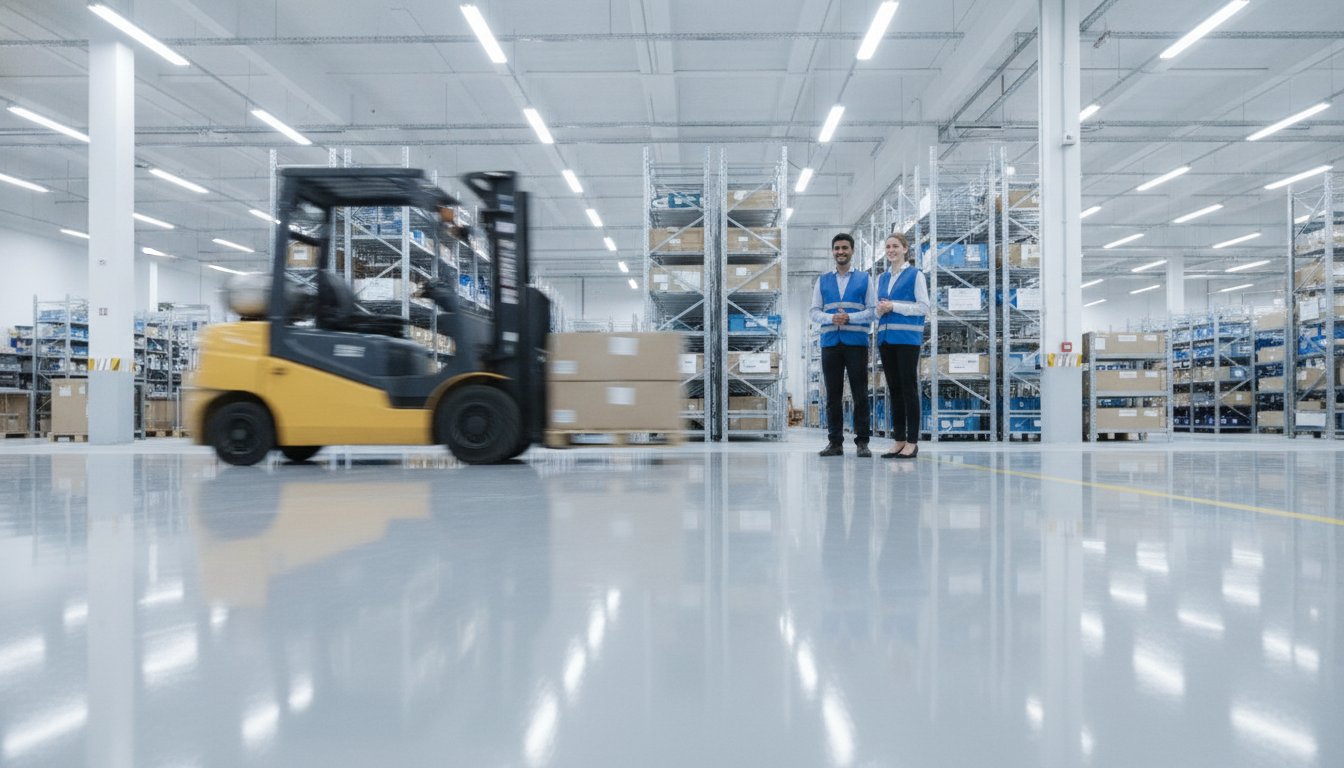
A floor is not a surface. In the high-intensity manufacturing hubs of Peel Region, your floor is a technical component that’s either an asset or a liability. Most facility managers realize too late that a standard coating cannot withstand the relentless abuse of heavy machinery or chemical exposure. If you’re currently managing industrial epoxy flooring Brampton projects, you’ve likely experienced the frustration of recurring delamination or the stress of a safety audit. These failures aren’t just an eyesore; they’re an operational hazard that compromises your bottom line.
You deserve a maintenance-free environment that meets every industrial safety and chemical standard without constant repair cycles. This guide provides the technical roadmap for selecting and installing flooring engineered to last 15 years or more. We’ll examine the engineering behind chemical-resistant systems, explain how to ensure compliance with the Ontario Building Code, and detail the meticulous preparation required to keep your operations running without disruption. It’s time to stop patching problems and start installing solutions that actually last.
Key Takeaways
- Learn why high-performance industrial epoxy flooring in Brampton requires an engineering-first approach to survive the intense stress of heavy forklift traffic and logistics operations.
- Understand the technical differences between resinous chemistries to ensure your facility’s floor meets specific chemical resistance and safety standards.
- Discover why mechanical diamond grinding is the only acceptable method for surface preparation to prevent the common failures of peeling and delamination.
- Realize the importance of professional moisture testing and site evaluations in securing a maintenance-free floor that lasts for over 15 years.
- Explore how specialized industrial coatings contribute to facility sustainability and support your goals for LEED certification.
Why Industrial Epoxy Flooring in Brampton Demands an Engineering-First Approach
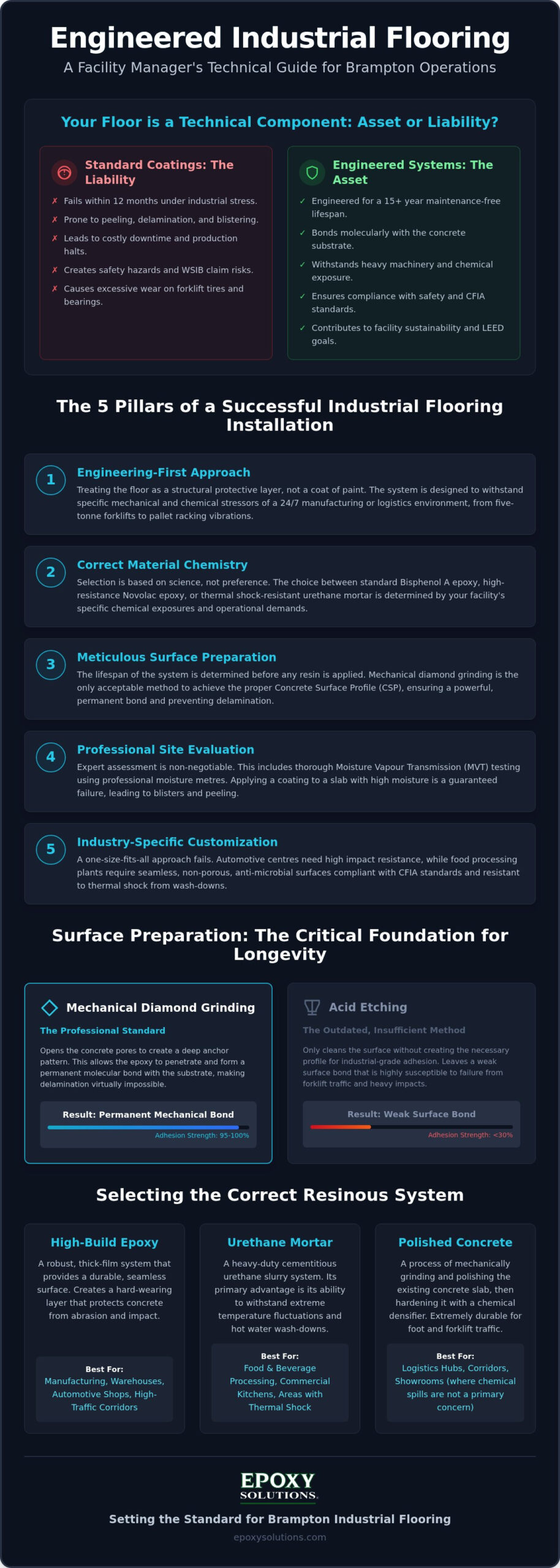
Paint peels. Engineering lasts. Facility managers often mistake industrial epoxy flooring Brampton for a simple aesthetic upgrade, but the reality is far more technical. A high-performance resinous system is a structural protective layer designed to bond with the concrete substrate at a molecular level. Unlike thin-film coatings or “off-the-shelf” retail products that fail within 12 months, true industrial epoxy is engineered to withstand the specific mechanical and chemical stressors of a 24/7 manufacturing environment.
Brampton’s position as a premier North American logistics hub creates unique challenges for facility surfaces. The constant vibration from heavy pallet racking and the lateral shear forces generated by five-tonne forklifts will shred a standard floor in weeks. Success requires a precise Concrete Surface Profile (CSP). We prioritize mechanical diamond grinding over outdated acid etching to create the necessary anchor pattern for long-term adhesion. Without this mechanical bond, delamination isn’t just a possibility; it’s a certainty.
The Economic Impact of Floor Failure in Local Facilities
Downtime kills profits. The true cost of a floor failure isn’t the price of the resin; it’s the thousands of dollars lost during an unplanned production halt. In Ontario, a peeling floor is a major liability that increases the risk of workplace accidents and WSIB claims. Furthermore, degraded surfaces cause excessive wear on equipment. Rough, uneven floors destroy forklift tires and bearings, leading to maintenance costs that far exceed the price of a premium flooring installation.
Brampton’s Industrial Landscape and Flooring Requirements
Different sectors demand tailored specifications. Automotive parts distribution centres require high impact resistance and line marking that won’t fade under heavy traffic. Conversely, food processing plants in the GTA must manage thermal shock and strict hygiene requirements. These facilities need seamless, non-porous surfaces that comply with Canadian Food Inspection Agency (CFIA) standards. By integrating anti-microbial agents and slip-resistant textures, we ensure your facility remains compliant with the Ontario Building Code while protecting your workforce from environmental hazards. We don’t just apply a coating; we install a high-performance technical component designed for the specific rigours of your industry.
Selecting Concrete Protective Coating Specialists: Materials and Performance
Material selection is not a matter of preference; it is a matter of chemistry. Most general contractors default to standard Bisphenol A epoxy because it’s cost-effective and easy to apply. However, in environments requiring extreme acid resistance or high-temperature stability, Novolac epoxy is the only viable choice. Choosing the wrong resin for industrial epoxy flooring Brampton projects leads to rapid degradation and substrate exposure. We evaluate the specific chemicals used in your facility to ensure the coating’s molecular structure can actually withstand the environment.
Preparation determines the lifespan of the system. While some installers still rely on acid etching, this method is insufficient for industrial-grade adhesion. We utilize mechanical diamond grinding to open the concrete pores and remove surface laitance. This process also allows us to address Moisture Vapour Transmission (MVT). If moisture levels in the slab are high, the coating will blister and delaminate. Professional installers must use moisture metres to verify the slab is ready for a high-performance system before a single drop of resin is mixed.
High-Build Epoxy vs. Urethane Mortar vs. Polished Concrete
Choosing the right system depends on your operational stressors. High-build epoxy provides excellent impact resistance for manufacturing, while urethane mortars are essential for food processing areas that face thermal shock from hot water wash-downs. For facilities focused on low maintenance and high traffic, comparing polished concrete vs epoxy flooring cost is a critical first step. Polished concrete offers extreme durability in corridors where chemical spills aren’t a primary concern, whereas resinous systems are required for full substrate protection.
Chemical Resistance and Containment Standards
Secondary containment is a regulatory requirement, not an option. Facilities with battery charging stations or bulk chemical storage must utilize lining systems that prevent hazardous materials from reaching the soil. You must evaluate chemical resistance charts against the specific concentrations of acids or solvents present in your facility. Our team specializes in tailored chemical containment systems that meet provincial environmental standards while providing a safe, slip-resistant work surface. Don’t rely on a generalist to interpret technical data. Ensure your specialist understands the specific resistance levels required for your industry to avoid catastrophic floor failure.
Performance Standards for Brampton’s Critical Environments
A floor is a safety device. In Brampton’s heavy-industrial landscape, meeting performance standards is the difference between a facility that passes inspection and one that faces heavy fines. We move beyond the visual finish to integrate technical precision into every square foot. This includes leveraging high-reflectivity coatings that act as light amplifiers. In massive logistics centres, a brighter floor reduces the demand on overhead lighting, directly lowering energy expenditures while improving worker visibility.
Sustainability is no longer a peripheral concern. With water-based, eco-friendly epoxy formulations projected to hold 45.70% of the market share by 2026, we prioritize low-VOC systems that support LEED certification. These coatings don’t just protect the concrete; they enhance the environmental profile of the entire building. We also address the common objection that resinous floors are inherently slippery. By suspending specialized aggregates like aluminum oxide in the topcoat, we create a surface that provides superior traction even in wet conditions, effectively neutralizing slip-and-fall hazards.
Anti-Static and ESD Solutions for Electronics and Data Centres
Static kills sensitive electronics. For facilities handling microchips or high-density data, standard industrial epoxy flooring Brampton specifications are insufficient. We engineer anti-static flooring for critical environments to bleed off electrostatic charges safely into a dedicated grounding point. This prevents catastrophic component failure and ensures your facility meets rigorous international testing and certification requirements for ESD-protected areas.
Precision Line Marking and Safety Compliance
Paint is temporary; epoxy is permanent. Most facility managers waste thousands annually repainting lines that wear away under forklift traffic. We utilize durable epoxy floor striping to define pedestrian zones and hazardous aisles with surgical precision. These markings are chemically bonded to the floor system, ensuring they remain vibrant and visible. This level of clarity is essential for maintaining compliance with the Accessibility for Ontarians with Disabilities Act (AODA) and provincial workplace safety regulations, where stable, slip-resistant, and clearly marked surfaces are a legal mandate.
The Facility Manager’s Resource: 5 Pillars of a Successful Installation
Precision is non-negotiable. A successful industrial epoxy flooring Brampton project is not the result of a lucky application; it’s the outcome of a disciplined engineering process. For facility managers, the installation phase is where the long-term ROI of the floor is secured or squandered. It starts with a comprehensive site evaluation that goes beyond a visual inspection. We identify hidden concrete contamination, such as deep-seated oil saturation or old silicate sealers, which act as bond-breakers if not properly mitigated. Ignoring these subsurface issues is the primary cause of premature floor failure.
Moisture is the second pillar. Professional moisture testing is a mandatory requirement, not an optional service. We measure Moisture Vapour Transmission (MVT) to ensure the slab won’t blow the coating off from the inside out. Following this, meticulous surface preparation via mechanical diamond grinding creates the industry-standard profile needed for a permanent mechanical bond. Finally, we manage the internal climate. Humidity and temperature must be strictly controlled during the application and curing phases to ensure the resin reaches its full design strength. Once installed, treating the floor as a technical asset through proper maintenance will maximize its lifespan for 15 years or more.
Industrial Flooring for Food Processing and Hygiene
Hygiene standards in Ontario are uncompromising. When designing seamless resinous flooring systems for food processing plants, we focus on eliminating bacterial harbourage points. This requires integrated coving and precision drainage slopes to prevent standing water at floor-to-wall transitions. These non-porous surfaces are engineered to meet CFIA and local health inspection standards, providing a sterile environment that can withstand aggressive chemical wash-downs and thermal shock without cracking or peeling.
Evaluating Contractor Qualifications and Warranty
Accountability matters. You should prioritize contractors who utilize 100% in-house teams rather than subcontracting the labour. This ensures total quality control from the first grind to the final topcoat. When reviewing a proposal, decipher the warranty language carefully. Most “lifetime” warranties only cover material failures, which are rare, while excluding installation errors, which are common. Before signing, ask polished concrete contractors in Toronto and Brampton about their specific moisture mitigation protocols and surface profile verification methods. To ensure your next project meets these rigorous standards, request a technical site evaluation from a seasoned industry veteran.
Epoxy Solutions™: Setting the Standard for Brampton Industrial Flooring
Results define reputation. Since 1981, Epoxy Solutions™ has operated as an industry leader in resinous flooring and polished concrete across North America. We don’t just follow industry standards; we set them. Our “Problem-First” approach means we’re often the firm called in when a previous industrial epoxy flooring Brampton installation has failed. We identify the root cause of delamination or chemical degradation and provide a definitive, engineered answer that ensures the second application is the final one.
Extreme capability is our baseline. Whether it’s a high-traffic logistics hub in the GTA or a specialized chemical containment area, we possess the technical expertise to perform under pressure. We don’t offer generic, one-size-fits-all products. Instead, we provide customized specifications that tailor the resin chemistry to your facility’s exact environmental stressors. From UV-resistant coatings to heavy-duty traffic toppings, every system is designed for maximum longevity and operational safety.
Our Commitment to Industrial Durability
We refuse to compromise. Quality begins with the substrate, and we never skip the meticulous mechanical preparation required for a permanent bond. Our legacy is built on solving complex flooring challenges where others have seen only obstacles. By utilizing premium materials and high-performance specifications, we deliver a guarantee of performance that exceeds standard industry benchmarks. Our case studies across Brampton’s automotive and manufacturing sectors prove that a correctly engineered floor is a generational investment, not a recurring expense.
Next Steps for Your Brampton Facility
Secure your infrastructure today. The path to a maintenance-free floor begins with a professional technical site assessment. We don’t guess at moisture levels; we perform rigorous moisture testing to ensure your slab is a viable candidate for resinous systems. Once the data is gathered, we develop a phased installation plan specifically designed to minimize operational downtime. We understand that your facility cannot stop for a floor. Contact the specialists at Epoxy Solutions™ to define a high-performance flooring specification that will protect your asset for the next 15 years.
Secure Your Facility’s Future with Engineered Flooring
A floor is a technical asset, not a cosmetic choice. In Brampton’s aggressive industrial landscape, choosing the right system is the difference between a 15-year asset and a 12-month failure. We’ve established that industrial epoxy flooring Brampton requires an engineering-first mindset, prioritizing mechanical diamond grinding and precision moisture testing. These steps are the only way to prevent delamination and ensure your facility meets strict provincial safety and hygiene standards.
Don’t leave your operations to chance. Since 1981, Epoxy Solutions™ has specialized in high-performance resinous systems that survive where others fail. With North American-wide expert installation teams, we provide the technical accuracy and specialized materials your facility needs to stay productive and compliant. It’s time to stop managing floor failures and start investing in a permanent solution.
Request Your Technical Site Assessment from Epoxy Solutions™ and take the first step toward a maintenance-free, high-performance environment.
Frequently Asked Questions
How long does an industrial epoxy floor installation take in Brampton?
Most installations require three to five business days depending on the square footage and the required surface preparation. Day one involves mechanical diamond grinding to open the concrete pores. Subsequent days involve applying the primer, base coat, and high-performance topcoats. While the floor is often walkable within 24 hours, full chemical resistance and heavy forklift traffic typically require a seven-day cure period for maximum durability.
Can epoxy flooring be installed over old or contaminated concrete?
Yes, provided the substrate undergoes aggressive mechanical preparation. Contaminated concrete requires deep degreasing and shot-blasting or diamond grinding to reach a clean, sound layer. If oil saturation is deep, we utilize specialized oil-stop primers to prevent bond failure. Installing industrial epoxy flooring Brampton over improperly prepped concrete is the leading cause of delamination, so we never skip these critical remediation steps.
What is the difference between a garage epoxy coating and an industrial epoxy system?
Thickness and chemistry define the difference. Residential garage kits are thin-film coatings designed for light foot traffic and basic aesthetics. Industrial systems are high-build, resinous environments engineered for impact, chemical resistance, and heavy machinery loads. These premium systems use 100% solids epoxy or urethane mortars that bond at a molecular level, providing a structural protective layer that outlasts retail-grade paints by decades.
How do I know if my facility needs a moisture vapour barrier?
Professional moisture testing is the only way to determine this need. We measure the Moisture Vapour Transmission (MVT) rate using calcium chloride or relative humidity probes. If the slab emits moisture above industry-standard thresholds, a specialized moisture vapour barrier is required. Without this barrier, osmotic pressure will build under the resin, leading to inevitable blistering and the eventual destruction of the floor system.
Is polished concrete a better option than epoxy for my warehouse?
The choice depends on your operational requirements. Polished concrete is an excellent, low-maintenance solution for high-traffic aisles where chemical spills aren’t a concern. However, if your facility handles acids, oils, or heavy manufacturing, an epoxy system is necessary for full substrate protection. Resinous floors provide a seamless, non-porous barrier that polished concrete cannot match, especially in environments requiring strict hygiene or chemical containment.
What maintenance is required for a high-performance resinous floor?
Maintenance is minimal but essential for longevity. Regular sweeping and scrubbing with pH-neutral cleaners will remove abrasive grit that can dull the finish over time. Unlike traditional flooring, these systems never require waxing or stripping. For heavy-industrial settings, a scheduled mechanical scrubbing routine ensures the slip-resistant texture remains effective and the floor stays compliant with provincial safety and hygiene standards.
Does Epoxy Solutions™ provide safety line marking and floor striping?
Yes, we specialize in permanent epoxy line marking. Unlike standard floor paint that wears away under forklift traffic, our striping is chemically bonded to the floor system. This ensures that pedestrian walkways, forklift aisles, and hazardous zones remain clearly defined for years. Precision line marking is a critical component for maintaining a safe, organized, and WSIB-compliant industrial environment in Ontario.
How do industrial epoxy floors improve facility safety and compliance?
These systems enhance safety by providing reliable slip resistance and superior visibility through light-reflective finishes. They ensure compliance with the Ontario Building Code and AODA by creating stable, non-hazardous surfaces. Additionally, specialized chemical-resistant coatings provide secondary containment for hazardous materials, protecting both your workforce and the environment from accidental leaks or spills in your Brampton facility.