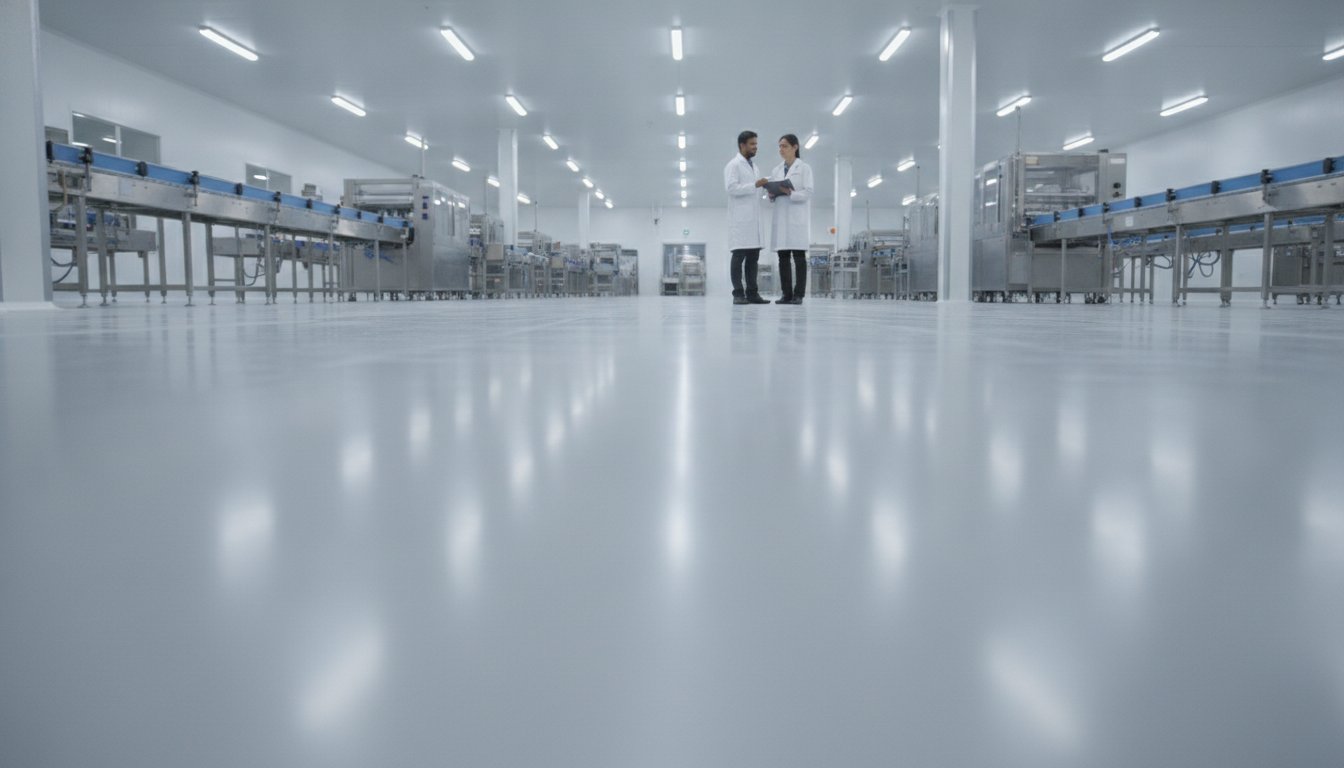
Your floor is equipment. It isn’t just a coating; it’s a high-performance engineered system designed to survive biological and thermal warfare. In a high-volume facility, the wrong choice leads to peeling surfaces near ovens and bacteria-trapping grout lines that fail CFIA audits. You already know that a single floor failure can stop production for days, costing more in lost revenue than the original installation. Selecting the right food processing plant flooring requires more than just picking a colour. It demands a technical understanding of thermal shock, chemical resistance, and the 2026 Prohibition of Certain Toxic Substances Regulations.
We’ve seen every industrial failure since 1981, and we know how to prevent them before the first gallon of resin is poured. This guide provides the technical roadmap you need to master food-grade standards and ensure your facility remains safe for the next decade. We’ll examine the engineering behind urethane mortars, analyze the impact of new chemical restrictions, and detail the precise installation methods that eliminate downtime. You’ll realize the clarity needed to choose a seamless system that withstands heavy traffic and simplifies your cleaning cycles.
Key Takeaways
- Eliminate bacterial harbours by understanding the critical role of fluid-applied, non-porous surfaces in maintaining a hygienic facility.
- Compare the technical performance of epoxy coatings against urethane mortars to select the system that survives extreme thermal shock and chemical exposure.
- Navigate the 2026 Canadian regulatory landscape, including CFIA standards and HACCP requirements, for high-performance food processing plant flooring.
- Map your facility’s high-risk zones to prevent common failures like peeling near ovens or impact damage in heavy traffic aisles.
- Implement an engineered approach to installation that prioritizes long-term durability and safety over the lowest initial bid.
What is Seamless Resinous Flooring and Why is it Essential?
Seams are failures. In a food production environment, any break in the floor surface is an invitation for contamination. Seamless polymer flooring is a fluid-applied, non-porous system that bonds directly to the concrete substrate, creating a monolithic barrier. Unlike traditional tile, which relies on porous grout lines, these resinous systems eliminate the crevices where organic matter and moisture accumulate. If your floor has a seam, it has a failure point that will eventually compromise your facility’s safety and longevity.
Traditional tile and grout fail because they can’t withstand the constant moisture and aggressive cleaning cycles required for modern food processing plant flooring. Grout is inherently absorbent and structurally weak. Over time, it cracks and erodes under the stress of heavy forklifts and acidic food byproducts. This allows washdown water to seep beneath the tiles, creating a hidden environment for anaerobic bacteria to flourish. These bacterial reservoirs often lead to foul odours and failed health inspections long before the damage is visible on the surface.
The Anatomy of a High-Performance Resinous System
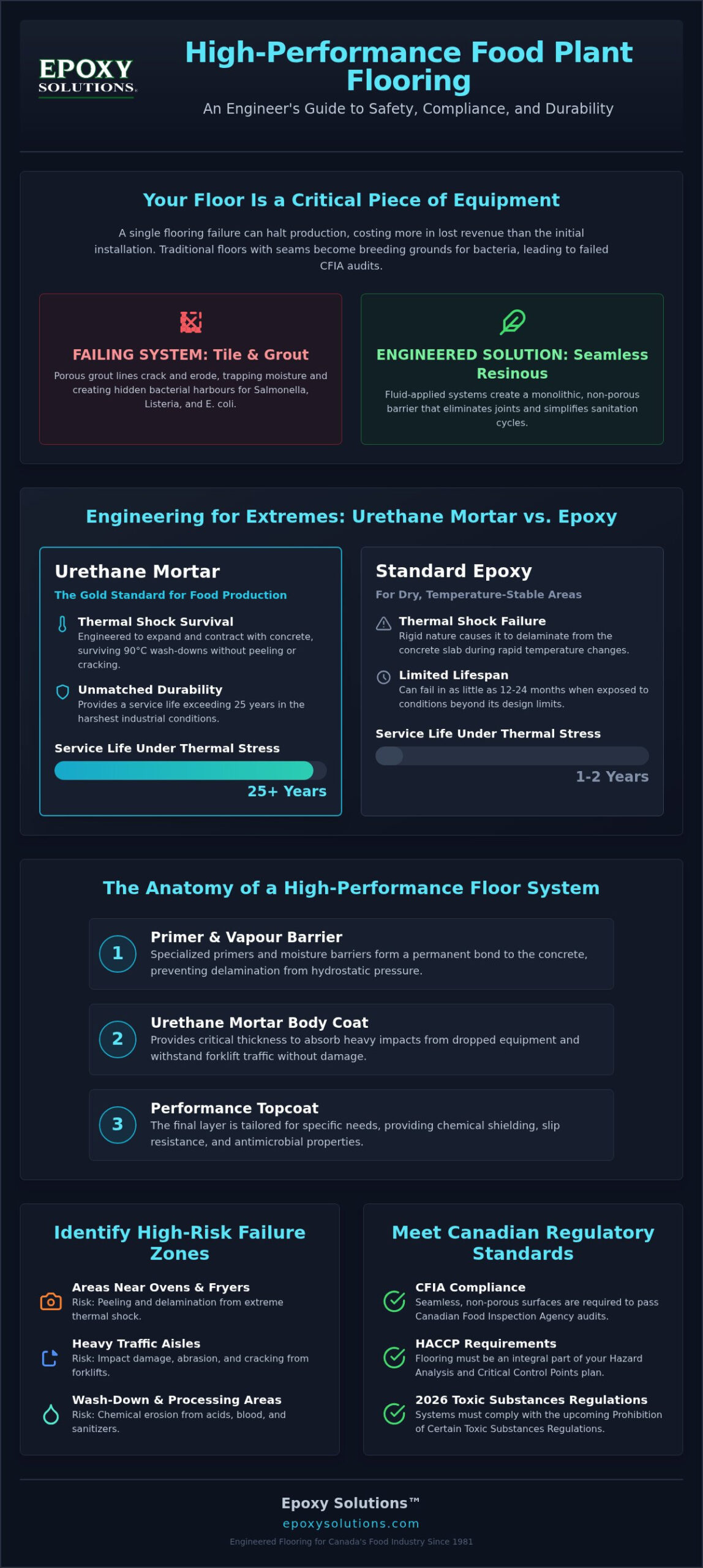
A premium floor is built in methodical stages to ensure long-term stability. It begins with moisture vapour barriers and specialized primers that ensure a permanent bond to the slab, preventing delamination caused by hydrostatic pressure. The body coat follows, providing the necessary thickness to absorb heavy impacts from dropped equipment or vibrating machinery. Finally, high-performance topcoats are applied to tailor the surface for specific slip resistance and chemical shielding. This layered approach ensures the system survives the harshest industrial environments without losing its structural integrity or safety rating.
Hygienic Benefits and Pathogen Control
Seamlessness is your primary defence against pathogens. By eliminating joints, you remove the primary breeding grounds where Salmonella, Listeria, and E. coli thrive. These surfaces simplify the Clean-In-Place (CIP) process, as hot water and detergents reach every square inch of the floor without being hindered by physical obstacles. For 2026 standards, antimicrobial additives are integrated directly into the resin matrix to provide a permanent, secondary layer of protection against microbial growth throughout the floor’s entire lifespan. This engineered solution ensures your food processing plant flooring remains compliant with the most rigorous CFIA audits.
Engineering for Extremes: Comparing Urethane Mortar and Epoxy
Material choice is binary. You either select a system engineered for your specific environment, or you prepare for a costly failure. Standard epoxy is an excellent choice for dry packaging areas, but installing it in a high-temperature wash-down zone is a recipe for peeling. For high-performance food processing plant flooring, the environmental stressors dictate the chemistry. You must recognize that a floor in a bakery faces entirely different “thermal warfare” than a floor in a cold storage warehouse.
Urethane mortar, also known as cementitious urethane, is the industry gold standard for food production. It handles the extremes that destroy standard coatings. While epoxy offers premium chemical resistance, it lacks the flexibility to survive rapid temperature shifts. In harsh conditions, urethane mortar provides a service life exceeding 25 years, whereas standard epoxy may fail in as little as 12 to 24 months. If your facility requires minimal downtime, Methyl Methacrylate (MMA) provides an ultra-fast cure, allowing you to return to full production in hours rather than days.
Thermal Shock and Thermal Cycling Survival
Thermal shock occurs when 90°C sanitizing water hits a floor stabilized at 10°C. This massive temperature delta causes materials to expand or contract at different rates. Standard epoxy is rigid; it cannot move with the concrete, leading to immediate delamination and cracking. Urethane mortar is engineered to mimic the thermal expansion coefficient of concrete. It breathes with the slab, ensuring the bond remains intact during aggressive steam cleaning or near high-heat industrial ovens. Whether you’re managing cold storage or a bakery line, matching the floor’s thermal profile to your operational reality is non-negotiable.
Chemical Resistance: Acids, Blood, and Brine
Food byproducts are surprisingly aggressive. Organic acids like citric, lactic, and acetic acids can dissolve unprotected concrete in months. In meat and poultry processing, the constant presence of blood and fats creates a corrosive environment that standard coatings can’t handle. You must also account for the harsh alkaline cleaners and sanitizers used to meet safety standards. For specific chemical tolerances and technical specs, consult our high-performance epoxy guide for industrial facilities. Selecting a tailored resinous system ensures these substances are neutralized on the surface rather than penetrating the substrate. If you’re unsure which chemistry fits your specific production line, consult with a flooring specialist to avoid premature system failure.
Navigating Canadian Regulatory Standards for Food Plant Floors
Compliance isn’t optional. In Canada, the regulatory landscape for food processing plant flooring is governed by the Canadian Food Inspection Agency (CFIA) and Health Canada. While many international competitors focus on American USDA or FDA standards, Canadian facility managers must satisfy local inspectors who prioritize the physical integrity of the floor as a hygienic barrier. A “food-grade” label is worthless if the material degrades under your specific cleaning chemicals or fails to maintain a non-porous finish. True compliance is a performance standard, not a marketing claim.
Seamless resinous systems are the backbone of a robust Hazard Analysis and Critical Control Points (HACCP) plan. By eliminating joints, you remove the primary risk factor for cross-contamination. Beyond hygiene, you must also consider worker safety to ensure WSIB compliance in Ontario. Slip resistance is a critical engineering requirement; a floor that’s too smooth becomes a liability when wet, while one that’s too aggressive is impossible to sanitize. We balance these competing needs through precision-textured topcoats that meet safety ratings without compromising cleanability.
Audit-Ready Flooring: What Inspectors Look For
Inspectors hunt for standing water. Ponding is a red flag that indicates poor slope-to-drain engineering or substrate settling. Your flooring system must be installed with enough precision to ensure every litre of washdown water moves toward the drainage system. We also emphasize the installation of integral coving. This creates a seamless, radiused transition from the floor to the wall, eliminating the 90-degree corners where organic debris traditionally hides. Maintaining this integrity is especially vital when separating “High-Care” processing zones from “Low-Care” storage areas to prevent pathogen migration.
Environmental Standards in the GTA
Installation shouldn’t shut down your entire facility. In Toronto and Mississauga, strict VOC (Volatile Organic Compound) regulations dictate indoor air quality standards. We utilize odourless, high-solids systems that allow for installation without tainting sensitive food products or endangering your staff. For a deeper look at how these resinous systems compare to other finishes regarding air quality and maintenance, see our polished concrete contractors in Toronto FAQ. Choosing a standard-setting provider ensures your facility remains operational and audit-ready throughout the 2026 regulatory shift.
Assessing Your Facility: Identifying High-Risk Failure Zones
Map your failure points before they map you. A food processing plant flooring system is only as strong as its weakest zone. You can’t apply a “one-size-fits-all” solution to a facility that houses both blast freezers and high-heat ovens. We identify high-risk areas by analyzing mechanical stress, such as heavy traffic aisles and forklift impact zones. If you ignore the specific demands of each room, you’re essentially scheduling your next repair before the current project is even finished.
Point loading is a silent killer of industrial floors. Heavy machinery with small contact points exerts massive pressure that can crush a thin coating or delaminate a poorly bonded system. If the substrate preparation isn’t flawless, the bond will fail regardless of the material’s quality. We maintain that surface preparation is 90% of the success in any industrial environment. Without mechanical profiling to create a “hook” for the resin, your investment is just a temporary film waiting to fail. To ensure your facility is properly mapped for these stressors, book a technical facility assessment with our engineering team.
The “Wash-Down” Zone Challenge
High-pressure hosing and constant moisture demand an integrated engineering approach. These zones require resinous flooring to be perfectly keyed into stainless steel trench drains to prevent water from migrating under the system. We prioritize the transition points where the floor meets the drain, as these are the most common sites for bacterial growth and bond failure. Selecting the correct aggregate for your food processing plant flooring is a delicate balance; it must provide non-slip safety for workers while remaining smooth enough for sanitizers to reach every surface during a Clean-In-Place cycle. A floor that is too aggressive to clean is just as dangerous as one that is too slippery to walk on.
Cold Storage and Blast Freezers
Sub-zero environments present unique logistical and chemical hurdles. Standard epoxies won’t cure in these conditions, and the risk of frost heave can snap a rigid floor if the substrate isn’t properly insulated or bonded. We utilize specialized chemistries that remain flexible enough to handle the contraction of the concrete slab without cracking. In freezer environments, MMA systems reach a full physical cure in less than 60 minutes at temperatures as low as -30°C. This extreme capability allows us to perform installations without the need for a full facility thaw, keeping your cold chain intact and your production schedule on track.
The Epoxy Solutions™ Standard: Engineered for Longevity
We don’t sell coatings. We solve failures. Our “Problem-First” approach means we identify the root cause of your current floor’s degradation before we ever propose a fix. If your floor is peeling near the ovens or cracking in the freezer, we find out why. Since 1981, we’ve operated as a North American specialist in high-performance resinous flooring, serving the heavy industrial corridor across Toronto, Mississauga, and Brampton. You’ll realize that the lowest bid is often the most expensive choice when a floor fails within its first year. We prioritize long-term performance because your production schedule shouldn’t be held hostage by poor craftsmanship or inferior materials.
Precision installation is the bedrock of our reputation. It begins with heavy-duty diamond grinding to remove contaminants and create a profile that ensures a permanent mechanical bond. We don’t skip steps. We perform rigorous moisture vapour testing and substrate analysis to prevent delamination before the first layer of resin is even mixed. From the body coat’s thickness to the meticulous application of chemical-resistant topcoats, every phase is executed to set a standard that others simply follow. This level of technical accuracy is what separates a standard floor from a premium food processing plant flooring system designed to last a decade or more under heavy forklift traffic.
Tailored Specifications for GTA Facilities
We understand the specific environmental demands of food processors in Brampton and Vaughan. These facilities face unique logistical challenges and regulatory pressures that require customized resinous systems. For Brampton-area facility managers dealing with recurring delamination or chemical exposure failures, our industrial epoxy flooring Brampton resource guide provides a detailed technical roadmap for selecting systems engineered to last 15 years or more. Our commitment to Canadian-made quality and North American standards ensures your facility remains compliant and safe. Whether you’re managing a dairy facility or a commercial bakery, our systems are tailored to your specific zone’s thermal and chemical stressors. To understand the financial implications of your choice, read our 2026 facility manager’s guide on polished concrete vs epoxy cost. We ensure your investment is protected by selecting the right chemistry for your facility’s reality.
The Result: A Standard-Setting Floor
A floor from Epoxy Solutions™ isn’t just a surface; it’s a strategic asset. By reducing long-term facility maintenance costs and simplifying cleaning cycles, we allow you to focus on production rather than constant repairs. You’ll gain total peace of mind during CFIA audits, knowing your floor meets every hygienic and safety benchmark without exception. We are the reliable partner who steps in when others have failed, emphasizing a legacy of setting standards rather than just following them. Don’t settle for a temporary fix when you can have an engineered solution. Consult with an Epoxy Solutions™ expert for your facility assessment.
Secure Your Facility’s Future with Engineered Flooring Standards
Your floor is the foundation of your facility’s safety and operational efficiency. Choosing the correct food processing plant flooring is a technical decision that impacts your ability to pass CFIA audits and maintain production uptime for the next decade. You’ve realized that standard coatings won’t survive the thermal shock of high-heat washdowns or the corrosive nature of organic food acids. Success requires a tailored approach that matches the specific chemistry of urethane mortars or MMA to your facility’s high-risk zones.
Epoxy Solutions™ has been a North American specialist in high-performance resinous systems since 1981. We bring decades of industry-leading expertise to every site in Toronto, Mississauga, and Brampton, ensuring your installation meets the most rigorous standards. We identify failure points before they disrupt your schedule, providing a seamless surface that lasts. Don’t leave your compliance to chance with a general contractor. Get a Professional Facility Assessment from Epoxy Solutions™ to ensure your plant is ready for the 2026 regulatory shift. We look forward to helping you build a safer, more durable environment.
Frequently Asked Questions
Does the CFIA require specific flooring for food processing plants?
The CFIA requires floors to be impervious, non-absorbent, and easily cleanable to prevent bacterial harbours. While they don’t mandate a single brand, seamless resinous systems are the industry standard for meeting these rigorous safety audits. Your food processing plant flooring must remain free of cracks and crevices to ensure compliance. We install systems that withstand aggressive sanitization and heavy mechanical stress, ensuring your facility passes every inspection without the risk of cross-contamination.
How long does a resinous floor installation take in a food plant?
Standard installations typically require three to five days depending on the square footage and substrate condition. Surface preparation accounts for the majority of this timeline as we must mechanically profile the concrete to ensure a permanent bond. If your production schedule cannot accommodate a multi-day shutdown, we utilize Methyl Methacrylate (MMA) systems. These specialized resins achieve a full physical cure in less than one hour, allowing for overnight transformations.
Can you install food-grade flooring over existing tile or concrete?
You can install resinous systems over concrete, but existing tile usually requires removal to guarantee long-term performance. Grout lines in tile are frequent failure points that trap moisture and bacteria; this can compromise the new bond. We utilize heavy-duty diamond grinding to remove old coatings and contaminants from concrete substrates. This creates the necessary mechanical “hook” for the resin, preventing the peeling and delamination often seen in low-bid installations.
What is the difference between food-grade epoxy and urethane mortar?
The primary difference is thermal shock resistance. Epoxy is a rigid coating that offers excellent chemical shielding but may crack when exposed to rapid temperature changes during hot washdowns. Urethane mortar is a high-performance system that mimics the thermal expansion of concrete, allowing it to breathe without losing its bond. For most food processing plant flooring projects, urethane mortar is the superior choice because it survives the “biological warfare” of daily sanitation cycles.
How do I maintain slip resistance while keeping the floor hygienic?
Maintaining safety without compromising cleanability requires precision-engineered aggregate. We integrate specific textures into the topcoat that provide enough traction for wet environments while remaining smooth enough for sanitizers to reach every surface. This balance is critical for WSIB compliance in Ontario facilities. A floor that’s too aggressive will trap organic debris and fail audits, while a floor that’s too smooth becomes a liability. We tailor the grit to your specific zone’s needs.
What happens if my food processing floor starts to peel or crack?
Cracks and peeling surfaces are immediate red flags for health inspectors and indicate a compromised hygienic barrier. These failures allow washdown water and organic matter to seep beneath the system, creating invisible reservoirs for anaerobic bacteria. You must address these issues immediately to prevent a full-scale contamination event. We perform technical assessments to identify whether the failure was caused by poor preparation, thermal shock, or moisture vapour transmission before proposing a permanent fix.
Are there odourless flooring options for facilities that cannot shut down?
Odourless, high-solids epoxies and urethane mortars are standard for facilities that require ongoing production during installation. These systems eliminate the risk of tainting sensitive food products with volatile organic compounds (VOCs). We select chemistries that meet strict indoor air quality standards in Toronto and Mississauga, allowing for safe application in active environments. This ensures your facility remains operational and compliant with environmental regulations without the need for a total plant shutdown or expensive air scrubbing equipment.