

A single, invisible spark can compromise a million-dollar cleanroom in a fraction of a second. For facilities across the Greater Toronto Area, selecting high-performance anti-static flooring for critical environments isn’t just a basic facility upgrade; it’s a fundamental insurance policy against catastrophic component failure. You likely realize that standard floor coatings or porous tiles often fail under the pressure of heavy equipment and strict hygiene protocols. When conductivity fades or surfaces begin to peel, the risk to your sensitive electronics and data infrastructure becomes an unacceptable liability.
This article details how to protect your infrastructure with resinous ESD systems engineered for Toronto’s rigorous industrial demands. You’ll learn how to achieve a seamless, easy-to-clean surface that meets the latest ANSI/ESD S20.20-2021 standards while providing the integrated chemical resistance your operations require. We’ll examine the technical differences between conductive and dissipative systems and show you why a tailored resinous approach outperforms generic alternatives in both durability and long-term safety.
Key Takeaways
- Understand how high-performance anti-static flooring for critical environments mitigates the risk of unnoticed ESD events that cause immediate or latent component failure.
- Distinguish between conductive and dissipative resistance profiles to ensure your grounding system matches the specific sensitivity of your electronics or data infrastructure.
- Compare the long-term performance of monolithic resinous coatings against traditional tiles to eliminate risks associated with seam contamination and adhesive failure.
- Evaluate the necessity of integrated chemical resistance to prevent your floor from losing its conductivity when exposed to industrial cleaners or solvents.
- Learn how a tailored assessment identifies root-cause failures to provide a reliable, high-performance flooring solution that meets strict ANSI/ESD S20.20 standards.
The Hidden Risk of Static Discharge in Critical Facilities
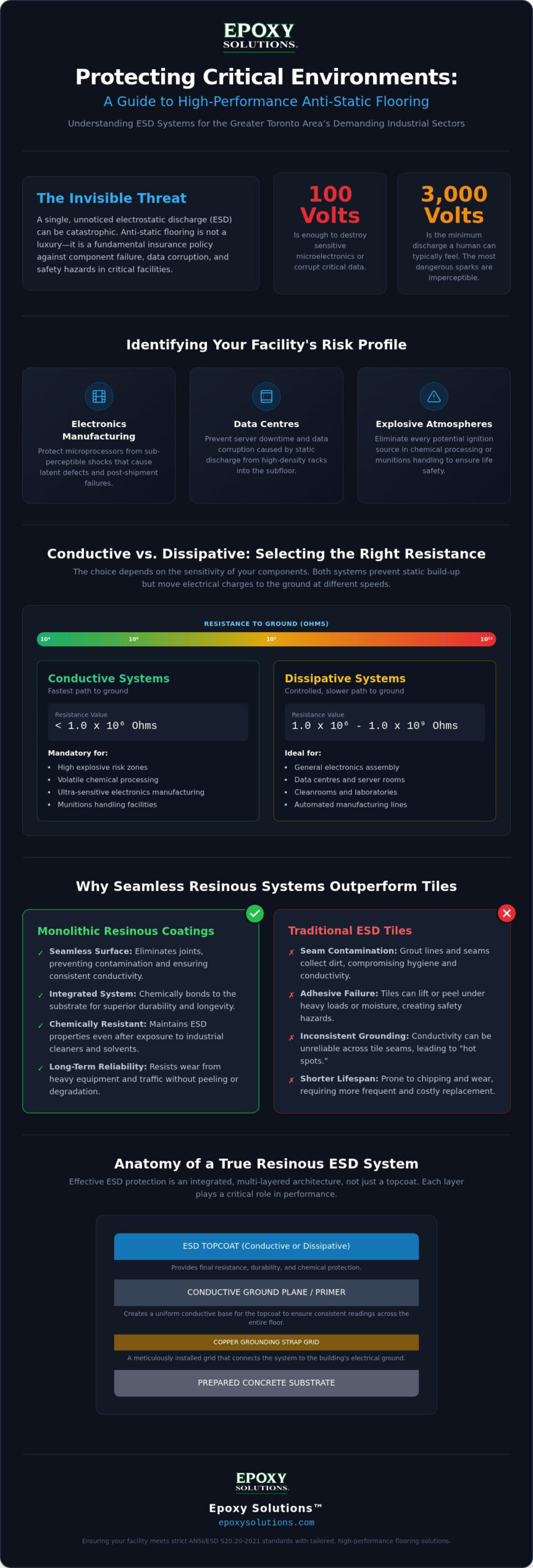
Static electricity is a silent facility killer. While a human being cannot feel an electrostatic discharge (ESD) until it reaches approximately 3,000 volts, a mere 100 volts is enough to destroy sensitive microchips or corrupt critical data. In high-stakes settings, anti-static flooring for critical environments is not a luxury; it is a technical necessity. This specialized surface acts as a permanent grounding system, safely draining electrical charges from personnel and equipment through a path of controlled resistance before they can do damage.
Generic epoxy coatings often fail because they treat conductivity as a surface-level afterthought. True ESD protection is not just a paint job. It requires a multi-layered resinous system, including a copper grounding strap, a dedicated conductive ground plane, and specialized conductive primers. Without this integrated architecture, a floor might pass an initial test but will inevitably lose its efficacy as the surface wears or humidity levels fluctuates. The financial consequence of a single discharge event can easily exceed the entire cost of a premium floor installation. Choosing a subpar system is an operational gamble that most GTA manufacturers simply cannot afford.
Identifying Your Critical Environment Risk Profile
Every facility carries a unique risk signature that dictates the flooring specification. In electronics manufacturing, the primary goal is protecting microprocessors from sub-perceptible shocks that cause latent defects, which are failures that occur after the product has reached the end user. Data centres must prioritize the prevention of server downtime and the data corruption that occurs when high-density racks discharge into the subfloor. For explosive atmospheres, such as chemical processing or munitions handling, the flooring system must eliminate every potential ignition source to ensure life safety and strict regulatory compliance.
Why “Anti-Static” Is Not a Universal Standard
The term “anti-static” is frequently misused as a catch-all marketing phrase, but it lacks the precision required for engineering reliability. To maintain true ESD compliance, you must distinguish between dissipative and conductive properties based on your specific equipment and safety protocols. Many out-of-the-box claims fall apart during site-specific grounding tests because they don’t account for the concrete’s moisture content or the presence of non-conductive contaminants. For true ESD compliance, conductive systems must maintain a resistance to ground of less than 1.0 x 10^6 ohms, whereas dissipative systems are classified between 1.0 x 10^6 and 1.0 x 10^9 ohms. Relying on a product that cannot guarantee these specific ranges across the entire floor surface puts your infrastructure at constant risk.
Conductive vs. Dissipative: Selecting the Right Resistance Profile
Choosing the wrong resistance profile is a common point of failure for GTA facilities. The distinction between conductive and dissipative systems is defined by the speed at which the floor moves electrical charges to the ground. In the context of anti-static flooring for critical environments, this choice depends entirely on the sensitivity of your components and the specific safety requirements of your workspace. While both systems prevent static build-up, they operate at different ends of the electrical resistance spectrum to meet specific engineering goals.
Reliable performance starts long before the topcoat is applied. An effective ESD floor relies on a meticulously installed grounding grid, typically utilizing copper foil tape connected directly to the building’s electrical ground. If the sub-floor preparation is botched or the grounding points are insufficient, even the most expensive resin will fail to meet ANSI/ESD S20.20-2021 standards. During dry Ontario winters, low humidity levels can significantly increase static accumulation, making the precision of this grounding grid even more vital for maintaining consistent readings when the air is at its driest.
Conductive Systems for High-Risk Zones
Conductive flooring provides the fastest path to ground, maintaining a resistance of less than 1.0 x 10^6 ohms. These systems are mandatory in environments with high explosive risks, such as munitions handling or volatile chemical processing, where even a tiny spark could be catastrophic. They are also the benchmark for ultra-sensitive ESD flooring for electronics manufacturing where micro-components are vulnerable to sub-perceptible charges. Installation requires specialized conductive primers that create a continuous electrical pathway across the entire surface. To maintain this performance, you must manage the surface carefully:
- Perform regular testing with a surface resistance meter to verify ongoing compliance.
- Use only ESD-safe cleaning agents that do not leave behind an insulative film.
- Ensure immediate repair of any physical gouges that penetrate the conductive primer layer.
Dissipative Systems for General Manufacturing
Dissipative systems offer a slower, more controlled discharge, typically ranging from 1.0 x 10^6 to 1.0 x 10^9 ohms. This is the preferred choice for cleanrooms, high-tech assembly lines, and server rooms where static control must be balanced with personnel safety. Because dissipative floors offer more resistance, they provide a critical layer of protection for workers against accidental electrical shocks from high-voltage equipment. Many modern facilities in the GTA also require these systems to integrate with UV resistant epoxy flooring to maintain a bright, professional aesthetic without compromising electrical integrity. If you aren’t sure which profile your facility demands, a professional site assessment can identify the specific resistance requirements for your operational load.
Resinous Coatings vs. Resilient Tiles: Why Seamless Systems Win
Seams are liabilities. In any high-precision facility, the thousands of joints created by vinyl or rubber tiles represent potential failure points for both hygiene and electrical continuity. When specifying anti-static flooring for critical environments, the choice between a monolithic resinous system and a modular tile layout often determines the facility’s long-term operational success. Resinous epoxy systems are engineered to be monolithic, bonding directly to the concrete substrate to eliminate the risk of edge-peeling, adhesive degradation, or “tripping” hazards caused by lifting tiles.
Durability under extreme point loads is another area where resinous systems outperform resilient alternatives. Heavy server racks, high-density storage units, and specialized manufacturing machinery exert massive pressure on the floor surface. Resilient tiles frequently “dent” or compress under this weight, eventually causing the material to crack or the adhesive bond to fail. A high-performance resinous floor distributes these loads across the entire slab, maintaining a perfectly level surface that won’t compromise the stability of expensive equipment. While competitors often promote the myth of “easy tile replacement,” the reality is that matching dye lots and achieving a reliable bond with a single replacement tile is notoriously difficult. Resinous systems allow for localized, seamless repairs that maintain the electrical integrity and aesthetic of the entire floor.
Hygiene and Maintenance in Critical Zones
Seamless floors allow for aggressive cleaning protocols that would destroy a tiled surface. Without seams, there is nowhere for water, solvents, or contaminants to seep into the sub-floor. This is especially vital for preventing “carbon sloughing,” a condition where low-quality ESD tiles shed conductive particles into the air, effectively turning your floor into a source of dust in a cleanroom environment. A tailored resinous system encapsulates the conductive elements within the resin matrix, ensuring that your maintenance schedule remains focused on hygiene rather than managing material degradation.
Long-Term Performance and ROI
The financial reality of industrial flooring is measured in decades, not years. Resinous systems typically offer a 10-15 year lifespan, whereas many resilient tiles require a full replacement cycle every five years due to wear and adhesive failure. You’ll realize a significantly higher return on investment by choosing a system that requires fewer repairs and less intensive labour for upkeep. Facility managers evaluating their total cost of ownership should also review the polished concrete vs epoxy flooring cost breakdown to understand the full lifecycle economics before committing to a specification. For facilities requiring clear organizational markings, durable epoxy floor striping integrates seamlessly with ESD surfaces to define safety zones and traffic lanes without creating the dirt-trapping edges found with traditional tape or painted lines.
Chemical Resistance and Durability in High-Precision Zones
Critical environments are rarely just about electronics. Many GTA facilities include battery storage, chemical processing, or aggressive sanitization routines that involve harsh reagents. Standard anti-static flooring for critical environments often fails when exposed to aggressive solvents, industrial cleaners, or battery acids. Generic ESD tiles are particularly vulnerable; they can dissolve or lose their electrical resistance properties when their surface integrity is compromised by chemical attack. This creates a dangerous gap in your grounding protection that often goes unnoticed until a component fails. The same principles that govern chemical resistance in ESD systems also apply to facilities like automotive service bays, where epoxy flooring for automotive workshops must withstand brake fluid, road salt, and heavy impact without compromising surface integrity.
Epoxy Solutions™ engineers specialized resinous systems that maintain precise grounding properties even under direct chemical exposure. This isn’t just about the surface. It’s about a high-performance bond that resists thermal shock, ensuring the floor doesn’t delaminate during rapid temperature shifts in controlled GTA laboratories. A monolithic resinous system provides a seamless barrier that protects the concrete substrate while ensuring the conductive pathway remains uninterrupted by physical or chemical degradation.
Specifying for Chemical Resistance
A floor that grounds static but fails under a solvent spill is a liability. You must evaluate the specific chemical profile of your facility, whether you handle concentrated acids, caustic bases, or volatile solvents like Isopropyl Alcohol (IPA). In many high-precision zones, secondary containment is legally required alongside anti-static properties to prevent environmental contamination. Realize that the selection of the topcoat is the most critical decision in this process. The right resin chemistry preserves both the aesthetic colour and the technical conductivity of the system, even after years of aggressive cleaning cycles.
The Ontario Climate Factor: Humidity and Static
Canadian winters present a unique engineering challenge for static control. As indoor relative humidity drops, the risk of tribocharging (static generation through friction) increases dramatically. A floor that passes inspection in a humid July might fail catastrophically in a dry January. We ensure your system is tested and verified to perform at 15% relative humidity, which is the realistic baseline for a Toronto winter. Our testing protocols verify resistance across all four seasons to ensure your infrastructure remains protected year-round. If your current floor is showing signs of chemical degradation or failing winter resistance tests, contact Epoxy Solutions™ for a technical consultation.
Specifying Your ESD Solution with Epoxy Solutions™
Most industrial floors fail because of poor specification. When it comes to anti-static flooring for critical environments, a “one-size-fits-all” approach is a recipe for operational disaster. We don’t just sell coatings; we engineer reliability. Our process begins with a no-nonsense assessment of your facility’s current state. We identify the root cause of failure, whether it’s delamination from osmotic pressure, adhesive breakdown in old tiles, or a complete loss of conductivity, before we ever propose a new system. This diagnostic phase ensures that your investment addresses actual risks rather than just covering them up. Before finalizing any ESD specification, facility managers should consult a comprehensive set of industrial flooring specifications to ensure every performance metric is properly defined and documented.
Customized engineering is the hallmark of our service. We match the specific resin chemistry to your facility’s unique load requirements, traffic patterns, and chemical exposure risks. A cleanroom in Mississauga handling micro-electronics requires a vastly different system than a munitions plant in Brampton. We don’t guess at the requirements. We verify the necessary resistance profiles and select materials that provide the exact balance of durability and grounding performance your infrastructure demands. For a deeper look at how these principles apply specifically to circuit board and component assembly operations, our ESD flooring guide for GTA electronics manufacturing outlines the full technical framework. We have seen every possible challenge since 1981 and possess the specific expertise to resolve them.
Our Proven Installation Methodology
A high-performance floor is only as good as the surface preparation. We utilize aggressive mechanical preparation, such as shot blasting or diamond grinding, to ensure a permanent, monolithic bond to the concrete substrate. This eliminates the risk of peeling or bubbling that plagues inferior installations. Once the substrate is prepared, we execute a precision layout of the copper grounding grid. These grounding points are strategically placed to ensure uniform conductivity across the entire floor surface, leaving no “dead zones” where static could accumulate. Our multi-layer application process then builds the depth of protection required for long-term chemical resistance and structural integrity.
Ready to Secure Your Critical Environment?
We provide standard-setting results across Toronto, Mississauga, Brampton, Vaughan, and the entire GTA. Whether you are managing a new build or a complex retrofit in an active facility, we provide the technical accuracy and meticulous execution required for total compliance. We don’t just install the floor and walk away; we perform rigorous certification testing to verify the ohms and ensure your system meets ANSI/ESD S20.20 or IEC 61340 standards. Consult with an Epoxy Solutions™ expert to specify your anti-static floor today.
Secure Your Infrastructure with Engineering Precision
Protecting a high-precision facility requires more than a simple floor coating. You’ve seen how monolithic resinous systems eliminate the liabilities of seams and adhesive failure while providing the integrated chemical resistance that standard tiles lack. Choosing the correct resistance profile is a technical decision that impacts both personnel safety and component integrity. In the Greater Toronto Area, your flooring must also remain reliable during the extreme humidity fluctuations of the Ontario winter.
Epoxy Solutions™ has been a specialist in high-performance resinous systems across North America since 1981. Our expert GTA-based installation teams understand that anti-static flooring for critical environments is a specialized engineering requirement, not a commodity. We don’t just apply a finish; we build a permanent grounding solution that meets strict ANSI/ESD S20.20 standards. Don’t leave your sensitive infrastructure to chance or settle for a system that will fail under industrial loads.
Get a technical specification for your critical environment flooring today and ensure your operations remain protected for the long term. We look forward to securing your facility.
Frequently Asked Questions
What is the difference between anti-static and ESD flooring?
Anti-static is a broad term for materials that reduce static build-up, but ESD flooring is a technical system designed to ground electrical charges. While anti-static surfaces might prevent basic shocks, true ESD systems provide a measurable path to ground through controlled resistance. Most anti-static flooring for critical environments must meet specific ANSI/ESD S20.20 standards to ensure sensitive components are actually protected from discharge.
How often do anti-static floors need to be tested for conductivity?
You should test your floor’s conductivity at least once every six to twelve months. High-traffic GTA facilities often perform quarterly audits to verify that physical wear or chemical exposure hasn’t compromised the conductive pathways. Testing involves using a surface resistance meter to ensure the readings remain within the specified ohm range required for your facility’s safety compliance.
Can I apply an anti-static coating over my existing epoxy floor?
No, you cannot simply apply a conductive topcoat over an existing epoxy finish. A reliable ESD system requires a direct connection to the concrete substrate and an integrated grounding grid. Applying new resin over old, unknown coatings risks delamination and electrical failure. We insist on mechanical surface preparation to remove old finishes and ensure a permanent, monolithic bond for the new system.
Do anti-static floors require special cleaning chemicals or waxes?
Yes, standard floor waxes and generic cleaners will destroy the floor’s conductivity. These products leave behind an insulative film that blocks the path to ground, rendering the ESD properties useless. You must use specialized, residue-free ESD cleaners. Using the wrong chemicals is one of the most common reasons why high-performance floors fail to pass their annual resistance audits.
How does humidity in Toronto affect the performance of an ESD floor?
Low humidity during dry Toronto winters increases static generation, a process known as tribocharging. When the air is dry, electrical charges build up more rapidly on personnel and equipment. We engineer our resinous systems to maintain their specified resistance even at 15% relative humidity. This ensures your infrastructure remains protected during the most challenging environmental conditions in Ontario.
What industries in the GTA are required to have anti-static flooring?
Electronics manufacturing, aerospace, data centres, and pharmaceutical laboratories are the primary sectors requiring these systems. Any facility in Mississauga, Brampton, or Vaughan that handles sensitive microprocessors or volatile chemicals must implement static control. These systems are also vital in munitions handling and specialized medical device assembly where a single spark could lead to ignition or equipment failure.
Is anti-static flooring safe for employees to walk on all day?
Yes, these systems are completely safe and provide excellent ergonomic properties for workers. Dissipative floors actually offer an additional layer of safety by protecting personnel from accidental electrical shocks from high-voltage machinery. They provide the same slip-resistance and durability as standard industrial floors, ensuring a safe and productive environment for your entire team throughout their shifts.
How long does a resinous anti-static floor installation take?
A typical installation requires four to six days to complete properly. This timeline allows for aggressive mechanical surface preparation, the precision layout of the copper grounding grid, and the application of multiple specialized resin layers. Each layer must cure fully to ensure the floor achieves its maximum chemical resistance and electrical integrity before the facility returns to full service.