A single microscopic crack in your sterile zone isn’t just a maintenance oversight; it’s a regulatory ticking time bomb. Your pharmaceutical cleanroom flooring is either a fortress against contamination or its primary gateway. You already realize that ISO and GMP audits are becoming more rigorous, focusing heavily on the integrity of your physical environment. Failing an inspection due to floor degradation or porous coving isn’t an option when production uptime and patient safety are on the line.
Failed audits are expensive. This article provides the technical engineering framework required for facilities operating within the GTA’s strict regulatory landscape. We’ll explore how to meet the 2022 EU GMP Annex 1 revisions and ISO 14644 standards while avoiding the common pitfalls of cracking and chemical erosion. You’ll discover the specific material comparisons, from premium epoxy systems to polyurethane mortars, required to maintain a seamless, antimicrobial surface that survives the most punishing cleaning cycles. We’ll also examine the engineering behind surface roughness (Ra) values and coved bases to ensure your facility stays ahead of 2026 compliance benchmarks.
Key Takeaways
- Identify the exact technical specifications required to satisfy the 2022 EU GMP Annex 1 revisions and maintain a robust Contamination Control Strategy.
- Compare the performance of epoxy, polyurethane, and vinyl to determine which pharmaceutical cleanroom flooring system survives aggressive sterilization without degradation.
- Factor in the mechanical stresses of robotic transport and heavy machinery to ensure your flooring bond remains permanent under GTA manufacturing conditions.
- Discover why specialized coving and seamless finishes are mandatory for eliminating microbial traps and securing long-term regulatory compliance.
- Learn the “Problem-First” approach to mechanical preparation that prevents common failures like peeling and cracking in high-traffic sterile zones.
Compliance Starts at the Surface: Why Cleanroom Flooring Matters
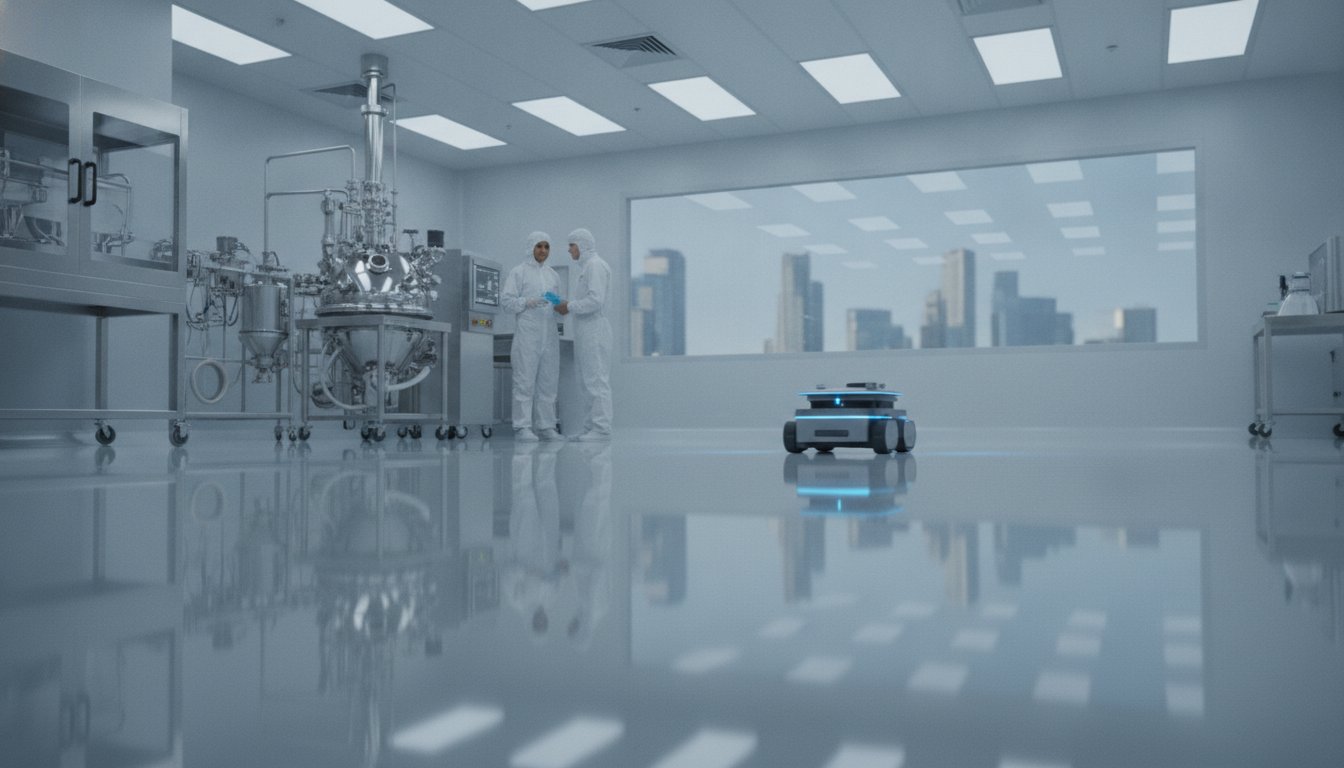
Sterility is not a suggestion. It is a requirement. In the high-stakes world of GTA drug manufacturing, your floor is the foundation of your entire sterile environment. If the surface fails, the integrity of your product follows. High-performance pharmaceutical cleanroom flooring serves as the primary barrier between your concrete subfloor and your production zone. It must withstand relentless foot traffic, heavy equipment, and the corrosive nature of decontamination chemicals without shedding a single particle or harbouring a single microbe. We have seen countless facilities fail because they treated their floor as an afterthought. Don’t make that mistake.
Surface degradation is a liability. Every crack or peel becomes a breeding ground for bacteria that your air filtration systems cannot reach. In a cleanroom environment, the floor directly impacts ISO air purity classifications and airborne particle counts. If your surface sheds particles, your validation will fail. Regulatory bodies like Health Canada don’t accept excuses for peeling coatings; they see them as immediate contamination risks. The financial risk of a facility shutdown or a rejected batch is massive. Investing in a premium, non-porous surface is the only way to secure your operational future and avoid the cost of non-compliance.
The Role of Flooring in Contamination Control
Surface integrity is non-negotiable. We define pharmaceutical cleanroom flooring as a critical barrier system designed to prevent the migration of contaminants from the substrate into the sterile atmosphere. Non-porous materials like high-grade epoxy ensure that dust and microorganisms have nowhere to hide. By utilizing seamless transitions and integral coving, you eliminate the right-angle crevices where pathogens typically accumulate. This creates a monolithic surface that is easily sanitized, ensuring your facility remains compliant with the most stringent global standards for years to come.
Safety and Ergonomics in Sterile Zones
Performance isn’t just about cleanliness. It’s about protecting your assets and your people. You must balance the need for a smooth, cleanable surface with the physical safety of your operators. We provide tailored solutions that offer sufficient slip resistance without compromising the ease of decontamination. Static control is another vital factor for modern labs. Sensitive equipment requires specialized anti-static flooring to prevent electrostatic discharge that could lead to equipment failure or catastrophic data loss. In high-output manufacturing centres, the right floor also addresses worker ergonomics. A properly engineered resinous system provides a subtle degree of flexibility, supporting the long-term health of your staff while maintaining an impenetrable hygienic seal.
The Technical Standard: ISO and GMP Requirements for Pharma Floors
Compliance is the baseline. In the Greater Toronto Area, pharmaceutical facilities operate under the strict oversight of Health Canada’s GMP guidelines. These regulations demand surfaces that are impermeable, easily cleanable, and entirely free from cracks or open joints. If your pharmaceutical cleanroom flooring fails to meet these benchmarks, you aren’t just looking at a minor repair; you’re looking at a total halt in production. Global alignment with international standards like ISO 14644 is now the standard expectation for any facility aiming for Grade A or B certification. We have seen facilities attempt to cut costs with generic coatings. They always regret it during their first major audit.
ISO 14644-1 Classification for Flooring
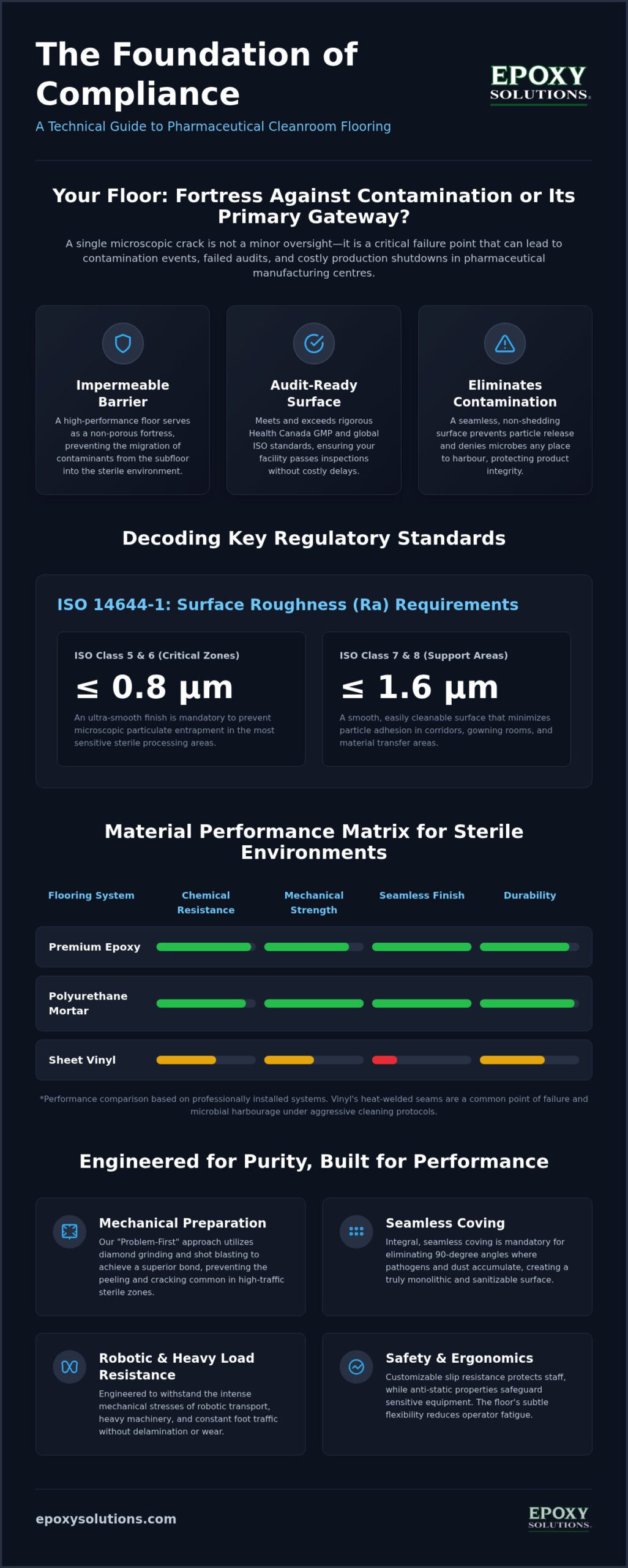
Particle release is the enemy. ISO 14644-1:2015 remains the global benchmark for classifying cleanroom cleanliness based on airborne particle concentrations. For critical zones classified as ISO 5 or 6, the surface roughness (Ra) must be ≤ 0.8 µm to prevent particulate entrapment. In support areas like ISO 7 or 8, the requirement is Ra ≤ 1.6 µm. These technical specifications ensure that the floor does not contribute to airborne particle counts. Outgassing properties are equally critical. Sensitive production environments require materials with low airborne molecular contamination (AMC) to prevent chemical vapours from compromising volatile pharmaceutical compounds during the manufacturing process.
GMP Decontamination Standards
Sterilization is brutal. Grade A and B environments undergo rigorous decontamination cycles that would destroy standard industrial coatings in weeks. Your flooring must resist aggressive agents like vaporized hydrogen peroxide (VHP) and concentrated disinfectants without staining or softening. Adhering to 21 CFR Part 211 – GMP Requirements ensures that your facility maintains a construction that facilitates proper cleaning and prevents the harbouring of microorganisms. Beyond chemical resistance, thermal shock is a major factor. High-temperature washdowns cause rapid expansion and contraction in the floor. If your system lacks the necessary thermal stability, it will delaminate from the substrate and create a massive contamination risk. We recommend evaluating chemical resistance flooring options that are specifically engineered to survive these extreme conditions without losing their bond or surface integrity.
In Ontario, the lack of specific municipal codes for cleanrooms means that federal Health Canada mandates are the final word. These guidelines emphasize the need for a formal Contamination Control Strategy (CCS). Your choice of flooring is a primary pillar of this strategy. It’s not enough for a floor to look clean; it must be scientifically proven to be non-shedding and chemically inert. Selecting a system that meets these standards is the only way to protect your facility from the financial fallout of a failed inspection.
Comparing the Top 3 Systems: Epoxy, Polyurethane, and Vinyl
Material selection is a critical engineering decision. Choosing the wrong pharmaceutical cleanroom flooring often leads to premature delamination and regulatory citations. We see facilities prioritize low initial costs only to face a total floor replacement within 36 months. A high-performance surface is an investment in your facility’s uptime, not a line item to be minimized. You must evaluate materials based on their chemical resistance, mechanical bond strength, and ability to maintain a monolithic seal under relentless sterilization cycles.
Seamless Epoxy and Urethane Mortar Systems
Resinous systems are the industry benchmark. High-build epoxy and urethane mortar systems provide a superior mechanical bond to concrete substrates, ensuring the floor doesn’t peel under the weight of heavy manufacturing equipment or robotic transport. These systems create a monolithic, non-porous surface that eliminates joints entirely. For a deeper look at how these materials perform in demanding settings, consult our high-performance epoxy guide. Urethane mortars, in particular, offer exceptional thermal shock resistance, making them the definitive choice for areas subjected to high-temperature washdowns or steam cleaning.
Heat-Welded Vinyl and Interlocking Tiles
Speed is often a trap. While heat-welded vinyl and interlocking tiles offer rapid installation, they introduce a significant long-term liability: seams. In high-moisture pharmaceutical zones, these seams are the first point of failure. Once a seam is compromised, moisture and microbes penetrate the substrate, leading to sub-floor contamination that is nearly impossible to remediate without a full teardown. Vinyl may be suitable for low-impact secondary packaging areas, but it lacks the durability required for high-traffic sterile production zones where heavy machinery and aggressive chemicals are the daily norm.
Anti-Static (ESD) Flooring Solutions
Static control is a safety mandate. Modern pharmaceutical labs rely on sensitive electronics and automated systems that are vulnerable to electrostatic discharge. We provide specialized anti-static flooring designed to safely dissipate static electricity before it can damage equipment or create explosive hazards in environments with volatile powders or solvents.
- Conductive systems: Provide the fastest path to ground, ideal for high-risk zones.
- Dissipative systems: Offer a controlled flow of electricity, suitable for general lab environments.
Maintaining these systems requires precise execution during installation and specific cleaning protocols to ensure consistent performance. A failed ESD test during an audit can result in immediate equipment grounding and production delays.
The cost-benefit analysis is simple: a premium resinous system costs more upfront but eliminates the recurring expense of seam repairs and early replacements. In the GTA’s competitive manufacturing landscape, reliability is your most valuable asset. We recommend prioritizing systems that offer a permanent mechanical bond and a seamless finish to ensure your facility remains a standard-setting environment.
Selecting Your Surface: Critical Factors for GTA Pharmaceutical Facilities
Selection is about longevity. In the Greater Toronto Area, facilities face unique environmental challenges that often lead to substrate failure. Extreme seasonal humidity swings in Ontario cause moisture vapour transmission issues if your pharmaceutical cleanroom flooring isn’t specified correctly from the start. We’ve seen floors in Mississauga and Vaughan peel because the installer ignored the local climate. You must look beyond the material’s data sheet. You need to evaluate how that material interacts with your specific facility’s slab and operational demands.
Engineering for Heavy Loads and Traffic
Compressive strength is non-negotiable. Modern pharma manufacturing involves high-density storage and automated robotic transport systems that exert massive point loads on the surface. If your resinous system lacks the necessary impact resistance, the coating will fracture at the bond line. This creates a hidden pocket for microbial growth. We recommend auditing your facility against our durability checklist to ensure your compressive strength meets healthcare-grade standards. Loading docks and transport corridors require even higher build systems to withstand the constant vibration and abrasion of forklift traffic without delaminating.
Coving and Drainage Integration
Corners are contamination risks. A truly sterile environment eliminates 90-degree angles where dust and pathogens hide. We install 15-centimetre integral coved bases as the industry standard for pharmaceutical zones. This creates a smooth, continuous transition from the floor to the wall that is easy to sanitize. Waterproof seals around floor drains and cleanouts are equally vital. A failure at the drain interface allows chemicals and wash water to seep under the floor, rotting the bond from the inside out. We ensure every penetration is mechanically prepared and sealed to create an impenetrable barrier.
Aesthetics drive operational safety. We use high-performance pigments and safety markings to define workflows and hazardous zones. This isn’t just about looks. It’s about directing traffic and preventing cross-contamination between different production stages. If you are ready to secure your facility’s future, explore our chemical resistance flooring solutions designed for the most demanding Ontario labs.
Engineering Longevity: The Epoxy Solutions™ Approach to Sterile Environments
Preparation is everything. Most pharmaceutical cleanroom flooring failures aren’t caused by inferior materials; they’re caused by lazy installation. At Epoxy Solutions™, we employ a “Problem-First” philosophy that identifies potential failure points before a single drop of resin hits the substrate. We’ve been setting the benchmark for industrial flooring since 1981, and we realize that in a sterile manufacturing environment, there is no margin for error. A peeling floor in a Grade A zone is a catastrophic failure that we refuse to let happen.
Reliability is our signature. We provide customized resinous blends tailored to the specific chemical and thermal demands of your facility. Whether you’re operating a high-capacity production line in Mississauga or a specialized research lab in downtown Toronto, our systems are engineered to withstand the relentless cycle of pharmaceutical manufacturing. We don’t just follow industry standards; we set them by ensuring every square foot of your facility is a fortress against contamination.
Meticulous Surface Preparation
Bond strength is non-negotiable. We begin every project with rigorous testing for moisture vapour transmission to ensure the concrete substrate is ready for a permanent coating. If moisture levels are ignored, the resulting osmotic pressure will eventually blow the coating off the floor. We use heavy-duty diamond grinding and shot-blasting to open the pores of the concrete, creating a profile that allows for a deep, permanent mechanical bond. Mechanical bonding is the only way to ensure a resinous system survives the mechanical and thermal stresses of a high-output pharma facility. We also meticulously repair concrete cracks and joints to prevent reflective cracking from telegraphing through your finished surface, ensuring a monolithic, seamless result that satisfies every ISO and GMP auditor.
Standard-Setting Installation and Service
Downtime is a revenue killer. Our professional crews are trained to work with surgical precision, minimizing facility disruptions while maintaining the highest levels of craftsmanship. We understand the logistical complexities of GTA pharmaceutical facilities and coordinate our installations to get your production back online as quickly as possible. We don’t offer generic fixes; we provide long-term performance guarantees for high-stakes environments where reliability is the only metric that matters. Our commitment to the Greater Toronto Area is built on decades of proven results in the world’s most demanding industrial settings. If you’re ready to move beyond temporary patches and invest in a permanent solution, contact Epoxy Solutions™ for a tailored facility assessment. We’ll identify your risks and provide the engineering framework to eliminate them for good.
Secure Your Facility’s Sterile Future
A compliant pharmaceutical cleanroom flooring system is more than just a surface; it’s a critical barrier in your contamination control strategy. You’ve seen how precise material selection, from premium epoxy to thermal-resistant urethane mortars, dictates your facility’s ability to survive rigorous audits and aggressive sterilization cycles. Precision engineering is the only way to eliminate the risks of cracking, peeling, and microbial harbourage that lead to catastrophic production shutdowns. Every detail, from the compressive strength of the build to the integrity of the coved base, must be executed with total accuracy.
With over 45 years of specialized industrial experience, Epoxy Solutions™ provides the technical expertise required to navigate the complexities of ISO and GMP compliance. We deliver high-performance systems tailored for longevity and safety in Toronto, Mississauga, and throughout the GTA. Our “Problem-First” approach ensures that your substrate is mechanically prepared for a permanent bond that won’t fail under pressure. Request a Professional Facility Assessment from Epoxy Solutions™ to ensure your environment remains a benchmark for industry excellence. Your path to long-term regulatory security starts with a floor that’s built to last.
Frequently Asked Questions
Is epoxy flooring suitable for all pharmaceutical cleanroom classes?
Epoxy systems are highly suitable for all pharmaceutical cleanroom classes provided they are engineered to meet specific surface roughness (Ra) requirements. For ISO 5 and 6 zones, we ensure the finish achieves an Ra of ≤ 0.8 µm to prevent particulate entrapment. In ISO 7 and 8 support areas, an Ra of ≤ 1.6 µm is the standard. These premium resinous systems provide the non-shedding, impermeable surface required for total atmospheric control.
Can cleanroom flooring be installed over existing concrete in older Toronto facilities?
Installation over existing concrete is possible in older GTA facilities, but meticulous mechanical preparation is mandatory to ensure a permanent bond. We utilize diamond grinding and shot-blasting to remove contaminants and open the concrete pores. If the slab shows signs of moisture vapour transmission or structural cracking, we remediate these issues first. This “Problem-First” approach prevents the delamination and peeling commonly seen in aging manufacturing centres.
How long does a typical pharmaceutical cleanroom floor installation take?
A typical pharmaceutical cleanroom flooring installation generally requires three to five days, depending on the complexity of the surface preparation and the specific system selected. Meticulous diamond grinding and substrate repair take the most time, followed by the application of primers and high-build layers. We prioritize efficiency to minimize your facility’s downtime, but we never compromise on the curing times necessary to achieve full chemical and mechanical resistance.
What is the difference between conductive and dissipative anti-static flooring?
The primary difference lies in the speed at which static electricity is moved to the ground. Conductive flooring has a lower resistance (10^4 to 10^6 ohms) and provides a rapid path for discharge, which is vital in zones with explosive powders. Dissipative flooring (10^6 to 10^9 ohms) moves static more slowly and is standard for general lab areas. Both systems protect sensitive electronics from electrostatic damage and prevent catastrophic data loss.
How do I maintain ISO compliance with my cleanroom floor over time?
Maintaining ISO compliance requires a rigorous environmental monitoring schedule and strict adherence to validated cleaning protocols. You must regularly inspect the surface for microscopic cracks or delamination that could harbour microbes or shed particles. If the floor’s surface roughness increases due to abrasive wear, it may no longer meet the requirements for your specific cleanroom class. Timely maintenance and professional assessments ensure your facility remains audit-ready and compliant.
Can resinous flooring withstand aggressive sterilization chemicals like peracetic acid?
High-performance resinous flooring is specifically engineered to withstand aggressive sterilization agents like peracetic acid and vaporized hydrogen peroxide. Standard industrial coatings often soften or discolour when exposed to these chemicals, but our premium blends maintain their integrity. We select materials based on their proven chemical resistance to ensure your floor doesn’t become a contamination liability after repeated decontamination cycles in high-sanitation pharmaceutical zones.
What is an integral coved base and why is it required in pharma?
An integral coved base is a curved transition that extends the flooring material up the wall, usually by 15 centimetres. It is mandatory in pharmaceutical environments because it eliminates 90-degree corners where dust and pathogens typically accumulate. By creating a seamless, monolithic connection between the floor and the wall, you make the entire room easier to sanitize and satisfy the strict “smooth and impervious” requirements of Health Canada and GMP audits.
How does thermal shock resistance affect flooring choice in pharmaceutical plants?
Thermal shock resistance is a critical factor in facilities that utilize high-temperature washdowns or steam cleaning. Rapid temperature shifts cause the floor and substrate to expand and contract at different rates. If the flooring lacks thermal stability, it will crack and delaminate from the concrete. Urethane mortar systems are the preferred choice for these conditions as they possess a coefficient of thermal expansion similar to concrete, ensuring a permanent bond.