
Coatings fail from below. When facility managers and plant engineers seek out GTA commercial flooring services, it is almost always because an off-the-shelf floor coating has blistered, cracked under heavy forklift traffic, or surrendered to tracked-in de-icing salts during an Ontario freeze-thaw cycle. You know firsthand that premature surface failures mean costly operational downtime, elevated slip risks, and wasted capital on recurring patch repairs that never fix the underlying slab.
True floor longevity demands engineering the mechanical bond directly into the concrete, not rolling out decorative paint. This comprehensive guide details how to specify, prepare, and install high-performance resinous coatings and polished concrete systems engineered to endure Southern Ontario’s most punishing industrial environments. We break down the essentials of turnkey mechanical preparation, moisture vapour mitigation, and Ontario Building Code compliance, giving you the technical blueprint to eliminate delamination and protect your facility for decades.
Key Takeaways
- Understand why southern Ontario freeze-thaw cycles, sub-slab hydrostatic pressure, and tracked de-icing salts compromise unengineered concrete slabs across Greater Toronto Area facilities.
- Discover how to specify dedicated resinous chemistries, including chemical-resistant epoxy coatings, traffic toppings, and polished concrete, tailored to your exact operational loads.
- Learn why professional GTA commercial flooring services rely on captive shot-blasting and diamond grinding instead of acid etching to eliminate chronic delamination.
- Master phased zone sequencing techniques that allow your facility to complete high-performance floor installations without interrupting round-the-clock operations.
- Identify the essential qualifications, safety credentials, and mechanical preparation standards needed to vet specialized commercial contractors across Toronto, Mississauga, and Brampton.
The Realities of GTA Commercial Flooring: Environmental and Operational Demands
A floor is an engineering barrier. In high-output industrial and commercial settings, performance is measured strictly by mechanical resistance against heavy point-load impact, continuous thermal cycling, and aggressive chemical exposure. Too many operations treat concrete finishes like residential surface upgrades, installing modular coverings or thin topical paints that shatter under real operating stress. Specifying proper GTA commercial flooring services requires moving past cosmetic assumptions and building a monolithic barrier bonded directly to the structural slab.
Southern Ontario Climate Impacts on Concrete Slabs
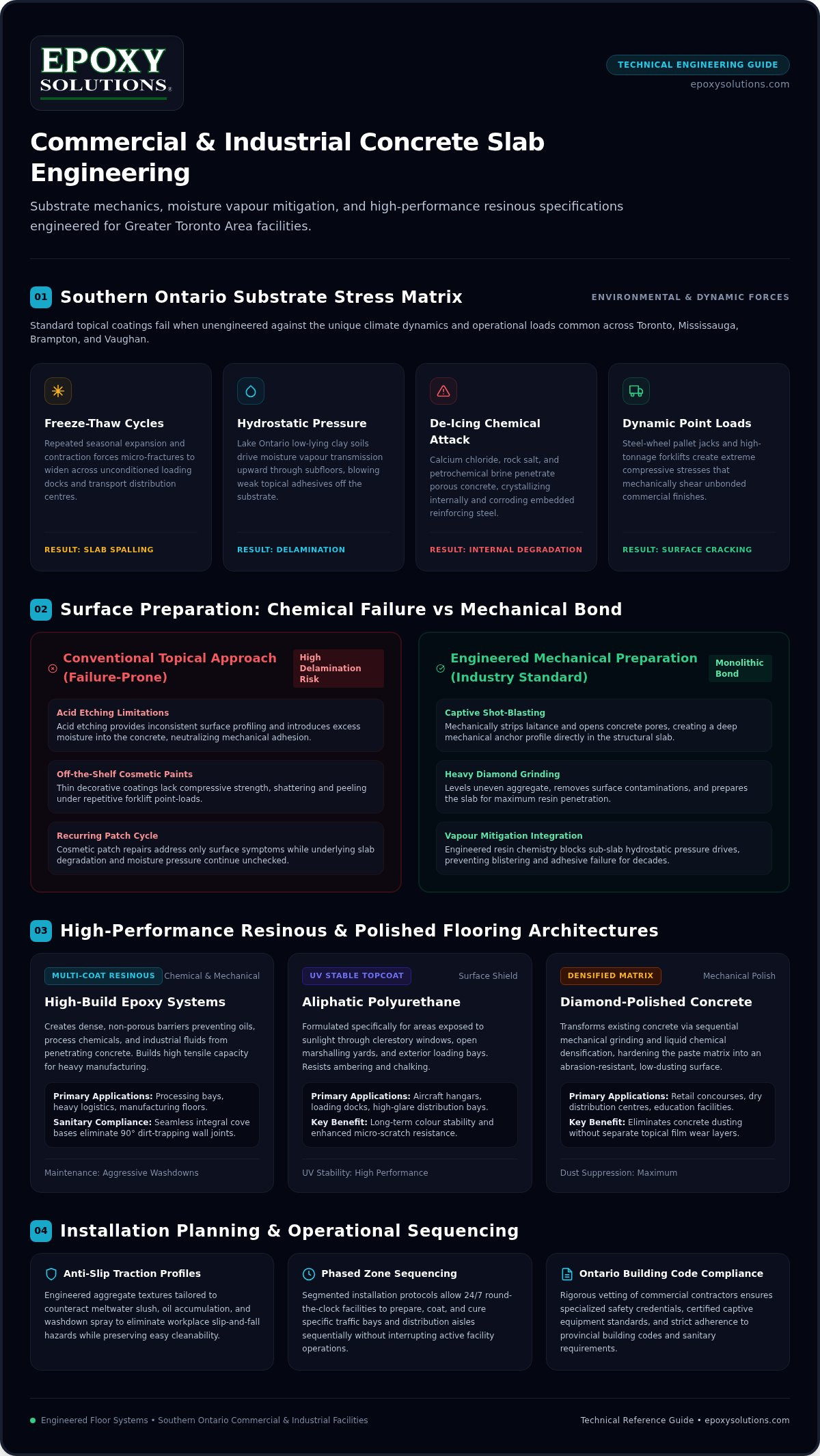
Weather breaks weak concrete. Southern Ontario facilities face aggressive seasonal freeze-thaw cycles that force unsealed slabs to expand and contract repeatedly, widening micro-fractures across unconditioned loading docks and transport distribution centres. Near Lake Ontario, low-lying clay soils drive continuous moisture vapour transmission upward through the subfloor, creating hydrostatic pressure that blows weak adhesives off the substrate. Compounding this hydrostatic drive is winter road slush; heavy transport vehicles drag dissolved calcium chloride, rock salt, and petrochemical brine directly onto interior surfaces. These de-icing chemicals penetrate porous concrete, crystallizing within the capillaries, corroding embedded steel, and triggering spalling from the inside out.
Commercial Traffic Classes in Modern Facilities
Traffic ratings dictate chemistry. Light pedestrian traffic presents minimal mechanical wear, but modern logistics facilities across Mississauga, Brampton, and Vaughan subject slabs to extreme dynamic forces. Concentrated steel-wheel pallet jacks and high-tonnage forklifts generate punishing compressive stresses that shear standard commercial finishes. While broad architectural classifications group diverse flooring materials together, industrial operations demand high-compressive epoxy coatings and seamless traffic toppings built for extreme abrasion. Beyond mechanical loading, winter storms track heavy meltwater into processing bays and entrance corridors, introducing severe slip-and-fall hazards that necessitate engineered anti-slip aggregate profiles to preserve workplace safety and maintain regulatory compliance.
Evaluating High-Performance Commercial Flooring Systems for Your Facility
One size fits none. Selecting the right surface chemistry requires balancing physical traffic, cleanability protocols, and allowable operational downtime. Where light commercial spaces rely on modular coverings, heavy industrial and logistics facilities require monolithic floor systems that bond directly to the substrate to withstand point loads and mechanical shear. Specifying specialized GTA commercial flooring services ensures your slab chemistry matches your facility’s daily reality rather than an architect’s aesthetic rendering.
High-Build Epoxy and Resinous Coating Systems
Resinous coatings deliver seamless strength. High-build epoxy systems create dense, non-porous barriers that prevent oils, process chemicals, and contaminants from soaking into concrete. Detailed in our High-Performance Epoxy Guide, multi-coat resinous assemblies build tensile capacity while tolerating routine aggressive washdowns. For spaces exposed to UV through clerestory windows or open marshalling docks, an aliphatic polyurethane topcoat prevents ambering and chalking. In pharmaceutical, clinical, or food processing environments, installing integral cove bases curves the floor directly into the wall, eliminating the 90-degree dirt-trapping joint required for strict sanitary compliance.
Commercial Diamond-Polished Concrete
Densify the existing slab. Diamond-polished concrete transforms bare concrete through sequential mechanical grinding and liquid chemical densification. This process hardens the paste matrix into an abrasion-resistant, low-dusting surface well-suited for high-traffic retail concourses, educational facilities, and dry distribution centres. To determine whether your facility benefits more from a densified crystalline surface or a build-layer resin barrier, consult the Polished Concrete vs. Epoxy Flooring Cost evaluation framework.
Specialized Safety, Line Marking, and Anti-Static Systems
Static kills microelectronics. Facilities handling printed circuit boards, munitions, or flammable solvents require electro-static dissipative (ESD) resinous systems that channel charges safely to copper earthing points. Review our Anti-Static Flooring Guide to verify the precise conductivity thresholds your assembly line demands. Alongside static control, high-visibility epoxy line marking and safety walkways separate pedestrian paths from active vehicle lanes, aligning with Ontario workplace safety requirements and testing protocols established by the National Floor Safety Institute. If recurring surface failures disrupt your workflow, consider having epoxysolutions.com run a diagnostic assessment on your concrete.
Why Commercial Floors Fail: Surface Preparation and Moisture Engineering
Delamination is an engineering failure. Over seventy percent of premature coating breakdowns trace directly to substandard substrate preparation and unaddressed subfloor moisture, not defective resin materials. Applying expensive finishes over contaminated or slick concrete guarantees bond failure under dynamic traffic loads. Premium GTA commercial flooring services prioritize subfloor diagnostics, running ASTM F2170 relative humidity (RH) in-situ probe tests to measure the internal moisture profile before mixing a single drum of resin. When moisture vapour emissions exceed critical limits, unmitigated vapour drives soluble alkalis upward, triggering osmotic blistering that shears the cured film directly off the concrete.
ICRI Concrete Surface Profile (CSP) Standards
Acid etching is obsolete. Relying on muriatic acid introduces corrosive moisture into the slab and leaves behind neutralized salt residues that destroy resin adhesion. High-performance coatings require the International Concrete Repair Institute (ICRI) mechanical standards to establish an open, uniform anchor profile:
- CSP 2 to CSP 3: Planetary diamond grinding cuts through surface laitance and existing thin sealers, establishing an ideal profile for thin-mil coatings and polished concrete systems.
- CSP 4 to CSP 5: Captive steel shot-blasting propels steel abrasive into the slab to fracture the paste matrix, delivering the deep tooth necessary to anchor heavy-build industrial epoxy and traffic toppings.
Substrate Moisture Remediation and Crack Repair
Clean concrete before coating. Standard surface mopping or degreasing agents only remove loose particulate, leaving deeply embedded machining oils and hydraulic fluids trapped within porous capillaries. Thorough decontamination demands diamond grinding down to virgin, uncontaminated aggregate. Where high sub-slab moisture is detected, installing specialized penetrating epoxy moisture barriers stops excessive hydrostatic pressure in its tracks. Finally, dynamic structural cracks cannot be plastered over; crews rebuild deteriorated joint edges using high-tensile epoxy mortars and inject semi-rigid polyurea joint fillers across active control lines to handle concrete slab expansion without cracking the monolithic wear surface.
Planning Your Installation: Minimizing Commercial Downtime and Operational Disruption
Unplanned downtime destroys margins. In continuous production hubs across Southern Ontario, closing an entire facility for floor work is rarely viable. Professional GTA commercial flooring services engineer the installation sequence just as rigorously as the resin formulation. A successful rollout requires a four-stage execution roadmap:
- Phase 1: Diagnostic and Substrate Mapping: Conducting core moisture profiling, identifying joint deterioration, and isolating slab contamination before bringing machinery on site.
- Phase 2: Operational Containment: Erecting physical isolation bulkheads and establishing dedicated tooling corridors to prevent silica dust migration into operational zones.
- Phase 3: Turnkey Mechanical Profiling: Executing captive shot-blasting and diamond grinding under continuous negative air pressure.
- Phase 4: Resin Placement and Staged Turnover: Applying multi-coat chemistries systematically, transitioning zones from light foot traffic within 24 hours to full heavy mechanical loading at full cure.
Facility Phasing and Off-Hours Project Execution
Work while production rests. To prevent operational bottlenecks, experienced crews split extensive floor footprints into discrete logistical zones, allowing warehouse staging, packaging lines, and assembly cells to function without interruption. Crews coordinate shift schedules to execute heavy surface preparation during scheduled weekend shutdowns or overnight shifts. Before heavy machinery touches the concrete, logistics managers coordinate pallet racking relocations and line staging, ensuring clear paths that keep adjacent production safe and active.
Ventilation, Odour Control, and Safety Protocols
Clean air protects staff. Enclosed industrial and commercial facilities cannot tolerate caustic off-gassing or migrating airborne silica. Utilizing 100% solids, zero-VOC epoxy formulations eliminates solvent odours, allowing occupied facilities to continue daily business without evacuating administrative personnel. Grinding machinery integrates directly with industrial HEPA-filtered vacuum systems to trap concrete particulates at the cutting head, ensuring strict compliance with Ontario Ministry of Labour regulations and WSIB safety mandates. To engineer a scheduled installation that safeguards your operating uptime, request a facility operational assessment from epoxysolutions.com.
Selecting the Right Commercial Contractor in Toronto, Mississauga, and the GTA
General painters aren’t flooring engineers. Applying high-performance industrial polymers requires specialized machinery, rigorous environmental controls, and a complete understanding of concrete mechanics. Hiring an unqualified crew armed with rental equipment and residential rollers regularly leads to peeling films, uneven mil thicknesses, and catastrophic bond failures. When sourcing GTA commercial flooring services, commercial facility managers must demand verified mechanical capabilities, deep technical portfolios, and extensive regional experience across demanding industrial environments.
Mandatory Vetting Questions for Facility Managers
Demand documented proof before awarding tenders. Painting contractors often attempt resin applications without the capital investment in captive blast track machines or heavy three-phase planetary grinders. Facility managers should review our Industrial Flooring Specs Guide to audit contractor technical compliance. Before signing contracts, require crews to provide documented in-situ relative humidity testing logs and verify direct manufacturer-approved applicator credentials, ensuring formulations carry full backing from raw material manufacturers.
The Epoxy Solutions™ Advantage Across Southern Ontario
Experience builds unmatched reliability. Founded by Roger Hildebrand in 1981, Epoxy Solutions™ has delivered continuous, specialized commercial and industrial flooring services across North America for over four decades. Rather than spreading operations across residential domestic trades, our teams focus squarely on heavy-duty resinous coatings, diamond-polished concrete, chemical-resistant linings, and durable safety demarcations across Toronto, Mississauga, Brampton, Milton, and Vaughan. We own and operate an extensive fleet of captive shot-blasters and diamond grinders, taking full accountability for surface profiling down to bare aggregate. When premature coating failure threatens facility operations, schedule an engineering diagnostic via the Epoxy Solutions™ Project Assessment to specify an enduring floor system engineered specifically for your facility’s mechanical loads.
Build an Enduring Foundation for Your GTA Facility
Stop repairing surface symptoms. A reliable commercial floor isn’t a cosmetic afterthought; it is a structural barrier engineered to withstand Southern Ontario climate extremes, harsh de-icing chemicals, and punishing mechanical wheel loads. Long-term performance begins below the surface, requiring comprehensive moisture testing, rigorous joint rehabilitation, and aggressive mechanical profiling that locks high-performance resins directly into the structural slab.
When selecting GTA commercial flooring services, work with standard-setting specialists who control the entire execution process. Backed by over 40 years of continuous commercial installation experience since 1981, Epoxy Solutions operates dedicated preparation fleets utilizing captive shot-blasting and diamond tooling across Toronto, Mississauga, Brampton, Milton, and Vaughan. We eliminate the guesswork of vague material specifications, delivering monolithic floor systems that eliminate recurring repairs and keep your operations moving. Schedule a Concrete Floor Assessment with Epoxy Solutions™ to build an enduring floor engineered for your facility’s exact operational demands.
Frequently Asked Questions
How do de-icing salts and winter slush damage GTA commercial flooring?
De-icing chemicals attack unsealed or porous concrete chemically and mechanically. Tracked road salts dissolve in slush and penetrate the porous cement paste. As moisture evaporates, salt crystals expand within capillaries, generating internal pressure that causes surface scaling and spalling. In unheated loading zones, trapped brine accelerates freeze-thaw cycles, destroying light paints and unsealed slabs across Greater Toronto Area facilities.
What is the difference between commercial epoxy floor paint and high-build resinous systems?
Thickness, solids content, and mechanical bond strength separate the two. Off-the-shelf floor paint contains solvents or water carriers that leave behind a micro-thin film prone to peeling under wheel traffic. High-build resinous systems installed by professional GTA commercial flooring services utilize 100% solids epoxy formulas applied at substantial thicknesses, creating a monolithic, impact-resistant barrier mechanically anchored into profiled concrete.
How long does a commercial resinous flooring installation take to cure before traffic can resume?
Most commercial resinous floor systems accept light pedestrian traffic within 24 hours and resume full mechanical wheel loading in 48 to 72 hours. Full chemical cure generally completes within seven days, after which aggressive washdowns and harsh process chemicals can be introduced. Ambient slab temperatures in Ontario distribution centres directly impact chemical cross-linking times.
Can high-performance flooring be installed over old, oil-contaminated, or damaged concrete slabs?
Yes, provided the slab undergoes deep mechanical decontamination and structural joint rehabilitation first. Industrial machine oils penetrate deep into concrete pores, entirely preventing resin adhesion. Professional contractors use heavy captive shot-blasting or coarse diamond grinding to strip away oil-saturated concrete down to sound aggregate, rebuilding damaged expansion joints with high-tensile epoxy mortars before primer application.
How do facility managers determine if diamond-polished concrete or an epoxy coating is the right choice?
Operational exposure and moisture resistance determine the proper system. Diamond-polished concrete hardens existing concrete for dry, high-traffic logistics corridors and commercial retail spaces requiring low maintenance. In contrast, operations handling frequent fluid washdowns, harsh chemicals, or winter road brine require non-porous resinous coatings. Vetted GTA commercial flooring services analyze operational loads to recommend the correct chemistry.
Why is moisture testing mandatory before installing resinous coatings on Ontario commercial slabs?
Moisture vapour emissions drive coating delamination from beneath the surface. Southern Ontario’s dense clay soils and low-lying water tables create continuous upward hydrostatic pressure. Conducting ASTM F2170 in-situ relative humidity testing identifies sub-slab moisture levels before coating placement. Without testing and penetrating moisture mitigation primers, rising vapour deposits alkalis along the bond line, triggering osmotic blistering and coating failure.